iShares Bitcoin Trust ETF (IBIT) Price | Live Chart, Market Cap and FAQs
IBIT is not a company's stock. It is a share of a Bitcoin trust issued by iShares, part of BlackRock, under the full name iShares Bitcoin Trust ETF, and it trades on Nasdaq.
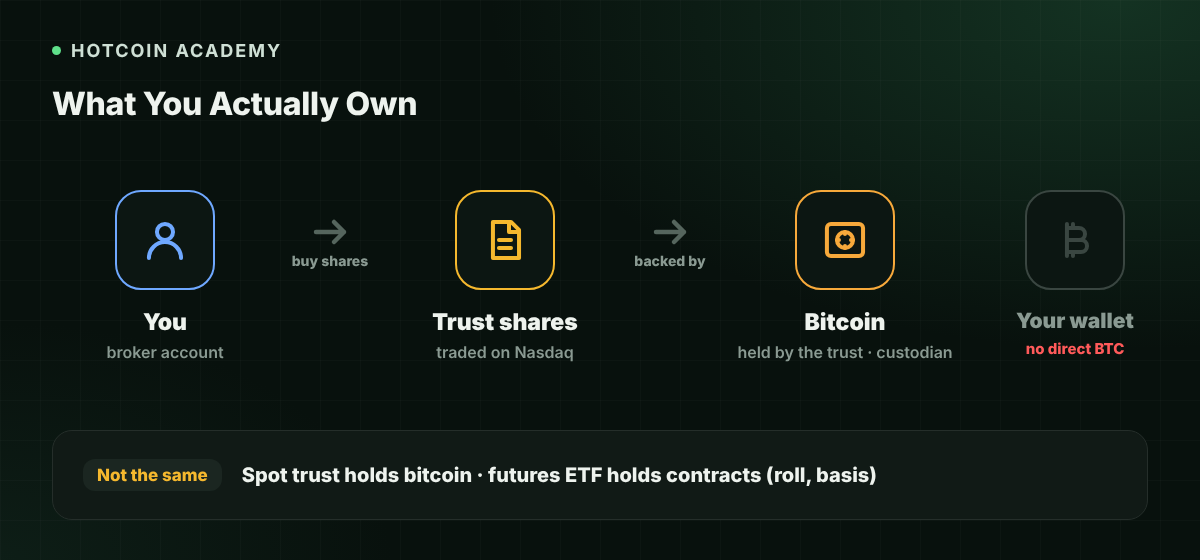
The product aims for its share price to reflect Bitcoin's price performance. Ordinary holders buy trust shares, not Bitcoin that can be withdrawn to their own wallets.
The live price, NAV and size on the page should be fed by the system with the latest data and will change with the market. This article only explains how to read these numbers, not treats any moment's price or size as final.
Key takeaways
- IBIT is a Bitcoin trust share traded on an exchange, not a listed company, and it is generally not registered as a traditional mutual fund or equity ETF under the Investment Company Act of 1940.
- The product seeks to reflect Bitcoin's price performance, with the CME CF Bitcoin Reference Rate - New York Variant as its pricing benchmark; the share market price, NAV per share and spot Bitcoin price are three similar but not always identical numbers.
- The issuer's product page lists a Sponsor Fee of 0.25% per year. The trust may sell small amounts of Bitcoin to pay fees, and over the long run the amount of Bitcoin per share may decline; refer to the latest prospectus.
- Ordinary investors cannot exchange a small number of shares with the trust for Bitcoin; shares are bought and sold on a securities exchange and are subject to risks including tracking error, premium or discount, trading sessions and Bitcoin price volatility.
What is IBIT? It is not a company
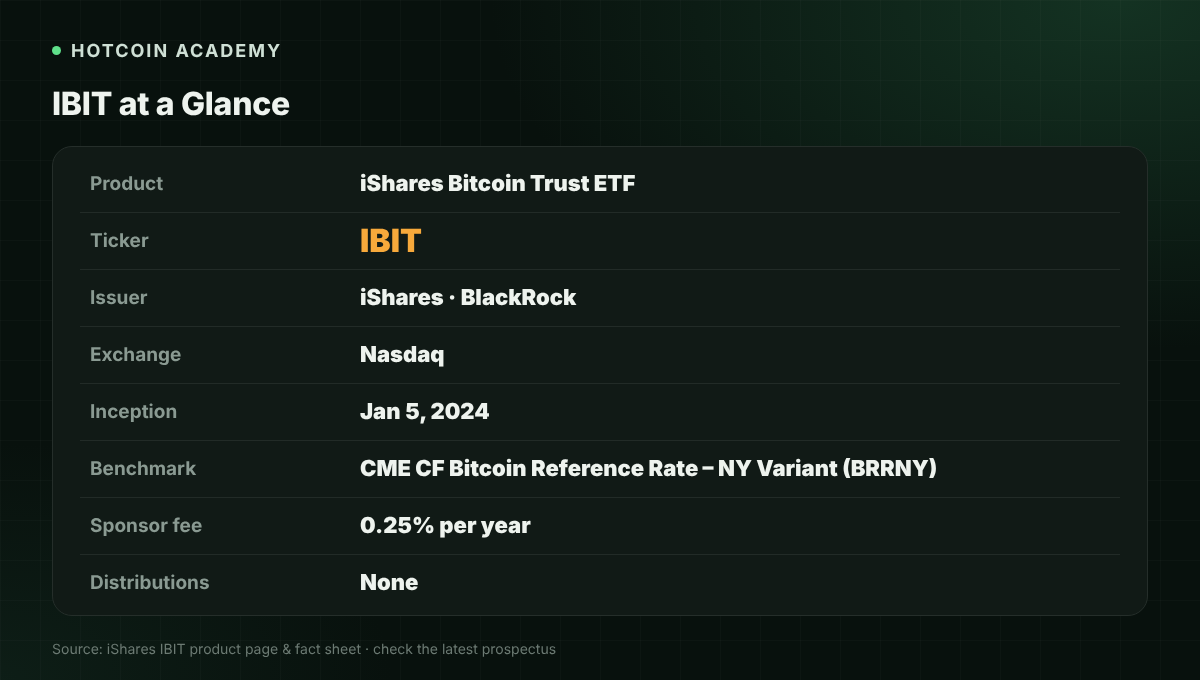
IBIT is issued by iShares, part of BlackRock, and listed on Nasdaq. According to the iShares product page, its goal is to reflect Bitcoin's price performance, giving investors Bitcoin exposure through an exchange-traded product without having to handle the operational and custody processes of holding coins directly.
The product page also notes that the trust is not registered as an investment company under the Investment Company Act of 1940, so not all regulatory requirements for such mutual funds or ETFs apply; it is also not a commodity pool under the Commodity Exchange Act. Before buying, you should read the risks and other disclosures in the prospectus.
In a spot product like IBIT, the trust holds Bitcoin itself. There is another type of Bitcoin futures ETF, which holds Bitcoin futures contracts and is also affected by contract expiry, rollover and the spread between futures and spot prices; the two are not the same product.
| Item | Content (subject to the issuer's product page and prospectus) |
|---|---|
| Full product name | iShares Bitcoin Trust ETF |
| Ticker | IBIT |
| Issuer | iShares, part of BlackRock |
| Listing exchange | Nasdaq |
| Inception date | Listed as January 5, 2024 on the product page |
| Tracking objective | Reflect Bitcoin's price performance |
| Pricing benchmark | CME CF Bitcoin Reference Rate - New York Variant (Bloomberg ticker BRRNY) |
| Sponsor fee | Listed as 0.25% per year on the product page |
| What is held | The trust holds Bitcoin; investors hold trust shares |
| Distribution schedule | The issuer's product page lists the distribution frequency as None (no distributions); refer to the latest product page |
The prospectus also states that Bitcoin custody arrangements include institutions such as Coinbase Custody Trust Company, LLC; the actual custodian and backup arrangements may change, so refer to the latest legal documents.
How does IBIT relate to the spot Bitcoin price?
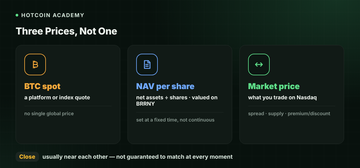
When reading IBIT, you should at least distinguish three prices:
| Price | What it represents | Why it may differ |
|---|---|---|
| Spot Bitcoin price | A BTC quote on a trading platform or a composite index | There is no single global execution price, and different sources will differ |
| NAV per share | The trust's net assets divided by shares outstanding; the product page states Bitcoin is valued using the CF Benchmarks index above | Usually calculated at specified times and rules, not a continuous execution price |
| ETF market price | The price at which investors actually buy and sell shares on Nasdaq | Affected by bid-ask spread, supply and demand, trading sessions and premium or discount |
Share prices often stay close to Bitcoin because the trust calculates NAV based on the benchmark, and authorized participants can create or redeem large blocks of shares and arbitrage together with market makers, pulling the secondary market price back near NAV. This only means "close"; it does not guarantee they are identical at every moment.
Also note the different trading hours: the spot Bitcoin market runs around the clock, while IBIT is quoted only during securities market trading sessions. When US stocks are closed, Bitcoin may still move sharply, and the ETF may gap when it reopens. Intraday supply and demand can also make shares trade briefly above or below NAV, which is a premium or discount.
Fees, tracking error and key risks
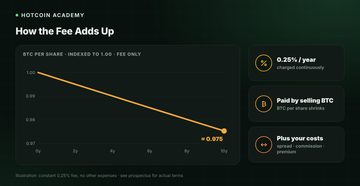
The issuer's product page lists the Sponsor Fee as 0.25% per year and states that fees are subject to the prospectus. This fee accrues continuously at an annual rate during the product's life, rather than being charged once at purchase. The trust itself generally has no operating income and may periodically sell small amounts of Bitcoin to pay fees and expenses. The issuer discloses that during the trust's life, the amount of Bitcoin per share will decline as a result; if Bitcoin's price appreciation is not enough to offset this decline, the share price may also fall.
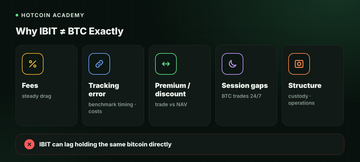
Even if the goal is to reflect Bitcoin's price, long-term performance may still lag directly holding the same amount of Bitcoin. Common sources of deviation include:
- Fees: the most stable and predictable deduction.
- Tracking error: differences between benchmark timing and actual execution, creation/redemption and transfer costs, and changes in assets and liabilities can all make the NAV path not fully match a given spot quote.
- Premium or discount: investors actually transact at the market price; buying above NAV or selling below NAV will affect the result.
- Trading sessions and gaps: Bitcoin keeps trading when securities markets are closed, and shares may quickly reflect that move after the open.
- Product and custody structure: ordinary holders rely on the issuer, trustee, custodian and exchange arrangements; custody losses, operational interruptions or special circumstances in the legal documents may all affect share value.
Ordinary investors buy and sell shares on the secondary market and generally receive cash in their brokerage account; they cannot hand a small number of IBIT shares to the trust in exchange for Bitcoin. The creation and redemption arrangements in the prospectus are handled by authorized participants, who alone can create or redeem baskets of shares under the rules; this is a common structure for spot Bitcoin ETFs and does not mean ordinary holders can directly redeem Bitcoin from the trust.
How to read IBIT's live chart and size?
It is recommended to read the page in the following order rather than staring at just one price:
- First look at market price and NAV: if the two are close, tracking is broadly normal; when there is a clear premium or discount, consider the bid-ask spread and liquidity at the time, not just the on-screen change.
- Then look at trading sessions: regular trading is 9:30 to 16:00 New York time. Pre-market and after-hours trading is thinner and should not be treated as the official closing result, still less as equivalent to all of the spot Bitcoin moves over the same period.
- Check share moves and Bitcoin moves separately: direction is often similar, but magnitude need not be identical; fees, premium/discount and session differences all cause deviations.
- Size figures also change: the product page also shows net assets, shares outstanding and more. These are snapshots at a point in time and will change with creations, redemptions and Bitcoin's price; this article does not turn one day's size into a fixed fact.
- Rely on the page and latest documents: if fee rates, creation/redemption mechanisms and custody arrangements are updated, the latest prospectus and issuer page should govern.
Common misconceptions
- "Buying IBIT means transferring Bitcoin to your own wallet": you buy trust shares, and ordinary holders cannot withdraw Bitcoin from the trust by share.
- "IBIT's price must match one exchange's BTC quote exactly": the product tracks a specified benchmark, then deducts fees and is affected by market premium/discount; small deviations are part of the mechanism itself.
- "The fee is paid only once at purchase": the Sponsor Fee accrues continuously during the product's life and may be paid by selling Bitcoin, reducing the amount of Bitcoin per share.
FAQs
Q1: Is IBIT a company's stock? No. IBIT is a Bitcoin trust fund share issued by iShares and traded on Nasdaq. Investors hold trust shares, not listed company equity, and not Bitcoin they can transfer themselves.
Q2: What does IBIT track? Why is it not exactly the same as the spot Bitcoin price? It seeks to reflect Bitcoin's price performance, with the CME CF Bitcoin Reference Rate - New York Variant as its pricing benchmark. Fees, tracking error, premium or discount, and the difference between securities trading sessions and round-the-clock Bitcoin trading all make the share market price not exactly the same as a given spot quote.
Q3: What is IBIT's fee? The issuer's product page lists the Sponsor Fee as 0.25% per year, subject to the latest prospectus. In addition, investors may bear bid-ask spread, brokerage commissions and costs from premium or discount.
Q4: Can ordinary investors exchange IBIT for Bitcoin? Usually not. Ordinary holders buy and sell shares on a securities exchange; Bitcoin redemption arrangements are for authorized participants and must comply with the product documents.
Q5: How should I understand IBIT's "market cap" or net assets? The net assets or size on the page is generally the trust's asset size calculated at the then-current NAV and shares outstanding, and will change with Bitcoin's price and creations/redemptions. It is not a company's equity market cap, nor does it mean you can cash out entirely at that number at once.
Conclusion
IBIT is a Bitcoin trust share issued by BlackRock's iShares and traded on Nasdaq. Its goal is to reflect Bitcoin's price performance, but it is not a company stock and is not equivalent to directly holding Bitcoin. When looking at this product, check market price, NAV, fees, premium/discount and trading sessions together, and understand tracking error and Bitcoin's own volatility risk; specific numbers should be based on the live data on the quote page and the latest prospectus.
If you want a systematic understanding of how spot Bitcoin ETFs work and how they differ from directly holding BTC, you can start with A comprehensive guide to spot BTC ETFs: a milestone for institutional entry.
Risk warning: This article is for educational and informational purposes only and does not constitute any investment advice or buy/sell recommendation. IBIT share prices will fluctuate significantly with Bitcoin and may deviate from expectations due to fees, tracking error, premium or discount, trading session differences, custody and product structure, which may cause partial or total loss of principal. Please refer to the issuer's latest prospectus, product page and the live data on your page, and make decisions carefully based on your own risk tolerance.
Recommended
View more