Copper Price | Live Trends, Historical Data, and Key Factors
One page shows a copper price of 4, while another is close to 10,000. This does not necessarily mean the market is thousands of times apart. COMEX often quotes in USD per pound, while LME often quotes in USD per tonne. The first step is to unify the units.
When checking the live copper price, confirm the latest data timestamp, quotation unit, and price type at the same time. This article explains how to read trends and historical data and does not provide a fixed “today’s price.” All examples in this article are hypothetical and must not be treated as current market data or a transaction commitment.
Key Takeaways
- A common unit for reading copper is USD per pound (COMEX); the quoted number must always be read together with its unit.
- Spot, benchmark pricing, specific-month futures, and retail products may correspond to different prices.
- Historical trends should use consistent sources, contracts, and data processing methods.
- Price direction does not equal position returns; fees, leverage, and contract rolls can all change actual results.
What the Copper Price Means
Copper is an industrial metal widely used in power, construction, manufacturing, and other sectors. The COMEX standard copper futures code is HG; LME copper contracts use a different market and term structure. For “spot” quotes, also verify the delivery location, grade, and premium or discount.
When reviewing the copper standard futures contract specifications, separate the quotation from the contract size: the standard contract code covered in this article is HG, with a contract size of 25,000 pounds. Micro contracts or products on other exchanges may differ and should not be applied directly.
How to Read Live Trends and Historical Data
First look at “which market, which product, and which time,” then look at the rise or fall. The latest traded price reflects the most recent transaction; the bid and ask reflect current orders in different directions; the settlement price is a value formed according to exchange rules. They can exist at the same time and do not have to be equal.
Intraday highs and lows should use the same trading session, and the comparison basis for percentage changes should also be consistent. A trading day may differ from the calendar day in your region; during market closures, the displayed price may be the last traded or settlement value. Do not assume it is still updating in real time just because the page still shows a number.
When reading historical data, first confirm whether it refers to the same specific contract. Continuous futures charts link different months according to rules, and some also apply back-adjustment or spread adjustments. Therefore, a jump around a contract roll does not necessarily mean the same holdable asset instantly produced the same return.
| Data type | What it is suitable for observing | What to verify when using it |
|---|---|---|
| Spot or spot assessment | Current physical market and reference prices | Location, quality, assessment time, and method |
| Specific-month futures | Price expectations for a certain delivery term | Contract month, expiry, and trading depth |
| Continuous futures chart | Longer-term trend display | Roll rules and whether historical prices are adjusted |
| Retail or investment products | The quote of the product you actually purchase | Fees, premiums, leverage, and subscription/redemption terms |
How to Convert Quotation Units and Amounts
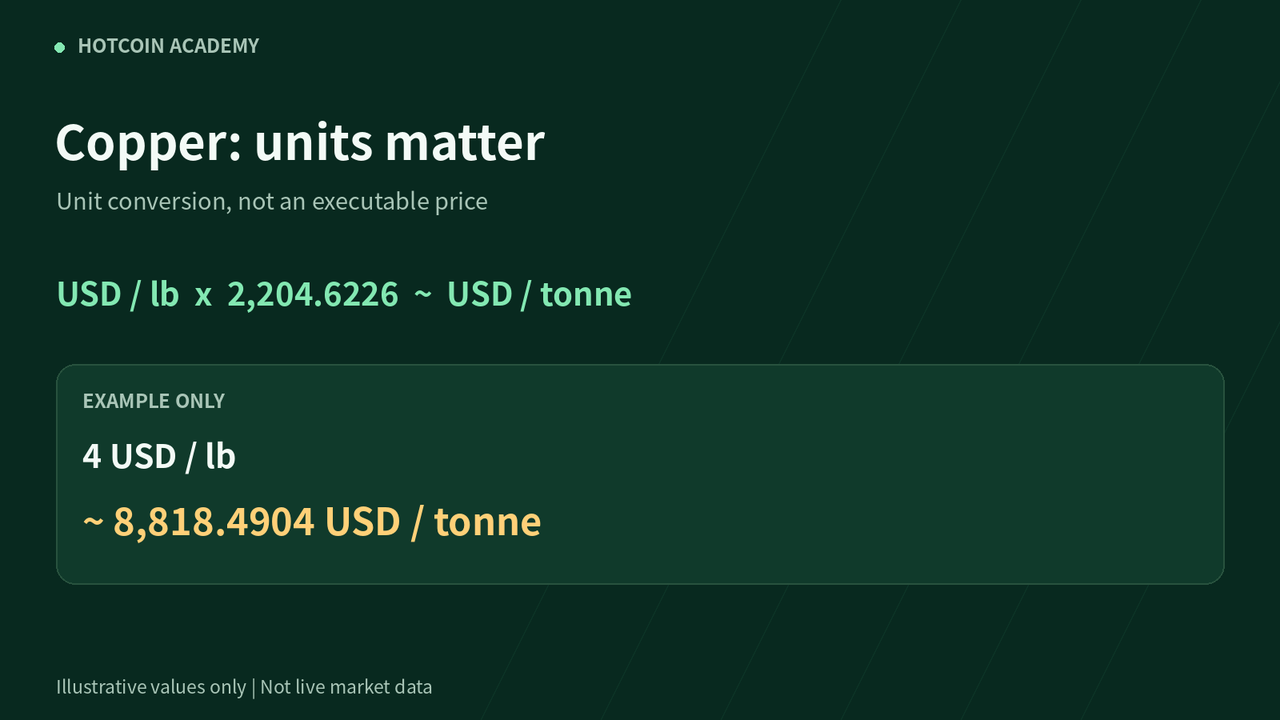
USD per pound × 2,204.6226 ≈ USD per tonne.
Assuming a copper price of 4 USD per pound, the unit conversion is approximately 8,818.4904 USD per tonne. This formula only unifies the weight unit and does not adjust for delivery location, term, taxes, or grade. All calculations are only for unifying the basis and do not include the fees, premiums, or taxes of actual products.
| Unit or basis | Meaning |
|---|---|
| 1 pound | 0.45359237 kilograms |
| 1 tonne | 1,000 kilograms, approximately 2,204.6226 pounds |
| Comparison across markets | After units are consistent, also verify term and delivery conditions |
If you use a futures quote to calculate the notional size of one contract, multiply the unit price by the standard quantity of that contract. Margin is only the funding arrangement required to open and maintain a position; it cannot replace the total contract value and is not equal to the maximum loss.
What Factors Affect the Copper Price
Copper prices are often used to observe industrial activity, but they are not an error-free thermometer of economic activity. Power grid, construction, and manufacturing demand; mine and smelter supply; scrap copper recycling and inventory distribution can all change prices; financial trading can also make short-term fluctuations deviate from physical changes.
| Factor to observe | Link to price |
|---|---|
| End demand | Observe changes in power grid, construction, manufacturing, and equipment investment |
| Mine and smelter supply | Shutdowns, maintenance, energy, and raw material constraints may change supply |
| Inventory and trade flows | The location of inventory, deliverable status, and regional premiums or discounts are important |
You can use the LME copper contracts and prices to continue verifying product information. When judging the market, especially distinguish between supply and demand changes that have already occurred and market expectations: data beating expectations and the data itself rising are not necessarily the same thing.
What Is the Difference Between Copper and Similar Products
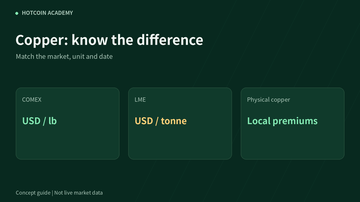
COMEX and LME cannot be regarded as completely identical after only converting units. After aligning units, also compare quality, delivery location, term, and tariff and logistics environments. If domestic copper prices are expressed in RMB per tonne, also verify taxes and contract basis.
Prices for different terms may also show contango or backwardation. When holding futures or related products that require rolling, in addition to direction, also verify the roll mechanism, financing, and management fees; do not directly copy the underlying spot gain as product return.
Common Misconceptions
- Looking only at rises and falls, not units. The same price number can mean completely different things when converted into different weights, energy, or currencies.
- Treating historical curves as directly realizable returns. Continuous charts, spot curves, and specific investment products may differ due to rolls and costs.
- Predicting a certain rise or fall based on a single piece of news. “Copper prices rising proves the global economy will definitely recover” is a misunderstanding. Supply disruptions, inventory transfers, or changes in trading positions can also push short-term prices higher.
FAQ
Q1: How do you convert USD per pound to USD per tonne? Calculated by metric tonne, 1 tonne is approximately 2,204.6226 pounds, so a USD per pound quote multiplied by 2,204.6226 gives the unit conversion value in USD per tonne, but it does not eliminate delivery and term differences across markets.
Q2: Why are copper prices on two websites inconsistent? First check whether they use the same market, spot or futures type, contract month, currency, and update time; do not compare only the last decimal on the screen.
Q3: Can the historical high be used directly as a future target? No. Historical highs reflect the supply, demand, monetary, and market conditions at that time and may also belong to different contracts or data bases; there is no guarantee they will recur.
Q4: The chart shows a rise, so why has the product I bought not risen that much? The product may include different term exposure, leverage, exchange rates, management fees, or roll arrangements. Read the documentation of the product you actually hold.
Q5: Can I judge whether it is worth buying by looking only at the copper price? Not enough. You also need to consider the specific product you buy, holding period, trading costs, tolerable loss, and exit conditions; a quote cannot directly determine a position size suitable for you.
Conclusion
Understanding the copper price starts with confirming the quotation object and unit. Verify the time basis of live data, the processing method of historical series, and the actual product costs before discussing trends. Only then can you avoid treating numbers from different markets as the same investment result.
Risk warning: This article is for educational and informational reference only and does not constitute investment advice. Commodity prices may fluctuate significantly, and derivatives leverage and delivery arrangements may bring additional risks; actual trading is subject to the rules of the corresponding product.
Recommended
View more