Overcoming FOMO in Trading: The Essential Course in Rational Trading
FOMO (Fear of Missing Out) is one of the most widespread and most destructive emotional traps in crypto trading. It pushes people to buy at highs out of anxiety rather than rational analysis. Data shows that as many as 84% of crypto holders have made an investment decision driven by FOMO around a price surge, and 63% admit that such emotional decisions hurt their portfolios. Overcoming FOMO is the essential course that moves you from reactive trading to disciplined trading.
What Is Crypto FOMO? The Chain from Psychology to Action
FOMO describes the anxiety a trader feels when an asset is rising fast and others appear to be profiting: the fear of missing out on potential gains. That anxiety is not based on fresh analysis; it is a purely psychological reaction.
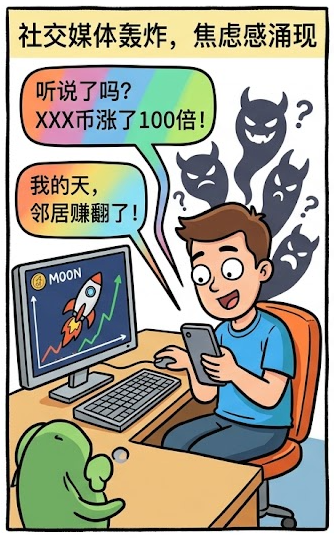
The process typically follows one chain: a coin starts to rise → social media picks it up and hype spreads → the first traders post profit screenshots, creating social proof → the fear of missing out appears, "if I don't buy now, the chance is gone" → more buyers pile in and push the price higher → late buyers finally enter and end up buying the top at the peak of the hype.
FOMO is especially common in crypto because of three market traits: 24/7 trading means prices can move at any moment; extreme volatility makes short bursts of 30%–50% gains frequent; and social media spreads profit screenshots and hot takes within seconds, creating a distorted picture that shows only the winners.
The High Cost of FOMO: More Than Paying Too Much
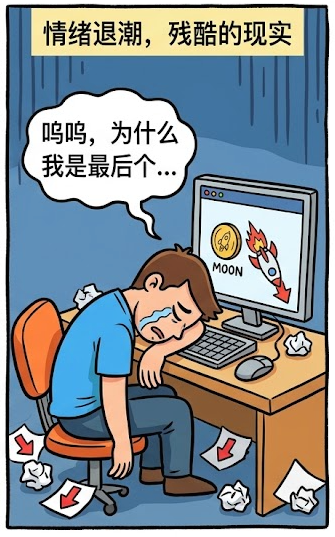
The most direct consequence of FOMO is buying at the high. When your anxiety peaks, that is often exactly when early buyers are preparing to take profit and exit, so you effectively become the liquidity they exit into.
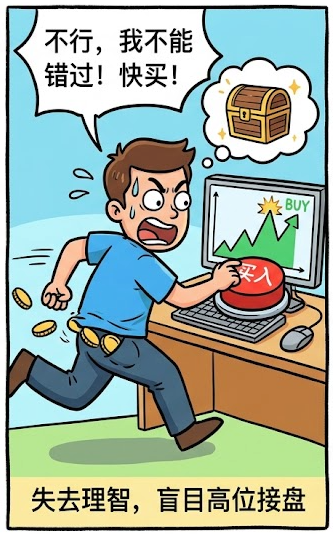
FOMO also sets off a chain reaction: you may skip the research you should have done and ignore fundamentals and technical indicators; you may neglect risk management, trade without a stop loss, or size positions beyond your plan; you may even slide into revenge trading, rushing to win back losses. With leverage, a single FOMO-driven impulsive entry can trigger a forced liquidation and cause a loss far beyond your initial capital.
How to Manage FOMO: Building Guardrails for Discipline
The point of managing FOMO is not to feel nothing. It is to put a mandatory buffer between your emotions and your trading actions.
Write a trading plan and run a pre-flight check: define your entry conditions (for example, 3–4 specific technical indicators), position limits, and stop-loss and take-profit levels. Every time an urge to enter appears, check it against the plan item by item. Anything that fails the check is a non-entry moment that is fine to miss. This willingness to pass on an opportunity on purpose is the antidote to FOMO, and it matches the JOMO (Joy of Missing Out) mindset: understanding that not every apparent opportunity is worth taking is a more mature, more disciplined approach.
Isolate emotion with automation: DCA (dollar-cost averaging) bots buy a fixed amount on a fixed schedule, buying less when prices are high and more when they are low, which removes the anxiety of asking whether today is the right day to buy. Grid trading bots buy low and sell high automatically inside a preset range, so execution is driven by data rather than dopamine. These tools act as a tireless, emotionless assistant managing your risk.
Accept missing out and keep a review log: the market offers new entry opportunities every day, and missing one move does not mean losing money. You simply were not part of that particular swing. Logging your emotional state on every entry and exit in a trading journal helps you spot hidden emotional decision patterns and trace how FOMO has seeped into your trading system.
FAQ
Q1: How do I tell "reasonable momentum chasing" apart from "FOMO-driven buying"?
Reasonable momentum chasing builds on a clear entry plan you already have: the trade meets technical conditions you wrote down in advance, the position is inside your risk framework, and the stop loss is preset. FOMO-driven buying looks like this: no plan, a last-minute impulse, and a feeling while placing the order that you must act right now or it will be too late.
Q2: Does FOMO only affect beginners?
No. Data shows that 81% of crypto holders have made decisions based on FUD and 84% have acted on FOMO. Emotional traps affect traders at every level. The difference is that experienced traders have built guardrails that stop emotion from reaching the order book directly.
Q3: What should I do emotionally when I see others posting huge profits?
Recognize that social media shows a survivorship bias: winning screenshots get shared widely, while losses are rarely posted. Accept that a gain you missed is not a real loss, then pull your attention back to your own trading plan instead of staring at someone else's returns.
Q4: What should I do after two consecutive FOMO losses?
Stop trading and step away from the screen. FOMO is often followed by revenge trading, an attempt to win the money back fast, and that is the most dangerous chain of traps. Review your trading journal first, find the pattern that triggers your FOMO, and re-enter only after your emotions have settled and you have reconfirmed your trading plan.
Lectura recomendada
Ver más