Crypto Leverage Trading Explained: Margin, Leverage and Risk
Crypto leverage trading means using borrowed funds to enlarge your position. Its core components are margin, the leverage multiple and liquidation risk: it magnifies gains, and it magnifies losses just as fast.
Leverage lets a trader control a much larger notional position with a small amount of capital, so even a small price move produces a larger swing in returns. That is exactly why it is one of the easiest places for beginners to lose money. The sections below explain how leverage works, what margin actually is, and how to understand and control the risk.
What Is Crypto Leverage Trading
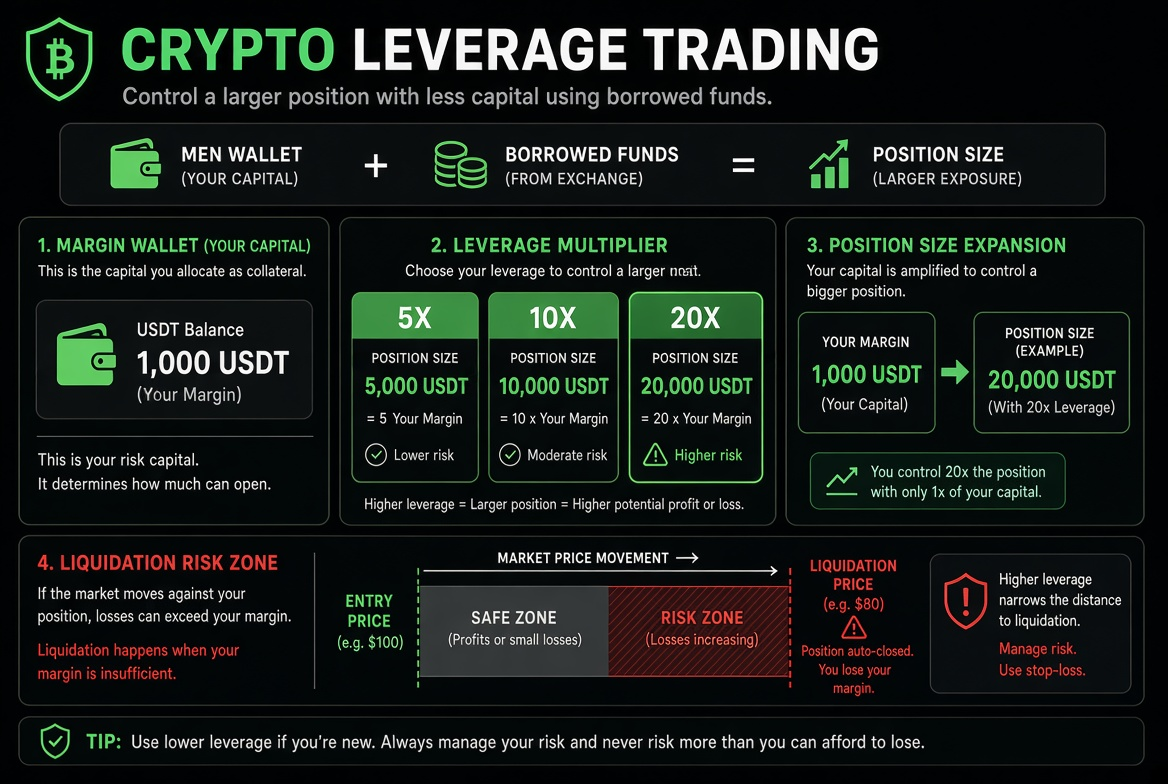
Leverage trading means borrowing funds from the platform to open a position larger than your own capital.
For example:
Own capital: 1,000 USDT
Leverage: 10x
Notional position value you can open: about 10,000 USDT
If the price rises 1%, the position theoretically gains about 100 USDT (roughly 10% of your capital);
if the price falls 1%, the loss is also about 100 USDT.
Leverage multiplies price moves in both directions.
Common products include perpetual futures, delivery futures and some leveraged token products. This article focuses on contract-based leverage trading.
What Margin Is
Margin is the capital you pledge to open and keep a position open.
Initial margin: the minimum amount you must deposit to open a position
Maintenance margin: the minimum equity level your account must not fall below while holding
Available margin: funds still free to open new positions or absorb volatility
Once price moves against you, unrealized losses grow and your margin ratio falls. If it drops below the maintenance requirement, a margin call or forced liquidation may follow.
How the Leverage Multiple Affects Your Trade
The higher the leverage:
The lower the initial margin required
The larger the swing in returns
The closer the liquidation price sits to your entry price
The smaller the room for error
The lower the leverage:
The more margin the position occupies
The greater the tolerance for volatility
The better the fit for beginners and medium-term positions
A simple way to think about it: leverage does not make you more likely to profit, it makes you more sensitive to price.
What Cross and Isolated Margin Mean in Leverage Trading
Isolated margin: risk is contained, and a single position's loss normally affects only that position's margin
Cross margin: account funds are shared, which can improve capital efficiency, but risk spreads between positions
Beginners are better off starting with isolated margin, so the risk boundary of each trade is clearly drawn.
Why Forced Liquidation Happens
When account equity falls below the maintenance margin requirement, the platform force-closes the position to stop losses from growing.
Common triggers:
Leverage is too high, so a small adverse move reaches the liquidation price
The position is too large and leaves no buffer
Volatility spikes and price breaks a key level in a short time
No stop-loss is set, so the system is left to handle it
Liquidation is not just losing a little. With high leverage it can wipe out most or even all of your margin very quickly.
The Core Risks of Leverage Trading
Rapid loss of capitalA small adverse move can cause a large percentage loss.
Liquidation riskIn violent markets you may not have time to act manually.
Funding rate costsHolding perpetual futures long term may mean paying or receiving funding fees, which affects net returns.
Emotion and overtradingLeverage encourages frequent opening and closing of positions, which magnifies mistakes.
Platform and execution riskWrong direction, wrong leverage, network delays and extreme slippage can all cause extra losses.
How Beginners Can Use Leverage More Safely
Start with low leverage, such as 2x–5x
Keep the risk of each trade to a very small share of the account
Check the liquidation price before opening, and leave a safety distance
Prefer isolated margin mode
Always set a stop-loss instead of hoping the price will come back
Practise opening, adding to, reducing and closing positions on a demo account first
Avoid gambling-style trades with oversized positions
What really matters is not how much leverage you can open, but how much drawdown you can absorb while staying disciplined.
A Simple Example
Suppose the account holds 1,000 USDT and you open a leveraged long on BTC:
With 5x leverage, allocate 200 USDT as margin
The notional position is about 1,000 USDT
If price moves against you into the liquidation zone, the main risk is concentrated in that 200 USDT
With 20x leverage, the same margin opens a much larger position, but a smaller adverse move can trigger liquidation and the room for error shrinks significantly.
Risk Warning
Crypto leverage trading carries extremely high risk and can result in the loss of your entire capital. Leverage magnifies profits and losses at the same time, and it is not suitable for people with a low risk tolerance or those who do not yet understand how liquidation works. This article is for educational purposes only and is not investment advice. Use only funds you can afford to lose, and follow the laws and regulations that apply to you.
FAQ
Q1: What is the biggest difference between leverage trading and spot trading? A: Spot trading normally buys assets with your own funds; leverage trading borrows funds to enlarge the position, can go long or short, and carries liquidation risk.
Q2: Is higher leverage always better? A: No. The higher the leverage, the closer the liquidation price and the smaller your margin for error. For most people, lower leverage is more sustainable.
Q3: Why was I liquidated before losing very much? A: With high leverage, a small adverse price move is enough to push your margin ratio below the requirement, so the system force-closes the position by rule.
Q4: Do beginners have to use leverage? A: No. Many people take part in the market mainly through spot buying and regular investing. Leverage is an optional tool, not a required step.
Q5: How do I judge whether my leverage is too high? A: Look at how close the liquidation price is to the current price, whether the potential loss on one trade exceeds what you can bear, and whether you can actually follow your plan through the volatility.
Lectura recomendada
Ver más