
What Is a Hash Algorithm? A Guide to Blockchain Cryptography Basics
A hash algorithm converts data of any length into a fixed-length digest, often called a digital fingerprint. It is used to check whether data has changed, but unlike encryption, it cannot use a key to restore the original content.
Blockchains make extensive use of hash functions to identify transactions, link blocks, and summarize data. Hashing is only one foundational tool; ledger security also depends on digital signatures, node validation, and consensus mechanisms.
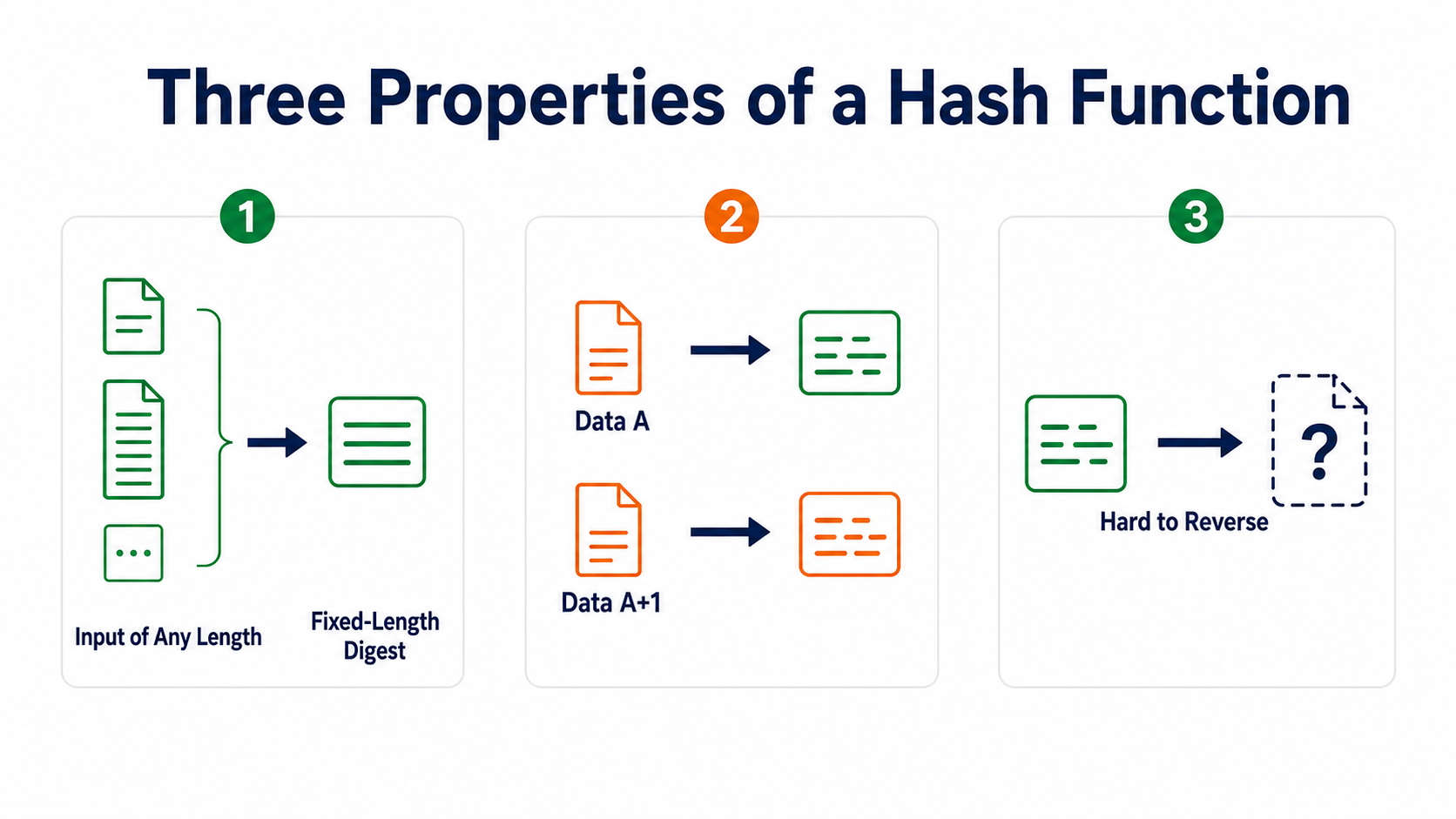
What Are the Key Properties of a Hash Function?
Secure hash functions generally emphasize the following properties:
- Determinism: The same input processed by the same algorithm always produces the same digest.
- Fixed length: The input can be short or long, while the algorithm determines the output length.
- Avalanche effect: A tiny change to the input will usually produce a dramatically different output.
- One-way property: Reconstructing the original input from its digest should be computationally infeasible.
- Collision resistance: Finding two different inputs that produce the same digest should be extremely difficult.
Collisions are mathematically inevitable because infinitely many possible inputs are mapped to a finite set of fixed-length outputs. Cryptography requires exploitable collisions to be impractical to find with real-world computing power; it does not claim that collisions can never exist.
What Is the Difference Between Hashing and Encryption?
Encryption aims to protect confidentiality. After data is transformed with a key, an authorized party can decrypt it and recover the original content. Hashing aims to produce a digest and normally has no reverse or “unhashing” process.
Hashing a public transaction therefore does not automatically make its contents secret. If an attacker can guess the original input, they can hash each guess and compare the resulting digest. Password storage requires salts and specialized slow password-hashing schemes; it should not simply reuse the approach used for blockchain transaction hashes.
What Does Hashing Do in a Blockchain?
Identify Transactions and Blocks
Many networks hash serialized transactions or block headers to produce transaction hashes or block hashes. A blockchain explorer can use a hash to locate a record, but the hash is only an identifier. It is not proof of asset ownership and cannot be used to reverse a transaction.
Link Adjacent Blocks
A new block typically stores the hash of its parent or preceding block. If the contents of an older block change, its hash changes as well, causing the reference stored in the following block to stop matching.
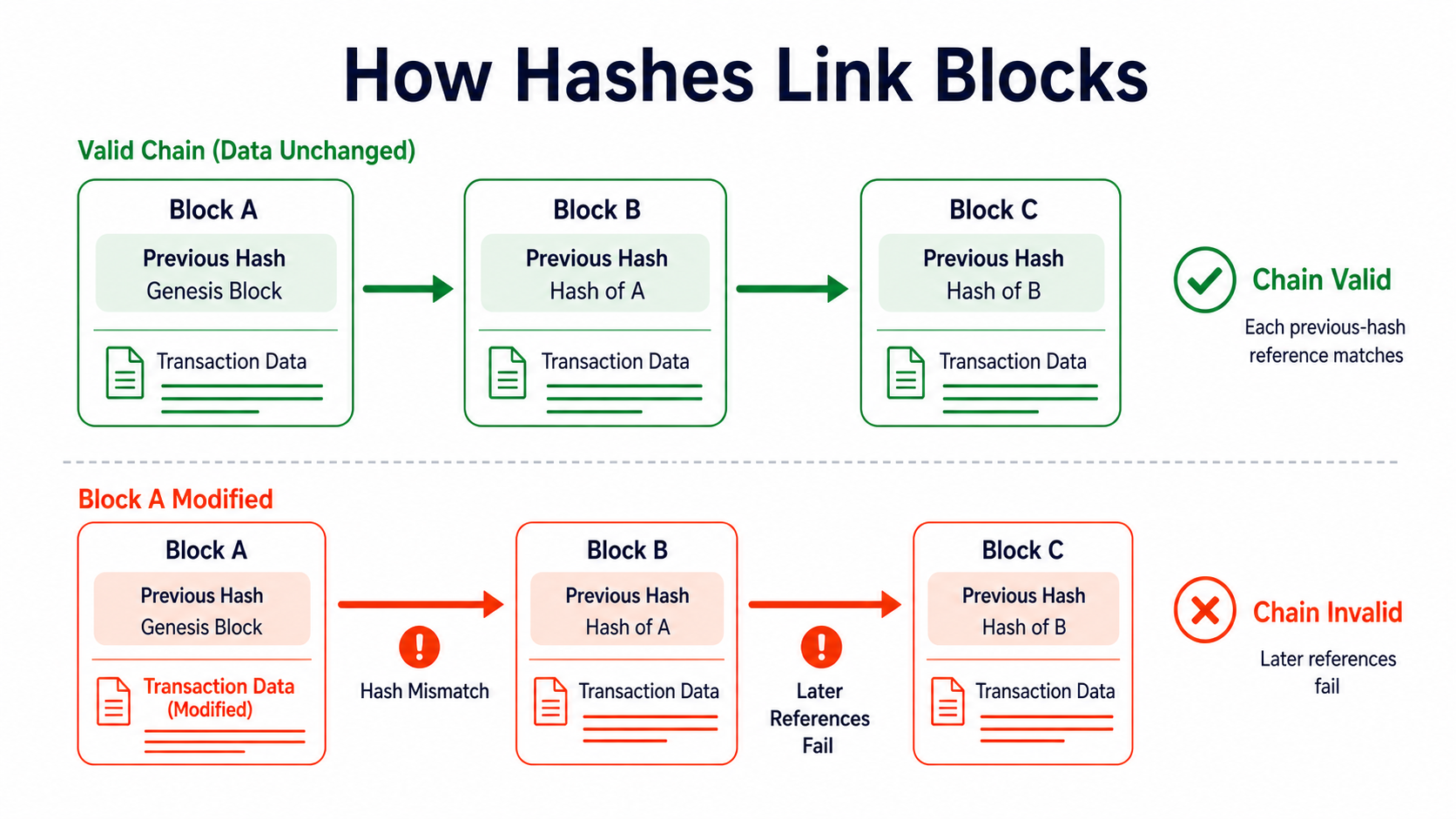
This structure makes changes easy to detect, but the difficulty of rewriting history also comes from subsequent blocks, consensus resources, and copies held by other nodes. Simply arranging files into a hash chain on one computer does not automatically provide the security of a public blockchain.
Summarize Large Numbers of Transactions
A Merkle tree combines transaction hashes layer by layer until it produces a Merkle root. A node can use a relatively short proof path to verify that a transaction was committed to a block without transferring every transaction for that verification. For more detail, see An In-Depth Look at Block Structure.
Participate in Proof of Work
In some proof-of-work networks, miners repeatedly adjust fields in the block header and calculate hashes while searching for a result below a target value. The difficulty comes from performing a large number of trials, not from decrypting a hash.
Is SHA-256 the Standard for Every Blockchain?
No. Bitcoin uses SHA-256 in multiple parts of its protocol, Ethereum commonly uses Keccak-256, and other networks may use different algorithms or combinations. Similar names also do not mean identical implementations: the standardized SHA3-256 and the Keccak-256 used by Ethereum should not be treated as the same algorithm.
The choice of algorithm can also vary by purpose. Transaction identifiers, address generation, signed-message digests, and consensus may use different hash functions. When reading a protocol, verify the specific field, encoding method, and number of hashing rounds instead of remembering only one algorithm name.
How Can You Verify the Hash of a File or Transaction?
To verify a file, calculate its digest locally with the same algorithm and compare it character by character with a value published through a trusted channel. Any change in spaces, line endings, encoding, or file content will affect the result.
To verify an on-chain transaction, select the correct network and paste the complete transaction hash into the corresponding blockchain explorer. Do not compare only the first and last few characters, and do not confuse an address, block hash, and transaction hash.
Hashing and signing often work together, but they have different responsibilities. To understand how digital signatures prove authorization, continue with Public-Key Cryptography. To place these components in the context of a complete system, see A Complete Guide to Core Blockchain Concepts.
Frequently Asked Questions
Can Matching Hashes Prove That Two Files Came From the Same Person?
No. Matching digests provide strong evidence that the file contents are identical, but they do not prove the publisher’s identity. Verifying the source also requires an identity mechanism such as a trusted channel, digital signature, or certificate.
Does a Transaction Hash Expose a Private Key?
Not in a correctly implemented system. A transaction hash is derived from transaction data, while a private key is used to generate a signature and is not written directly into the hash. However, an incorrectly implemented key-generation or signature algorithm may still leak key information.
Is a Longer Hash Always More Secure?
Not necessarily. Output length affects the difficulty of brute-force searches and collision attacks, but algorithm design, implementation, usage, and the threat model are equally important. An outdated algorithm with practical weaknesses should not continue to be used merely because its output looks long.
Why Does a Blockchain Explorer Sometimes Show Multiple Hash Fields?
A page may display a transaction hash, block hash, parent block hash, contract event topic, or internal data digest at the same time. Each is calculated for a different object, so its purpose must be determined from the field name and context.
Lectura recomendada
Ver más


service hotcoin.com
producthotcoin.com
businesshotcoin.com
casecnhotcoin.com