
What Is Blockchain? A Complete Guide to Its Technology and Core Concepts
A blockchain is a distributed ledger maintained collectively by multiple nodes. Once transactions are verified, they are written into blocks, which are linked in sequence through hashes. This makes the records independently verifiable and difficult for any single party to rewrite.
Blockchain is neither a single encryption algorithm nor another name for Bitcoin. Bitcoin is one application of blockchain, while blockchain systems can also support smart contracts, asset registries, and multi-party coordination. To understand the technology, it helps to view ledgers, transactions, blocks, cryptography, nodes, and consensus as parts of one continuous process.
What Are the Main Components of a Blockchain?
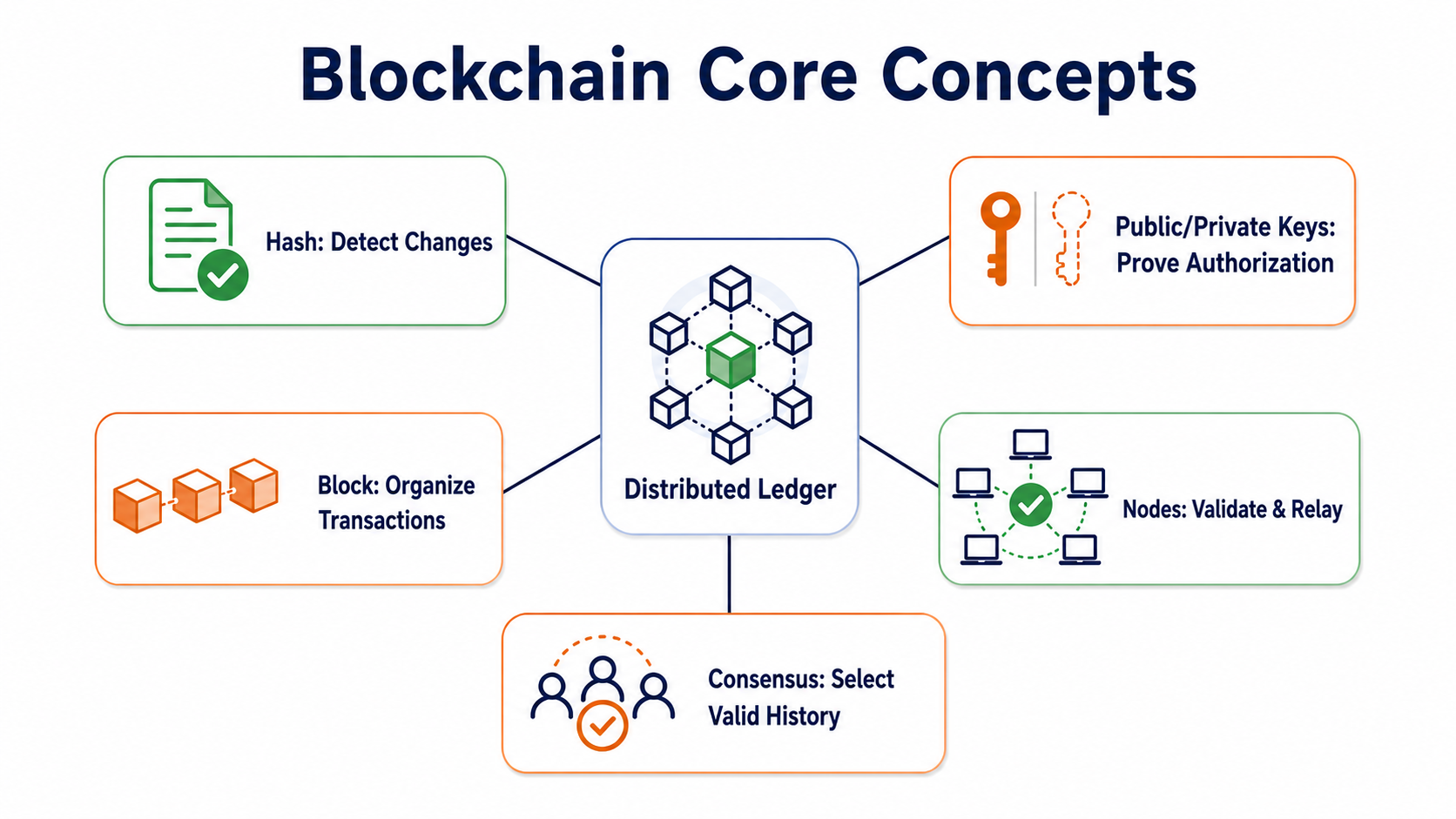
A typical blockchain includes at least the following components:
- Transactions: Requests submitted by users to change the system's state, such as transferring assets or calling a smart contract.
- Cryptography: Hash functions create fingerprints of data, while public and private keys and digital signatures prove authorization.
- Blocks: Packages that contain a batch of checked transactions together with block header data.
- Nodes: Computers running the protocol software that receive, relay, validate, and store network data.
- Consensus rules: Rules that determine which transactions and blocks are valid and which history should be followed when nodes see competing chain tips.
- Distributed ledger: Copies of the ledger that multiple nodes store and update.
Each component has a distinct role. A digital signature cannot determine transaction order, and hashing alone cannot make all nodes agree. The system forms a shared history only when protocol rules, network communication, and consensus work together.
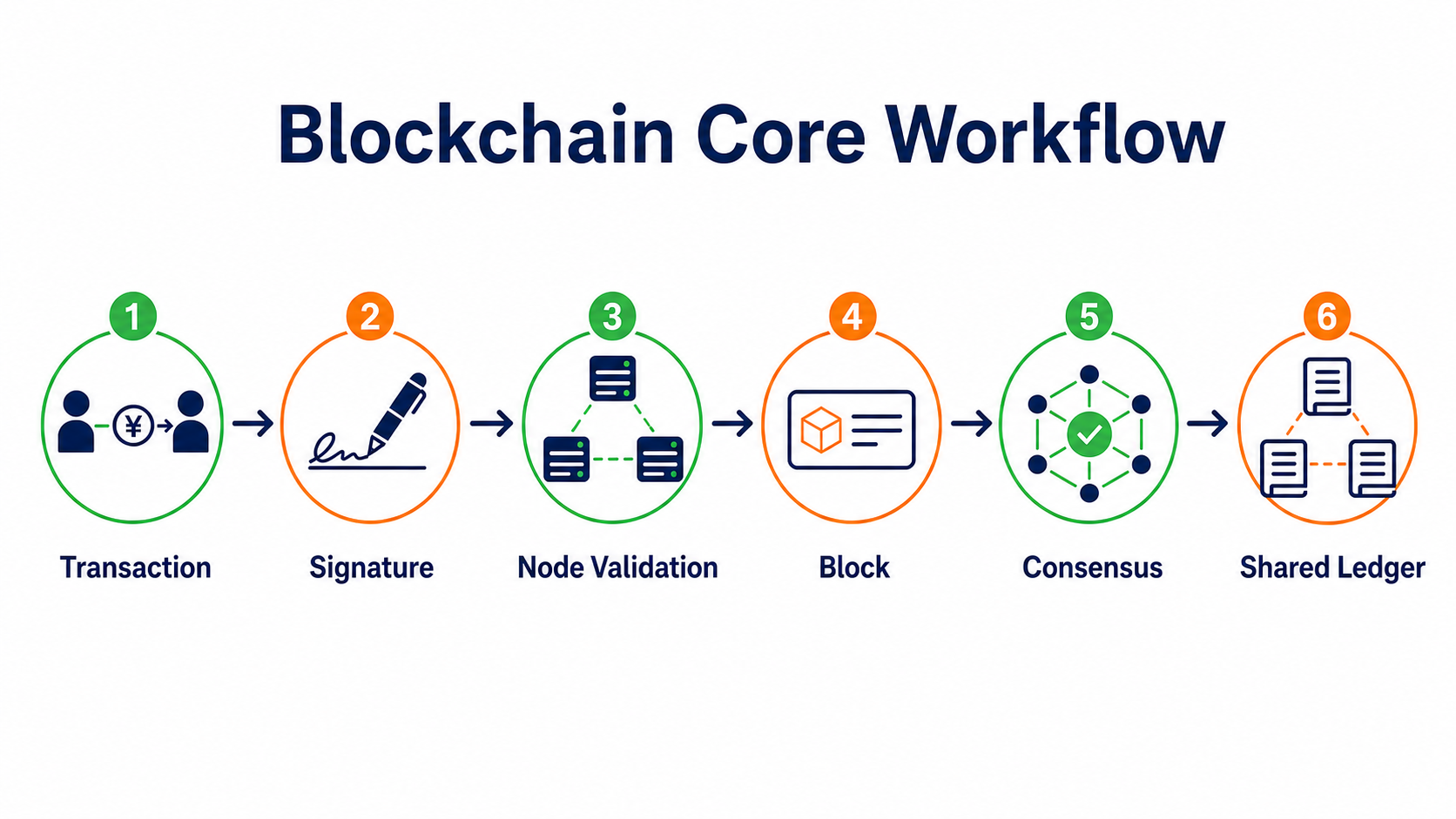
How Does a Blockchain Record a Transaction?
A user first creates a transaction in a wallet and signs it with a private key. After the transaction is broadcast, nodes check conditions defined by the protocol, such as the signature, balance or unspent outputs, transaction format, and fees. Transactions that pass these initial checks usually enter a pending pool and wait to be selected by a block producer.
The block producer assembles transactions into a candidate block. When other nodes receive the block, they independently execute or verify its transactions and block header. A node adds the block to the chain it recognizes only if the block complies with the consensus rules. Each subsequent block then increases the transaction's confirmation depth.
Block production, validation, and finality work differently across networks. For a step-by-step explanation of this process, see How Blockchain Works.
What Do Hashes, Public and Private Keys, and Digital Signatures Do?
A hash function maps data of any length to a fixed-length digest. Even a small change to the input will usually produce a noticeably different digest, allowing nodes to detect whether data has been altered. A block header contains a reference to the previous block's hash, so changing a historical block also invalidates the references that follow it.
A private key creates signatures, while a public key verifies them. A valid signature shows that the holder of the corresponding private key authorized specific data, but it does not conceal the transaction amount or address. Public keys can generally be shared, whereas private keys must remain secret. For more detail, read Hash Algorithms Explained and Public-Key Cryptography.
Why Is Blockchain Hard to Tamper With but Not Absolutely Immutable?
More precisely, a blockchain makes tampering detectable and raises the cost of rewriting history. Changing an old block alters its hash and breaks its connection to later blocks. An attacker must also convince the network to accept an alternative history. The deeper a block is in the chain, the harder it generally becomes to rewrite.
This does not mean that every on-chain record is mathematically incapable of changing. A network may experience a short reorganization, protocol upgrades may change its rules, and a party controlling enough consensus resources may attempt to rewrite recent history. Applications should therefore choose confirmation thresholds based on the network and assess validator concentration, software defects, and governance practices.
What Is the Difference Between Public, Consortium, and Private Blockchains?
A public blockchain generally lets anyone read data, submit transactions, or operate a node, although the protocol still defines the exact permissions. A consortium blockchain is jointly managed by several known organizations, with controlled membership and write access. A private blockchain is managed by one organization or a limited group and is closer to an internal system with cryptographic auditability.
Distributed and decentralized do not mean the same thing. Data can be replicated across many servers while one entity still controls the rules. An open network can also become concentrated through its nodes, validation power, or client implementations. To understand a blockchain's governance, examine who can validate, who can upgrade the protocol, and who can block transactions rather than looking only at the node count.
What Are the Advantages and Limitations of Blockchain?
Blockchain is useful when multiple participants need to share a common state without relying entirely on a single record keeper. It can provide a consistent transaction order, traceable records, and independent verification.
These capabilities come with trade-offs. Having multiple nodes repeatedly store and verify the same data creates throughput, latency, and storage costs. A public ledger does not inherently protect privacy. Once incorrect data is confirmed, it usually cannot be fixed by directly editing a row as it could in a conventional database. If a business already has a trusted central authority and does not need joint verification by multiple parties, a traditional database is often simpler and more efficient.
A Reading Path for Core Blockchain Concepts
| Question | Recommended reading |
|---|---|
| How is a transaction confirmed? | How Blockchain Works |
| How do multiple participants share a ledger? | Distributed Ledger Technology |
| How can a data fingerprint reveal changes? | What Is a Hash Algorithm? |
| How does a wallet prove transaction authorization? | Public-Key Cryptography |
| What information is stored inside a block? | Blockchain Block Structure Explained |
| How can public on-chain records be queried? | How to Use a Blockchain Explorer |
| What data do different kinds of nodes store? | Full, Light, and Archive Nodes |
| Where does the first block come from? | What Is a Genesis Block? |
| Why can protocol upgrades split a chain? | Soft Forks and Hard Forks |
Frequently Asked Questions
Can a Blockchain Transaction Be Completed Entirely Offline?
A transaction can be created and signed on an offline device, but it must still be broadcast to nodes through an internet-connected device before the network can validate it and include it in a block. Offline signing helps isolate private keys; it does not replace network submission.
Does Blockchain Eliminate the Need for Trust?
No. It changes what users must trust. Users still depend on their software, cryptographic implementations, and protocol rules, and they must assess whether validators, oracles, bridges, and custodial services are reliable.
Can a Smart Contract Automatically Understand Real-World Events?
No. A smart contract can process only data available on-chain. External information such as weather, prices, or sports results is generally supplied by oracles, which introduce additional data-source and governance risks.
Does Deleting a Blockchain Account Erase Its Transaction History?
Usually not. Stopping use of an address or deleting a local wallet does not remove transactions already recorded on a public ledger. A wallet primarily manages keys and provides an interface for interacting with the network; it is not where the on-chain history is stored.
Recommended
View more


service hotcoin.com
producthotcoin.com
businesshotcoin.com
casecnhotcoin.com