What Does HODL Mean? Origin, Long-Term Holding Strategy and Risks
When cryptocurrency prices fall, you may see someone in the community say "I'm still HODLing." It means "I'm still holding, and this drop hasn't made me sell."
HODL started as a spelling mistake and later became a common term for long-term holding in crypto. When prices move, people who use this strategy focus on a longer-term question: do the reasons I chose to hold still stand?
Key Takeaways
- What HODL means: It usually refers to holding crypto assets for the long term, especially maintaining your holding plan through short-term price swings.
- Where HODL comes from: It originated from a 2013 Bitcointalk post titled "I AM HODLING." "Hold On for Dear Life" is a later popular interpretation.
- Relationship to DCA: HODL describes how you hold; dollar-cost averaging (DCA) describes how you buy. The two can be used together.
- Risks of long-term holding: During the holding period, you may still face price declines, project failure, insufficient liquidity or asset custody issues.
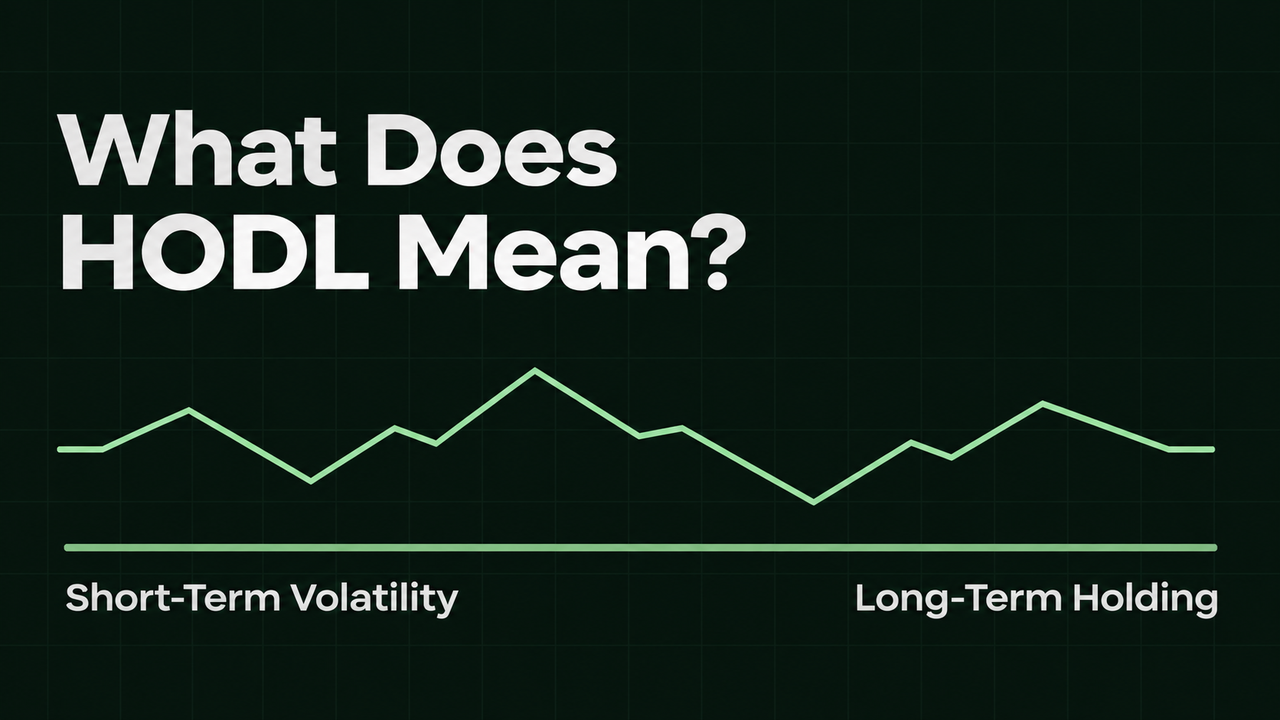
What Does HODL Mean?
HODL is crypto slang that usually means holding crypto assets for the long term and maintaining your original holding plan through short-term price rises or falls. It is close in meaning to the English hold, and in crypto communities it often carries the tone of "prices moved, and I'm still holding."
For example, when someone says "I'm HODLing BTC," they usually mean they still hold Bitcoin. How long they plan to hold and under what conditions they would adjust the position depend on their personal plan. For further reading, see Binance Academy's explanation of the HODL strategy.
The Origin of HODL
On December 18, 2013, the price of Bitcoin was falling. Bitcointalk user GameKyuubi posted a thread titled "I AM HODLING," spelling HOLDING as HODLING. In the post, he admitted he was not good at short-term trading, so he chose to keep holding Bitcoin.
The spelling later spread through crypto communities. People also built the phrase Hold On for Dear Life from the four letters of HODL, roughly meaning "hold on tight." The phrase carries on the community's tone of choosing to hold even when prices swing sharply.
How Should You Understand the HODL Long-Term Holding Strategy?
The difference between long-term holding and short-term trading
People who use a long-term holding strategy usually review their positions based on longer-term conditions, such as whether the blockchain network keeps operating or whether the asset's main use has changed significantly. Short-term traders are more likely to adjust positions based on recent prices, trading volume or market events.
Extending the decision horizon can reduce the need to repeatedly judge short-term entry and exit points. During the holding period, the asset's value will still change with market prices.
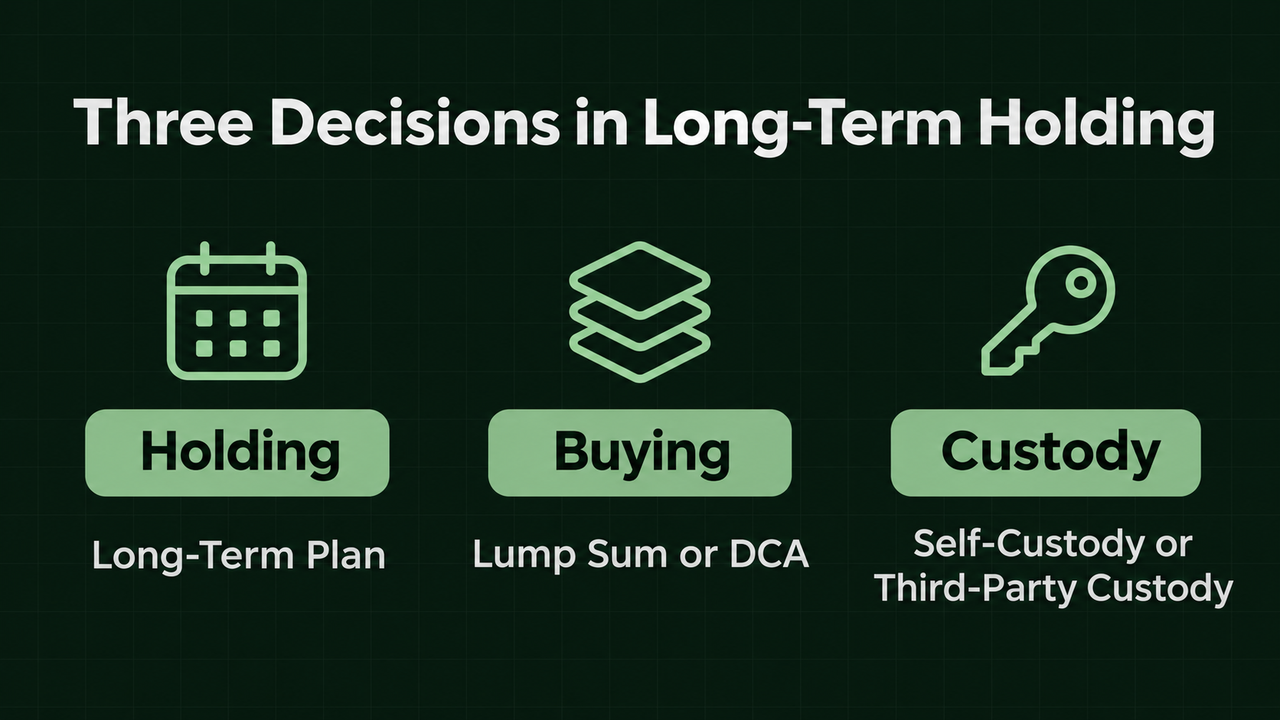
Holding, buying and custody are three decisions
| Decision | Question to answer | Example |
|---|---|---|
| How to hold | How long do you plan to view this asset? | Hold long term and periodically review the original reasons for holding |
| How to buy | How do you build the position? | Buy all at once, or buy a fixed amount regularly (DCA) |
| How to custody | Who manages access to the asset? | Manage private keys yourself, or use third-party custody |
Two people who both plan to hold long term may choose differently: one may buy all at once, while the other may use DCA. The timing of purchases affects cost, while the custody method affects how the asset is accessed and the security risks you bear.
What Risks Does HODL Involve?
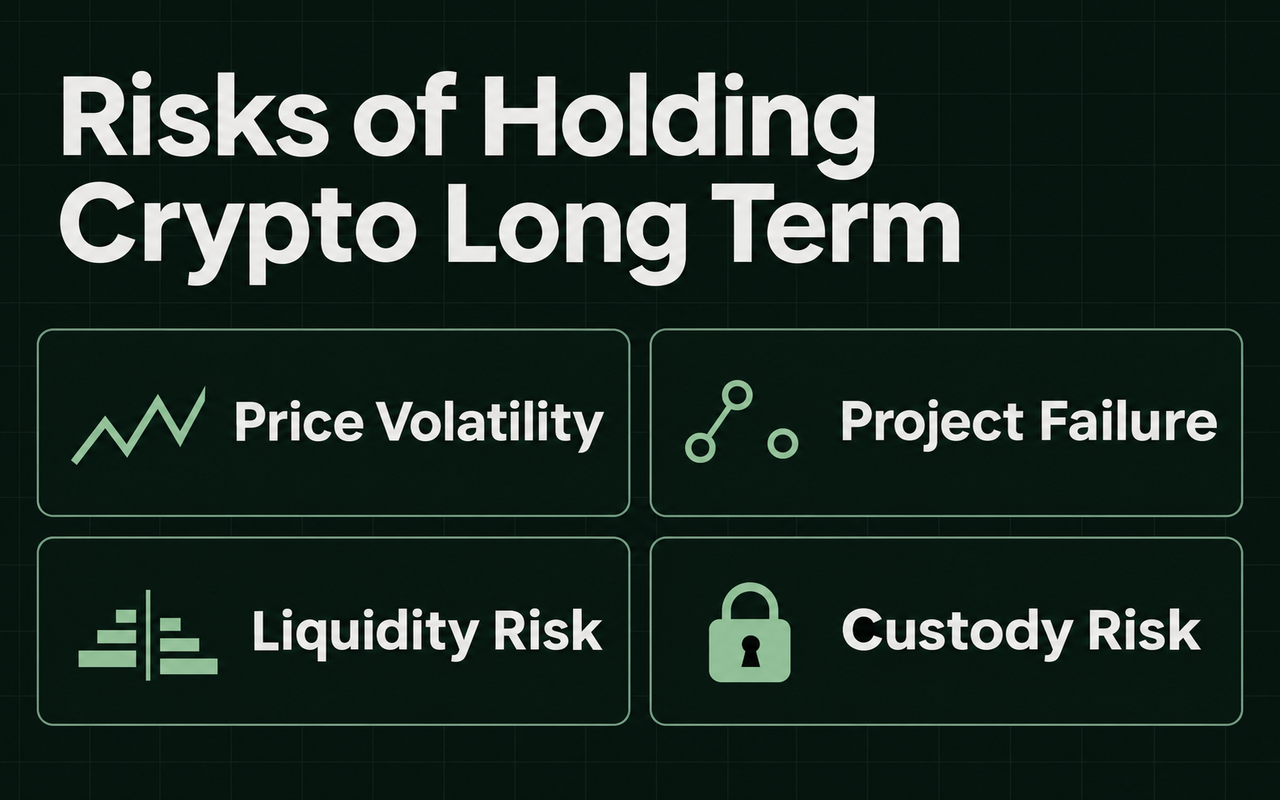
Price declines and project deterioration
When the market price falls below your purchase cost, the position shows an unrealized loss. Even if you have not sold, the asset's value at the current market price has already declined. The longer you hold, the more likely you are to encounter further declines.
A price decline may also come with changes in the project itself, such as core services shutting down or the token's original use disappearing. When the conditions that supported holding change, past price highs cannot show whether the asset will recover in the future.
Liquidity and custody
| Risk | What may happen during the holding period |
|---|---|
| Liquidity risk | The market shows a quote, but buy orders are not enough to absorb the amount you want to sell, so the actual execution price may be lower than expected. |
| Self-custody risk | If you lose your private key and have no usable backup, you may permanently lose access to the asset. |
| Third-party custody risk | If the custody platform has operational or security problems, services may be interrupted or withdrawals may be suspended. |
Your custody method determines who manages the private keys and what measures can be taken if problems occur. See Investor.gov's guide to crypto asset custody.
When Is It Worth Reassessing Your Holding Plan?
Suppose you hold a crypto asset because it has a clear use on a network that keeps operating. When the overall market falls, if the network is still running normally and the asset's use has not changed significantly, price alone is not enough to judge whether the reasons for holding have changed. If the network's core services stop, or market buy orders keep shrinking, you have a concrete reason to review the position.
Your personal situation can also change your holding plan. Even if the project operates as usual, if money you originally could invest long term is needed for expenses in the near future, the price volatility you can bear and the waiting time you can accept will also change. When reassessing, you can start by asking yourself three questions.
- Do the reasons for holding still stand? Which of the uses or operating conditions you valued at the start have now changed?
- Can this money still be invested long term? What would happen if you needed the money but could not sell at the expected price?
- Can the asset still be accessed safely? Are your self-custody backups usable? Have the access and withdrawal conditions of third-party custody changed?
Common misconceptions
- "If I haven't sold, I haven't lost." An unrealized loss shows that the position's value at the current market price is below cost. If you sell below cost, the loss becomes realized.
- "If it falls long enough, the price will come back." Whether the price recovers depends on later changes in the asset and the market. Project failure or loss of liquidity can keep an asset depressed for a long time.
- "HODL means holding forever." A long-term holding plan can include conditions for reassessment, such as a change in the asset's use or an earlier need for the money.
HODL FAQ
Q1. What does HODLer mean?
A HODLer is a holder who follows the HODL approach. In crypto communities, calling yourself a "BTC HODLer" usually means you plan to hold Bitcoin long term.
Q2. How long do you have to hold to count as HODL?
The community term HODL has no unified threshold in months or years. If you are reading an on-chain analysis report, check how that report defines "long-term holders," because different metrics may use different time thresholds.
Q3. Can you DCA and HODL at the same time?
Yes. Buying crypto with a fixed amount each month is DCA, while holding the accumulated position according to a long-term plan is HODL. Buying in batches changes the timing and cost of purchases, and the position's value will still fluctuate with market prices.
Q4. Does HODL only apply to Bitcoin?
The term originated in the Bitcoin community and later came to be used for other crypto assets. Even with the same holding approach, different assets can differ greatly in use, liquidity and project risk.
Q5. Does HODL automatically generate interest or staking rewards?
Simply holding a crypto asset generally does not automatically earn interest or staking rewards just because you hold it longer. If a specific protocol or platform offers rewards, eligibility, distribution and withdrawal conditions depend on that mechanism's rules.
Conclusion
HODL grew from a single forum typo into a common term for long-term holding in crypto. Extending the holding period can reduce the need to trade frequently due to short-term volatility, but asset value, liquidity and custody risks will still change. When prices fall, it is worth looking back at whether the original reasons for holding still stand and whether the position still fits your funding needs.
Risk warning: This article is for educational and informational purposes only and does not constitute investment advice. The abbreviations in this article reflect community sentiment and language habits and should not be used as a basis for buying, selling or using leverage. Crypto asset prices are highly volatile and may lead to loss of principal. Make decisions based on your own risk tolerance and consult a professional adviser when necessary.
Recommended
View more