
What Does FUD Mean? Understanding Fear, Uncertainty, and Doubt in Crypto
Your group chat suddenly floods with "It's going to crash," "The exchange is in trouble," or "This coin is a rug pull." Do you panic and rush to sell? This state of being pushed around by negative narratives is commonly called FUD in crypto.
FUD is short for Fear, Uncertainty, and Doubt. In Chinese, it is often translated as "fear, uncertainty, and doubt." It can refer to the panic atmosphere created by spreading or amplifying negative information, or to the feelings of doubt people hold toward an asset, project, or the entire market.
Key boundary: FUD is not an automatic sell signal. Verifiable real risks should not be dismissed with a simple "don't listen to FUD"—check the source first, then decide whether to change your plan.
Key Takeaways
- FUD means Fear, Uncertainty, and Doubt: it describes panic or doubt narratives or their emotional effects.
- Common triggers in crypto are negative headlines, unverified rumors, and regulatory or security-related speculation. It reflects information and emotion, and cannot be used as a standalone trading basis.
- "This is FUD" can itself be misused to shut down evidence-based doubts. The standard for judgment is whether there are independently verifiable facts.
- The response relies on preset rules: primary sources, cross-checking multiple sources, a cooling-off period, and position limits—not being rushed into orders by a single post.
What Does FUD Mean?
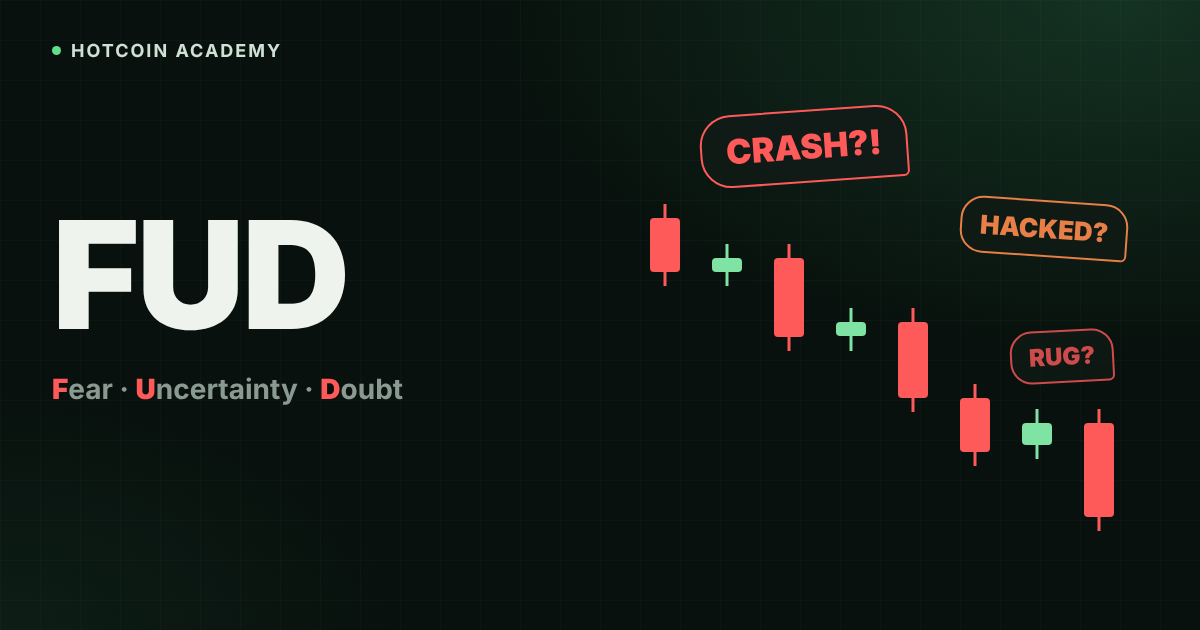
FUD stands for Fear, Uncertainty, and Doubt. In cryptocurrency communities and trading contexts, it usually points to two interrelated phenomena:
First, the rapid spread of negative information: including exaggerated, out-of-context, or unverified content that drives up collective panic.
Second, investors' strong sense of uncertainty: investors develop doubts about a project's prospects, platform security, or regulatory direction, leading them to shorten decision-making time, loosen risk controls, or temporarily rewrite them.
It can also be used as a verb or a label, such as "stop FUDding" or "this article is FUD"—sometimes accusing someone of spreading panic, sometimes just slapping a label on harsh criticism. FUD itself does not tell you where the price will go next; it only describes the current information atmosphere and psychological state.
The term FUD predates cryptocurrency, originally used for scare-tactic marketing in business and market competition.
How Does FUD Happen in Crypto?
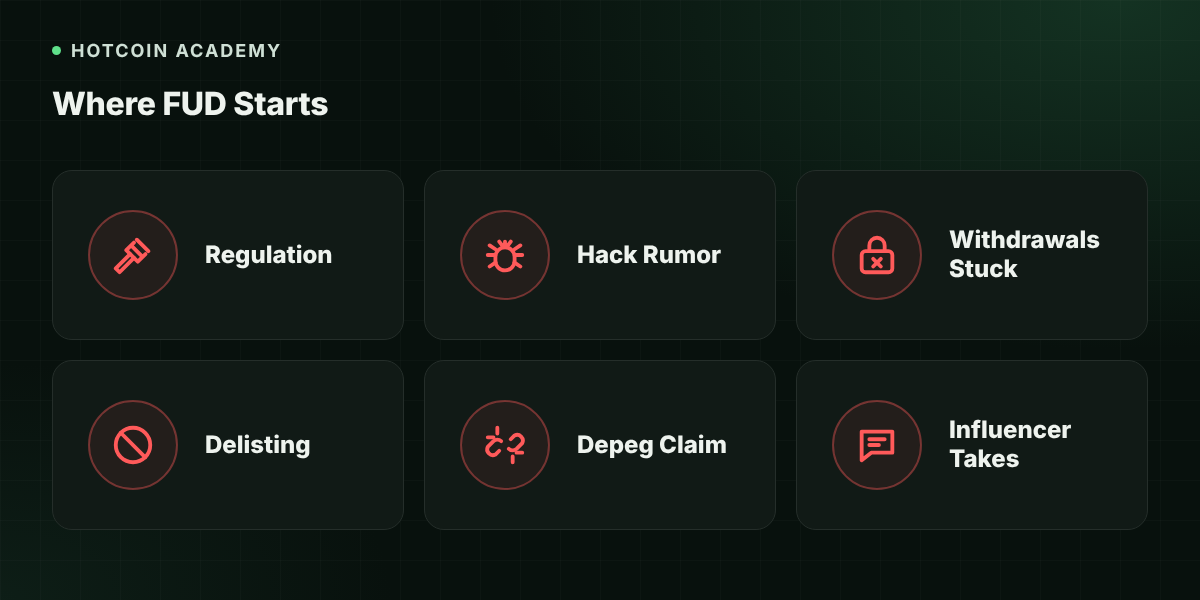
Common triggers are no mystery: regulatory bans or investigation headlines, hack/exploit rumors, screenshots of blocked withdrawals, delisting or shutdown rumors, claims that a stablecoin is "about to depeg," and celebrity bearish comments that get reprocessed. Sensational headlines are more easily shared than clarification notices; by the time clarifications come out, panic has often already made a round.
The common consequences are: panic selling before verification, or liquidation cascades on leveraged positions that amplify the decline; others go the opposite way and "buy every FUD," which can also hit real risks.
FUD most often flares in the hours to days after sudden bad news—this doesn't mean you can't adjust positions, but once emotions rise, people are more likely to forget verification and their own exit rules.
The motive for deliberately creating FUD is usually related to interests: short sellers want prices to fall, those wanting to accumulate cheaply need others to panic sell, and competing projects may use it to divert attention. But more FUD is not orchestrated; it is real risks being exaggerated or misrepresented.
Why Can "This Is FUD" Also Be Dangerous?
The danger is not in "staying alert to bad news," but in the label being misused in both directions. On one side are baseless rumors and malicious smears used to hammer prices or set a narrative.
On the other side: verifiable doubts such as abnormal contract permissions, opaque reserves, unusual team wallet activity, and anomalies on official status pages are also dismissed with a simple "don't listen to FUD." The latter makes communities lose the ability to discover problems, but the problems don't disappear because of it.
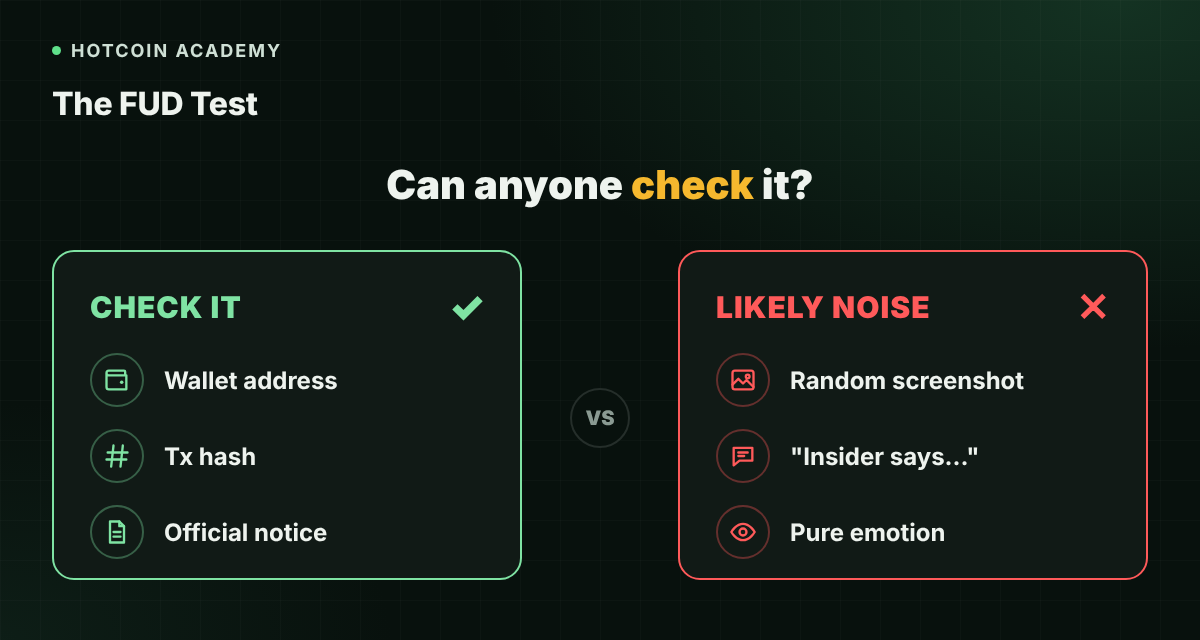
So when judging, rather than looking at tone or which side the speaker is on, ask one question: Can a third party verify this claim themselves? If it comes with an address, transaction hash, or link to the original announcement, it is a doubt awaiting verification; if only hearsay, emotion, and "I heard someone inside say" remain, it is closer to narrative-driven FUD.
What's the Difference Between FUD, FOMO, LFG, and HODL?
To understand at a glance, it helps to put FUD in the same group of emotion words for comparison. You can also refer to the 10 Essential Crypto Terms Glossary for Beginners:
| Abbreviation | Full Form (Common) | One-line Meaning | Typical Scenario |
|---|---|---|---|
| FUD | Fear, Uncertainty, Doubt | Panic, doubt narrative/label | Bad news, unverified rumors, mutual "troll" labeling |
| FOMO | Fear of Missing Out | Afraid of missing out and wanting to chase | Sharp rallies, showing off gains, hot sector rotation |
| LFG | Let's Freaking/F***ing Go | Let's go, charge | Listings, breakouts, event kicks-off |
| HODL | Hold (folk: Hold On for Dear Life) | Hold long-term | Volatility, bear market mindset reminders |
FUD pushes you to "be afraid now (or deny fear)"; FOMO pushes you to "buy now"; LFG is a rallying cry; HODL leans toward holding discipline. When bad news spreads, first separate verifiable facts from narrative-driven stories; when the market is hot and LFG floods the screen, guard against FOMO opening up your plan.
How to View and Use FUD?
The most practical approach is to "verify sources, separate facts from interpretation, and execute preset rules," rather than going all-in contrarian or liquidating at the sight of red candles or scary headlines. To compare slogan sentiment with quantitative indicators, you can also read What Is the Crypto Market Sentiment Index?.
- Find primary sources first, then look at retellings: prioritize official announcements, status pages, original regulatory texts, block explorers, and verifiable on-chain records; anonymous screenshots and unknown "insider groups" can only be clues, not conclusions.
- Separate facts from interpretation: for example, "a certain function is suspended" is a fact, "so the project goes to zero tomorrow" is interpretation. For rumors, wait for a second independent source. After separating them again: Does this verified event invalidate your original reason for buying? Only act on verified facts that would change your position rules.
- Use preset guardrails, not rules rewritten on the spot: position limits, leverage limits, and the conditions under which you may reduce or add positions should be written down before emotions rise. FUD is not an automatic sell signal, nor an automatic bottom-fishing signal.
- Set a cooling-off period and scale in batches: leave time to check multiple independent sources from seeing the news to placing an order; if you must adjust positions, do it in batches to avoid doing it all at once in the most chaotic hour of information.
- Reduce stimulus sources, be wary of panic rhetoric: turn down push notifications with scary headlines; stay skeptical of "transfer now or it's too late" and "the safe address given by customer service." For combinations like urgency, secrecy, and designated transfers, refer to the pause rules in the Complete Guide to Crypto Scams.

Common Misconceptions
- "All bad news is FUD, just ignore it": real security vulnerabilities, regulatory actions, or solvency issues won't disappear because you label them.
- "Anything called FUD must be fake": FUD describes the fear effect and the way it spreads, not an automatic true/false judgment.
- "When FUD appears, sell immediately/buy immediately": both treat emotion as a signal; the safer approach is to return to your plan and verifiable facts.
- "As long as the community unanimously shouts FUD, you can relax": unanimous rejection of criticism is sometimes exactly the signal of refusing to check evidence.
FAQ
Q1: What does FUD mean? FUD stands for Fear, Uncertainty, and Doubt. In Chinese, it is often translated as "fear, uncertainty, and doubt." In crypto, it mostly refers to the panic atmosphere brought by the spread of negative or unverified narratives, and can also be used to label bearish and doubtful comments.
Q2: Is FUD a sell signal? FUD is not a sell signal. It describes emotion and information atmosphere and does not constitute trading advice. The safer approach is to verify primary sources and your own risk control rules, rather than being rushed by a single post to liquidate or add positions.
Q3: What's the difference between FUD and FOMO? FUD leans toward panic and doubt, easily driving panic selling or avoidance; FOMO is the fear of missing out, easily driving chasing highs. Both are emotional states, and both require verifying the facts before acting.
Q4: Why do some people say "this is FUD" whenever they face criticism? "This is FUD" is often used to shift the discussion from "is it true" to "are you one of us." If the doubt has already provided a verifiable address, hash, or document, verify the content first, rather than defining the speaker's stance first.
Q5: How do I know if I'm being led by FUD? If you mainly change plans temporarily because of scary headlines, anonymous screenshots, or group emotions, wanting to immediately sell at market or go all-in contrarian, you are very likely being led by FUD. Step away from the market and community for a few minutes, find the rules on paper and verifiable sources, and then decide whether to trade.
Conclusion
Understanding what FUD means is about recognizing when "fear, uncertainty, and doubt" are making decisions for you, and when "this is FUD" is shielding a project from criticism. Like FOMO, LFG, and HODL, it is an emotional term: it can be a thermometer, but not an automatic buy/sell switch. Primary sources, verifiable items, and preset risk controls are more useful than regretting a sale at the lowest point afterward.
To compare market sentiment and capital flows daily, you can read the Daily Crypto Market Report.
Risk warning: This article is for educational and informational purposes only and does not constitute any investment advice. The abbreviations in this article reflect community sentiment and language habits and cannot be used as a basis for buying, selling, or adding leverage. Crypto asset prices are highly volatile and may result in loss of principal. Please make decisions based on your own risk tolerance and consult a professional advisor if necessary.
Recommended
View more