Uniswap In Depth: The Evolution of the DEX Leader
Uniswap is one of the most representative decentralized trading protocols today. Instead of relying on a traditional order book, it settles on-chain token trades through smart contracts, liquidity pools, and an automated market maker (AMM). Understanding Uniswap means understanding the core logic of how a DEX prices assets, executes trades, and sources liquidity.
What this article covers: a breakdown of Uniswap from v1 to v4, why it became the face of DEXs, and what ordinary users genuinely need to watch when trading on-chain.
1. What Exactly Is Uniswap?
Uniswap is essentially a decentralized trading protocol deployed on a blockchain.
Traditional centralized exchanges usually run on an order book: buyers post bids, sellers post asks, and the matching engine pairs them up. Uniswap uses the AMM model instead. You are not trading against a specific counterparty, but swapping directly with a liquidity pool held in a smart contract.
A typical liquidity pool holds two tokens, for example ETH/USDC. When you swap USDC for ETH, you are in effect adding USDC to the pool and taking ETH out of it, and the smart contract calculates the final amount based on the pool's balances and its pricing mechanism.
That is why understanding AMMs matters so much. If you want to get to grips with the math behind Uniswap first, start with AMM Explained: The Mathematical Beauty of x*y=k.
2. Why Does Uniswap Not Need a Traditional Order Book?
Uniswap's most classic design choice is using liquidity pools in place of an order book.
Take early Uniswap as an example. An ETH/USDC pool holds both ETH and USDC at the same time. When you trade, you swap directly against those pooled assets rather than waiting for someone else to post an order in the opposite direction.
Classic AMMs use:
x × y = k
Where:
x: the amount of the first token in the pool
y: the amount of the second token in the pool
k: the constant product
When a user buys ETH, the pool's ETH balance falls and its USDC balance rises. The ratio between the two tokens shifts, and the price moves with it. Uniswap's official documentation still presents x*y=k as the key foundation for understanding the classic v2 constant product model.
The biggest implication of this design is that trades no longer require a buyer and a seller to be matched one to one; as long as the pool holds enough liquidity, a swap can go through.
3. How Did Uniswap Develop Step by Step?
Uniswap's development was not simply a matter of piling on features. It kept solving three core problems:
How can trades happen more easily? How can liquidity become more efficient? How can the protocol become more composable?
1. Uniswap v1: Proving AMMs Work for On-Chain Trading
Uniswap v1 was a major early experiment with the AMM model.
Through liquidity pools and the constant product mechanism, it let users swap tokens directly on-chain. Compared with traditional exchanges, this lowered the barrier to market making and gave anyone a chance to become a liquidity provider.
Still, v1 had clear limitations in pair design and liquidity efficiency.
2. Uniswap v2: The Classic AMM Model Matures
v2 made important structural improvements, making trades between arbitrary ERC-20 tokens far more flexible.
It was from this stage onward that x*y=k became the textbook example many people associate with AMMs.
v2 liquidity is typically spread across the entire price range. That makes the model simple and easy to grasp, but it also means a large share of capital may sit outside the prices where trading actually happens, so capital efficiency is not high.
3. Uniswap v3: Concentrated Liquidity Changes the LP Model
One of v3's biggest changes is concentrated liquidity.
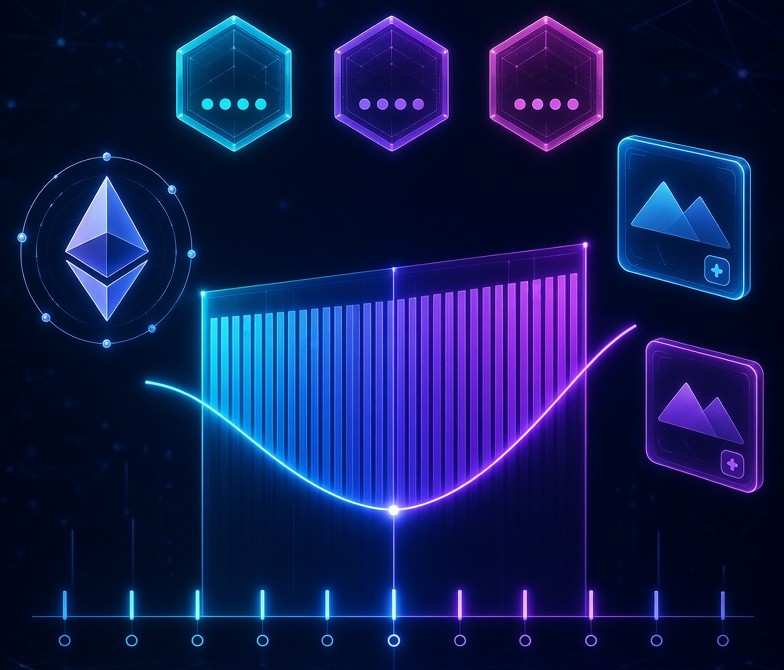
In v2, an LP's liquidity basically covers the whole price range, whereas v3 lets LPs choose their own price range and concentrate capital inside it.
For example, an ETH/USDC LP can provide liquidity only within a chosen price band instead of spreading funds across a nearly infinite range of prices.
This can raise capital efficiency in specific price regions, but it also adds management complexity for LPs: once the price leaves the range you selected, that liquidity may stop participating in trades and therefore stop generating fees the normal way. Uniswap's own materials state plainly that v3/v4 liquidity is concentrated within the price range chosen by the LP.
4. Uniswap v4: Further Modularization
Building on v3's concentrated liquidity, Uniswap v4 changes the protocol architecture again, introducing designs such as Singleton, Hooks, and Flash Accounting.
One important concept here is Hooks.
Hooks can be understood as letting developers inject custom logic into a pool's lifecycle and trading flow, giving liquidity pools far greater programmability.
Developers can, for instance, design more flexible mechanisms around trading, fees, and liquidity changes.
As of now, Uniswap's official developer documentation positions v4 as the recommended version for new integrations, while v2 is better suited to understanding the classic constant product AMM and v3 mainly corresponds to the concentrated liquidity mechanism.
4. What Actually Differs Between Uniswap v2, v3, and v4?

Note that "newer version" does not mean older versions are meaningless. Different versions may keep running because of their assets, liquidity, application integrations, and specific trading needs.
So when you actually trade or provide liquidity, do not rely on a label like "v4 is newer". Look further at the specific pool's liquidity, trading depth, fees, and price range.
5. How Is the Price on Uniswap Formed?
This is one of the most important questions for understanding Uniswap.
In a classic AMM, the amounts of the two assets in the pool determine the current price.
Suppose a pool initially holds:
10 ETH
30,000 USDC
Then the pool's constant product is:
k = 10 × 30,000 = 300,000
If a user buys ETH with USDC, ETH leaves the pool and USDC enters it. To preserve the constant product relationship, the pool's asset ratio has to change, so the in-pool price of ETH changes as well.
This means:
The larger a trade is relative to the pool's liquidity, the more pronounced the price impact usually is.
Uniswap's official documentation also states clearly that the larger a trade is relative to pool depth, the higher the resulting Price Impact tends to be.
That is why buying the same 1,000 USDC worth of ETH can yield a completely different amount in a deep pool versus a shallow one.
6. Why Does Uniswap Need LPs to Provide Liquidity?
Without liquidity pools, a DEX would not have enough assets for users to swap against.
That is why another key role in Uniswap is the LP (Liquidity Provider).
LPs deposit assets into a designated liquidity pool, and other users trade through that pool. The fees generated by trading are then distributed to eligible liquidity providers according to the relevant rules.
In v3 and v4, because liquidity uses the concentrated liquidity mechanism, being an LP is no longer a matter of "deposit and forget". LPs have to consider price ranges, trading activity, fee income, and the risk that comes with price movement. Uniswap's current liquidity documentation likewise frames the LP role as one that requires managing a specific price range.
Therefore:
Traders care about execution price and trading cost, while LPs care more about liquidity utilization, fees, and price risk.
Both groups use Uniswap, but they face different problems.
7. What Costs Really Matter When Trading on Uniswap?
Many new users see the exchange rate on the trading page and assume that is the final cost.
In reality, a DEX trade involves at least several factors worth watching.
1. Network Fee
This is the blockchain network fee.
It depends on the specific blockchain network and how congested the network is at the time.
2. Trading Fee
Different pools and different versions may have different fee settings.
So even for the same ETH/USDC pair, trading costs can differ from pool to pool.
3. Price Impact
Price Impact refers to how your own trade moves the pool's price.
Generally, the larger the trade amount and the shallower the pool, the more obvious the Price Impact.
4. Slippage
Slippage is the gap between the price you actually get and the price you expected.
It is not the same concept as Price Impact.
In simple terms:
Price Impact is about "how much my trade moved the pool price"; Slippage is about "how far the final execution drifted from what I expected".
On top of that, DEX users also need to consider on-chain execution risks such as MEV.
8. Why Did Uniswap Become the Face of DEXs?
Uniswap's advantage is not just high trading volume. More importantly, it built an open on-chain liquidity infrastructure.
Open
Users can interact directly with smart contracts, with no traditional centralized exchange account system required.
Non-Custodial
Users generally manage assets through their own wallets, and control of those assets does not have to be handed to a centralized platform during trading.
Composable
Uniswap's liquidity and trading functions can be called by other DeFi applications, aggregators, wallets, and other infrastructure.
Programmable
Especially after v4 introduced Hooks, liquidity pools can carry far more complex custom logic.
So Uniswap's value lies not only in "being a place to buy and sell tokens", but in being part of on-chain financial infrastructure.
9. As an Ordinary User, How Should You Judge Whether a Trade Makes Sense?
Do not just ask "can I buy?". Check in this order:
First, check the token contract address.
Tokens sharing a name may have multiple different contracts, so neither the name nor the logo can be your only basis for judgment.
Second, check the pool's liquidity.
When liquidity is too low, the page may still quote a price, but the price impact can be large.
Third, check Price Impact.
Especially for larger trades, do not focus only on the exchange rate currently displayed.
Fourth, check the Slippage setting.
Slippage that is too low may prevent the trade from going through, while one that is too high may accept an excessive deviation in execution price.
Fifth, check network and Gas costs.
Small trades especially need attention here, or the fee can take up a large share of the trade amount.
Sixth, confirm the final transaction details.
Review the contract interaction, token amounts, and approval scope in your wallet pop-up carefully. Do not assume every transaction is safe just because "it is the Uniswap page".
10. What Are Uniswap's Strengths and Risks?
Uniswap's core strengths are being open, non-custodial, free of traditional order book matching, and able to automate trading and liquidity management through smart contracts.
But decentralization does not mean there is no risk.
Users have to face smart contract risk, fake token risk, insufficient liquidity, price volatility, Slippage, MEV, incorrect approvals, and failed network execution.
For LPs, there is also impermanent loss, price range management, and the question of whether fee income can cover the risk taken on.
So a more accurate understanding of Uniswap is this:
It lowers the barrier to participating in on-chain trading and market making, but it does not remove the risks inherent in financial markets and smart contracts.
11. The 5 Mistakes Uniswap Beginners Make Most Often
Mistake 1: Checking only the token name and not the contract address.
Tokens sharing a name are not necessarily the same asset.
Mistake 2: Looking only at the quote and not at liquidity.
A quote can exist, but when depth is insufficient the actual execution can be noticeably worse.
Mistake 3: Treating Price Impact and Slippage as the same thing.
They correspond to different trading risks.
Mistake 4: Assuming that collecting fees as an LP means "stable income".
Fee income is affected by trading volume, liquidity size, price movement, and the specific pool's mechanics, among other factors.
Mistake 5: Assuming a DEX is automatically safe.
A DEX's decentralized nature cannot replace your own security judgment. Incorrect approvals, malicious tokens, phishing sites, and malicious contracts can still cause asset losses.
FAQ: Common Questions About Uniswap
Is Uniswap an exchange?
From a user experience standpoint, Uniswap completes token swaps, so it is often called a decentralized exchange (DEX). Technically, though, it is more accurately described as a decentralized trading protocol and smart contract system deployed on a blockchain.
Why does Uniswap not use an order book?
Uniswap uses an AMM and liquidity pools, so users swap directly against the pooled assets. That removes the need for the order-by-order matching of buyers and sellers found in a traditional order book.
What is the biggest difference between Uniswap v2 and v3?
The core difference is how liquidity is organized. v2's classic model spreads liquidity across the entire price range, while v3 introduced concentrated liquidity, letting LPs choose their own price range and thereby improving capital efficiency in specific price regions.
Is Uniswap v4 necessarily better for ordinary users than v3?
You cannot simply conclude that. v4 upgrades the protocol architecture and programmability further, but any specific trade still needs to be judged by the pool's liquidity, fees, price, assets, and actual trading needs.
Why does price slippage occur when trading on Uniswap?
Because when an on-chain transaction executes, the pool state may have changed, and the trade itself can also shift the ratio of assets inside the pool. Trade size, liquidity depth, and network conditions can all affect the final execution result.
Conclusion
Uniswap's development can be summed up as a clear technical path:
v1: proving AMMs → v2: perfecting the classic AMM → v3: concentrated liquidity → v4: modular, programmable AMM.
What it truly changed is not just "where you trade tokens", but the fact that trading, market making, and liquidity became smart contract infrastructure that runs directly on a blockchain.
For ordinary users, the most important thing is not to memorize the technical terms of every version, but to grasp one complete chain of judgment:
Token → Pool → Liquidity → Price Impact → Slippage → Gas → Transaction → Risk
Master that chain and you can genuinely understand why a DEX trade produced the result it did, rather than treating Uniswap as nothing more than an "on-chain swap page".
Risk warning: Crypto assets carry relatively high price volatility and liquidity risk, and DEX trading may also involve risks such as smart contracts, network congestion, slippage, MEV, malicious tokens, and incorrect approvals. This article is for blockchain and DeFi educational purposes only and does not constitute any investment or trading advice.
Recommended
View more