TSMC ADR (TSM) Stock Price | Live Chart, Market Cap and FAQs
TSM is not TSMC's ordinary share listed in Taiwan; it is the American Depositary Receipt (ADR) of Taiwan Semiconductor Manufacturing Company Limited (TSMC) listed on the New York Stock Exchange.
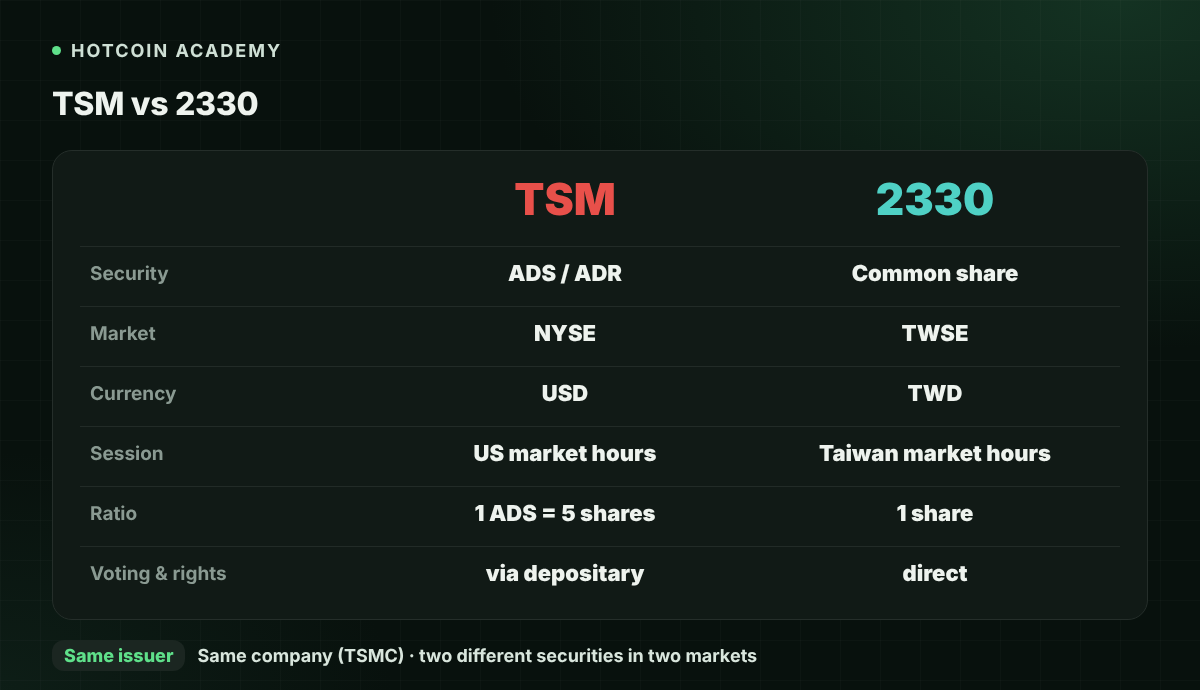
TSMC's ordinary shares trade on the Taiwan Stock Exchange under the code 2330, are quoted in New Taiwan dollars, and follow the Taiwan market schedule. TSM is quoted in U.S. dollars in New York and follows the U.S. market schedule. Both correspond to the same company, but they are not the same security in the same market.
Key Takeaways
- TSM is the American Depositary Receipt (ADR) of TSMC listed on the New York Stock Exchange. It is not the same security as the 2330 ordinary share on the Taiwan Stock Exchange, and the two do not share a market, a quotation currency, or the same trading hours.
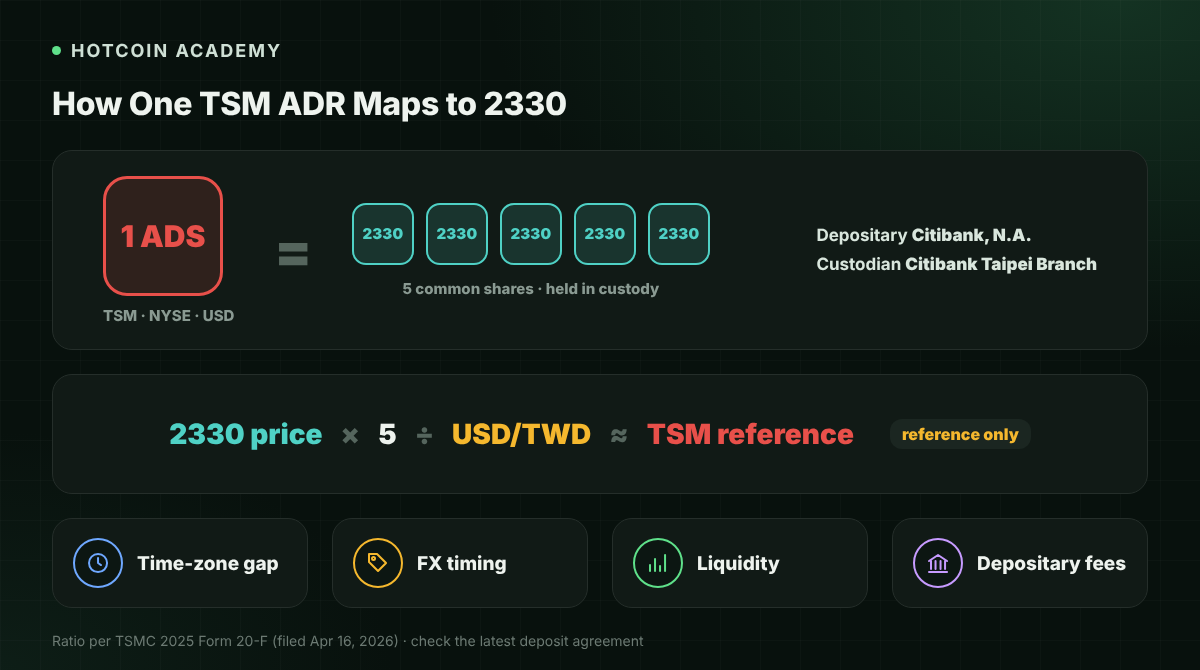
- According to the company's 2025 Form 20-F, each ADS/ADR represents 5 ordinary shares, with Citibank, N.A. as the depositary. If the ratio changes, the latest documents from the company and the depositary prevail.
- The company usually reports financial figures in both New Taiwan dollars and U.S. dollars. Check the reporting period and currency before reading, and never add or subtract the two directly.
- Market cap is generally estimated as "share price × the corresponding number of shares outstanding." When comparing TSM with 2330, also consider the depositary ratio, the exchange rate, and the timing of each market.
What Is TSMC? How Do TSM and 2330 Differ?
Taiwan Semiconductor Manufacturing Company Limited (TSMC) is headquartered in Hsinchu, Taiwan, and is a dedicated integrated circuit manufacturing services (pure-play foundry) company. According to the company's 2025 annual report Form 20-F (filed April 16, 2026), its ordinary shares have been listed on the Taiwan Stock Exchange under the code 2330 since September 5, 1994; its American Depositary Shares (ADS) have been listed on the New York Stock Exchange under the code TSM since October 8, 1997.
An American Depositary Receipt is an arrangement in which shares of a foreign company are held by a depositary and tradable receipts are issued in the U.S. market. TSMC states in its 20-F that it has appointed Citibank, N.A. as depositary bank, with Citibank Taipei Branch as custodian, and that each ADS represents 5 ordinary shares held in custody. ADSs are usually evidenced by ADR certificates, so market pages often call TSM the TSMC ADR. If this ratio or the rights details are updated, the latest deposit agreement and 20-F or other announcements from the company and the depositary prevail.
| Item | TSM (American Depositary Receipt) | 2330 (Ordinary Share) |
|---|---|---|
| Issuer | Taiwan Semiconductor Manufacturing Company Limited (TSMC) | The same company |
| Security type | American Depositary Share / Receipt (ADS/ADR) | Ordinary share |
| Trading market | New York Stock Exchange (NYSE) | Taiwan Stock Exchange (TWSE) |
| Quotation currency | U.S. dollar | New Taiwan dollar |
| Regular trading session | Follows U.S. securities market schedule | Follows Taiwan securities market schedule |
| Ratio | Each ADS represents 5 ordinary shares (subject to the latest depositary documents) | 1 ordinary share |
| Exercise of shareholder rights | Voting and other rights are usually exercised through the depositary under the deposit agreement | Exercised directly under the company's articles and relevant Taiwan rules |
Because the two markets' trading hours do not fully overlap, and because of exchange rates, liquidity, and depositary fees, the USD price of TSM does not have to equal "2330 price × 5 ÷ USD/TWD exchange rate" at all times. A deviation does not automatically mean one side has "calculated it wrong"; when comparing, check which market, time point, and exchange rate the quote belongs to.
| Item | Content |
|---|---|
| Full company name | Taiwan Semiconductor Manufacturing Company Limited |
| ADR code | TSM |
| Taiwan ordinary share code | 2330 |
| Headquarters | Hsinchu, Taiwan |
| Reporting cycle | Calendar year |
| Latest reported quarter | Q3 2026, ended September 30, 2026 |
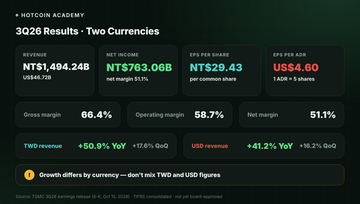
According to the Q3 2026 earnings release published on the company's investor relations website on October 15, 2026, consolidated revenue for the quarter was NT$1,494.24 billion (about NT$1.49 trillion), or US$46.72 billion; net income was NT$763.06 billion; diluted earnings per share were NT$29.43 per ordinary share, or US$4.60 per ADR. Gross margin was 66.4%, operating margin 58.7%, and net margin 51.1%. In NT dollar terms, revenue grew 50.9% year over year and 17.6% quarter over quarter; in USD terms, revenue grew 41.2% year over year and 16.2% quarter over quarter. These figures are prepared under TIFRS and come from the company's published announcement; later quarters will be updated, so refer to the latest documents.
How Should You Read TSMC's Business and Revenue Mix?
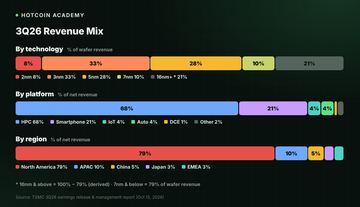
TSMC's core business is providing manufacturing services to customers, including advanced process technologies, specialty processes, and advanced packaging, rather than selling its own branded end-consumer electronics. The Q3 2026 earnings release and the management report for the same period provide a more detailed breakdown:
| Perspective | Q3 2026 company disclosure |
|---|---|
| By technology (share of wafer revenue) | 2nm 8%, 3nm 33%, 5nm 28%, 7nm 10%; 7nm and more advanced technologies together accounted for 79% of wafer revenue |
| By platform (share of net revenue) | High Performance Computing (HPC) 68%, smartphones 21%, IoT 4%, automotive 4%, consumer electronics 1%, others 2% |
| By region (share of net revenue) | North America 79%, Asia Pacific 10%, China 5%, Japan 3%, EMEA 3% |
The same management report also states that diluted weighted average shares outstanding for the quarter were about 25.932 billion shares. These breakdowns help explain demand and capacity structure, but cannot be directly converted into a "fair price" for TSM or 2330. When reading USD and NT dollar figures, remember that the exchange-rate basis may differ, and do not compare growth rates across currencies directly. When reading third-party company profiles or quote pages, note that some profiles still say the company has completed 5nm volume production while 3nm and 2nm are still in development, which does not match the wafer revenue mix already disclosed in the latest quarter; some pages also put TSM and 2330 in the same ticker list, or introduce the company without stating that TSM is an American Depositary Receipt. To confirm the security type, market, currency, and technology mix, refer to the latest 20-F or earnings release.
How Do You Read TSM's Live Chart?
Read in the following order rather than staring at a single price:
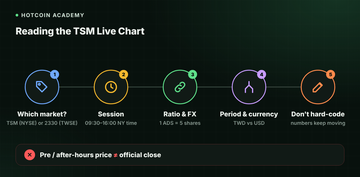
- First confirm which market you are looking at: if the quote page shows TSM, it is the ADR in New York; if it shows 2330, it is the Taiwan ordinary share. The code, currency, and trading hours all differ.
- Then confirm the trading session: TSM's regular session is 9:30 to 16:00 New York time. 2330 follows the Taiwan Stock Exchange's trading hours and holidays. When one market is open and the other is closed, price gaps or jumps are not unusual. Pre-market and after-hours TSM prices should not be treated as official closing results.
- Check the depositary ratio and currency: per the 2025 20-F, each ADR represents 5 ordinary shares. When comparing the two prices, also convert between USD and TWD and confirm which exchange rate time point is used.
- When reading financial reports, check the reporting period and currency first: the company publishes results in both NT dollars and USD, and year-over-year growth rates may differ because of exchange rates.
- Do not hard-code a number from one moment: TSM prices, 2330 prices, and exchange rates all move. This section only explains how to read them; for specific numbers, see the live display on the page.
How Should You Read Market Cap?
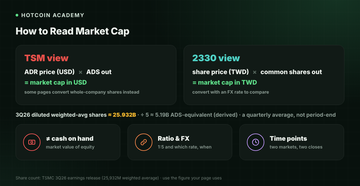
Market capitalization is generally estimated as follows:
Market cap ≈ current price × the corresponding number of shares outstanding
For 2330, this is usually the ordinary share price multiplied by the number of ordinary shares outstanding; for TSM, some pages multiply the ADR price by the number of ADS outstanding, while others estimate based on the company's total share capital and then convert to USD. Either way, the result reflects the market value of the equity, not the cash on the company's books.
When comparing valuations across the two markets, also note that the depositary ratio, exchange rate, number of treasury ADS, and transaction prices at different times can all make the two calculations slightly different. Rely on the explanation on the page you are viewing, and do not treat a market cap at one moment as definitive.
Common Misconceptions
- "TSM and 2330 are the same stock, just with different codes": they correspond to the same company, but are listed in New York and Taiwan respectively, with different security types, quotation currencies, and trading hours.
- "Multiplying the 2330 price by 5 and dividing by an exchange rate must equal the TSM price at this moment": this is only a reference way to understand the depositary ratio. Time differences, exchange-rate timing, liquidity, and depositary arrangements can all cause deviations, so it cannot be treated as an equation that must always hold.
- "Looking only at USD revenue, or adding NT dollar and USD figures directly": the company reports in both currencies at the same time. When comparing growth or margins, first confirm the basis and rely on the latest announcement.
FAQs
Q1: Is TSM TSMC's ordinary share listed in the U.S.? No, it is not the ordinary share itself. TSM is the American Depositary Receipt of TSMC listed on the New York Stock Exchange. The company's ordinary shares are listed on the Taiwan Stock Exchange under the code 2330.
Q2: How many TSMC ordinary shares does one TSM represent? According to the company's 2025 Form 20-F, each ADS represents 5 ordinary shares, with Citibank, N.A. as depositary bank. If the company and the depositary update the deposit agreement, the latest documents prevail; do not rely on an outdated ratio.
Q3: Why do TSM and 2330 sometimes not move in sync? Because the two markets have different trading hours, quotation currencies, holidays, and liquidity. After one side closes, the other may still be trading; exchange-rate changes also affect the converted result. This does not automatically mean one side's quote is wrong.
Q4: How should I read TSMC's latest quarterly results? In Q3 2026 (ended September 30, 2026), the company reported consolidated revenue of NT$1,494.24 billion (about NT$1.49 trillion), or US$46.72 billion; net income of NT$763.06 billion; and diluted earnings per share of NT$29.43 per ordinary share, or US$4.60 per ADR. For later quarters, refer to the company's latest announcements.
Q5: How is TSM's market cap calculated? Does holding an ADR mean directly holding 2330? Market cap is generally price multiplied by the corresponding number of shares outstanding, but a page may estimate it based on ADS or on the company's total ordinary shares, so rely on the quote page's explanation. Holding TSM means holding depositary receipts that represent ordinary shares; shareholder rights are usually exercised through the depositary under the deposit agreement, and it is not the same as directly holding 2330 in a Taiwan securities account.
Conclusion
TSM is the American Depositary Receipt of TSMC listed on the New York Stock Exchange. It corresponds to the same company as Taiwan-listed 2330, but belongs to different markets, currencies, and trading hours. When looking at this security, first confirm the depositary ratio and the reporting period and currency in the latest financial reports, then return to the quote page to read the live price and market cap; these numbers move with the market and exchange rates, and the live display on the page and the latest documents from the company and the depositary should prevail.
If you also want to understand how directly holding a listed stock or depositary receipt differs from trading products that only track price performance, you can first read What is the difference between Hotcoin TradFi and traditional brokers (Interactive Brokers, Tiger, Futu)? A comparison of fees, trading hours and thresholds.
Risk warning: This article is for educational and informational purposes only and does not constitute any investment advice or recommendation to buy or sell. The financial figures in this article come from the company's published financial reports or earnings releases and may be updated by later documents. As a depositary receipt traded in the U.S., TSM's price may fluctuate significantly due to semiconductor cycles, customer demand, exchange-rate fluctuations, time differences between the two markets, and depositary arrangements, potentially causing partial or total loss of principal. Please refer to the company's latest announcements and the real-time data on your page, and make prudent decisions based on your own risk tolerance.
Recommended
View more