DeFi Decentralized Finance: A Complete Beginner's Guide
DeFi is an open financial system built on blockchains and smart contracts. It lets users trade, lend, borrow and swap assets without a bank, broker or exchange acting as the intermediary. Understanding DeFi is not just about memorising the word "decentralized": it means knowing what DeFi is made of, how it runs, how to read its yields, and what risks come with using it.
What is DeFi?
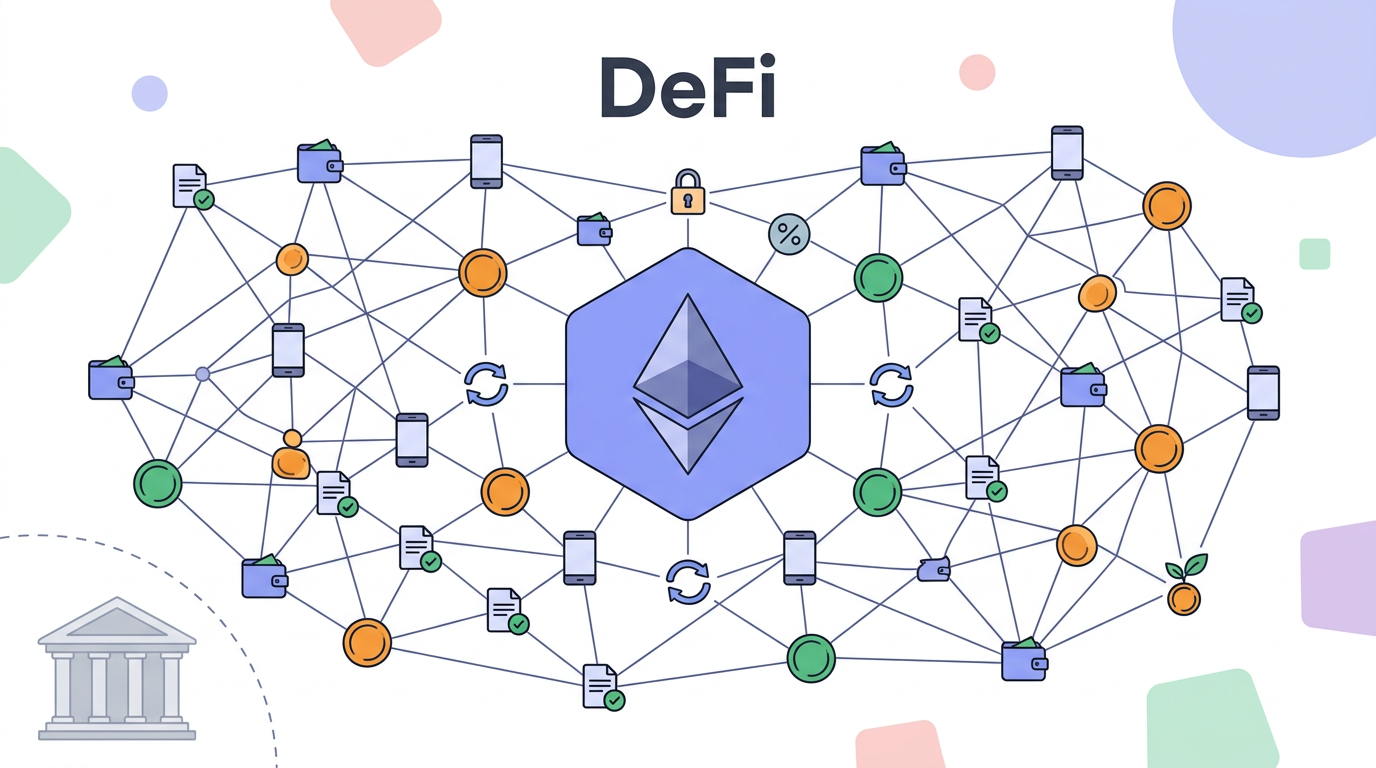
DeFi stands for Decentralized Finance. It is not one platform or a single product, but a category of financial protocols and applications that run on blockchains and execute preset rules automatically through smart contracts.
Traditional finance relies on banks, brokers and exchanges for account management, trade matching and settlement. DeFi moves part of those functions onto publicly verifiable blockchains and smart contracts. Users usually interact with protocols through a wallet, and trades and asset balances can be checked on-chain. That does not mean DeFi is risk-free, and it does not mean every DeFi project is equally decentralized.
If you want to dig into how DeFi differs from traditional finance in accounts, trading, custody and intermediation, you can read What is DeFi? Traditional Finance vs DeFi.
How does DeFi work?
The basic logic of DeFi is simple to describe: the blockchain provides the infrastructure, assets provide the capital, protocols provide the financial rules, and applications give users something to operate. Smart contracts handle trading, lending and swapping under preset conditions, while the blockchain records the results and the state of assets.
When a user swaps two tokens on a decentralized exchange, for example, the funds are not matched by a human at a counter; the user interacts with the relevant smart contract. Lending protocols work in a similar way: users can deposit assets under the protocol rules to become liquidity providers, or borrow other assets by meeting the collateral requirements.
DeFi therefore does not mean "no rules". The rules are largely implemented by code that runs in public, on-chain data and protocol mechanics. Bugs in code, oracle failures and thin liquidity can still cause losses.
What are the core DeFi use cases?
DeFi has grown into several connected categories of financial applications. The most fundamental are decentralized trading, lending, stablecoins and derivatives.
DEX (decentralized exchange) is mainly used for on-chain asset swaps: users exchange tokens through smart contracts. Unlike the traditional order-book model, some DEXs use automated market making, where a liquidity pool supplies the assets needed for trades.
DeFi lending lets users deposit assets and supply liquidity to a protocol, or borrow other assets under collateral rules. Borrowing usually requires collateral, so price moves can change the collateral ratio and may trigger liquidation.
Stablecoins are mainly used to reduce the impact of crypto price volatility on trading and settlement, and they are a base asset in many DeFi applications. Stablecoins are not risk-free: their peg mechanism, reserve structure, and issuance and redemption rules all need to be assessed separately.
Derivatives bring financial contracts on-chain, covering more complex scenarios such as perpetual futures and options. DeFi components are not isolated from each other: stablecoins can enter lending protocols, and borrowed assets may become part of DEX liquidity. This composability is a defining feature of the DeFi ecosystem.
If you want a systematic view of what DEXs, lending, stablecoins and derivatives each do, and how they work together, continue with Core DeFi Components: DEX, Lending, Stablecoins, Derivatives.
How do you judge DeFi ecosystem size and yields?
The two most common metrics for reading DeFi data are TVL and APY, but they answer completely different questions. TVL is closer to "how many assets are locked in the protocol", while APY expresses a yearly return calculated under a specific compounding assumption. They should not be mixed into a single verdict on whether a protocol is good or bad.
TVL (Total Value Locked) is usually used to measure the size of the assets in a DeFi protocol. Note that a high TVL only means the protocol holds a large amount of locked assets. On its own it does not prove that the protocol is safe, that yields are high, or that it will perform well in the future. Asset price changes, capital inflows and outflows, and the counting method can all affect TVL.
If you want to know what TVL means, how it is calculated and what to watch out for in practice, you can read What is TVL? A Key Metric for DeFi Protocols.
APY is the metric to focus on when reading yields. APR usually means a simple annual rate, while APY folds in the effect of compounding, so the same base rate can produce different APYs at different compounding frequencies. When you see a high APY, keep checking where the yield comes from, whether token rewards are involved, the term, market volatility and whether the principal is at risk. Do not look only at the annual number on the page.
For the difference between APR and APY and how they are calculated, read APY vs APR: How to Read DeFi Yields Correctly.
Why does DeFi carry risk?
DeFi risk mainly comes from smart contracts, oracles, market volatility, liquidity and the links between protocols. Because protocols can be combined, an anomaly in one underlying protocol can pass through collateral, lending and liquidity pools into other applications.
Smart contract risk is one of the most typical technical risks in DeFi. Even a protocol that has run for a long time cannot be assumed to be free of bugs. An oracle failure can feed a protocol incorrect price data, which then affects trades, collateral ratios or liquidation mechanics.
On top of that, fast price moves can lower the value of collateral, thin liquidity can raise trading costs or cause large slippage, and protocols that depend on each other create systemic risk. Judging DeFi risk therefore means looking beyond a single smart contract: protocol mechanics, assets, liquidity and external dependencies all matter.
If you want a systematic view of the different DeFi risks and how they arise, you can read What Are the Risks of DeFi? Smart Contracts, Oracles and Systemic Risk.
What should you watch for in DeFi security?
With DeFi, security is not only about which protocol you choose; it is also about how you behave. A mistake in any single step, such as the wallet address, the official website, the network, a smart contract approval or a transaction signature, can lead to asset losses.
Before you act, build a short checklist: confirm you are on the correct website, then verify the network and the receiving address; when approving, check who you are approving and how wide the allowance is; before signing, confirm what the transaction does; and avoid putting in a large amount when trying a new protocol for the first time. For unfamiliar projects, do not skip the basics because of a high yield or a limited-time reward.
DeFi transactions are usually strongly irreversible, so checking before you act matters more than fixing things afterwards. If you want to learn more about common DeFi attack methods and the precautions users can take, you can read DeFi Security: Common Attack Methods and How to Protect Yourself.
How did DeFi get to where it is today?
DeFi did not appear all at once. It expanded as stablecoins, decentralized trading and lending infrastructure matured step by step. Early protocols answered the question of whether assets could be used on-chain; the ecosystem then shifted towards capital efficiency, liquidity, yield mechanics and composability between protocols.
Understanding this history helps explain why today's protocols adopt different liquidity and incentive models. In particular, the path from early liquidity mining to protocol-owned liquidity reflects DeFi's ongoing search for an answer to how liquidity can be acquired and kept for the long term.
To learn how the ecosystem moved from early projects such as MakerDAO to the modern DeFi landscape, you can read The History of DeFi: From MakerDAO to a Trillion-Dollar Ecosystem.
What is DeFi 2.0?
DeFi 2.0 generally describes a set of mechanisms and protocols that try to fix the limits of the early DeFi model. It is not a unified technical standard. The discussion centres on capital efficiency, liquidity management, user experience and how protocols can reduce their reliance on short-term token incentives.
One important concept here is protocol-owned liquidity (POL). Traditional liquidity mining attracts outside capital with rewards, whereas protocol-owned liquidity has the protocol itself control part of the liquidity, reducing how quickly liquidity leaves when incentives decline.
DeFi 2.0 should therefore not be seen simply as an "upgraded version of DeFi". What matters more is understanding which improvements it proposes for the early DeFi economic model. For the specific mechanisms, read What is DeFi 2.0? Protocol-Owned Liquidity.
How should beginners approach DeFi?
For users new to DeFi, the most effective approach is not to study every protocol at once, but to build understanding in the order of concepts, components, metrics, risks and operations. Start with how DeFi differs from traditional finance, then work through core components such as DEXs, lending and stablecoins, then learn common metrics such as TVL, APR and APY, and only then move on to operating specific protocols.
When you actually take part in DeFi, first be clear about whether you are swapping assets, lending, borrowing or doing something else, and confirm the network, fees, slippage, collateral ratio and liquidation conditions in advance. Do not ignore principal risk because a protocol offers a high yield, and do not read past returns as a forecast of future results.
DeFi FAQ
Are DeFi and cryptocurrency the same thing?
No. Cryptocurrency mainly refers to digital assets on a blockchain, while DeFi is a set of financial protocols and applications built around those assets. Crypto assets can serve as the base assets of DeFi, but DeFi itself also covers different financial functions such as trading, lending, stablecoins and derivatives.
Is DeFi always safer than traditional finance?
Not necessarily. DeFi removes some traditional intermediaries, but it introduces new risks around smart contracts, oracles, wallet approvals and on-chain operations. Assessing safety means weighing technical, market, liquidity and operational risk together.
Is a DeFi protocol with higher TVL always better?
You cannot judge that way. TVL mainly reflects the size of the assets locked in a protocol. A higher TVL shows the protocol has a larger pool of capital, but it does not on its own prove that the protocol is safe, that yields are higher, or that risk is lower.
Does a higher APY always mean higher returns?
Not necessarily. APY is one way of expressing an annualized return, and the actual result is also affected by the price of the reward asset, changes in yield, compounding conditions, lock-up terms and principal volatility. When comparing yields, always confirm where the yield comes from and what risks come with it.
What is the difference between DeFi 2.0 and ordinary DeFi?
DeFi 2.0 usually emphasises improvements to the early DeFi model, such as better capital efficiency, better liquidity management and mechanisms such as protocol-owned liquidity. It is not a unified platform or a single product, and it should not be treated as a general label for every "new DeFi project".
Risk warning
DeFi is a high-risk area of crypto asset applications, exposing users to market volatility, thin liquidity, smart contract vulnerabilities, oracle failures, liquidation, de-pegging and user error. No yield, past performance or protocol size guarantees future results. Before taking part, make sure you understand the specific mechanisms and decide carefully based on your own risk tolerance.
If you are ready to learn how DeFi is used in practice, start from specific protocols and trading scenarios rather than deciding on the basis of yield or market hype alone.
Start exploring DeFi: https://www.hotcoin.com/
Recommended
View more