What Is DeFi? DeFi vs Traditional Finance Compared
DeFi is a decentralized financial system built on blockchains and smart contracts. It moves part of the financial services we know, such as trading, lending, and asset swapping, onto the chain. Compared with traditional finance, the key difference is not simply whether a bank sits in the middle, but who controls the money, who executes the trade, how users get access, and who carries the risk.
1. What exactly is DeFi?
DeFi is short for Decentralized Finance: financial applications and protocols built on blockchains and smart contracts.
Traditional finance usually relies on banks, brokers, and exchanges to provide accounts, custody, trading, lending, and settlement. DeFi tries to turn some of those functions into smart contracts that run on a blockchain.
A simple way to picture it:
Traditional finance: user → financial institution → financial service
DeFi: user → blockchain wallet → smart contract → financial service
A bank loan, for example, usually requires opening an account, passing identity checks, going through a credit assessment, and waiting for manual or system approval. With some DeFi lending protocols, a user can connect a wallet, post collateral under the protocol's rules, and borrow other assets, with the terms set by the smart contract and protocol parameters.
That said, decentralization does not mean DeFi has no centralized elements at all. A given protocol may still depend on a development team, governance mechanisms, oracles, the underlying blockchain network, and other infrastructure. So a project is not decentralized simply because "DeFi" appears in its name.
2. How is DeFi different from traditional finance?
Both traditional finance and DeFi can offer trading, lending, and asset management, but they operate in different ways.

Note that this table compares the typical operating models of the two systems. It does not mean every traditional institution or every DeFi protocol matches each point exactly.
To really understand the difference, it helps to break it down into money, execution, access, and information.
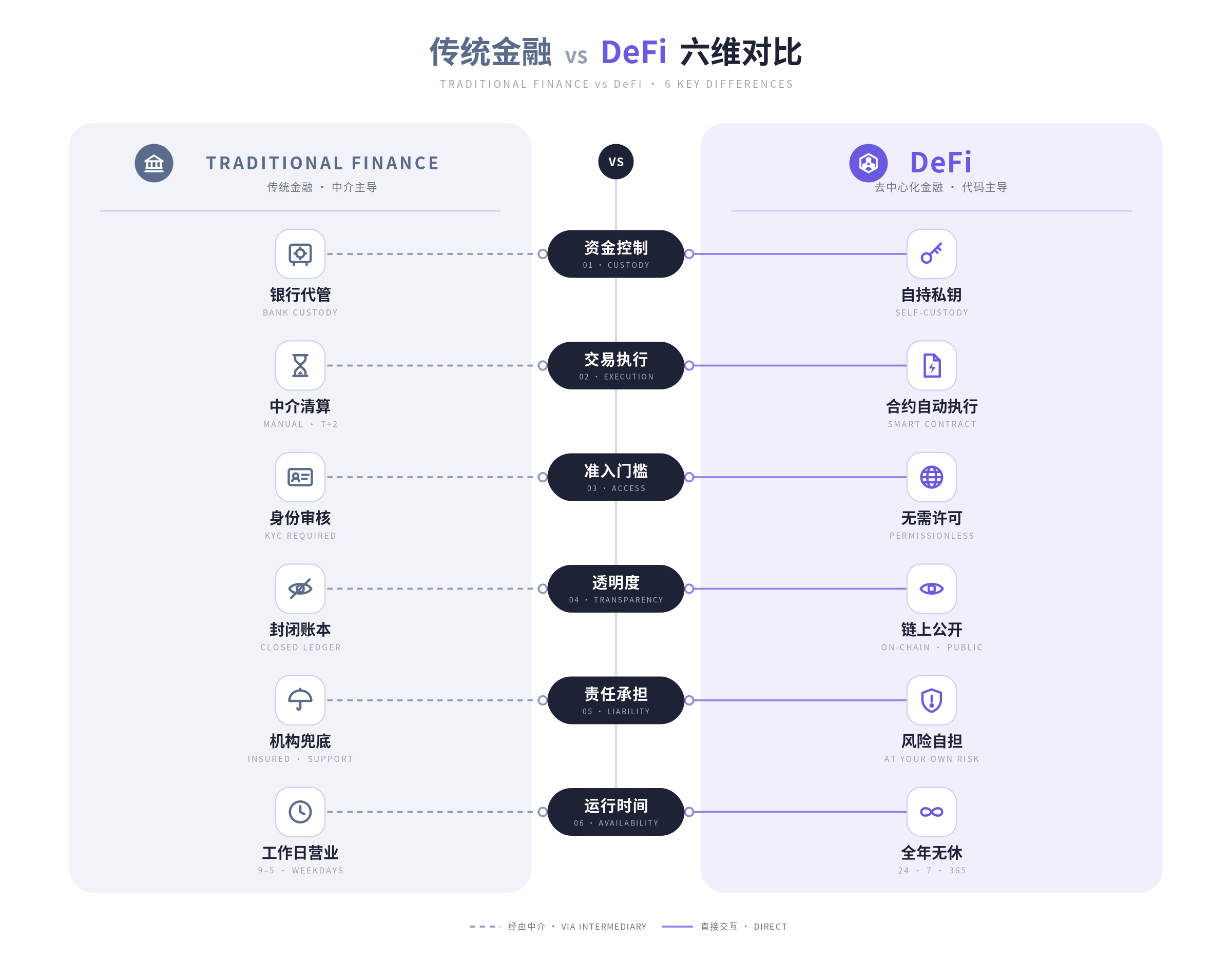
3. Who controls the money? The most visible difference
In traditional finance, user funds typically sit inside accounts provided by a bank, broker, exchange, or another institution.
When you deposit money at a bank, what you hold is a claim on the bank, not direct control over a particular bundle of cash in its vault. The institution handles safekeeping, account management, and transaction execution.
The typical DeFi model works differently.
Users usually manage their own assets through a blockchain wallet. To interact with a DeFi protocol, they must authorize or transfer assets according to the rules of the smart contract.
This gives users more direct control over their assets, but it also means more responsibility lands on the user.
A lost private key, a bad approval, a transfer on the wrong network, or an interaction with a malicious contract can all lead to losses.
So self-custody does not automatically mean better security. A more accurate reading is this:
Users gain greater control over their assets and take on more responsibility for managing them.
4. Who executes the trade? Why DeFi has no traditional traders
Trading in traditional markets usually depends on exchanges, brokers, market makers, and other institutions providing matching, clearing, and settlement infrastructure.
DeFi can instead use smart contracts to execute rules that were set in advance.
Take decentralized trading as an example. Some DEXs use an automated market maker mechanism. Once a user submits a trade, the smart contract calculates the result from the assets in the liquidity pool and the defined algorithm, then completes the swap.
That leads to an important shift:
Trading rules no longer depend entirely on the manual work of an institution. They can be executed by public program logic.
But it also means the smart contract itself becomes a new source of risk.
If the contract has a flaw, or if the protocol parameters are poorly designed, the whole process can still run automatically and still cause serious losses.
DeFi therefore is not a world where removing intermediaries removes risk. It shifts part of the trust that traditional finance places in institutions onto code, protocol rules, and underlying infrastructure.
5. Why does DeFi look more "open"?
Traditional finance usually applies clear access requirements.
To open a bank or brokerage account, or to use other financial services, users generally need to register, complete identity verification, and meet the relevant business conditions.
Many DeFi protocols take a more open approach.
As long as the blockchain network and protocol requirements are met, users can usually interact with a protocol directly through a compatible wallet, without first opening a conventional financial account.
This is the "open access" that DeFi often highlights.
But keep in mind:
Open access does not mean there are no rules.
DeFi protocols can still impose asset requirements, collateral ratios, trading limits, and network requirements. On top of that, different countries and regions may apply different laws and regulatory requirements to digital assets and related services.
So when judging whether a DeFi service suits you, do not reduce it to "connect a wallet and use it however you like".
6. Why is DeFi considered more transparent?
Another important trait of DeFi is that a great deal of activity happens on public blockchains.
A transaction on-chain can usually be checked for its address, block, and asset transfers. Interactions with smart contracts can also be traced through blockchain explorers.
By contrast, much of the account information, internal risk-control logic, and business data at traditional institutions is not fully open to the public.
Two concepts are worth separating here:
On-chain public ≠ everything is transparent.
A blockchain can publicly record transactions and asset movements, but a user's real identity, the internal decisions of a protocol team, some off-chain assets, and complex risk exposures cannot always be fully judged from on-chain data alone.
So DeFi's transparency mainly means this:
Transactions and asset movements are highly verifiable, not that the entire financial system has no blind spots.
7. Is DeFi safer than traditional finance?
That conclusion does not follow automatically.
DeFi reduces part of the reliance on traditional institutions while introducing new types of risk.
The main risks of traditional finance can include institutional operating risk, credit risk, operational risk, and liquidity risk. Beyond market and liquidity risk, DeFi may also face smart contract exploits, oracle failures, private key management mistakes, governance attacks, and blockchain infrastructure risk.
The difference is better described this way:
Risk does not disappear. It moves and gets redistributed.
For example:
In traditional finance, users may lean more on an institution's risk control and asset management capabilities.
In DeFi, users need to watch more closely for:
Whether the smart contract has vulnerabilities;
Which oracle the protocol uses;
Whether liquidity is sufficient;
How the liquidation mechanism works;
Who holds administrative permissions;
Whether wallet approvals are safe.
As a result, decentralization on its own cannot serve as a measure of safety.
8. What are DeFi's advantages and limits?
Main advantages of DeFi
First, greater openness.
Many DeFi protocols let users take part directly through a wallet, without going through the account systems of traditional institutions.
Second, more direct control over assets.
Under a self-custody model, users control the assets in their wallet rather than relying entirely on a third party.
Third, rules are highly verifiable.
Smart contracts execute as programmed, and many transactions and asset movements can be checked publicly on-chain.
Fourth, strong composability.
Different DeFi protocols can be combined through smart contracts. An asset produced by one protocol can become a trading asset, collateral, or source of liquidity in another.
Main limits of DeFi
First, the learning curve is not necessarily low.
Wallets, private keys, Gas, networks, and approvals all add to the learning cost for new users.
Second, users carry more operational responsibility.
In traditional finance, a mistaken transfer or an unusual account state can usually be resolved by contacting the institution. Some on-chain actions in DeFi are irreversible, and mistakes can be very hard to undo.
Third, smart contracts carry technical risk.
Code running automatically does not prove the code is correct.
Fourth, market volatility and liquidity risk remain.
DeFi does not remove price swings in digital assets, and it cannot guarantee that users can trade or exit at their expected price at any moment.
9. How should beginners think about DeFi and traditional finance?
If you just want a quick way to tell them apart, remember these five questions:
1. Who controls my money?
Traditional finance usually provides custody and account services through institutions. DeFi leans toward user self-custody.
2. Who executes my trades?
Traditional finance relies mainly on institutions and trading systems. DeFi relies more on smart contracts.
3. Who decides whether I can use it?
Traditional finance normally has clear account and identity requirements. Many DeFi protocols offer open access, but they still have their own protocol rules and legal compliance boundaries.
4. How much information can I see?
On-chain transactions and asset movements in DeFi are usually easy to look up, but that does not mean all related information is public.
5. Who is responsible when something goes wrong?
This is the question most often overlooked.
In traditional finance, institutions usually carry more of the operational and service responsibility. In DeFi, users may have to bear the risks of private keys, approvals, smart contracts, and trading operations themselves.
If you want to understand how DeFi grew into today's ecosystem, continue with DeFi History: From MakerDAO to a Trillion-Dollar Ecosystem, which follows MakerDAO, DEXs, lending, and DeFi Summer to show how these building blocks developed step by step.
10. DeFi and traditional finance: not a simple case of one replacing the other
The rise of DeFi does not mean traditional finance will disappear overnight.
The problems they solve, the users they serve, and the environments they run in still differ clearly.
Traditional finance has mature legal systems, institutions, customer service, and risk management. DeFi offers different answers around open access, self-custody, on-chain transparency, and composability.
So the more accurate framing is not:
Traditional finance = the old model, DeFi = the new model.
It is this:
Two different financial infrastructures that make different design choices about control of funds, trade execution, access, and who bears risk.
For ordinary users, the real question is not whether DeFi is always better, but which model a given financial service uses, whether you understand its rules, and whether you can carry the risk that comes with it.
FAQ: Common questions about DeFi and traditional finance
Does DeFi have no banks or financial institutions at all?
Not necessarily. The core of DeFi is providing part of financial services through blockchains and smart contracts, but the wider ecosystem may still rely on centralized exchanges, stablecoin issuers, oracle providers, blockchain development teams, and other infrastructure. So decentralization does not mean the whole system has no centralized players.
Are DeFi and DEX the same thing?
No. A DEX is one type of application in the DeFi ecosystem, used mainly for decentralized asset trading. DeFi also covers lending, stablecoins, derivatives, and more. DEXs are only one piece.
Do I always need a wallet to use DeFi?
Most scenarios where you interact directly with an on-chain DeFi protocol require a compatible wallet, because the wallet manages your on-chain address and assets and signs transactions. The exact method varies by protocol and product.
Why can DeFi complete trades automatically?
Because many DeFi services are delivered by smart contracts. A smart contract processes trades, asset transfers, or other actions according to pre-set program rules, which removes some manual intermediary steps.
What is the biggest risk in DeFi?
No single risk applies to every DeFi protocol. Common risks include smart contract exploits, market price swings, insufficient liquidity, oracle failures, liquidation risk, private key management mistakes, and governance risk. The specific risk depends on how a protocol is built.
Are DeFi yields higher than traditional finance?
They cannot be compared that simply, and a higher nominal yield should not be read as a higher real return. Part of the high yield in DeFi comes from token incentives or from mechanisms that carry more risk. A headline yield does not represent an investment outcome.
Risk Notice
DeFi is a high-risk area of digital asset applications. Protocols differ widely in technical architecture, asset mechanisms, liquidity, and governance. Users may face market volatility, insufficient liquidity, smart contract exploits, oracle failures, liquidation, private key management issues, and other infrastructure risks.
This article is intended to help readers understand how DeFi and traditional finance differ in their operating mechanisms. It does not constitute investment, trading, or asset allocation advice. Before using any protocol or trading digital assets, make sure you fully understand the product rules and the potential for loss.
Recommended
View more