What Is a Bond? Understanding Yields, US Treasuries, and Bitcoin
When the news says "Treasury yields are rising," you might think bondholders are earning more—yet bond funds are falling. The issue is that "interest" and "yield" are not the same thing.
A bond is essentially a loan contract. Understanding how it is priced can also help you read the interest rates, dollar, and capital flows often mentioned in crypto markets. This article starts from the most basic concepts, then explains why US Treasuries and Bitcoin sometimes rise together and sometimes move in opposite directions.
Key Takeaways
- Buying a bond is like lending money to the issuer, receiving interest and principal as agreed, but you may still bear default risk.
- The market price and yield of fixed-rate bonds usually move in opposite directions.
- Coupon rate, current yield, and yield to maturity measure different things and are not interchangeable.
- Treasury yields affect the opportunity cost of capital, but cannot predict Bitcoin's rise or fall on their own.
What Is a Bond
A bond is a debt instrument issued by governments, companies, and other issuers to raise financing. Once you buy it, you hold a creditor claim, not an equity stake in the company. The issuer must pay interest according to the terms and repay the agreed principal at maturity; instruments such as zero-coupon bonds have different cash flow arrangements.
For example, a company issues a bond with a face value of $1,000, an annual coupon rate of 4%, and a 5-year term. Assuming annual coupon payments and no default, the holder receives $40 each year and recovers the $1,000 principal at maturity. If you sell before maturity, the transaction price may be higher or lower than your purchase price.
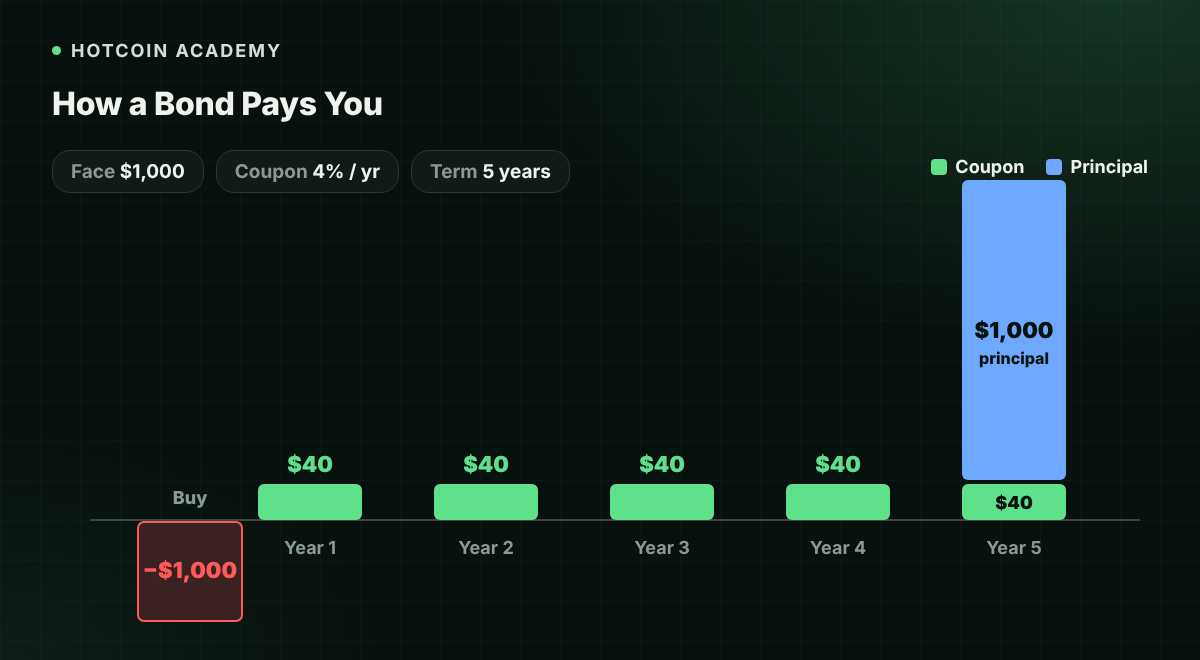
| Term | Meaning | Value in this example |
|---|---|---|
| Face value | The principal basis repaid per the terms at maturity | $1,000 |
| Coupon rate | The agreed interest ratio calculated on face value | 4% per year |
| Market price | The actual buy/sell price in the secondary market | Changes with the market |
| Maturity date | The date the principal is agreed to be repaid | Year 5 after issuance |
How to Read Bond Yields
Yield is also called "yield rate," but this name covers several different calculation methods.
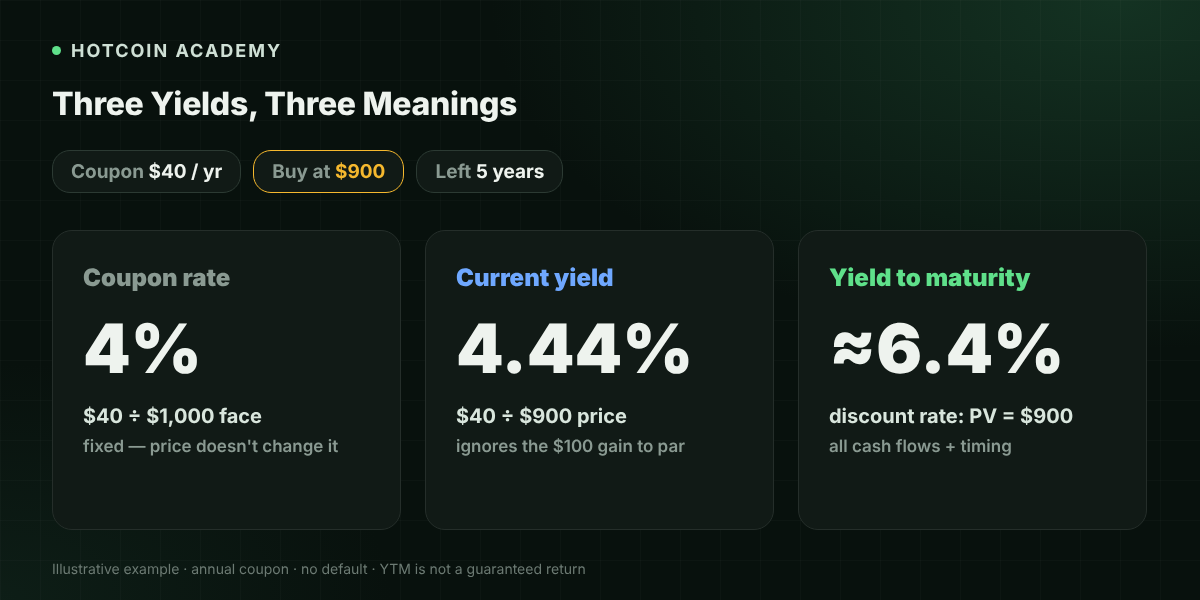
The coupon rate determines the agreed interest of a fixed-rate bond. In the example above, $40 is paid each year, and it does not automatically increase just because the market price falls to $900.
The current yield equals the annual coupon divided by the current price. If bought at $900, the current yield is approximately 40 ÷ 900 = 4.44%. It does not fully account for the difference between the purchase price and the principal at maturity, nor does it reflect the timing of cash flows.
The yield to maturity (YTM) is the discount rate that makes the present value of future agreed cash flows equal to the current price. Actual returns are also affected by default, reinvestment, transaction fees, and other factors; the YTM on screen should not be treated as an unconditional guarantee.
Why Do Bond Prices Fall When Treasury Yields Rise
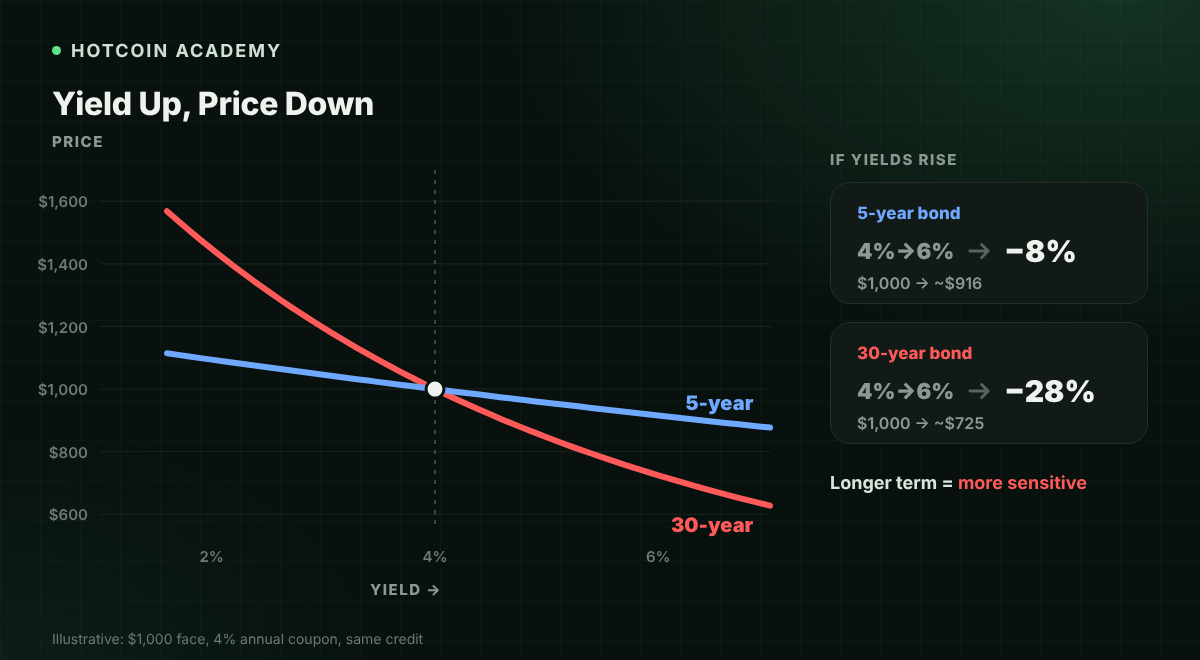
Suppose the old bond you hold pays $40 per year, while a new bond with the same term and credit conditions offers higher interest. For the old bond to attract buyers, its market price usually needs to fall. Buyers obtain the same coupon at a lower price, and the calculated yield rises.
Illustration of the inverse relationship between fixed-rate bond prices and yields
This is the interest rate risk of fixed-rate bonds. The same interest rate change affects different bonds differently: when other conditions are similar, bonds with longer remaining terms and lower coupon rates are usually more price-sensitive. Holding to maturity can reduce the price uncertainty of selling early, but cannot eliminate default, inflation, and opportunity costs.
How Are US Treasuries and Bitcoin Related
US Treasuries are debt instruments issued by the US government. When analyzing their impact on Bitcoin, the key is to distinguish why yields are changing, not just the direction.
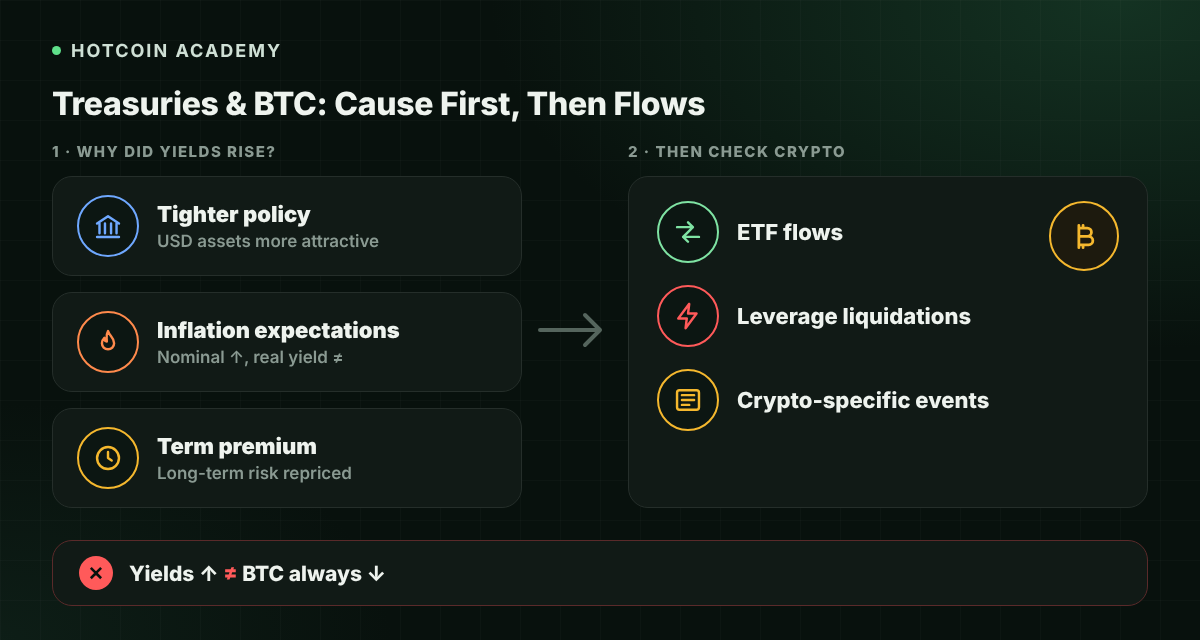
Below is an analytical framework for understanding the market, not a fixed causal formula: when the market expects tighter monetary policy, the appeal of holding dollar assets may increase, and risk asset valuations may come under pressure; when inflation expectations rise, nominal yields may rise, but real yields may not rise in tandem. Bitcoin is also affected by ETF flows, leverage liquidations, and crypto market events.
| Observation | What it mainly reflects | Limitations when reading it |
|---|---|---|
| Short-term Treasury yields | Expectations for near-term policy rates, etc. | Does not mean the central bank has already acted |
| Long-term Treasury yields | Growth, inflation, and term compensation, etc. | Cannot be attributed solely to rate hikes |
| Real yields | The interest rate dimension after deducting inflation compensation | Not a simple substitute for nominal yield minus the current month's CPI |
| BTC funding and leverage data | Supply and demand within the crypto market | May overshadow macro influences |
Understanding Treasuries and Bitcoin: look at the cause first, then flows and risk
Therefore, "Treasury yields rise, so BTC must fall" is too simplistic. A more useful question is: does this change come from policy expectations, inflation, or the market repricing the risk of holding long-term debt?
How Beginners Can Read Bond Market Information
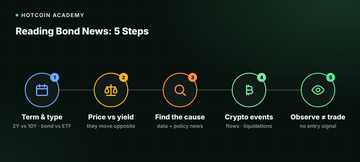
- Confirm the term and instrument type. Two-year and ten-year Treasuries, individual bonds and bond ETFs, cannot be treated as the same object.
- Distinguish price from yield. "Yields rising" in reports does not mean old bond prices are rising.
- Look at the cause of the change. Read economic data and policy news together, and avoid drawing conclusions from a single market screenshot.
- Then check whether BTC has independent events. Large capital inflows and outflows, trading platform events, or concentrated liquidations can all change short-term trends.
- Separate observation from trading. Even if a macro judgment is directionally correct, it cannot directly provide entry and exit timing.
Common Misconceptions
- "Government bonds can't lose money." Government credit and market price are two different things; selling early can still result in a loss.
- "Bond ETFs return principal at maturity." Ordinary bond ETFs continuously hold and adjust assets and are not equivalent to a single fixed-maturity bond; target-maturity products also have their own terms.
- "The higher the yield, the better the deal." Higher yields may correspond to higher credit risk, liquidity risk, or longer duration.
FAQ
Q1: What is the difference between bonds and stocks? Bonds represent creditor claims, while stocks represent ownership. Bond cash flows depend on contracts and repayment capacity, while stock returns are related to business operations, dividends, and market pricing.
Q2: Is the Treasury yield the same as the Fed rate? No. The former is determined by the market price of the corresponding bond, while the latter is the rate target or administered rate corresponding to monetary policy tools.
Q3: Does a 5% current yield mean earning 5% in a year? No. It only calculates the ratio of coupon to current price and does not cover price changes, fees, or reinvestment effects.
Q4: Do bonds definitely rise after a rate cut? Not necessarily. The market may have already priced in the rate cut, and actual trends are also affected by inflation, term compensation, and credit changes.
Q5: Can Treasury yields determine Bitcoin's buying points? Not on their own. They can help understand the macro environment, but specific market moves still need to be combined with crypto market supply and demand and your own risk constraints.
Conclusion
To understand bonds, first separate principal, coupon, price, and yield. When looking at Treasuries and Bitcoin, the key is the reason behind yield changes and whether those changes have been transmitted to risk assets.
Risk warning: This article is for educational and informational reference only and does not constitute investment advice. Both bonds and crypto assets involve risk, and investments involving foreign currencies may also incur exchange rate losses.
Recommended
View more