What Is Maintenance Margin? Formula, Examples, and Margin Calls
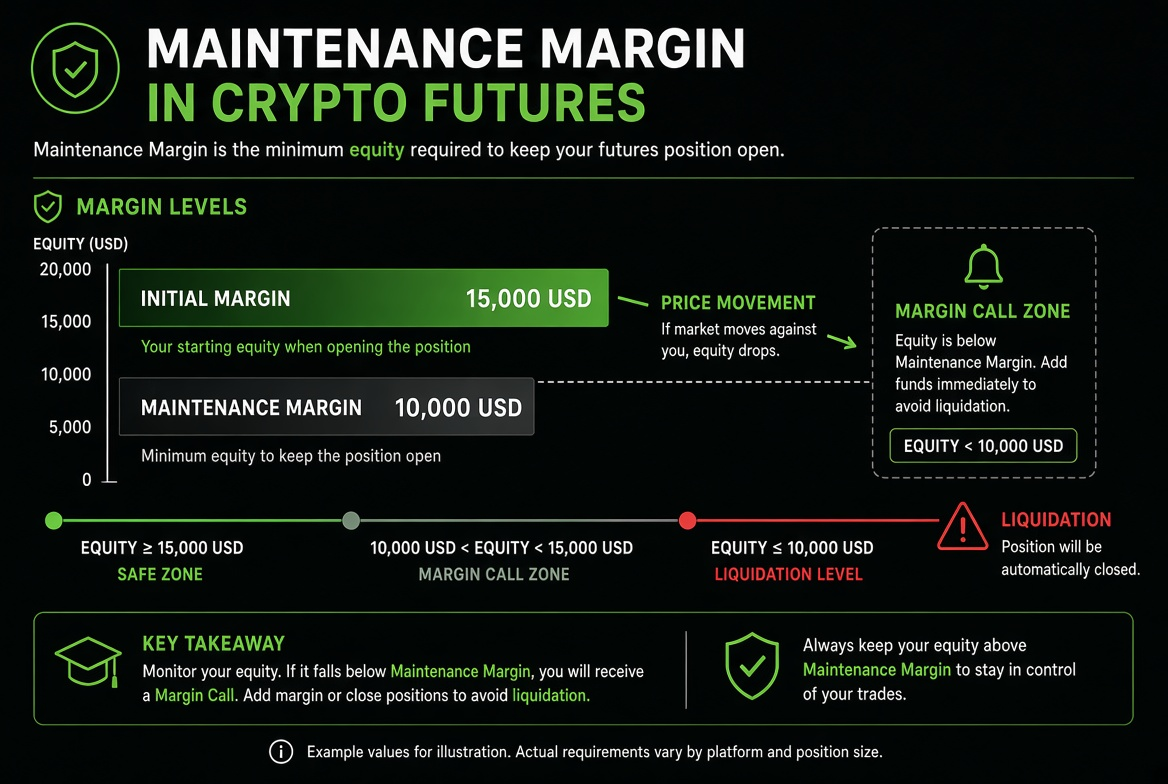
Maintenance margin is the minimum margin level required to keep a position open in futures trading. Once your account equity falls below that level, a margin call or a forced liquidation is triggered.
In crypto futures and traditional futures trading, maintenance margin is a core risk-control concept. It determines how much adverse price movement your position can absorb, and it directly decides whether the position gets liquidated. The sections below use clear formulas, a worked example and practical suggestions to explain what maintenance margin is, how it is calculated, and how to respond to a margin call.
What Is Maintenance Margin
Maintenance margin is the minimum margin amount or ratio that the exchange requires your account to hold while a position is open.
Initial margin: the margin you must deposit to open a position.
Maintenance margin: the minimum requirement your account equity must not fall below while the position is held.
When the market moves against you and account equity drops below the maintenance margin level, the system issues a margin call, or starts forced liquidation directly, to stop losses from growing further.
Put simply: initial margin is the entry threshold, while maintenance margin is the line that keeps the position alive.
Maintenance Margin Formulas
Exchanges differ slightly in their exact parameters, but the core logic is the same. Common calculation methods:
Ratio-based (most common) Maintenance margin = Position notional value × Maintenance margin rate
Relationship to initial margin On most platforms the maintenance margin rate is lower than the initial margin rate. For example:
Initial margin rate: 1% (equivalent to 100x leverage)
Maintenance margin rate: 0.5%
- Simplified liquidation price formula For a long position, the liquidation price roughly satisfies: (Entry price − Liquidation price) × Position size ≈ Initial margin − Maintenance margin − Fees, etc.
The actual calculation also needs to account for:
Cross margin / isolated margin mode
Funding rates
Maintenance margin rate tiers (larger positions may carry higher requirements)
Fees and liquidation penalties
It is best to use the exchange's contract calculator: enter the entry price, leverage and position direction to see the estimated liquidation price and maintenance margin requirement.
A Worked Example
Assume a BTC perpetual contract on an exchange:
Entry price: 80,000 USDT
Position: 1 BTC (notional value 80,000 USDT)
Leverage: 20x
Initial margin rate: 5% → Initial margin = 4,000 USDT
Maintenance margin rate: 2.5% → Maintenance margin = 2,000 USDT
When account equity approaches or falls below 2,000 USDT because of a price decline, a margin call or forced liquidation is triggered.
The corresponding liquidation price sits noticeably below the entry price at some level (use a calculator for the exact figure).
If you add margin and equity recovers above the maintenance margin, the position can stay open; otherwise the system force-closes it to control risk.
Maintenance Margin and Margin Calls
A margin call is the risk warning an exchange issues when account equity approaches or breaks below the maintenance margin.
Common ways to respond:
Add margin: transfer in more funds to raise account equity.
Reduce the position: actively cut size to lower the maintenance margin requirement.
Set a stop-loss: close the position before it reaches the liquidation price instead of being force-closed.
Keep in mind that crypto futures are highly volatile, and many platforms move straight into liquidation once equity drops below the maintenance margin, leaving very little time to react. Do not rely on handling things only after the margin call arrives — keep a sufficient buffer in advance.
Cross Margin vs Isolated Margin
Isolated margin: maintenance margin applies only to that position, risk is contained, and a liquidation does not affect other positions.
Cross margin: the whole account balance shares the risk, maintenance margin calculations are more complex, and the loss on one position can drag down the entire account.
Beginners are usually advised to start with isolated margin, so each position's risk can be controlled separately.
Practical Tips and Risk Control
Check the liquidation price and maintenance margin level with a calculator before opening a position.
Keep enough of a safety margin and avoid maxing out your leverage.
Lower your position size or leverage during highly volatile periods.
Set a stop-loss instead of passively waiting for liquidation.
Regularly check the distance between account equity and the maintenance margin.
Risk warning: Futures trading is high risk and can lead to the loss of all your capital. The maintenance margin mechanism is a risk-control tool used by exchanges, not a guarantee of profit. Calculator and formula results are estimates only; the actual liquidation price may differ because of funding rates, mark price, liquidity and other factors. Only trade with funds you can afford to lose, and make sure you fully understand the specific rules of the platform you use.
FAQ
Q1: What is the difference between maintenance margin and initial margin? A: Initial margin is the amount you must deposit to open a position; maintenance margin is the minimum equity requirement while holding it. The first decides whether you can open, the second whether you can keep holding.
Q2: Why was my position liquidated? A: When account equity falls below the maintenance margin level, the exchange force-closes part or all of the position to prevent losses from growing.
Q3: How can I reduce the risk of liquidation? A: Use lower leverage, smaller positions, extra margin and stop-loss orders, and avoid holding heavy positions during extreme volatility.
Q4: How is maintenance margin calculated in cross margin mode? A: In cross margin the system calculates across all positions and the account balance together. The exchange's live display is the reference, so use the official calculator.
Q5: Do I have to add funds immediately after a margin call? A: Not necessarily, but without adding margin or reducing the position, it will very likely be liquidated soon. The faster you react, the more control you keep.
By now you should have a clear picture of what maintenance margin is, how it is calculated, a worked example, and how to respond to a margin call. Confirm the maintenance margin level and liquidation price before every position you open, and put risk control ahead of profit expectations. Markets carry risk, and discipline is the key to long-term survival.
Recommended
View more