Bitcoin and Ethereum: A Complete Guide to Crypto's Two Giants
Bitcoin and Ethereum are the two most representative networks in cryptocurrency, but they are not two brands of the same product.
Bitcoin set out to solve peer-to-peer value transfer and double spending on an open network. It uses fixed rules, proof of work, and limited issuance to create a digital asset without a central issuer. Ethereum expands the blockchain into a programmable state machine on which developers can deploy smart contracts, tokens, and decentralized applications.
BTC is the native asset of the Bitcoin network. It primarily supports value transfer, transaction fees, and network incentives. ETH is Ethereum's native asset. It pays for gas, helps secure proof of stake, and serves as collateral and a settlement asset across many on-chain applications.
Both networks use public ledgers and cryptographic signatures, and both let users hold their own keys. Their transaction models, consensus systems, issuance policies, upgrade processes, scaling paths, and risk structures are nevertheless very different. Calling ETH simply “a faster Bitcoin,” or BTC “old technology without smart contracts,” misses their actual design goals.
This guide brings together six supporting topics: Bitcoin fundamentals, mining and issuance, halvings, Ethereum and smart contracts, Ethereum's transition to PoS, and the core differences between BTC and ETH. It is based on protocol and project sources available through August 27, 2026, and avoids fast-changing spot prices, market-cap rankings, and yield figures.
Why are Bitcoin and Ethereum called crypto's two giants?
First, they established the industry's two most important technical directions. Bitcoin showed that an open network can maintain a scarce digital asset; Ethereum showed that a similar ledger can execute general-purpose programs.
Second, both have long operating histories, open-source clients, globally distributed nodes, developers, wallets, custody providers, exchanges, and data infrastructure. Maturity does not eliminate risk, but it provides more public evidence for research.
Third, BTC and ETH play different benchmark roles. Many investors use BTC to gauge risk appetite across crypto assets and ETH to observe activity in smart contracts, DeFi, stablecoins, NFTs, and Layer 2 networks.
Fourth, many other networks are attempts to answer questions raised by Bitcoin and Ethereum: how to create credible scarcity, let more people verify a ledger, improve throughput, support complex applications, and balance security with upgrades.
“Two giants” is not a return guarantee and does not mean they will lead forever. It simply means that understanding these networks is one of the most efficient foundations for entering the crypto industry.
What is Bitcoin?
Bitcoin is an open-source peer-to-peer network and the native digital asset recorded and issued under that network's rules. Instead of a central bank account database, nodes validate blocks and transactions while proof of work orders the history.
Satoshi Nakamoto published the white paper in October 2008, and the Bitcoin network began operating in January 2009. Its breakthrough was not being the first cryptographic digital money. It combined peer-to-peer networking, timestamps, proof of work, and economic incentives to address double spending in an open environment.
Anyone can run a full node and verify whether received blocks follow the rules. Miners propose candidate blocks, but nodes do not accept blocks that violate supply limits, signature requirements, or transaction rules merely because miners spent computing power on them.
BTC is not a physical coin. A wallet's balance comes from a set of unspent transaction outputs that its keys can spend. A user signs with a private key to prove the right to spend the corresponding assets.
For a ground-up introduction to the blockchain, UTXOs, private keys, confirmations, and Bitcoin's value logic, read What Is Bitcoin? An Introduction to BTC's Design and Value.
How does Bitcoin record balances? The UTXO model
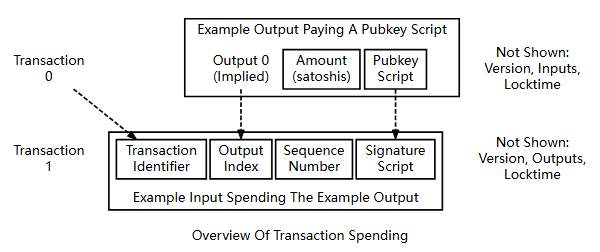
Bitcoin uses the Unspent Transaction Output model. Each transaction references previous UTXOs as inputs and creates new outputs.
If a wallet shows 0.5 BTC, that figure is usually not a single number in an account database. It is the sum of multiple UTXOs spendable by the wallet's keys.
The total value of the inputs must cover the outputs and the fee. If the inputs exceed the payment, the wallet normally creates a change output back to itself. Without correct change, the remainder may be treated as a miner fee.
A UTXO can be spent only once. Nodes verify that the referenced output exists, remains unspent, and satisfies its unlocking conditions and signature requirements, preventing the same asset from being reused.
The number of UTXOs affects transaction size. Spending many small UTXOs may take more block space than spending one large output, so fees are not determined solely by the amount transferred.
What are Bitcoin addresses, private keys, and wallets?
A private key is secret information used to create valid signatures. Public keys and addresses are derived within the key system and are used to define receiving and spending conditions.
Addresses may be shared, but private keys and seed phrases must remain secret. The Bitcoin network cannot reassign keys when a user forgets a password or reverse an attacker's transaction after checking a real-world identity.
A wallet is software or hardware that manages keys, addresses, UTXOs, and transactions. Assets are recorded on the blockchain; switching wallet interfaces does not itself move them.
A custodial platform controls on-chain keys for users, who access funds through accounts and platform rules. A self-custody wallet lets the user sign directly, while also transferring responsibility for backup, verification, and inheritance to that user.
Beginners should choose wallets through official sources, keep offline seed backups, secure their devices, and test sending, receiving, and recovery with small amounts first.
How does a Bitcoin transaction receive confirmations?
The sender's wallet selects UTXOs, creates outputs, estimates a fee, signs the transaction, and broadcasts it to the peer-to-peer network.
After validation, nodes may hold the transaction in their mempools. Miners select transactions, build candidate blocks, and perform proof-of-work calculations.
When the network accepts a valid block, the transaction receives its first confirmation. Each later block built on top makes replacement harder because rewriting the transaction would require redoing an increasing amount of work.
Confirmation is not an absolute time promise. Block production is probabilistic, low-fee transactions may wait longer, and individual nodes may apply different mempool policies.
A platform may also require a certain number of confirmations and internal review before crediting funds. A block explorer showing “confirmed” does not guarantee recovery from a wrong network, wrong platform address, or missing required information.
How does Bitcoin mining protect the network?
Miners repeatedly hash block-header data with changing values, trying to find a result below the current target. A successful miner earns the opportunity to propose a block.
Proof of work gives block creation a real computational cost. An attacker attempting to rewrite history must continuously obtain enough hash power and compete with the honest network.
The protocol adjusts difficulty periodically so the average block pace returns toward its target after hash-rate changes. More miners do not make Bitcoin issue coins faster over the long term; they increase competition and difficulty.
Mining pools combine many miners' hash power and distribute income under agreed rules. Pool concentration deserves scrutiny, but miners, pool operators, and full nodes are different roles. Nodes continue to verify block rules independently.
Mining revenue consists of the block subsidy and transaction fees. As the subsidy halves, fees are expected to become relatively more important to the long-term security budget.
For more on mining hardware, hash rate, difficulty, pools, block subsidies, and fees, see How Is Bitcoin Created? Mining and Issuance Explained.
Why is BTC issued?
Bitcoin did not allocate its entire supply to a founding team at launch. New BTC is released to miners through the coinbase transaction in a valid block.
This issuance does two jobs: it compensates security providers during the early period before a broad fee market exists, and it distributes new assets according to a public, verifiable schedule.
The block reward includes the block subsidy and transaction fees. The subsidy is newly issued BTC; fees come from user transactions and should not be confused with issuance.
Nodes enforce the issuance rules. Miners cannot raise the subsidy themselves because other nodes reject blocks that violate the rules.
Bitcoin's protocol limit is close to 21 million coins, while the amount actually available may be lower because of lost keys, mistaken transfers, and long-dormant holdings.
What is a Bitcoin halving?
After every 210,000 Bitcoin blocks, the block subsidy is cut in half. Because block timing varies, halvings occur roughly every four years, but the exact date can only be estimated.
The subsidy began at 50 BTC per block in 2009 and has declined in steps. After the 2024 halving, the current subsidy is 3.125 BTC per block. The next reduction will happen automatically when the relevant future block height is reached.
A halving changes the rate of new supply. It does not reduce BTC already in circulation or halve users' wallet balances.
Miners receive BTC revenue while paying for electricity, equipment, facilities, and financing. If price, fees, and efficiency are insufficient after a halving, high-cost miners may shut down or restructure.
Markets often discuss halvings in advance. Prices are also affected by liquidity, the macro environment, leverage, regulation, and demand. Historical cycles cannot prove that the future will rise on the same schedule or by the same magnitude.

For a focused review of the four historical halvings, supply shocks, mining economics, and common price misconceptions, read What Is the Bitcoin Halving? History and Market Effects.
Why is Bitcoin called digital gold?
“Digital gold” is a market analogy for some Bitcoin characteristics, not a legal classification or value guarantee.
The narrative points to transparent supply rules, a protocol cap, global transferability, divisibility, self-custody, and the absence of dependence on a single issuer's solvency.
BTC's value also depends on network security, node validation, mining economics, market liquidity, infrastructure, and social consensus. Scarcity is only one necessary part of the discussion and cannot create demand on its own.
Bitcoin also differs from physical gold. It relies on the internet, software, and cryptography; losing a private key can mean losing control; its price history is shorter and generally more volatile.
Anyone treating Bitcoin as a store of value should also assess entry valuation, custody, inheritance, regulation, liquidity, and extreme technical risks.
Is Bitcoin only for payments?
Bitcoin's core design focuses on value transfer and settlement, but its scripting system can express multisignature arrangements, timelocks, and other spending conditions.
Upgrades such as SegWit and Taproot improved transaction structure, efficiency, or script expressiveness. A proposed technical improvement is not necessarily adopted: users should distinguish BIP drafts, software support, miner signaling, and consensus activation.
The Lightning Network uses payment channels to process many small transactions off-chain and settle results back to Bitcoin. It can improve speed and reduce some fees, but adds channel-liquidity, routing, online-management, and implementation risks.
The Bitcoin ecosystem can also carry data and asset experiments, which create debate over block space, fees, node resources, and Bitcoin's role.
Both “Bitcoin can only transfer funds” and “Bitcoin can run every application just like Ethereum” are oversimplifications. Bitcoin supports programmable spending conditions but does not center on a general-purpose EVM contract model.
What is Ethereum?
Ethereum is an open, programmable blockchain network. Since its mainnet launched in 2015, developers have been able to deploy smart contracts on a shared state machine rather than merely record transfers of a native asset.
ETH is Ethereum's native asset. It pays for gas, supports PoS security, and serves as collateral or settlement across DeFi, stablecoins, NFTs, Layer 2 networks, and other applications.
Ethereum is not a company or a single cloud server. Multiple execution and consensus clients implement the protocol, while nodes and validators jointly maintain the network.
“World computer” is a metaphor for many nodes agreeing on the execution of the same programs and state changes. It does not mean Ethereum is faster or cheaper than ordinary cloud computing; on-chain computation is constrained by cost, throughput, and public visibility.
For more on accounts, the EVM, smart contracts, gas, tokens, and DApps, read What Is Ethereum? Smart Contracts and the World Computer.
How is Ethereum's account model different from Bitcoin's UTXOs?
Ethereum maintains global state containing account balances, nonces, contract code, and storage.
Externally owned accounts are normally controlled by private keys and can initiate transactions. Contract accounts are controlled by code and execute rules when called by a transaction or another contract.
Ethereum accounts resemble familiar account balances, while a Bitcoin wallet balance is composed of UTXOs. Both models can transfer value, but they construct transactions and manage parallelism, privacy, and state differently.
An Ethereum address can have the same format on several EVM networks without representing assets on the same chain. Sending tokens to an identically formatted address on a network unsupported by a platform may still prevent automatic crediting.
Account abstraction and smart-contract wallets can provide multisig control, recovery, limits, batching, and sponsored gas, but they also add contract, implementation, and signing risks.
Why does the EVM matter?
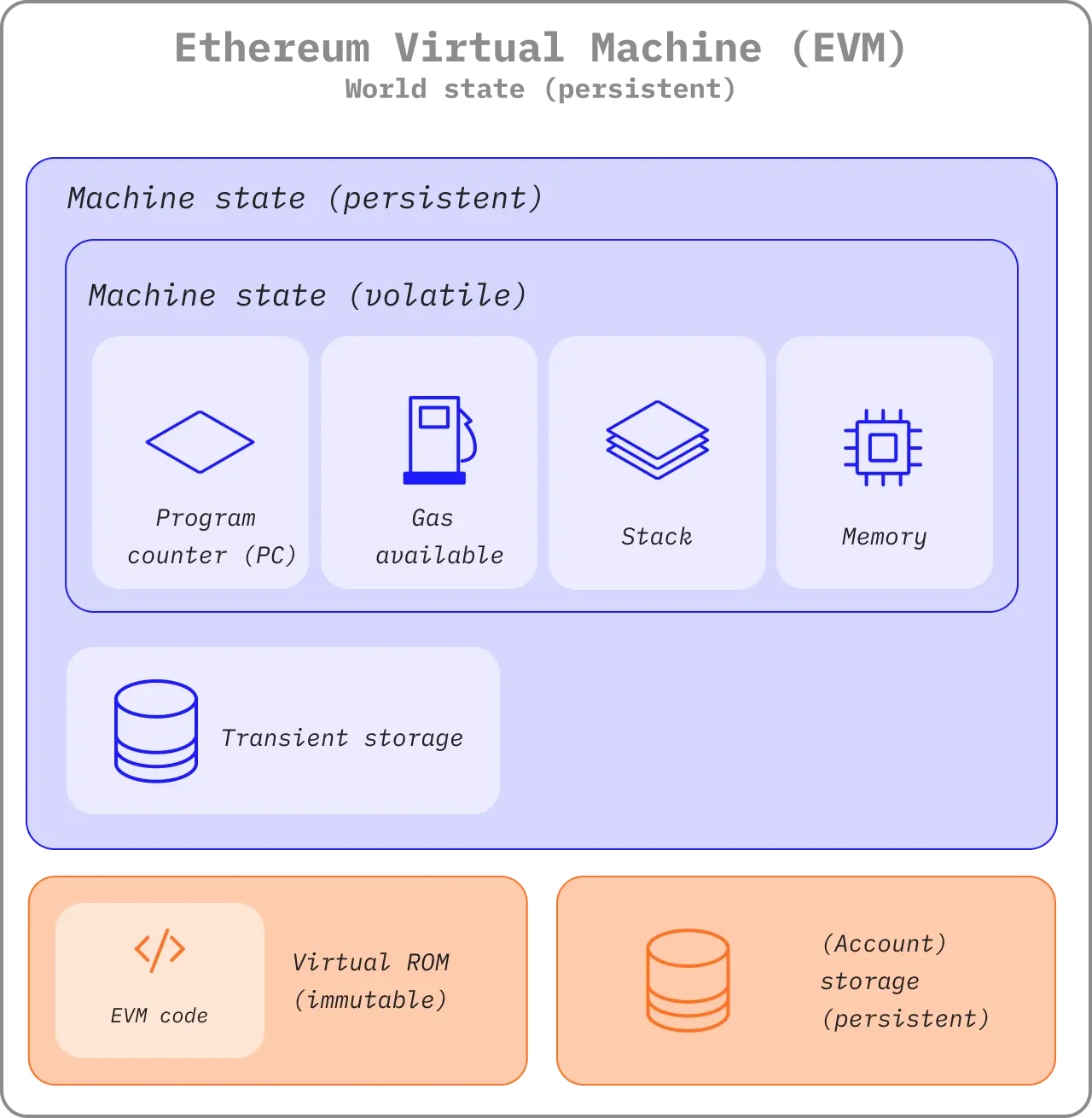
The Ethereum Virtual Machine, or EVM, is the virtual environment in which Ethereum nodes execute smart-contract code.
Developers deploy programs to contract addresses, and users call their functions through transactions. Every executing node follows the same rules and derives the same new state.
The EVM has created a broad tooling standard. Wallets, development frameworks, audit tools, and other compatible networks can reuse substantial infrastructure.
EVM compatibility does not mean inheriting Ethereum's security. Another chain may use its own validators, bridges, sequencers, and governance, each of which requires separate assessment.
Contract code can execute rules automatically but cannot determine whether a real-world promise is true. Oracles, issuers, and off-chain custodians still introduce external trust.
What is a smart contract?
A smart contract is program code and data deployed at a blockchain address. It can receive transactions, check conditions, update state, and call other contracts.
Token issuance, automated market making, lending, stablecoins, NFTs, DAOs, and on-chain games can all be built with smart contracts.
“Automatic execution” does not mean “no administrator.” Contracts may include upgrade, pause, freeze, mint, blacklist, or other privileged controls.
“Open source” does not guarantee safety either. Ordinary users may be unable to review bytecode, an audit covers only a specific version, and external dependencies may still fail.
When connecting to a DApp, wallet connection, message signing, token approval, and an on-chain transaction are different actions. Even a gas-free signature may create exploitable permissions.
Why does gas exist?
Gas measures the computation and storage resources required by Ethereum operations. Every transaction that changes state consumes resources, and users pay fees in ETH.
Gas limits keep programs from running forever and allow scarce block space to be allocated through fees.
EIP-1559 introduced a dynamic base fee. The base fee is burned, while users may set a priority fee and a maximum total fee. The final payment depends on actual gas use and fee parameters; a wallet's displayed maximum is not necessarily fully charged.
Contract interactions usually consume more gas than a simple ETH transfer. A failed transaction reverts state changes but generally still pays for network resources already used.
High gas does not imply a large ETH transfer, and low gas does not imply a safe contract. Users should review estimated fees, contract calls, approval amounts, and slippage together.
How is ETH's supply mechanism different from BTC's?
Bitcoin approaches a protocol supply cap through fixed subsidy halvings. ETH does not have the same fixed 21-million hard cap.
Ethereum PoS issues ETH to validators participating in consensus, while EIP-1559 burns transaction base fees. Net supply over any period depends on the balance between issuance and burning.
When activity and base fees are high, burns may increase; when activity falls, issuance may exceed burning. “ETH is permanently deflationary” is therefore not a protocol guarantee.
Staking rewards are not fixed interest. They depend on total stake, validator performance, protocol rewards, priority fees, and other factors, and come with price, slashing, custody, and liquid-staking risks.
Analysis of ETH supply should separate issuance, burning, staking, withdrawals, and Layer 2 activity rather than rely on a single day's net change.
Why did Ethereum move from PoW to PoS?
Ethereum initially used proof of work like Bitcoin, but its roadmap had long planned a move to proof of stake.
The Beacon Chain began operating PoS consensus in 2020. In September 2022, The Merge connected Ethereum mainnet's execution layer to Beacon Chain consensus, ending PoW mining as the source of mainnet blocks.
PoS validators lock ETH, propose blocks, and attest to other blocks. Honest participation earns rewards; severe violations or prolonged downtime may be penalized.
The transition sharply reduced consensus energy use and changed ETH issuance, but it did not automatically lower transaction gas. Fees mainly depend on block-space demand and scaling capacity.
The Merge did not create a second official ETH2 chain for token swaps. Ethereum.org has retired the term “Eth2”; execution layer and consensus layer are more accurate terms today.
For a full explanation of the Beacon Chain, The Merge, staking, slashing, withdrawals, and the naming change, see Ethereum 2.0: The Evolution from PoW to PoS.
Does “Ethereum 2.0” still exist?
“Ethereum 2.0” once summarized the transition to PoS, sharding, and a broader upgrade roadmap. It later caused users to assume that a new network and token would appear.
The official community increasingly uses execution layer, consensus layer, and the names of individual upgrades. Ethereum remains the same network, and ETH remains its native asset.
Any message asking users to send ETH to an unfamiliar address, swap one-for-one into ETH2, or enter a seed phrase for a “mainnet migration” should be treated as a scam risk.
A staking service may label an account balance ETH2, staked ETH, or something else. That balance could represent an internal receipt, a liquid staking token, or a platform ledger entry and is not automatically native ETH.
Check the issuer, redemption process, contract, network, and custody relationship instead of relying on a ticker symbol.
How does Ethereum scale?
Ethereum's current roadmap centers on Layer 2 rollups. An L2 executes or batches transactions outside mainnet, then submits data, proofs, or results to Ethereum.
Optimistic rollups generally use challenge periods and fraud-proof designs; ZK rollups use validity proofs. Security, withdrawal times, data availability, and upgrade controls vary by project.
L2 networks can lower fees and increase throughput, but expose users to additional sequencer, bridge, proof-system, administrator, and cross-layer messaging risks.
Sidechains and EVM-compatible chains are not necessarily Ethereum L2s. The key question is whether they rely on Ethereum mainnet for security or data settlement.
Bitcoin also has scaling systems such as Lightning, but its payment-channel model differs from the general-purpose contract environment of Ethereum rollups.
What Bitcoin and Ethereum have in common
Both are open networks with public client code and protocol documentation. Users can run nodes and independently verify part or all of the network state.
Both use cryptographic keys to control assets, and confirmed transactions are generally hard to reverse. Leaked seed phrases or private keys can lead to permanent loss.
Both have native assets used for network fees and economic incentives, and those assets may be used on centralized platforms, in self-custody wallets, and in some on-chain applications.
Neither is completely anonymous. Address activity is public, and identity may be inferred when platforms' KYC records, devices, networks, or real-world payments are linked to that activity.
Both face client bugs, economic attacks, regulatory changes, market volatility, custody failures, and user-error risks.
Core difference 1: Different design goals
Bitcoin prioritizes a digital asset and settlement network with relatively stable rules and predictable supply.
Ethereum prioritizes programmable state and general-purpose contract execution so developers can build many kinds of applications.
Bitcoin is therefore generally more cautious about base-layer changes, while Ethereum upgrades more frequently to improve execution, consensus, scaling, and user experience.
Caution does not mean never upgrading, and frequent upgrades do not mean arbitrary change. Both require research, implementation, testing, node adoption, and social coordination.
The right question is which goal fits a particular use case, not which chain has the higher raw transaction speed.
Core difference 2: Different ledger models
Bitcoin uses UTXOs. Transactions spend old outputs and create new ones, making independent units of value and some conditions naturally separable for validation.
Ethereum uses accounts and global state. Transactions modify balances, nonces, contract code, and storage, which better supports complex application composition.
Change outputs and the number of inputs shape Bitcoin transactions. On Ethereum, an account's nonce orders its transactions, so pending transactions from one account can block one another.
Both models have privacy and traceability concerns. Address reuse, consolidation, and application interactions can reveal behavioral links.
Users must not mix the two networks' addresses or fee rules.
Core difference 3: Different consensus systems and security budgets
Bitcoin protects its block history through PoW hash competition. Miners earn the block subsidy and fees.
Ethereum protects consensus through PoS. Validators put ETH at risk of slashing and receive protocol rewards and part of transaction income.
PoW attack costs relate to hash power, hardware, energy, and sustained competition. PoS attack costs relate to stake share, asset price, slashing, and social recovery.
Security cannot be compared through energy or total stake alone. Client diversity, node distribution, mining-pool or staking-provider concentration, governance, and user verification also matter.
Neither is “absolutely unattackable.” Each raises the cost of misconduct and defines a different recovery boundary.
Core difference 4: Different monetary policies
BTC supply centers on a fixed cap and periodic halvings, with new issuance declining over time.
ETH supply combines PoS issuance and EIP-1559 burning. It has no fixed hard cap, and net supply changes with network activity and staking.
BTC's predictability makes a scarcity thesis easier to model. ETH supply is more directly connected to network use, but is also more dynamic.
Supply mechanics do not determine price by themselves. Demand, liquidity, regulation, custody, and macro conditions still affect valuation.
Lost BTC and ETH may reduce the effective supply, but dormant addresses cannot always be classified as permanently lost rather than long-term holdings.
Core difference 5: Different application ecosystems
Bitcoin's ecosystem focuses on value transfer, long-term storage, multisig, timelocks, Lightning payments, and asset experiments around block space.
Ethereum's ecosystem spans stablecoins, DEXs, lending, staking, NFTs, DAOs, games, identity, RWAs, and Layer 2 networks.
A rich application ecosystem creates demand and innovation while expanding smart-contract, oracle, bridge, governance, and composability risks.
A more focused base layer reduces some complexity but does not eliminate risks in wallets, custody, payment channels, or second-layer services.
Users should choose a network for a real need rather than ignore fees, liquidity, and security because one has “more ecosystem” or “simpler rules.”
Core difference 6: Different fee and scaling paths
Bitcoin fees mainly depend on transaction data occupying block space and the selected fee rate, not the amount transferred. Lightning uses channels for small, frequent payments.
Ethereum fees depend on gas used and the price per unit of gas. Complex contract interactions usually consume more resources than a simple transfer.
Ethereum uses rollups to scale general-purpose application execution, while Bitcoin uses Lightning and other systems to scale payments. Their trust, exit, and liquidity models differ.
Network fees are never permanently fixed. Mainnet fees can rise during demand spikes, and L2s can be affected by sequencer, data-fee, or bridge congestion.
Before choosing a cheaper network, confirm the asset version, bridge, and platform support so a small fee does not lead to an unrecoverable route.
Core difference 7: Different upgrade and governance processes
Bitcoin improvements are coordinated through BIPs, client implementations, developer discussion, nodes, and ecosystem adoption. A BIP's existence does not mean consensus or activation.
Ethereum improvements move through EIPs, research, client teams, testnets, core-developer coordination, and mainnet upgrades. An EIP draft is not guaranteed to enter an upgrade.
Neither network has one CEO who can rewrite every node's rules at will. Foundations, core developers, miners, validators, custodians, and major applications nevertheless have different forms of influence.
Both “on-chain governance” and “social consensus” should be assessed through actual power, not merely by whether a voting button exists.
During disputes, the software users run, the chain markets value, and the rules supported by infrastructure collectively shape the outcome.
Can BTC and ETH be held in the same wallet?
One wallet brand may manage both Bitcoin and Ethereum keys, but the two chains can use different addresses, transactions, fees, and backup implementations.
Bitcoin has several common address formats, while Ethereum addresses normally begin with 0x. BTC cannot be sent directly to an Ethereum address, nor native ETH to a Bitcoin address.
A platform may show both assets under one account, but users must still choose the correct asset and network when withdrawing.
Seed-standard compatibility does not guarantee that every account will restore automatically. Wallets may use different derivation paths, address types, or imported accounts.
Test small sends, receives, and recovery on each chain, and save the transaction hash for every test.
How do WBTC, cross-chain ETH, and native assets differ?
BTC cannot exist natively inside Ethereum contracts. Wrapped assets such as WBTC generally lock BTC through a custodian or cross-chain mechanism and issue a corresponding token on Ethereum.
Wrapped BTC can enter DeFi, but adds custodian, contract, redemption, governance, and regulatory risks. A token trading close to BTC does not give it the same trust model.
ETH on Layer 2 networks, sidechains, or other chains may likewise be a natively bridged, wrapped, or third-party version.
If a bridge is exploited, paused, or undercollateralized, a destination-chain token can decouple from its underlying asset.
Check the full contract address, network, issuer, and redemption route rather than treating every asset named BTC or ETH as identical.
How do the sources of value for BTC and ETH compare?
BTC's value thesis primarily centers on verifiable scarcity, network security, decentralized settlement, liquidity, and long-term social consensus.
ETH's value proposition also includes paying execution fees, securing PoS, providing application collateral, settling stablecoin and DeFi activity, and burning base fees generated by network use.
Neither asset carries a shareholder's fixed cash-flow or legal claim like traditional company stock. Increased protocol use does not necessarily translate proportionally into a higher token price.
BTC faces risks around the post-halving security budget, regulation, custody, and demand. ETH faces complex-protocol, upgrade, L2 value-capture, staking-concentration, and application risks.
Sources of value can remain intact while market price trades far above or below reasonable expectations. Studying a network does not make every entry price appropriate.
How do the investment risks of BTC and ETH compare?
BTC has a more focused model, but its price remains sensitive to macro liquidity, leverage, regulation, miners, and institutional holdings.
ETH supports broader applications and therefore depends on additional smart contracts, stablecoins, bridges, Layer 2 networks, staking derivatives, and protocol upgrades.
BTC's fixed cap does not guarantee appreciation, and ETH fee burning does not guarantee deflation or appreciation. Every supply thesis also requires demand.
Both can experience severe drawdowns. Spot ownership, staking, lending, funds, and derivatives expose users to different risks, and historical performance cannot predict future results.
For a complete comparison of positioning, supply, consensus, fees, applications, valuation, and personal fit, read Bitcoin vs. Ethereum: Core Differences and Investment Comparison.
Should beginners learn BTC or ETH first?
Start with BTC if you want to understand digital scarcity, UTXOs, PoW, miners, and fixed issuance.
Continue with ETH if you want to understand smart contracts, gas, tokens, DApps, DeFi, and PoS.
The most effective method is comparison rather than choosing only one: examine how each records a transfer, confirms the network, pays fees, changes supply, and assigns trust.
Learning does not require buying. Users can read white papers, inspect block explorers, use testnets, or observe small transactions.
Do not enter leverage, bridges, or complex DeFi before understanding wallet backups, platform eligibility, tax obligations, and the maximum loss you can bear.
How can a beginner run a small BTC and ETH comparison experiment?
First, on a platform or wallet permitted where you live, confirm the native BTC and ETH networks rather than choosing similarly named wrapped assets.
Second, use an amount you could lose entirely and compare fee estimates, address formats, and confirmation behavior.
Third, search each transaction ID in the appropriate block explorer and identify inputs, outputs, gas, status, and confirmations.
Fourth, record the difference between a platform's internal transfer and an on-chain withdrawal. An internal trade does not necessarily create a public-chain transaction.
Fifth, if you try an Ethereum DApp, use a separate interaction wallet and first understand connections, signatures, approvals, and transactions.
Sixth, review the actual fees, wait times, recovery boundaries, and tax records. Do not infer long-term returns from one experiment.
Common misconceptions
Misconception 1: BTC is used only for crime. Public-chain activity is transparent and traceable, and the technology supports legal and illegal uses; one cannot define it by either alone.
Misconception 2: ETH is stock in a company. ETH is a protocol-native asset and does not represent equity in or dividends from the Ethereum Foundation.
Misconception 3: miners can issue arbitrary amounts of BTC. Full nodes reject blocks that violate subsidy and supply rules.
Misconception 4: price must rise after a halving. A halving reduces new supply, while price still depends on demand, expectations, and market conditions.
Misconception 5: The Merge lowered gas fees. It changed consensus and energy use; scaling primarily comes from rollups and later data-capacity improvements.
Misconception 6: ETH must be exchanged for ETH2. There is only ETH as the official native asset, and requests to send funds for such an exchange are a scam warning.
Misconception 7: identical EVM address formats mean any network is safe to choose. An address format does not prove that a wallet or platform supports the chain and asset.
The Hotcoin DOUBLE-6 learning method
This six-dimensional framework compares networks and assets; it is not investment advice.
35.1 D: Design—start with the design goal
Identify whether the network prioritizes value settlement, general computation, privacy, scaling, or another problem instead of comparing TPS alone.
35.2 O: Ownership—understand ownership records
Distinguish UTXOs from accounts and identify what private keys, addresses, wallets, contracts, and custodians each control.
35.3 U: Utility—analyze the native asset's uses
Check whether the asset pays fees, secures consensus, supplies collateral, or settles applications. Do not equate utility directly with price growth.
35.4 B: Block Production—compare block production and security
Study PoW hash power, miners, difficulty, and fees, or PoS validators, staking, rewards, and slashing.
35.5 L: Layers—inspect scaling and external dependencies
Identify Lightning, rollups, bridges, sequencers, custodians, and data availability, including how the base chain and second layer support exits.
35.6 E: Exposure—limit investment and operational risk
Combine valuation, liquidity, custody, technology, compliance, tax, and maximum-loss analysis, and separate learning about a network from buying its asset.
BTC and ETH security checklist
Confirm whether you are buying native BTC, native ETH, a wrapped or bridged token, or a platform receipt.
Confirm the withdrawal asset, network, address, memo, platform support, and fee, then make a small test transfer.
Keep seed phrases and private keys offline; never enter them on customer-service, airdrop, upgrade, or “ETH2 migration” websites.
For Bitcoin transactions, verify inputs, outputs, change, and fee rate rather than treating the balance as one account number.
For Ethereum actions, distinguish connection, signing, approval, and transaction, and review the contract and simulation result.
Identify the additional trust and exit conditions of any Layer 2, Lightning service, bridge, or staking provider.
Confirm that the relevant platforms and products are permitted where you live, and save orders, fees, and transaction hashes.
Make sure you can bear the worst outcome. Do not borrow, concentrate all funds, or use leverage and contracts you do not understand.
Frequently asked questions
37.1 Which is better, Bitcoin or Ethereum?
There is no universal answer without a use case. Bitcoin focuses more on scarce digital assets and settlement; Ethereum focuses more on programmable applications and on-chain economies.
37.2 Do BTC and ETH both have a 21-million cap?
No. BTC's protocol supply cap is close to 21 million; ETH has no equivalent hard cap, and its net supply combines PoS issuance with fee burning.
37.3 Does Ethereum still use PoW mining?
No. Ethereum mainnet has used PoS since The Merge in 2022, with validators and staked ETH maintaining consensus.
37.4 Can Bitcoin run smart contracts?
Bitcoin Script supports programmable spending conditions such as multisig and timelocks, but it does not provide a general-purpose contract environment like Ethereum's EVM.
37.5 Must ETH be converted to ETH2?
No. The Eth2 name has been retired, and ETH remains Ethereum's only native asset. A site asking you to send ETH for an ETH2 swap may be fraudulent.
37.6 Can BTC and ETH be sent directly to each other?
No. They exist on different networks. Cross-chain use generally requires a platform, bridge, or wrapped asset, adding custody and contract risks.
37.7 Should a beginner buy both BTC and ETH?
This guide does not give allocation advice. Understand each asset's use, valuation, risks, and local rules before deciding whether to participate with funds you could lose entirely.
Conclusion: Bitcoin defines digital scarcity; Ethereum extends programmable trust
Bitcoin uses UTXOs, PoW, difficulty adjustment, halvings, and node validation to create a publicly verifiable digital-asset network with a clear issuance schedule.
Ethereum uses accounts, the EVM, smart contracts, gas, and PoS to turn blockchain into a programmable platform for tokens, DeFi, stablecoins, NFTs, and Layer 2 networks.
Their differences are not simply “old versus new” or “slow versus fast.” They reflect different design goals and trade-offs. BTC emphasizes stable rules, scarcity, and settlement; ETH emphasizes program execution, composability, and continued upgrades.
Beginners should first understand how each network records ownership, who maintains security, why the native asset is needed, how supply changes, and which outside components scaling relies on before discussing prices and allocations.
No fixed cap, halving, staking return, fee burn, or ecosystem growth can guarantee appreciation on its own. Wallet, platform, bridge, contract, liquidity, legal, and tax risks must be verified separately.
For a standalone wallet for Web3 applications, consider Hotcoin Web3 Wallet. For mobile market and trading tools, visit the Hotcoin App. Browse more educational content at Hotcoin.
Risk warning: This article is based on protocol and project sources available through August 27, 2026, and is provided only for education and information. It is not investment, trading, legal, tax, or cybersecurity advice. BTC, ETH, wrapped assets, staking receipts, Layer 2 networks, bridges, and derivatives may face severe price volatility, insufficient liquidity, private-key compromise, platform failure or withdrawal suspension, smart-contract exploits, stablecoin depegging, bridge attacks, validator or mining-pool concentration, manipulation, fraud, and regulatory change. Before participating, verify local rules, the asset's network and contract, fees, and custody method, and use only funds you can afford to lose entirely.
Recommended
View more