
Crypto Earning Strategies: From Staking to Farming
The main ways to earn with crypto include Staking, liquid staking, Restaking, yield farming, lending yields, yield aggregation and yield trading. They differ widely in where the yield comes from, how long your capital is tied up and what risks you take on. The APY shown on a page alone cannot tell you which strategy suits you.
If you are new to DeFi, you can start by reducing crypto earning to one simple question:
"Who holds my assets, what are they used for, where does the yield come from, and what risks am I taking?"
Answer those four questions clearly and you will not confuse one DeFi yield strategy with another.
What are the main ways to earn with crypto?
The common DeFi earning methods today can be grouped by where the yield comes from.
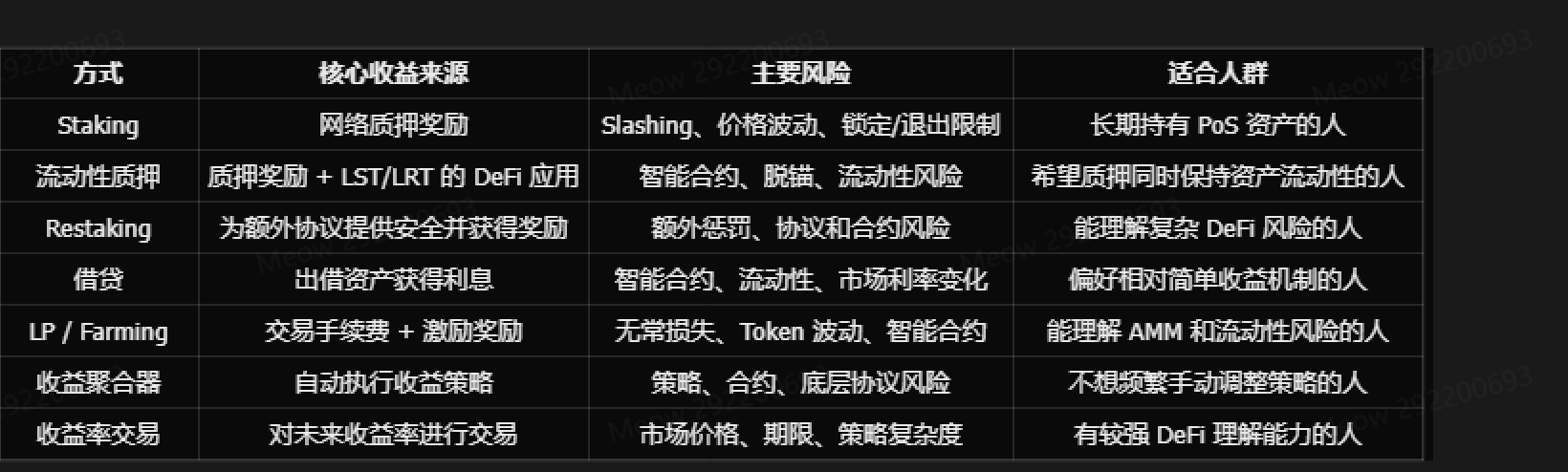
These methods are not independent of each other. ETH, for example, can be staked first, turned into an LST, and then used again in other DeFi protocols; an LP position can itself become the underlying asset of another yield strategy.
So DeFi earning is better described as financial instruments stacked layer by layer, not a single product that pays interest on deposited coins.
Staking: the most basic way to earn on-chain
Staking is one of the most fundamental yield mechanisms of a Proof of Stake (PoS) blockchain.
Take Ethereum: solo staking requires at least 32 ETH and a validator node you run yourself. If you do not have enough assets or do not want to maintain a node, you can also take part through a staking pool. Ethereum's official documentation still treats solo staking, staking as a service, and pooled/liquid staking as distinct ways to participate.

Staking yield essentially means that users lock or delegate assets to help validate the network and receive rewards under the protocol rules.
But "staking equals risk-free interest" is a common misconception. Validators can face offline penalties or slashing, and the staked assets themselves are still exposed to market price swings.
If you want a systematic look at how PoS staking works, where the yield comes from and how to take part, read What Is Staking? A Complete Guide to Earning with PoS Staking.
Liquid staking: keep using your staked assets
One of the biggest limits of traditional staking is that the assets may not be able to take part in other DeFi activity at the same time.
Liquid staking solves this: after you deposit a stakeable asset, the protocol handles the staking and gives you a liquid staking token (LST) that represents your staked asset. You keep earning staking rewards while you can still hold, trade, or use the LST in other DeFi protocols.
According to Ethereum's official materials, transparent liquid staking pools usually issue an LST representing staked ETH, and the value of that LST reflects staking rewards through a change in balance or in the exchange rate.
But liquidity does not make the risk disappear. LSTs add smart contract, market liquidity, depeg and governance risks.
To understand LSTs, LRTs and how liquid staking works in more depth, read Liquid Staking (LSD/LRT): Making Your Staked Assets Liquid.
Restaking: earn extra yield with assets you already staked
Restaking can be understood as making further use of the security properties of assets you have already staked.
Ethereum's official definition of Restaking is using already staked ETH to provide additional security for other decentralized services, in exchange for rewards. At the same time, stakers take on additional risk.
So Restaking may look more profitable than plain Staking, but this is not "yield out of thin air" — it is more risk in exchange for potential extra yield.
A simple way to see it:
Staking: provide security for one PoS network → earn the base reward
Restaking: on top of that, provide security for other services → earn extra rewards, and take on extra risk
If you want to know how EigenLayer, shared security and Restaking actually work, read Restaking: EigenLayer and Shared Security.
Yield farming: higher yield, but a more complex risk structure
Yield farming usually means supplying assets to a DeFi protocol for trading, lending or other financial activity, and earning fees, interest or Token incentives in return.
The most typical form is supplying assets to a DEX liquidity pool.
For example, providing ETH and USDC in an AMM pool may earn you trading fees; if the protocol also offers incentives, you may earn its Token as well.
The catch is that LP returns cannot simply be read as "fees + rewards = final profit".
If the prices of the two assets in the pool move a lot, the LP position can suffer impermanent loss; if the reward Token itself falls in price, a high nominal APY does not mean a high final return.
So when you farm, you have to account for all of this at once:
Trading fees + Token incentives − impermanent loss − Gas − Token price change
That is why yield farming looks simple but is in practice far more complicated than plain Staking.
For the full workflow and how to judge the returns, see Yield Farming: A Practical Guide.
Lending yields: supply idle assets to borrowers
DeFi lending is another relatively easy way to understand earning.
Take Aave: you can Supply supported Tokens into the protocol's liquidity pool, and once borrowers use those assets, suppliers earn yield at a dynamic market rate. The rate moves with factors such as capital utilization, so it is not a fixed interest rate.
The key to lending yield is understanding where it comes from:
Users supply liquidity → borrowers pay interest → part of that interest becomes supplier yield.
So when borrowing demand for an asset rises, supply-side yields may rise; when demand falls, yields may fall too.
For ordinary users, lending is usually easier to understand than complex multi-layer farming, but smart contract, asset price, protocol parameter and liquidity risks are still present.
Why is impermanent loss a concept every LP must understand?
If you hold only one asset, a rise or fall in its price mainly affects the market value of that single asset.
Once you become an LP, however, you hold a liquidity position made up of multiple assets. When the prices of the two assets in the pool change, the AMM keeps adjusting the asset ratio through trades.
That means:
The final composition of an LP position can differ completely from simply holding the Token.
So even after receiving fees, your final return may be lower than simply holding the asset, because of price changes and impermanent loss.
If you plan to do LP farming, impermanent loss is close to a required basic concept. Read more in What Is Impermanent Loss? Calculation and Mitigation.
Single-asset staking vs LP farming: which suits ordinary users better?
The core difference is that the complexity of the yield and the source of risk are different.
Single-asset staking usually only requires you to watch:
Token price + staking yield + protocol risk
LP farming additionally requires you to watch:
the price relationship between the two Tokens + impermanent loss + trading fees + liquidity + incentive Token + smart contract risk
So if your main goal is to hold a PoS asset long term while earning protocol rewards, single-asset staking is usually easier to understand.
If you can accept a more complex yield structure and are willing to bear impermanent loss, then LP farming is worth studying further.
For a detailed comparison, see Single-Asset Staking vs LP Farming: Which Strategy Fits You.
Yield aggregators: let the protocol execute the strategy for you
The core idea of a yield aggregator is to combine several operations and use automated strategies to reduce the cost of frequent manual action.
Products such as Yearn manage underlying assets for users through Vaults and strategy mechanisms, so users do not have to hunt for and switch between yield opportunities by hand every day.
What this solves is how to execute a yield strategy more efficiently — not how to create yield out of nothing.
So when using an aggregator, do not look only at the return rate on the Vault page. You also need to understand where the underlying strategy actually allocates the capital, and what risks the strategy itself carries.
To learn about Yearn and auto-compounding, read DeFi Yield Aggregators: Yearn Finance and Auto-Compounding.
Pendle: turning yield itself into a tradable asset
Pendle points to where DeFi yield strategies are heading: split yield from principal, then trade and manage each part separately.
Pendle standardizes yield-bearing assets and splits them into PT (Principal Token) and YT (Yield Token). PT represents the principal, while YT represents the right to the yield over a future period.
As a result, users are no longer limited to "hold the asset and wait for yield" — they can choose different strategies based on their own view of future yields.
For example:
If you expect yields to rise, you can increase your yield exposure;
If you want to lock in a specific yield, you can consider PT;
If you want more advanced yield trading, you can trade YT;
You can also provide liquidity to a Pendle pool to earn the corresponding yield.
Pendle's official documentation also clearly notes that yields change with market conditions, so the APY on a page is not a permanently fixed number.
To dig into this "financialization of yield", read Pendle: An Innovative Protocol for Yield Tokenization.
Does a high APY always mean a better opportunity?
No. APY is only a yield metric, not your final investment return.
A pool showing 100% APY may be paying it out of short-term Token incentives; if the market price of the reward Token drops quickly, the real return can be far below the number on the page.
You should also consider:
Whether the yield comes from Token incentives;
Whether the APY will change quickly;
Whether the Token behind the yield has enough liquidity;
Whether Gas costs are too high;
Whether there is a lock-up period;
Whether impermanent loss applies;
Whether the smart contract has been audited;
Whether the underlying protocol depends on other protocols;
Whether depegs or liquidations are likely in extreme market conditions.
So when judging a DeFi yield strategy, a more reasonable order is:
Source of yield → sustainability of yield → capital liquidity → underlying risk → cost → final net return
rather than deciding whether to participate the moment you see an APY.

How to choose the crypto earning method that fits you
You can work through five steps.
Step 1: Start with the asset.
Are you holding ETH, a stablecoin, or a more volatile Token? Different assets suit completely different strategies.
Step 2: Define your risk tolerance.
If you cannot accept large price swings, you should not enter a highly volatile farming pool just because the APY is high.
Step 3: Judge where the yield comes from.
The real question is: "Who is paying this yield?"
If it comes from genuine borrowing demand, trading fees or network rewards, the logic is relatively clear; if it relies mainly on new Token incentives, you need to judge whether those incentives are sustainable.
Step 4: Calculate the real cost.
Do not ignore Gas, swap fees, price impact, exit costs, and any impermanent loss you may incur.
Step 5: Check the exit mechanism.
The most overlooked question in a yield strategy is not "how do I get in" but "if something goes wrong, can I get out".
Confirm in advance whether there is a lock-up, a redemption waiting period, insufficient liquidity, a depeg, or a situation where you cannot exit in extreme market conditions.
Common misconceptions about DeFi earning
Looking only at APY, not at where the yield comes from
A high yield may simply be a short-term incentive; it is not the same as real yield.
Treating Staking as a risk-free deposit
Staking still carries asset price, validator performance, protocol and slashing risks.
Assuming LP fees always mean profit
Fee income can be offset by impermanent loss and Token price changes.
Chasing new pools for ever higher yields
Switching strategies frequently increases Gas, trading costs and smart contract exposure, and makes it easy to end up in a new protocol that has not been properly tested.
Assuming "auto-compounding" always means higher returns
Auto-compounding solves the execution problem of reinvesting yield; it does not remove underlying asset price, protocol or strategy risk.
Summary: the point of DeFi earning is not "finding the highest APY"
Crypto earning runs from simple Staking to liquid staking, Restaking, lending, LP farming, and on to yield aggregation and Pendle yield trading. In essence, all of them are different ways of putting idle assets to work.
But the more complex the yield, the more risk you usually need to understand. Staking is mainly about network and staking risk; liquid staking is about LST depegs and smart contract risk; Restaking is about additional penalties and underlying protocol risk; LP farming is mainly about impermanent loss; yield aggregation and yield trading require a further understanding of the strategy and the underlying assets.
So when choosing how to earn in DeFi, the question should not be "which APY is highest", but:
What are my assets? Where does the yield come from? How long can it last? What do I lose in the worst case? Can I exit at any time?
Answer those questions clearly before choosing the matching yield strategy, and your approach to DeFi earning will be far more sound.
Crypto and DeFi carry significant risk. Yields can change quickly with the market, protocol parameters and Token prices, and smart contracts, liquidity, depegs, liquidations and market volatility can all cause loss of principal. This article is for informational and educational purposes only and is not investment advice.
FAQ
What is the difference between Staking and Farming?
Staking earns protocol rewards mainly by taking part in PoS network validation; Farming usually earns fees, interest and Token incentives by providing liquidity, taking part in lending, or other DeFi activity. The two differ in where the yield comes from and in their risk structure.
Is DeFi earning passive income?
Some strategies generate yield automatically, but that does not mean they need no management at all. Yields, Token prices, protocol parameters, liquidity and security conditions can all change, so regular checks are still required.
Is a higher APY always better?
No. APY is only a yield metric. You still need to judge the source and sustainability of the yield, the Token price, Gas, impermanent loss and protocol risk. Especially high APYs often come with greater uncertainty.
Is there no price risk when earning with stablecoins in DeFi?
Stablecoins usually fluctuate less in price than highly volatile Tokens, but depeg risk remains, and they can also carry smart contract, protocol, liquidity and underlying asset risk.
Which DeFi earning method should beginners start with?
Prioritize a strategy whose source of yield and risks you can understand, instead of chasing a high APY. If you are new to DeFi, it is more prudent to understand the basics such as Staking, lending, LP, impermanent loss and APY/APR first, and only then move on to Restaking, yield aggregation and yield trading.
Recommended
View more


service hotcoin.com
producthotcoin.com
businesshotcoin.com
casecnhotcoin.com