
Liquid Staking (LSD/LRT): Making Your Staked Assets Liquid
Liquid staking means handing your PoS assets to a staking protocol that stakes them on the network, while you receive a liquid token that represents those staked assets. On Ethereum, for example, you deposit ETH and receive an LST such as stETH, so you keep earning staking rewards while still being able to transfer, trade or use that LST across other DeFi applications.
An LRT (Liquid Restaking Token) goes one step further: it is the liquid token produced by restaking assets that are already part of liquid staking. In simple terms:
ETH → Staking → LST → Restaking → LRT
So although LST and LRT sound alike, they represent different layers of yield and risk.
What is liquid staking?
One of the biggest problems with traditional staking is that staked assets can temporarily lose their liquidity.
When you stake ETH natively, for instance, that ETH is used to take part in Ethereum's validator mechanism. You still own the economic claim on the asset, but that ETH cannot be traded directly or moved into other DeFi protocols the way ETH in a normal wallet can.
Liquid staking solves exactly this problem.
When you deposit ETH into a liquid staking protocol, the protocol stakes the assets and issues you an LST (Liquid Staking Token) that represents your claim on the staked assets.
Ethereum's official documentation describes an LST as an ERC-20 token representing staked ETH and the right to claim its rewards. The underlying ETH stays staked, while the LST in your wallet can be transferred or used in other DeFi applications.
So liquid staking does not "cancel the staking". Rather:
The underlying asset stays staked, and you receive a transferable receipt for it.
What are LST, LSD and LRT?
These three terms often appear together, but they do not mean exactly the same thing.
LST: Liquid Staking Token
LST stands for Liquid Staking Token.
It represents the assets you have already staked together with the related rights. If you stake ETH through a liquid staking protocol, for example, you receive a corresponding LST.
Common LSTs include:
stETH
rETH
cbETH
Different LSTs differ in how they are issued, how rewards are reflected, how redemptions work, and how their risk is structured.
Ethereum's official documentation splits the way LSTs reflect rewards into two typical models: Rebasing, where the token balance grows with rewards, and Exchange Rate, where the token count stays roughly the same but each token is worth more ETH as rewards accrue.
LSD: Liquid Staking Derivatives
LSD usually stands for Liquid Staking Derivatives, a term widely used in the past to describe the derivative assets produced by liquid staking, or the liquid staking sector as a whole.
Today the industry more often uses LST for a specific liquid staking token.
So when reading DeFi material, a simple rule of thumb is:
LSD leans toward an older industry label, while LST is better for describing a specific liquid staking token.
LRT: Liquid Restaking Token
LRT stands for Liquid Restaking Token.
Its biggest difference from an LST is that an LST represents staking rights, while an LRT usually represents rights over assets that have been restaked.
A simplified flow looks like this:
ETH → liquid staking → LST such as stETH → restaking → LRT
Ethereum's official documentation draws a clear line between the two as well: users can obtain LSTs through services such as Lido and Rocket Pool, then use those LSTs in restaking and receive an LRT representing the restaked position.
So an LRT is not an "upgraded LST" — it is a new asset layer built on top of an extra restaking mechanism.

How does liquid staking actually work?
The whole process can be broken into four steps.
Step 1: The user deposits ETH
The user deposits ETH into a liquid staking protocol.
Based on its own staking mechanism, the protocol allocates the assets to node operators or validators.
Step 2: The protocol stakes the assets
The underlying ETH is used for staking and validation on the PoS network.
This means the user keeps earning staking rewards generated by the underlying blockchain network.
Step 3: The user receives an LST
The protocol issues the corresponding LST to the user.
For example:
Deposit ETH → receive stETH
The exact exchange relationship here depends on the protocol's design.
With Lido, for example, users receive stETH after staking ETH; Lido's official documentation states that stETH represents staked ETH and reflects staking rewards as well as related penalties.
Step 4: The LST can move into DeFi
Holding staked assets is no longer the user's only option.
Depending on what each protocol supports, an LST can be used for:
DEX trading
Lending and borrowing
Liquidity pools
Other DeFi strategies
Restaking
That is the core value of liquid staking:
Assets that are already staking can become liquid again.
How are LST rewards reflected?
This is the most confusing part of liquid staking.
An LST does not necessarily pay you "a bit of ETH" every day.
Different protocols use different accounting methods.
Rebasing: the token count grows
stETH is a typical Rebasing token.
If you hold 100 stETH, the amount of stETH in your wallet may gradually increase as staking rewards are generated.
In other words:
The token count changes → staking rewards are reflected
Lido's official material explains that the stETH balance is updated according to the consensus layer ETH state reported by oracles.
Exchange Rate: the token count stays the same, but redemption value grows
The other model does not directly increase the number of tokens in your wallet.
If you hold 100 LSTs, for example, those 100 tokens can be redeemed for a gradually larger amount of ETH as the underlying staking rewards accumulate.
In other words:
The token count stays roughly the same → the underlying assets behind each token grow
Ethereum's official documentation uses Rocket Pool's rETH as the example of this design.
So seeing that "my LST count has not increased" does not mean no staking rewards were generated.
What matters is which reward accounting method the protocol uses.
Why is an LST not always equal to 1 ETH?
This is one of the most important risks in liquid staking.
Many users see:
1 ETH → 1 LST
and then assume:
1 LST always = 1 ETH
But that is not absolutely true.
When an LST trades on the secondary market, it is affected by supply and demand, liquidity, market sentiment and redemption mechanisms.
Suppose an LST's theoretical asset value is close to 1 ETH, but a large number of users sell in a short period while buyers are thin — the secondary market price may temporarily fall below that theoretical value.
This is what is known as a depeg.
So it is worth separating two things:
the exchange relationship at the protocol level
and
the trading price on the secondary market
They are not exactly the same thing.
Some protocols may offer a native redemption mechanism, but redemption can still be limited by queues, liquidity or protocol rules.
So it is not safe to assume that "because staked assets back it, I can always sell it back for ETH at 1:1".
Why is liquid staking more flexible than ordinary staking?
The core value of ordinary staking is earning staking rewards, but capital efficiency on those assets can be limited.
Liquid staking adds a layer of composability.
For example:
ETH → LST → DEX
Or:
ETH → LST → lending
Or even:
ETH → LST → Restaking
This means the same underlying asset can keep taking part in other DeFi activity.
But note:
More liquidity ≠ less risk.
Quite the opposite: when users put an LST into another protocol, they are actually stacking risk on top of risk.
For example:
ETH itself carries price risk;
the LST adds protocol and depeg risk;
putting the LST into a lending protocol adds lending protocol and liquidation risk.
That is why the "stacked yield" so common in DeFi is also stacked risk.
What exactly is the difference between an LST and an LRT?
The biggest difference is the job the underlying asset takes on.
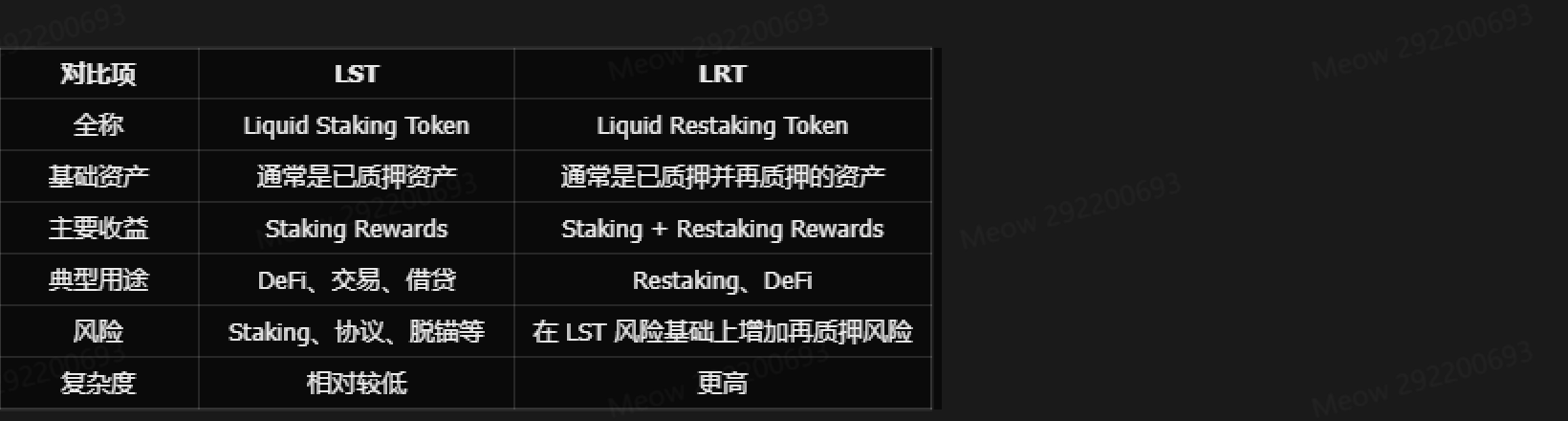
You can think of them as two layers of assets:
LST: makes staked assets liquid again.
LRT: makes restaked assets liquid again.
So an LRT has more potential sources of yield, but its underlying risk chain is usually longer.
How is an LRT created?
The basic logic of an LRT can be summarized as:
ETH → Staking → LST → Restaking → LRT
A user first obtains an LST through liquid staking, then uses that LST in a restaking service and receives an LRT representing that restaked position.
Ethereum's official documentation notes clearly that users can restake LSTs generated on platforms such as Lido or Rocket Pool, and earn staking and restaking related rewards through an LRT such as eETH.
One point deserves special attention:
Restaking is not the same as depositing an LST into an ordinary lending protocol.
The core of restaking is using already staked assets to provide additional security for other decentralized services.
So if a product claims "LRTs earn a lot", you should ask further:
Which protocol does the underlying asset actually enter? What extra obligations does it take on? Where do the rewards come from?
What are the main risks of liquid staking?
Liquid staking solves the liquidity problem of staking, but it adds new layers of risk at the same time.
Token price risk
LSTs and LRTs do not make the asset price stop moving.
If the underlying ETH falls, the market value of the related LST or LRT can fall as well.
Staking rewards may therefore fail to cover the price loss on the underlying asset.
Depeg risk
This is an important risk specific to LSTs and LRTs.
If the market price moves clearly away from the theoretical asset value, users selling on the secondary market may take an extra loss.
A depeg can come from:
market panic;
insufficient liquidity;
large-scale redemptions;
protocol anomalies;
smart contract risk;
problems with the underlying asset or related protocols.
Smart contract risk
Users no longer rely only on the underlying blockchain; they also have to trust the smart contracts of the liquid staking protocol.
Bugs, misconfigured permissions or other security issues in those contracts can lead to loss of funds.
Validator risk
Liquid staking protocols usually allocate the underlying assets to node operators.
If validators suffer serious failures or act maliciously, the protocol's penalty mechanism may be triggered.
Liquid staking therefore does not remove validator risk; it simply hands the node operation work to the protocol or the operator system.
Composability risk
This is the risk that LRTs and complex DeFi strategies need to watch most closely.
Suppose:
ETH → LST → LRT → lending → LP
Then a problem at any layer can affect the final position.
This risk can be understood as follows:
Risks do not simply add up — they can transmit to each other.
What kind of users is liquid staking for?
Liquid staking suits users who:
hold PoS assets for the long term;
want to earn staking rewards;
do not want to give up liquidity on those assets completely;
understand the relationship between an LST and the underlying asset;
can accept smart contract and depeg risk;
are able to judge the security and liquidity of different protocols.
If you simply want staking rewards and have no need to use an LST, staking directly may be easier to understand.
If you are not yet fully comfortable with PoS staking, you can start with What is Staking? A Complete Guide to Earning with PoS Staking before digging into liquid staking.

How do you judge whether an LST or LRT is worth using?
Do not look only at the APY it displays. Go through the following questions.
First, look at the underlying asset
Start by confirming what asset the token actually represents.
Is it ETH staking?
Or LST restaking?
Or has it gone further into other DeFi strategies?
The more complex the underlying structure, the more you need to understand how risk is transmitted.
Second, look at where the rewards come from
Confirm whether the rewards come from:
Staking Rewards?
Restaking Rewards?
Trading fees?
Token incentives?
Different sources of reward imply very different sustainability.
Third, look at the redemption mechanism
Focus on confirming:
whether native redemption is supported;
whether there is an exit queue;
whether there is a minimum redemption amount;
whether there is a waiting period;
whether, in extreme markets, selling on the secondary market is the only option.
Fourth, look at market liquidity
If an LST or LRT has almost no trading depth, then even a high theoretical asset value can mean a large price impact when you sell.
So "it can be traded" and "it can be traded at a reasonable price" are two different things.
Fifth, look at protocol risk
Pay attention to:
whether the smart contract is public;
the protocol's governance mechanism;
the validator system;
how assets are custodied;
past security incidents;
whether there is centralization risk.
Do not assume an LST or LRT is better just because its APY is higher than another product's.
Liquid staking or ordinary staking: how to choose?
A simple way to decide is to go by your needs:
If you only want to take part in the PoS network and earn base rewards:
start by understanding ordinary staking.
If you hold assets long term and want to keep using those assets:
liquid staking may fit better.
If you already understand LSTs and want to use staked assets for extra yield:
you can look into restaking and LRTs.
But as the structure grows more complex, risk increases layer by layer.
A simple way to think about the three:
Staking: earn base staking rewards
LST: keep liquidity while earning staking rewards
LRT: go further into restaking on top of an LST
FAQ
Is an LST the same as ETH?
No. An LST is a token representing a claim on staked ETH. Its value is usually closely tied to the underlying ETH, but its secondary market price can deviate, and redemption and liquidity limits may apply.
Does an LST generate yield?
It usually earns the underlying staking rewards, but protocols reflect those rewards differently. Some LSTs reflect rewards through a growing token balance, others through a changing exchange rate.
What is the biggest difference between an LRT and an LST?
An LST mainly represents liquid staking assets; an LRT usually represents assets that have been restaked. An LRT's yield can come from both staking and restaking, so its risk structure is more complex.
Does liquid staking mean there is no lock-up at all?
Not exactly. The LST itself is usually liquid and can be transferred or traded, but native exit of the underlying asset may involve a queue or a waiting time. Selling the LST on the secondary market instead means taking on market liquidity and price deviation risk.
Does liquid staking always earn more than ordinary staking?
Not necessarily. The core advantage of liquid staking is greater composability, not a guarantee of higher yield. Using an LST in other DeFi strategies may generate extra yield, and may also cause extra losses through depegs, smart contracts or market swings.
Is an LRT "one extra layer of yield"?
You can think of the yield sources that way, but not as risk-free stacked yield. An LRT usually involves an additional restaking mechanism, so potential extra rewards come together with added penalty, protocol and liquidity risk.
Summary
Liquid staking solves a very central problem in traditional staking:
Once assets are staked, how can they stay liquid?
By issuing an LST, it lets users keep their assets in PoS staking while holding a liquid receipt that can be transferred, traded and used in DeFi.
An LRT extends the same idea into restaking:
ETH → LST → Restaking → LRT
That can improve capital efficiency further, but it also lengthens the risk chain.
So the most important thing about understanding liquid staking is not memorizing the name of a particular LST or LRT, but seeing the whole asset chain:
What is the underlying asset → which staking protocol does it enter → what token do you receive → where do the rewards come from → is there a depeg → how do you exit → what extra risks do you take on.
Once you can trace that chain clearly, you can judge more rationally whether a liquid staking product is improving capital efficiency or simply stacking risk.
Crypto, staking and DeFi all carry relatively high risk. LSTs and LRTs may face token price volatility, depeg, smart contract, validator, liquidity and protocol composability risks, and actual returns may change. This article is for information and educational purposes only and is not investment advice.
Recommended
View more


service hotcoin.com
producthotcoin.com
businesshotcoin.com
casecnhotcoin.com