
Complete Guide to Cryptocurrency Trading Strategies
No single cryptocurrency trading strategy works in every market. Common approaches include dollar-cost averaging (DCA), grid trading, trend trading, breakout trading, pullback trading, arbitrage, funding rate arbitrage, trading bots, copy trading, algorithmic trading, and quantitative trading. Before choosing a method, assess your trading objectives, the market environment, the time you can commit, and your risk tolerance instead of simply looking for the supposedly “most profitable” strategy.

What Cryptocurrency Trading Strategies Are Available?
Cryptocurrency trading strategies can be grouped by objective and execution method into several broad categories: long-term allocation strategies, trend-based strategies, arbitrage strategies, and automated or programmatic trading. They solve different problems. DCA reduces dependence on making a single well-timed purchase, grid trading seeks to benefit from range-bound volatility, while trend, breakout, and pullback strategies focus more on price direction and entry timing.
The “suitable market” associated with a strategy is only a starting point, not a guarantee that it will work in that environment. Grid trading, for example, normally depends on prices repeatedly moving within a defined range. A sustained one-way move can invalidate that assumption. Trend strategies can likewise generate repeated false signals in a choppy market.
How Do You Choose the Right Trading Strategy?
You can evaluate a trading strategy across five dimensions: trading objective, market environment, time commitment, risk tolerance, and degree of automation. Defining the problem you want to solve before selecting a strategy is usually more useful than starting with a large collection of technical indicators.
If your main objective is to build a position gradually over the long term, DCA is primarily a capital-management method. If you want to benefit from repeated price movements in a sideways market, you can study grid trading. When a clear market direction has already emerged, trend, breakout, and pullback strategies become relevant. Arbitrage is designed to capture pricing differences, but it generally demands more capital, tighter cost control, faster execution, and greater technical ability.
One easily overlooked distinction is that a trading strategy and a trading tool are not the same thing. Grid, trend, and arbitrage describe trading logic, whereas a trading bot is an execution tool. A bot can implement grid, trend, or other rules. Automation therefore changes how a strategy is executed; it cannot automatically give an ineffective strategy an edge.
Which Strategies Suit a Range-Bound Market?
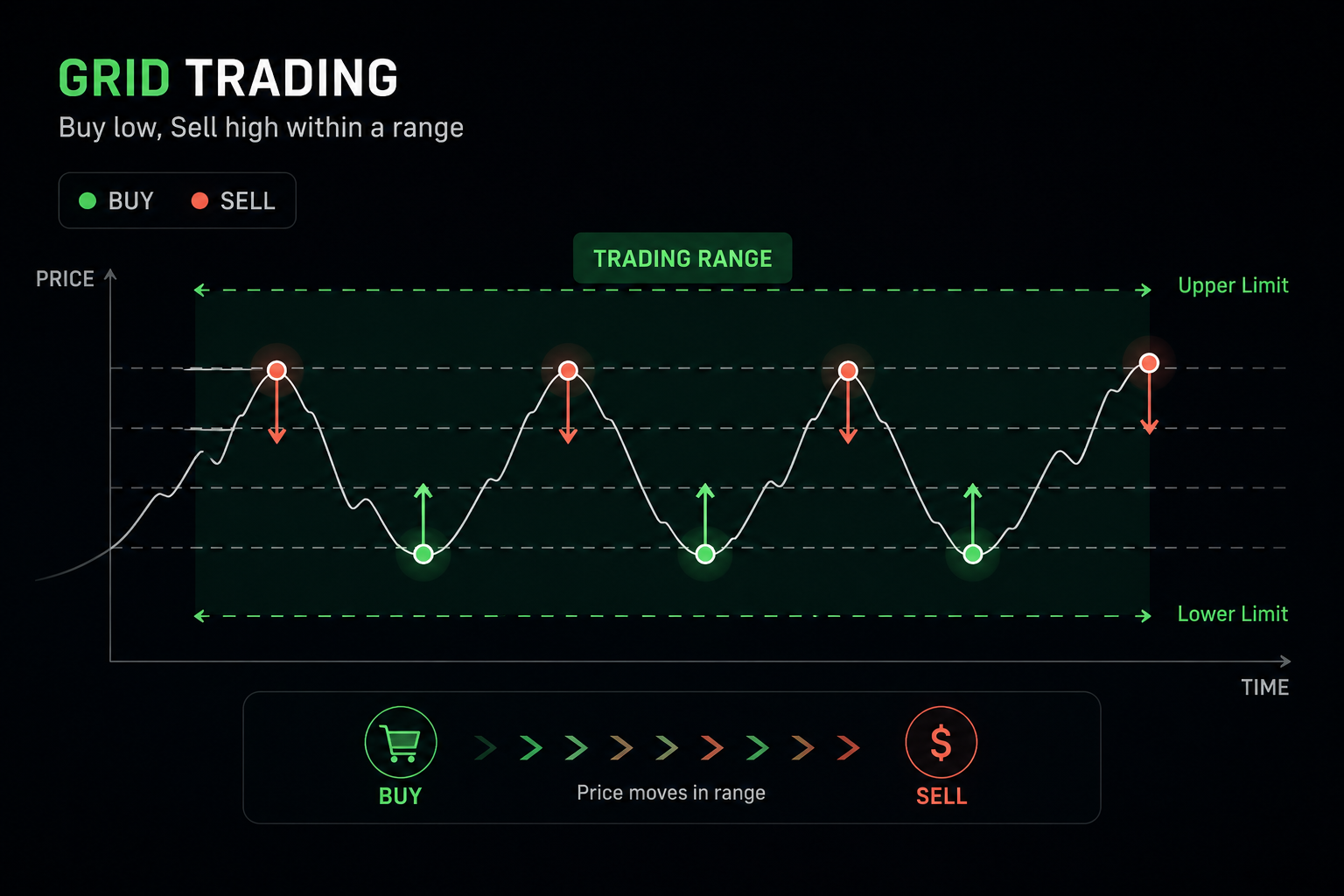
Grid trading and other range-based strategies are often better suited to sideways markets. When prices repeatedly move between relatively clear upper and lower boundaries, layered orders can capture multiple price swings. A grid strategy defines a price range in advance and places buy and sell orders at different levels. Its focus is not predicting the next candlestick but using repeated movement within the range.
The most important grid-trading decision is not how to add more grid levels, but when not to use a grid. If price breaks persistently beyond the original range and develops a clear trend, the strategy’s underlying assumption may no longer hold. If the range is too narrow, fees and slippage from frequent trades can also reduce the actual result. Before deploying a grid, first determine whether the market is genuinely range-bound.
For more on how grids work, their parameters, and their risks, read Complete Grid Trading Tutorial: Automating Range-Bound Trades.
Which Strategy Suits Long-Term Allocation?
Traders who do not want to make frequent short-term price decisions may consider DCA. Its core principle is to invest in installments according to a fixed schedule or predetermined plan. Spreading purchases across time reduces the effect of relying on a single entry point, making it more suitable for people with a longer time horizon.
DCA does not mean that a falling asset will inevitably become profitable, nor does it remove the asset’s market risk. Continued purchases can still produce losses if the asset performs poorly over the long term. In a rapidly rising market, installment purchases can also produce a different result from a lump-sum investment. DCA is therefore best understood as a capital deployment and timing-management method, not a guaranteed-return strategy.
For a closer look at its mechanics and applications, read DCA Strategy Explained: Using Time to Manage Market Volatility.
Which Strategies Suit a Trending Market?
A trending market is characterized by a relatively clear price direction over a period of time. Trend trading seeks to identify that direction and find opportunities aligned with it. It is not one specific entry method but a broader framework in which breakout trading and pullback trading can both serve as execution approaches.
The three can be understood as a continuous analytical process: first determine whether a trend exists, then observe whether price breaks a key level, and finally look for an appropriate entry during a pullback as the trend develops. This is more useful than memorizing the three strategy names separately because one price move may involve trend, breakout, and pullback phases.
For a systematic introduction, read Trend Trading Strategy: A Framework for Following the Market. For key-level breaks, continue with Breakout Trading Strategy: Identifying Critical Expansion Points. For entry timing within a trend, see Pullback Trading Strategy: Finding Lower-Risk Trend Entries.
When Is Arbitrage Trading Suitable?
Arbitrage seeks to capture price differences between markets, trading pairs, or contracts through a corresponding combination of trades. Common forms include cross-market arbitrage, spot-futures arbitrage, and triangular arbitrage based on relationships among several trading pairs.
A common misconception is that seeing a price difference is the same as seeing a profit. Actual execution must account for trading fees, transfer costs, slippage, and price changes during execution. If the spread does not cover all these costs, a theoretical opportunity may have no practical value. The relevant figure is therefore the net spread after all execution costs, not the simple difference between two displayed prices.
To learn about different cryptocurrency arbitrage methods, read Introduction to Arbitrage Strategies: Cross-Market, Spot-Futures, and Triangular Arbitrage.
How Does Funding Rate Arbitrage Differ From Other Arbitrage?
Funding rate arbitrage centers on the funding mechanism used by perpetual contracts. A common approach combines spot and derivatives positions to hedge part of the directional price exposure while attempting to collect funding payments. Unlike conventional cross-market arbitrage, the opportunity mainly arises from contract funding rates and the structure of the hedge.
Funding rate arbitrage should not be treated as “stable income” or “risk-free arbitrage.” Funding rates change with the balance between long and short demand, while basis movements, fees, liquidity, margin requirements, and liquidation risk can all affect the outcome. An apparently hedged position therefore still requires active risk management.
For more detail, read Funding Rate Arbitrage Strategy: Mechanics, Returns, and Risks.
How Does Automated Trading Differ From Manual Trading?
Automated trading follows predefined rules; it does not allow a bot to predict the market for the user. A trading bot can continuously monitor conditions and execute orders when its criteria are met, making it particularly useful for clearly defined strategies that require continuous execution or are vulnerable to emotional interference.
Automation does not automatically reduce market risk. If the rules do not suit current conditions, a bot will merely execute an unsuitable strategy more consistently. Before using one, confirm the strategy’s applicable conditions, exit rules, and risk controls.
For more on bot types and operating logic, read Complete Guide to Cryptocurrency Trading Bots. If you want to reduce independent decision-making by following other traders, see Copy Trading: From Beginner to Advanced.
What Is the Difference Between Algorithmic and Quantitative Trading?
Algorithmic trading emphasizes having software execute clearly defined trading rules. Quantitative trading generally goes further by using historical data, statistical analysis, backtesting, and strategy optimization to study a trading system. Put simply, algorithmic trading focuses on how software executes rules, while quantitative trading focuses more on using data to validate and improve those rules.
If you are new to programmatic trading, begin by translating a vague idea into explicit rules: when a signal appears, when to exit, how to size positions, and how to control risk. You can then consider implementing it in Python. At the quantitative stage, you must also account for trading costs, slippage, out-of-sample testing, and overfitting. Otherwise, a strategy that performs well in a historical backtest may fail to produce similar results in live markets.
To begin with Python and strategy execution, read Introduction to Algorithmic Trading: Building Strategies With Python. For backtesting and optimization, continue with Introduction to Quantitative Trading: Backtesting Systems and Strategy Optimization.
How Should Beginners Start Choosing a Trading Strategy?
Beginners do not need to learn every trading strategy at once. A more practical approach is to identify your objective and available time, then choose a set of rules you genuinely understand. Long-term allocators can begin with DCA, traders interested in market direction can start with trend trading, and those studying sideways conditions can explore grid trading.
Whatever strategy you choose, understand three questions first: Why might it work, under what conditions might it fail, and how will you exit when it fails? A method that only explains when to buy, without defining when to stop, how to size a position, or how to respond to abnormal conditions, is not yet a complete trading plan.
Frequently Asked Questions
Which Cryptocurrency Trading Strategy Is Best?
There is no “best” strategy for every market. Different methods address different environments and objectives. Choose based on your time horizon, risk tolerance, capital-management approach, and execution ability rather than simply comparing historical returns.
Is Grid Trading Suitable for Beginners?
Beginners can learn grid trading, but they first need to understand the price range, number of grid levels, capital allocation, and the risk of price leaving the grid. Grid strategies depend on range-bound movement and may stop being suitable when the market shifts into a sustained one-way trend.
Does DCA Guarantee a Profit?
No. DCA spreads purchases over time to reduce the pressure of making one perfectly timed entry, but it cannot eliminate downside risk or guarantee a profit. Whether it is suitable also depends on your investment horizon, budget, and the risk of the selected asset.
How Are Trend, Breakout, and Pullback Trading Related?
Trend trading is the broader framework, while breakout and pullback trading can be specific entry approaches within it. In practice, a trader may identify a trend, observe a break of a key level, and then look for an opportunity during a pullback. Each stage can still produce a failed signal.
Is Arbitrage Trading Risk-Free?
No. Arbitrage can reduce some directional price exposure, but fees, slippage, liquidity, funding-rate changes, execution delays, and hedge failures can still cause losses. Evaluate the result after all real costs rather than looking only at the headline spread.
Can a Trading Bot Make Money Automatically?
No. A bot is only a tool that executes trading rules; it cannot guarantee that those rules are effective. If the strategy is flawed, automation may cause the same bad trades to be executed repeatedly. Understand the strategy and its risk controls before deciding whether to automate it.
Risk Warning
Cryptocurrency markets are highly volatile, and every trading strategy can produce losses. Historical performance, simulations, and backtest results do not represent future performance. Grid, DCA, trend, breakout, pullback, arbitrage, copy trading, algorithmic, and quantitative strategies each have specific conditions and failure modes. Before using them, understand market volatility, liquidity, execution, capital, and leverage risks, and size positions according to your circumstances.
Leitura recomendada
Veja mais

service@hotcoinex.io
Product@hotcoin.com
Business@hotcoin.com
Casecn@hotcoin.com