Copy Trading: From Beginner to Advanced
Copy trading is a social investing model that lets you automatically mirror the entries, exits and risk controls of experienced professional traders, known as master traders. It is not the same as handing your money to someone else to manage: the platform links your account to the master trader's account, so when they buy you buy, when they sell you sell, and the whole process is mirrored proportionally.
Its core value is that beginners who lack expertise or have no time to watch the market can take part by copying the strategies of skilled traders, while also getting a window into how experienced operators think.
How Copy Trading Works

The underlying logic of copy trading has three parts: the roles, the synchronization rules and the fee structure.
Two core roles are involved. The master trader is an experienced trader whose strategy and live results (win rate, drawdown, return) are shown publicly on the platform. The follower (also called a copier) is the user who chooses to copy that trader; they only need to set the copy parameters and the system executes automatically.
Platforms differ slightly in how they synchronize trades and charge fees:
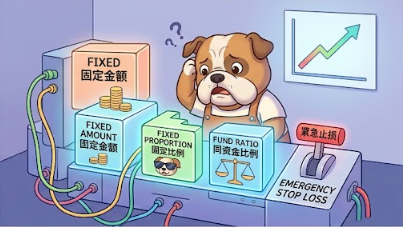
Synchronization: the system captures the master trader's signal in real time, then places orders in the same direction in the follower's account according to the ratio the follower configured. Hotcoin offers four modes: fixed amount, fixed ratio, fixed quantity and same fund ratio, each carrying a different level of risk exposure.
Fee structure: master traders usually take a share of the follower's net profit. Bybit, for example, takes a 10%~15% profit share depending on the master trader's tier, which encourages sustained profitability rather than churning trades.
How to Copy Trade on Hotcoin
According to Hotcoin's official documentation, the copy trading process breaks down into the following key steps.
Step 1: Choose a copy mode
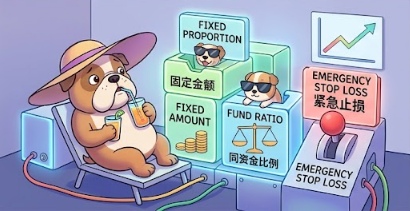
Hotcoin offers four ways to copy, which you can pick based on your capital and risk appetite:
Fixed amount: no matter how much the master trader commits, each of your trades uses a fixed amount (for example 50 USDT). Best for beginners, with controllable risk.
Fixed ratio: follow a multiple of the master trader's position size (if the master trader buys 10 contracts and you set the ratio to 5, you buy 50). Common among more advanced users.
Same fund ratio: calculated automatically from the ratio between your funds and the master trader's, perfectly replicating their position management (if the master trader uses 10% of capital, so do you). Most recommended, but a balance that is too small may cause the copy to fail.
Fixed quantity: buy a set number of contracts on every trade, suited to situations where you want precise control over position size.
Step 2: Set your risk controls
Set a copy trading stop loss before you start (for example, stop copying automatically once losses reach 20%). This is an extra layer of protection that is separate from the master trader's own stop loss.
Step 3: Monitor and exit
If the master trader's strategy stops working or you need to adjust, you can stop copying at any time via [My Copy Trading] → [Current Master Trader]. Note that when you stop copying, all open positions tied to that master trader are closed automatically at market price. You can also open a position in the opposite direction to hedge existing copied positions, but be aware that the system treats this as an independent trade and it is no longer covered by the copy trading logic.
Pros and Cons of Copy Trading
Key Advantages
Low barrier to entry: beginners can take part in the market without mastering complex technical analysis.
Saves time: no need to watch charts 24 hours a day or place trades manually, since the strategy runs automatically.
Diversification: you can copy several master traders using different strategies at the same time, diversifying at the strategy level.
Learning opportunity: by observing a master trader's reasoning, position management and risk control, you gradually build your own trading knowledge.
Key Risks
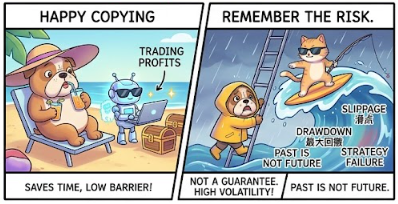
Past performance does not indicate future results: a high historical return may simply be a product of a particular market environment, and a strategy that stops working or a shift in market style can lead to losses. Master traders do not guarantee future results, nor that you will avoid losses.
Execution delay and slippage: there is a time gap between the master trader's order and its execution in your account, and it varies significantly between platforms. In extremely volatile markets your fill price can differ substantially from the master trader's, affecting your actual return.
Conflicts of interest and churning: some platforms pay master traders commissions based on copied capital or trading fees, which can encourage frequent trading to farm commissions rather than genuinely profit followers.
High leverage risk: many master strategies use high leverage, which magnifies gains and magnifies risk just as much. A single misjudgement can cause major losses to copied funds, or even wipe out the account.
Crowding can break a strategy: if a strategy is followed by a large amount of capital, its own market impact can erode the results.
How to Screen for Good Master Traders
Do not fixate on the single number of a high return. To judge whether a master trader is worth following, weigh the following dimensions together:
Length of trading history: look for at least 90 days of live trading records, not just recent highlights. The longer the record, the more luck is ruled out.
Maximum drawdown: this matters more than return. Drawdown represents the largest unrealized loss you might have to sit through. Choose a drawdown you can face calmly instead of following someone just because their returns look high.
Risk-adjusted return metrics: if the platform provides Sharpe ratio, Sortino ratio and similar metrics, use them first to tell a genuinely steady strategy apart from a high-risk strategy that got lucky.
Trading style and holding period: confirm that the master trader's style (short term, swing or long term; trending or range bound; whether high leverage is used) matches your own risk tolerance, so that a style mismatch does not throw off your discipline.
FAQ
Q1: How is copy trading different from giving my money to someone to manage?
The difference is significant. With copy trading your funds always stay in your own account and are never transferred to the master trader's wallet. The master trader can only control trading instructions and cannot withdraw your assets. You also control the exit: you can stop copying and close positions at any time.
Q2: Will my profit be exactly the same as the master trader's?
Not necessarily. In practice slippage can cause differences in fill price, especially in volatile markets. Choosing a platform with low execution latency, such as within 50 milliseconds, can reduce the impact of slippage. If you use fixed amount mode rather than a ratio mode, your position risk structure may also differ from the master trader's.
Q3: Does copy trading guarantee returns?
No. Any copy trading offer that promises guaranteed principal and guaranteed returns is a scam signal. A master trader's past performance does not guarantee future results, and a strategy that stops working or an extreme market can lead to losses. Copy trading is only an assistive tool; there is no shortcut that always makes money.
Q4: How much capital should I put into copy trading?
Going all in is not recommended. Allocate part of your total capital to copy trading and follow several master traders with different styles at the same time to spread risk. A sufficient account balance also matters: if the calculated copy amount is below the minimum contract unit, the copy will fail.
Related tutorials:
Recommended reading:
Recommended
View more