
2025 Overview of Major Layer1 Blockchain Ecosystems
There is no single ranking that determines which major blockchain is strongest in 2025. Bitcoin emphasizes value settlement, Ethereum centers on smart contracts and Layer2, while other networks use parallel execution, multichain systems, or application-specific chains to pursue different performance trade-offs.
This article uses 2025 as a reference point without relying on fast-changing rankings such as token prices, TVL, or daily transaction counts. It instead compares how networks reach consensus, execute transactions, fund security, and introduce new trust assumptions as their ecosystems scale.
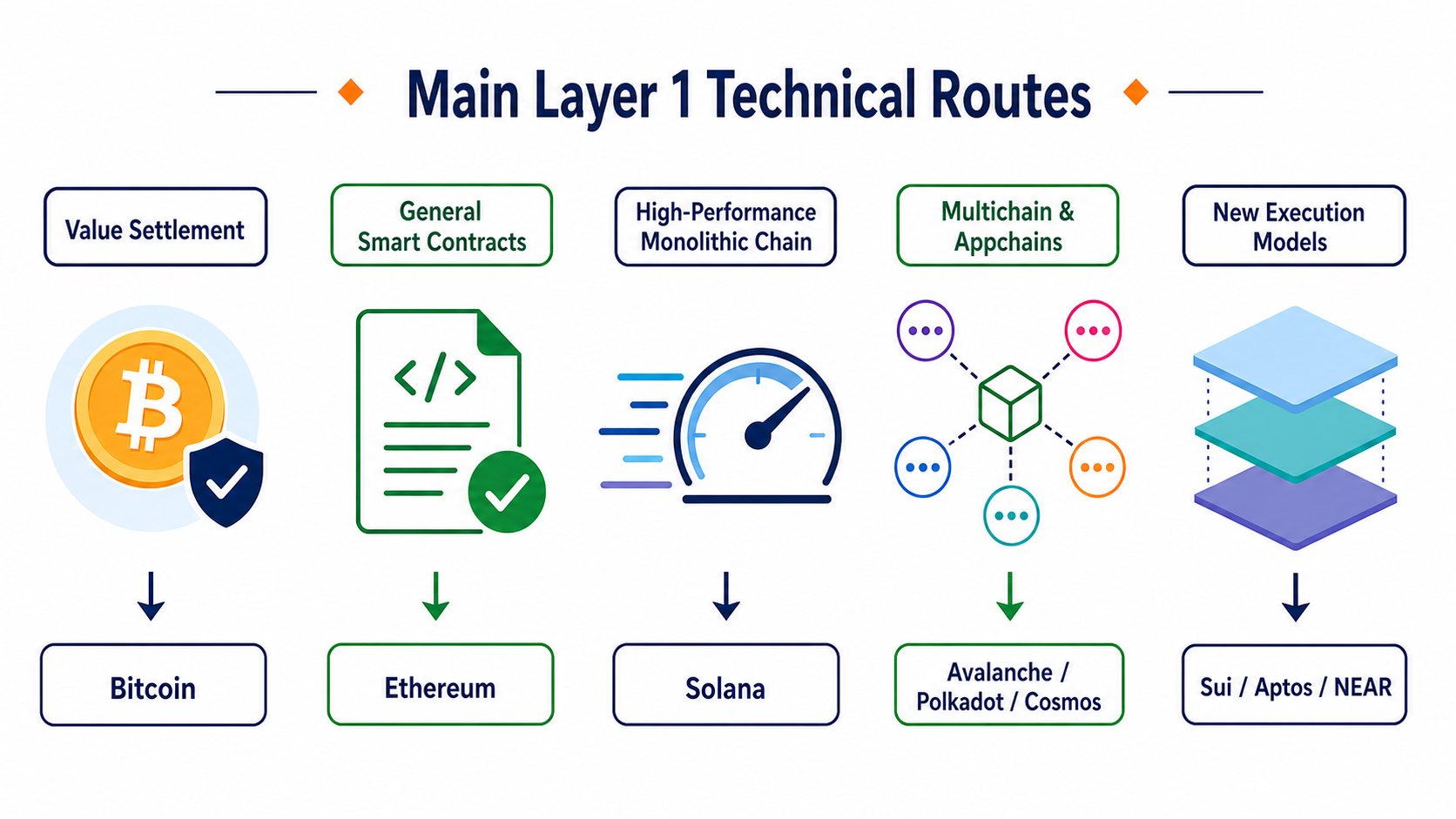
What Should You Compare Between Layer1 Blockchains?
A Layer1 is a base network that directly maintains its ledger, enforces protocol rules, and provides native security. Differences extend beyond TPS to account models, virtual machines, finality mechanisms, validator requirements, and cross-chain designs.
| Dimension | Questions to ask |
|---|---|
| Source of security | Does the network rely on computing power, staked assets, delegated validators, or shared security? |
| Data model | Does it use UTXO, account state, objects, or sharded state? |
| Execution environment | Does it support EVM, Move, Wasm, or specialized scripts? |
| Finality | Do transactions depend on confirmation depth or validator votes for finality? |
| Scaling path | Does it increase single-chain capacity, shard, use application chains, adopt Layer2, or run multiple chains in parallel? |
| User requirements | Are wallets, addresses, gas tokens, and cross-chain steps easy to understand? |
Peak throughput alone can hide hardware requirements and state growth. Validator counts can also be misleading if one operator controls several nodes or if staking and RPC infrastructure are concentrated.
How Do Major Blockchains Differ in Their Core Roles?
| Network | Main technical role | Native asset | Typical trade-off |
|---|---|---|---|
| Bitcoin | PoW value transfer and censorship-resistant settlement | BTC | Limited scripting, with stability strengthened through confirmation depth |
| Ethereum | General-purpose smart contracts and modular scaling | ETH | Limited L1 capacity and extensive ecosystem reliance on Layer2 |
| Solana | Highly parallel execution over one global state | SOL | Higher-performance node requirements and programs that must declare account access |
| BNB Smart Chain | EVM compatibility and shorter confirmation times | BNB | A smaller active validator set, trading open participation for efficiency |
| TON | Asynchronous messaging and dynamic sharding | TON | Multichain messaging increases development and debugging complexity |
| Avalanche | Primary Network and sovereign Avalanche L1s | AVAX | Each L1 can define its own validator set, so security boundaries differ |
| Polkadot | Relay-chain shared security and parachains | DOT | A layered architecture that requires understanding Coretime and XCM |
| Cosmos | Sovereign application chains and IBC interoperability | Each chain's native asset | Each chain has independent security; the ecosystem is not one shared validator set |
| Polygon | Polygon PoS and the Agglayer aggregation path | POL | Different products have distinct settlement and security models |
| Cardano | Ouroboros PoS and EUTXO | ADA | Research-driven design with an application model unlike account-based EVM chains |
| Sui, Aptos, and NEAR | New approaches using objects, parallel execution, or sharding | SUI, APT, NEAR | Different performance designs whose ecosystem maturity must be assessed separately |
Why Do Bitcoin and Ethereum Remain Two Benchmarks?
Bitcoin concentrates on permissionless value transfer, fixed issuance rules, and PoW security. Its UTXO model and limited scripting reduce the base layer's general-purpose execution scope but keep its system goals clear. Read the Bitcoin deep dive for more detail.
Ethereum extends blockchain into a programmable state machine. The EVM, smart contracts, and general account state support DeFi, stablecoins, and on-chain applications, while execution costs and state growth have pushed the ecosystem toward Rollups and other Layer2 systems. See the Ethereum deep dive for more information.
They are not substitutes on a single dimension. A useful comparison first identifies whether the goal is a store of value, base settlement, general-purpose applications, or high-frequency interaction.
How Does the High-Performance Single-Chain Approach Work?
Solana separates programs from data accounts. Transactions declare which accounts they will read and write, allowing non-conflicting transactions to be scheduled in parallel. It aims for high capacity within one shared state instead of splitting activity across many independent chains.
BNB Chain uses EVM compatibility to reduce migration costs and a PoSA validator set to provide shorter block times. TON uses asynchronous messaging and sharding, with Telegram Mini Apps and wallets serving as application access points.
High throughput does not mean every transaction can run in parallel. Popular contracts competing for the same state, validator hardware, network bandwidth, and account locks can still create bottlenecks.
How Do Multichain and Application-Chain Approaches Differ?
Avalanche lets projects operate Avalanche L1s with independent validator sets. Official materials still retain the term Subnet, but recommend the L1 architecture for new chains, so not every custom chain should be described as a legacy subnet.
Polkadot lets parachains use shared security provided by relay-chain validators and uses XCM for cross-consensus messaging. Cosmos provides Cosmos SDK, CometBFT, and IBC, while application chains generally maintain their own validator sets and economic security.
Shared security reduces the burden of establishing a new validator set but introduces resource-allocation and coordination layers. Sovereign application chains gain more control over parameters but must manage their own validators, token economics, and upgrade governance.
How Do Ethereum's Scaling Ecosystem and Other L1s Differ?
Polygon is often described broadly as an Ethereum scaling solution, but Polygon PoS, Agglayer, and the discontinued Polygon zkEVM Mainnet Beta are separate systems. To assess asset security, identify the specific chain, bridge, and exit mechanism.
Cardano uses EUTXO and Ouroboros, producing different transaction predictability from account-based chains. Sui, Aptos, and NEAR approach scaling through object models, parallel execution, and sharding, so they should not be reduced to one TPS ranking.
For more on the settlement relationship between Layer2 and Layer1, read the Layer2 scaling overview.
How Should You Choose a Blockchain?
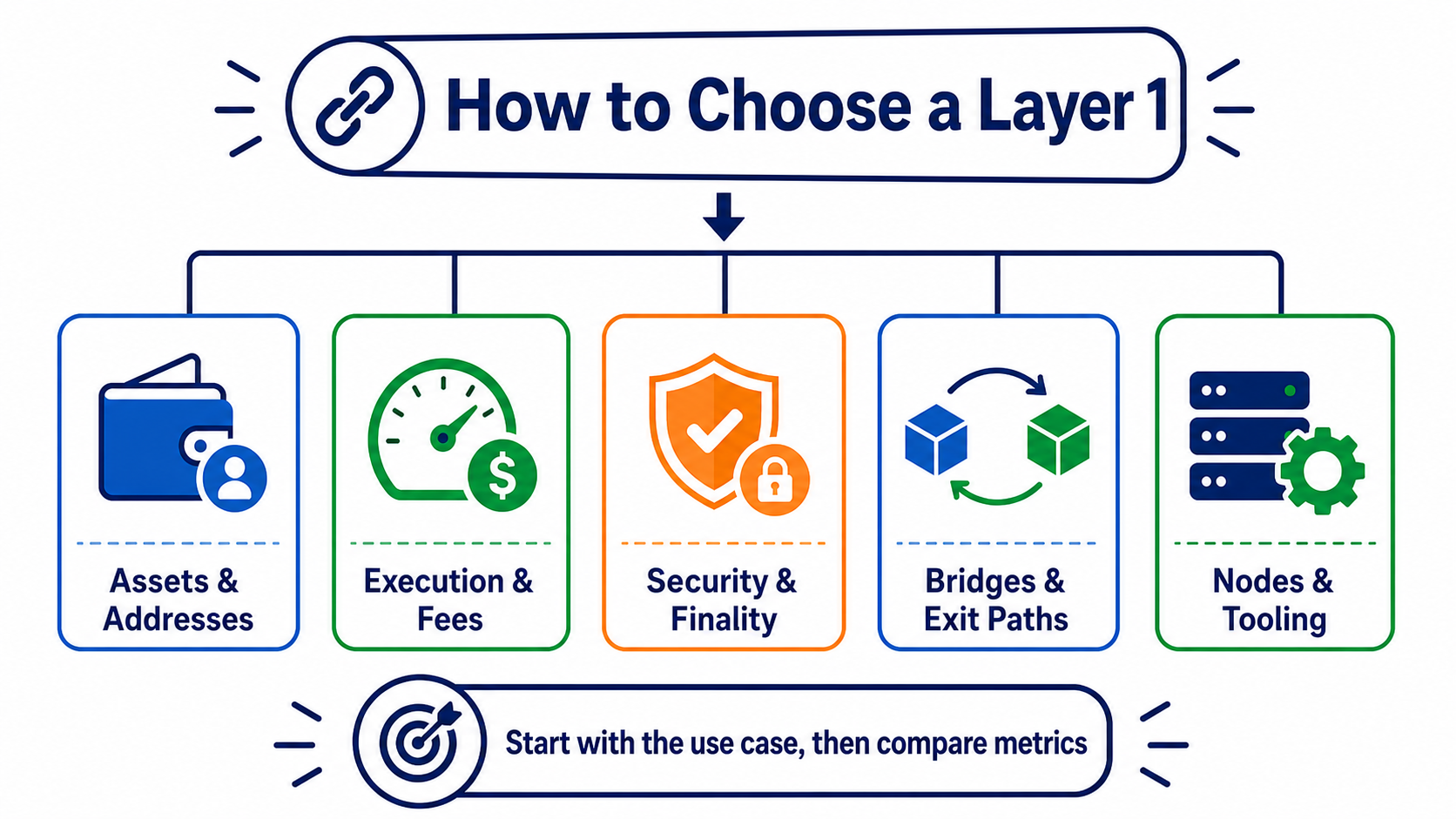
Start with the task rather than the token. For transfers, confirm the recipient's supported chain and address format. For applications, verify the wallet, gas token, contract address, and official entry point. For cross-chain activity, also inspect the bridge's verification method and failure-exit path.
| Use case | Check first |
|---|---|
| Long-term holding and transfers | Self-custody support, confirmation rules, and whether the address matches the network |
| DeFi or stablecoins | Contract audits, asset issuer, oracle, liquidity, and bridge source |
| Frequent on-chain interaction | Actual fees, congestion behavior, RPC availability, and failed-transaction handling |
| Application deployment | Execution environment, developer tools, state model, indexing services, and upgrade permissions |
| Running a node | Hardware, bandwidth, storage growth, staking threshold, and penalty rules |
| Cross-chain use | Source-chain finality, message verification, custody assumptions, and emergency pause authority |
Assets with the same name may exist on several networks. Choosing the wrong network is not equivalent to entering an incorrect transfer memo; recovery depends on whether the recipient controls the corresponding address and supports that chain.
Frequently Asked Questions
Why Are Networks Such as Tron and XRP Ledger Not in the Main Table?
This article selects representative technical approaches according to the established content cluster. It is not a complete ranking by market capitalization or activity. Omission does not mean a network is unimportant and does not imply anything about asset performance.
Is a Blockchain's Native Token Equivalent to Stock in the Project Company?
Usually not. A native token may pay gas, support staking, or enable governance, but it does not automatically grant equity, profit-sharing rights, or a debt claim. Specific rights depend on the protocol and applicable rules.
Can TVL Prove That a Blockchain Is More Secure?
No. TVL reflects the value deposited into protocols under a particular methodology and can be affected by token prices, double counting, and bridged assets. Network security must be assessed separately through consensus costs, validator distribution, and client risks.
Can the Same Wallet Address Be Used on Every EVM Chain?
The address format may be identical, but on-chain states are independent. A matching address does not make a transaction cross-chain automatically or guarantee that an exchange or wallet supports every network.
Inirerekumendang pagbabasa
Tingnan ang higit pa
service hotcoin.com
producthotcoin.com
businesshotcoin.com
casecnhotcoin.com