
TON Blockchain: The Web3 World on Telegram
TON is a smart contract network built around asynchronous messaging and multichain sharding. It can integrate with Telegram Mini Apps and wallets, but the Telegram interface, application servers, and TON's on-chain state operate at separate layers.
Opening an app in Telegram does not mean that every step happens on-chain. An app can use a conventional web backend and rely on TON only for asset transfers, signatures, or contract calls.
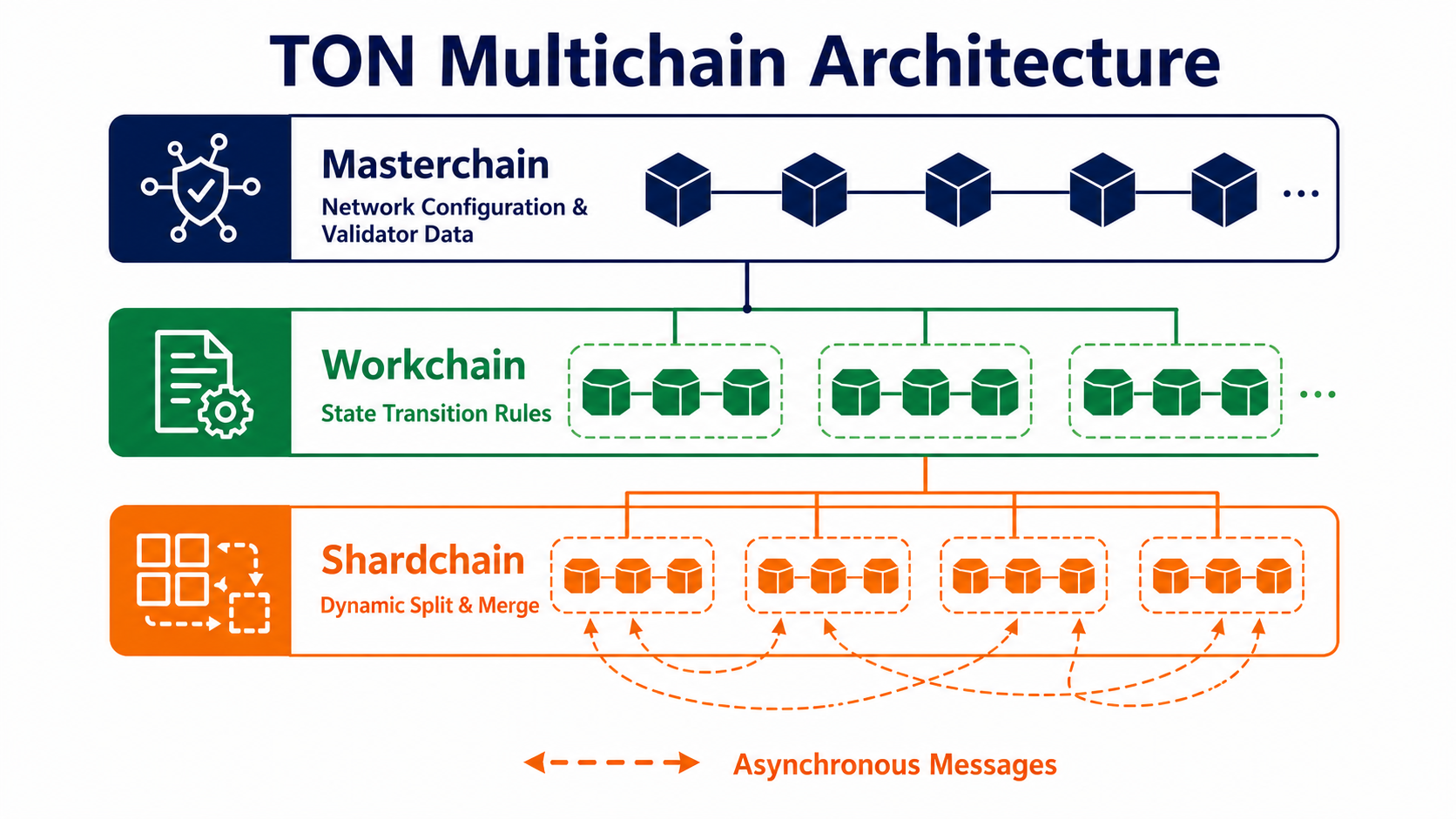
How Does TON's Multichain Architecture Work?
In TON's design, the Masterchain stores network-wide configuration and validator information. A Workchain can define its own state transition rules, while Shardchains divide a workchain's state by account ranges for parallel processing.
Shards can split or merge as demand changes. Smart contracts interact through messages, so cross-shard calls are inherently asynchronous rather than completing within a single synchronous call stack.
| Component | Primary role |
|---|---|
| Masterchain | Records network configuration, validators, and workchain summaries |
| Workchain | Defines a set of accounts, a virtual machine, and state rules |
| Shardchain | Processes part of a workchain's account state |
| Accountchain | Represents the state and message history of one account |
| Message | Transfers operations and value between accounts and contracts |
The asynchronous model supports horizontal scaling, but it also requires applications to handle delayed messages, failure responses, and multistep state changes. Sending the first message should not be treated as proof that the entire operation has finished.
What Role Does Toncoin Play in the Network?
Toncoin is TON's native asset. It is used to pay transaction and smart contract execution fees, participate in validator staking, and access network services.
When a TON contract receives a message, it must pay computation, storage, and forwarding fees. A poorly designed application may fail because the message lacks sufficient value or execution conditions are not met, so developers must account for remaining value and error handling.
Jetton is a common fungible token standard on TON. A Jetton generally consists of a master contract and a separate wallet contract for each holder. When verifying an asset, users should therefore check the Jetton Master address instead of relying only on its name or icon.
How Do Telegram Mini Apps Connect to TON?
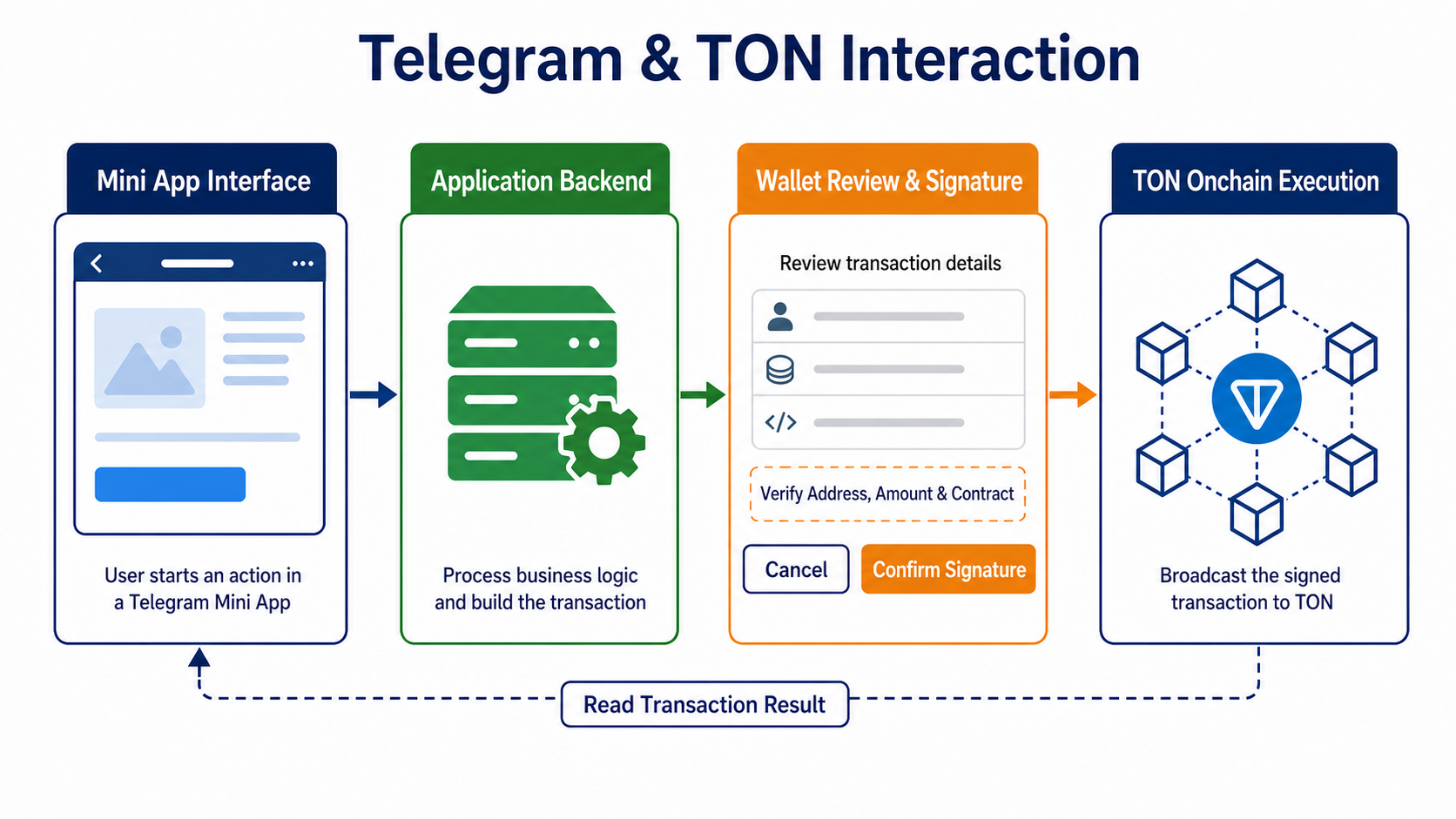
A Telegram Mini App is a web application that runs inside Telegram. It can use TON Connect or AppKit to request a wallet connection, signature, or transaction from the user.
In a typical flow, the app creates a transaction request, the wallet shows the destination address and amount, and the user approves it before the wallet signs and broadcasts the transaction. The app then reads the on-chain result. Telegram itself does not hold the private keys of a user's self-custody wallet.
| Layer | What it can do | What the user should verify |
|---|---|---|
| Telegram interface | Opens a Mini App and passes login context | Bot name, domain, and app source |
| Application backend | Provides pages, business logic, and off-chain data | Privacy, account linking, and service permissions |
| Wallet | Displays and signs transaction requests | Address, amount, token, and contract action |
| TON blockchain | Executes messages and records state | Transaction status, fees, and final result |
For more use cases that combine social access with on-chain assets, read the SocialFi guide.
What Are the Strengths and Limitations of the TON Ecosystem?
Telegram provides a ready-made distribution channel, Mini Apps require no separate installation, and wallet connections can be embedded in an application's flow. TON's messaging model and sharding architecture are designed to serve large numbers of accounts and interactions.
This convenient entry point can also amplify the risks of phishing bots, fake airdrops, and lookalike apps. Users should not judge trustworthiness solely by Telegram's familiar blue interface or the size of a group. Every signature request should be checked in the wallet for its destination and permissions.
Developers must also handle asynchronous messages, contract balances, shard routing, and indexing delays. An on-chain transaction may succeed before the application page updates, so its status should be cross-checked with a block explorer and the contract state.
To see where TON fits among major public blockchains, read the 2025 overview of leading Layer 1 ecosystems.
Frequently Asked Questions
Is a Telegram Account the Same as a TON Wallet?
No. A Telegram account is used for communication and application login, while a TON wallet is controlled by cryptographic keys. Some wallets can be integrated into Telegram, but their account recovery and asset control rules are still determined by the wallet.
Why Can a TON Transaction Contain Multiple Internal Messages?
One external request can trigger asynchronous messages among several contracts. A block explorer displays the resulting message chain, and each step can have its own fees and execution status.
Is Jetton Exactly the Same as ERC-20?
No. Both can represent fungible tokens, but TON Jettons use a master contract and holder wallet contracts, so their balance and transfer logic differs.
Will Deleting Telegram Cause My Toncoin to Be Lost?
It depends on the wallet type and backup method. Assets in a self-custody wallet are controlled through a recovery phrase or other keys. If no valid backup exists, deleting the app may make wallet access impossible to restore.
Recommended
View more
service hotcoin.com
producthotcoin.com
businesshotcoin.com
casecnhotcoin.com