
Avalanche: Subnet Architecture and Ecosystem
Avalanche is a heterogeneous network comprising the Primary Network and multiple sovereign Avalanche L1s. Legacy Subnets remain supported, but Avalanche now recommends converting existing chains to, or deploying new chains as, Avalanche L1s.
For that reason, “Subnet architecture” alone no longer fully describes the current system. An Avalanche L1 can have its own validator set and token economy while synchronizing with the P-Chain for network registration and interoperability.
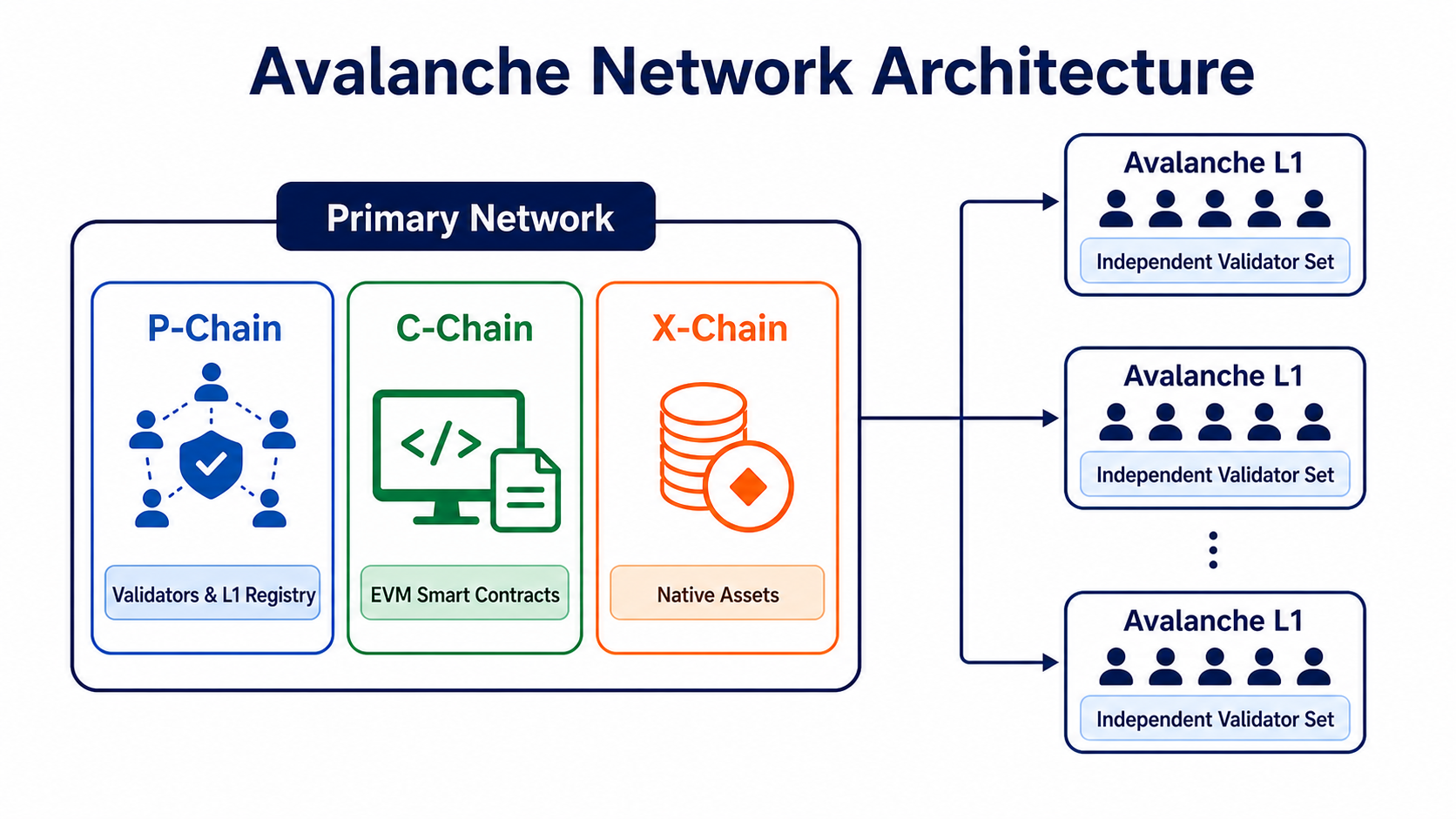
Why Does the Primary Network Contain Three Chains?
The Avalanche Primary Network is secured by one validator set but operates three blockchains with different purposes.
| Chain | Primary purpose | Execution environment |
|---|---|---|
| P-Chain | Manages validators, staking, and Avalanche L1 registration | PlatformVM |
| C-Chain | Deploys Solidity smart contracts and EVM applications | Coreth EVM |
| X-Chain | Creates and exchanges native assets | AvalancheVM |
The C-Chain uses EVM-compatible addresses and tools, making it the network most DeFi users encounter. P-Chain addresses, transaction types, and purposes differ. When transferring AVAX to an exchange, users must still select the correct network even though the asset is AVAX on both chains.
Primary Network validators must validate its base chains together. Other Avalanche L1s can define their own validator rules and do not automatically share the C-Chain's validator distribution.
How Are Avalanche Consensus and Snowman++ Related?
The Avalanche consensus family repeatedly queries subsamples of validators, gradually building preference and reaching probabilistic finality. Snowman++ applies this approach to linear blockchains, making it suitable for the C-Chain, P-Chain, and common smart-contract execution environments.
Unlike PoW, it does not have miners competing over hashes, nor does every node exchange messages with every other node in each round as in classic PBFT. Security still depends on stake weight, network synchronization, implementation, and parameters. Fast finality does not let transactions bypass validation rules.
When validators observe conflicts, they repeatedly update their preference until an acceptance threshold is reached. Applications should still follow the network's recommended transaction status checks instead of treating a newly produced block as sufficient grounds to deliver irreversible assets.
Why Were Subnets Reframed as Avalanche L1s?
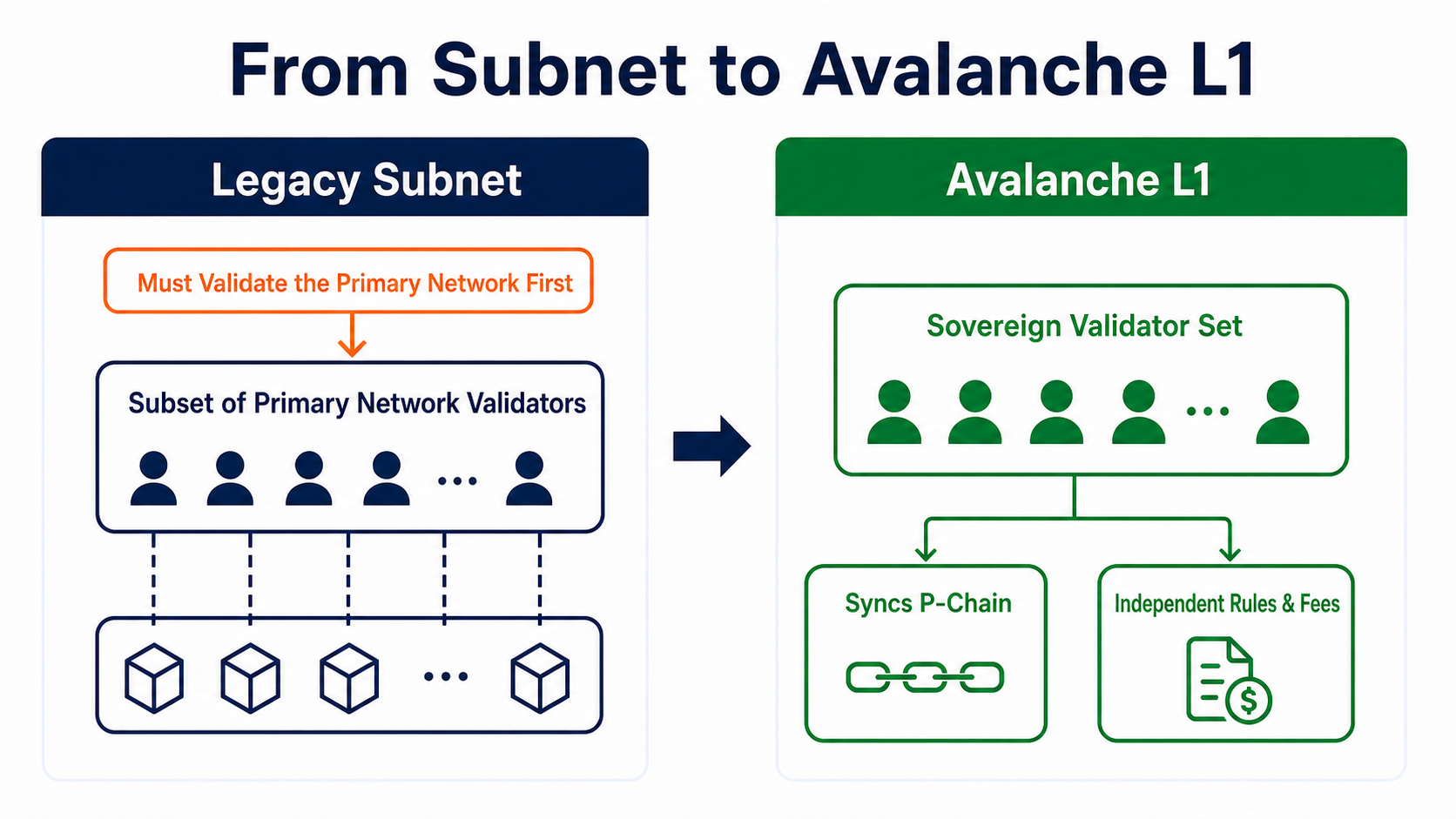
A legacy Subnet is a subset of Primary Network validators. Its members must first satisfy Primary Network validation and staking requirements before validating chains within the Subnet.
An Avalanche L1 has a sovereign validator set. Its validators do not have to validate the entire Primary Network, but they must synchronize with the P-Chain and pay ongoing interoperability fees. Each chain can define its membership, native gas token, virtual machine, and economic rules.
| Item | Legacy Subnet | Avalanche L1 |
|---|---|---|
| Validator source | Must be Primary Network validators | Uses an independent validator set |
| Primary Network requirement | Synchronizes with and validates P/C/X | Mainly synchronizes P-Chain registration data |
| Staking and fees | Affected by Primary Network staking thresholds | Can define independent rules and pays ongoing fees |
| Recommendation for new deployments | Still supported | Recommended architecture for new chains |
The terminology change reflects a shift in security and operational boundaries. When evaluating a project, determine whether it uses a legacy Subnet, has converted to an L1, or is simply deployed on the C-Chain.
What Trade-offs Come With Avalanche L1 Sovereignty?
An independent L1 can isolate application traffic, use permissioned validators, choose a custom gas token, and select its virtual machine. Games, institutions, and high-throughput applications therefore do not have to compete for the C-Chain's execution resources.
Sovereignty also means users cannot assume that every Avalanche chain shares the same validators or economic security. Moving assets across L1s requires messaging, bridges, or native interoperability protocols, and security depends on validation and asset issuance on both sides.
Avalanche's multichain approach can be compared with Polkadot and its shared security, or Cosmos and its sovereign appchains. For a broader overview, see the 2025 Overview of Major Layer 1 Ecosystems.
Frequently Asked Questions
Is AVAX a Different Token on the C-Chain and P-Chain?
No. Both belong to the same Avalanche native asset system, but the balances exist in different chain states. Cross-chain transfers require a compatible wallet to perform the appropriate operation, and the address formats may also differ.
Is Every Avalanche L1 EVM-Compatible?
No. Many L1s use Subnet-EVM, but the architecture supports other virtual machines and state transition rules. The answer depends on the chain's deployment configuration.
Does a New Avalanche L1 Automatically Inherit C-Chain Validators?
No. An L1 can use a sovereign validator set. It registers and interoperates through the P-Chain, but its security boundary is determined by its own validators and rules.
Has the Term “Subnet” Been Completely Retired?
No. The term Subnet still appears in code, transaction names, and legacy deployments, and official documentation continues to support it. However, current architectural guidance generally uses Avalanche L1 for the newer model.
Recommended
View more

service hotcoin.com
producthotcoin.com
businesshotcoin.com
casecnhotcoin.com