What Is Stagflation? Historical Cases and the Impact on Crypto Assets
Prices keep rising while the economy refuses to pick up. The media often calls this awkward combination "stagflation."
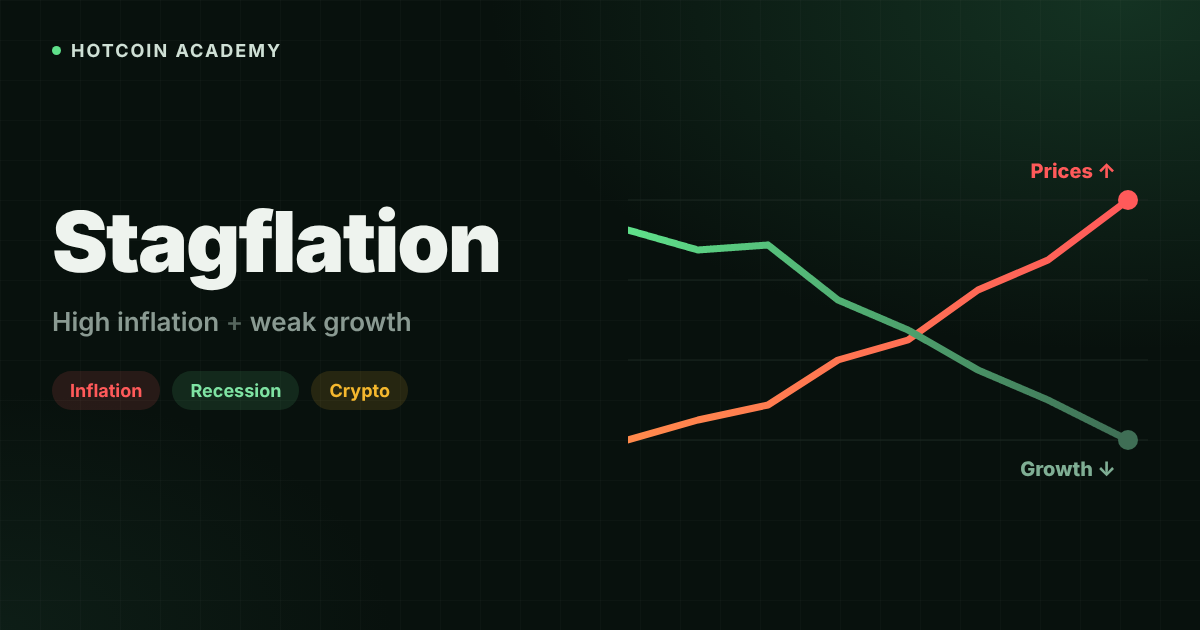
Stagflation broadly refers to stagnant or clearly slowing economic growth accompanied by persistently high inflation, and it often comes with pressure on employment / rising unemployment. It is harder to handle than "pure inflation" or "pure recession" because the usual policy tools pull against each other.
This article is for mechanism explanation only and is not a buy or sell recommendation.
Key Takeaways
- Stagflation is a situation where weak growth coexists with high inflation, often accompanied by rising unemployment; the English word stagflation combines stagnation and inflation.
- It is hard to cure because raising rates to fight inflation can worsen growth and employment, while cutting rates to stimulate the economy can make inflation harder to bring down.
- The major historical case most often discussed is the period around the 1970s, when supply shocks (such as a sharp rise in oil prices) intertwined with a policy dilemma.
- Crypto assets still lack a complete historical sample of a "classic stagflation cycle"; in the short term they are more often discussed within a risk-asset / liquidity framework, and "digital gold" remains a narrative rather than a guarantee.
What Does Stagflation Mean?
Stagflation describes a rare but particularly tricky macroeconomic combination: insufficient growth momentum (stagnation or a clear slowdown), while prices keep rising; the job market is also often under pressure at the same time.
The Cleveland Fed's inflation education explainer summarizes it as economic stagnation (higher unemployment, slowing growth) and rising inflation occurring at the same time, and notes that this runs counter to the intuition that "inflation usually appears when the economy is relatively strong." See its public explainer: Infographic on Inflation: Stagflation.
In terms of naming, stagflation (also known as stagflation) is an English blend of stagnation and inflation. The point is not the etymology itself, but the policy dilemma it marks: "growth and prices deteriorating at the same time."
Stagflation vs Inflation vs Recession: What's the Difference?
Here is a quick way to separate three concepts that are often confused:
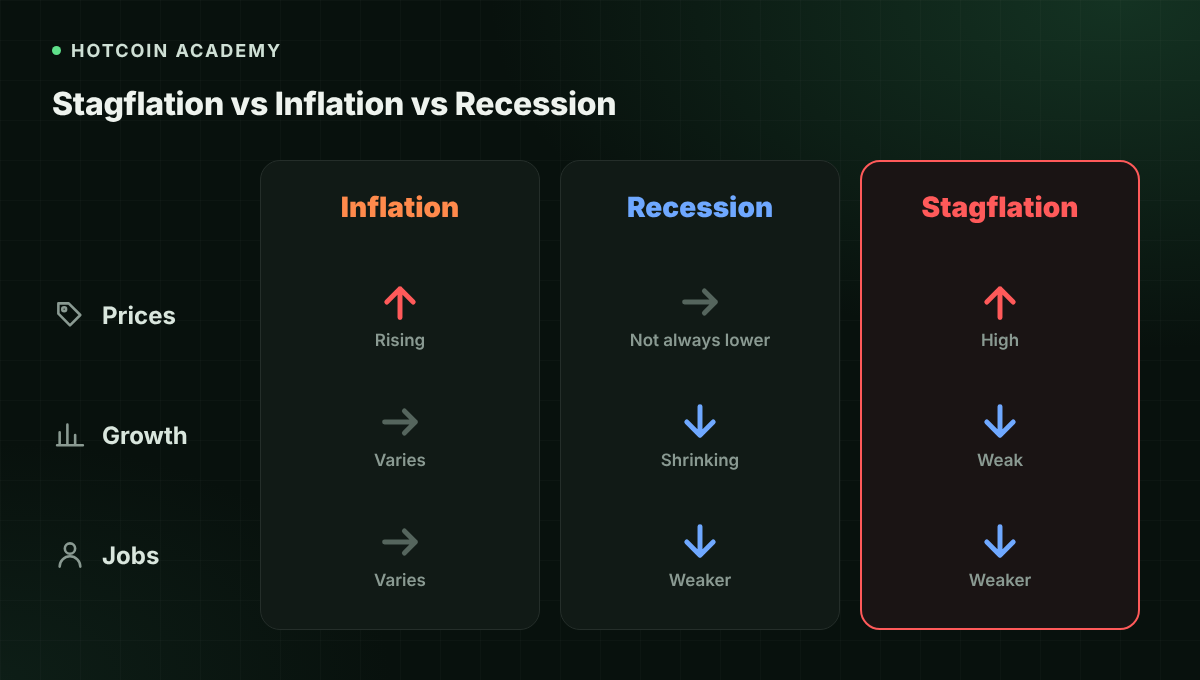
| Concept | How prices broadly move | How growth / employment broadly move | In one sentence |
|---|---|---|---|
| Inflation | Overall prices rise | Does not directly determine the direction of the economy | The purchasing power of money is eroded |
| Recession | Prices do not necessarily fall | Economic activity contracts, employment may weaken | Output and demand weaken |
| Stagflation | Inflation stays high | Growth is weak, often with rising unemployment | High prices + weak economy together |
Do not judge stagflation by a price increase in a single good, and do not slap the stagflation label on "one quarter of slower growth": prices, real growth, and employment need to be looked at together as trends, not concluded from a single day's headline.
Why Is Stagflation So Hard to Handle?
In discussions of common causes, supply shocks (key inputs suddenly becoming more expensive or scarcer, such as energy), inappropriate or misaligned policy mixes, and the inflation inertia left by prolonged excessive monetary easing are often mentioned together. When supply worsens, firms may raise prices and cut output / jobs at the same time, so prices and unemployment deteriorate together.
The policy dilemma follows:
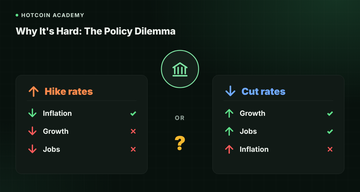
- Raising rates and tightening liquidity to fight inflation → borrowing and spending become more expensive, and growth and employment may worsen.
- Cutting rates and easing liquidity to rescue the economy → when supply is still tight, this may make inflation expectations harder to anchor.
This is exactly the core of the Cleveland Fed's emphasis on "why policymakers are especially worried about stagflation": standard tools pull in opposite directions for the two goals.
What Historical Cases of Stagflation Are There?
In public educational materials, around the 1970s is the period most often used to illustrate stagflation, especially in connection with supply shocks such as the sharp rise in global crude oil prices. The Cleveland Fed writes: the last major U.S. case was around the mid-1970s, when a sharp oil price rise drove broad price increases, inflation exceeded 12%, and the unemployment rate peaked at about 9%.
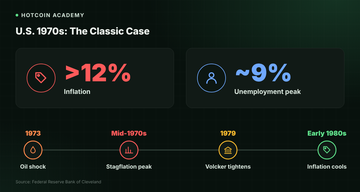
During the same period, U.S. policy repeatedly weighed "fighting inflation" against "protecting jobs"; it was not until Paul Volcker became Fed Chair in 1979 and sharply tightened money, sending rates soaring, that inflation gradually came down, at the cost of a recession. Details differ from country to country.
How Are Crypto Assets Usually Discussed in the Stagflation Narrative?
Let's be clear about the limits first: Bitcoin and other crypto assets were born after the late 2000s and have not experienced a complete stagflation cycle on the same scale as the 1970s, so there is no "historical script" that can be directly applied. There is also not enough data to prove that crypto will "always hold up" or "always succeed as a hedge" during stagflation.
At the mechanism level, market discussion mostly falls along three lines (all frameworks, not predictions):
- Risk appetite and liquidity: If central banks prioritize fighting inflation and tighten financial conditions, risk assets (including most crypto assets) often face pressure from higher funding costs and lower leverage and speculative demand.
- Correlation with traditional risk assets: Many observers put crypto in the same "high risk appetite" basket as growth stocks; when the economy and liquidity weaken, correlation can amplify declines rather than automatically decouple.
- The "digital gold" narrative: Features such as fixed supply and decentralization lead some to imagine it as a long-term store of purchasing power; but this is still a narrative and an assumption — short-term prices can still swing sharply due to risk appetite, liquidity, and leverage liquidations, and it cannot be treated as stagflation insurance.
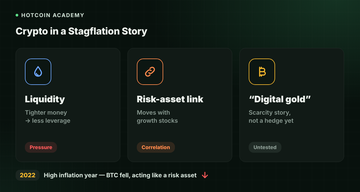
Traditionally, gold has often been treated as a store of value during inflation; although Bitcoin is called "digital gold," it has not yet been tested through a complete stagflation cycle. The most recent high-inflation period was 2022, when Bitcoin fell sharply and behaved more like a risk asset than a hedge.
So the more prudent reading is: treat stagflation news as background that changes the rate path and risk appetite, not as an automatic trading signal. Altcoins are usually more volatile and are even less suitable for a single heavy position based on one macro label.
How to Read and Use Stagflation?
The goal is to "read the combination," not to predict tomorrow's move. To compare the macro mood with crypto market sentiment, you can also read What Is the Crypto Market Sentiment Index?.
- First check whether inflation is "persistent and broad": for example, official data such as the consumer price index (CPI), focusing on the trend and coverage rather than a single item's headline.
- Then check whether growth is weakening at the same time: real GDP, industrial production, consumption, and investment momentum; monthly noise is large, so look at consecutive signals.
- Add employment and wages: changes in the unemployment rate, hiring, and hours worked help judge whether "stagnation" has really reached the labor market.
- Read the policy priority order: the market often debates whether the central bank fears inflation or recession more; the same data can mean completely opposite things for risk assets under different priorities.
- Use sentiment and liquidity dashboards to cut noise, not slogans to place orders: you can go to the Industry Data Overview to compare fear and greed and other market temperatures; rules should still be written before emotions rise (position limits, leverage limits, tolerable drawdowns).
Common Misconceptions
- "Prices rising means stagflation": you also need to confirm whether growth and employment are weakening at the same time.
- "Stagflation = definitely buy Bitcoin": there is a lack of complete historical verification; in the short term it more often reflects liquidity and risk appetite first.
- "Rate hikes only hit stocks and have nothing to do with crypto": tightening financial conditions often transmits to crypto markets through risk appetite and leverage.
- "Rate cuts are always bullish and inflation can be ignored": if inflation expectations become unanchored, easing itself may prolong uncertainty.
FAQ
Q1: What does stagflation mean? Stagflation refers to a macroeconomic situation in which economic growth is stagnant or clearly slowing while inflation stays high, often accompanied by rising unemployment.
Q2: How is stagflation different from inflation and recession? Inflation mainly describes rising prices; recession mainly describes contracting economic activity; stagflation is high inflation superimposed on weak growth (often adding employment pressure), making policy trade-offs more difficult.
Q3: What cases are often mentioned in history? Public educational materials most often discuss the period around the 1970s, related to supply shocks such as oil prices. In the U.S. case, the Cleveland Fed notes a major case around the mid-1970s, with inflation exceeding 12% and an unemployment peak of about 9%.
Q4: Is stagflation bullish or bearish for Bitcoin? There is no definitive answer yet on whether stagflation is bullish or bearish for Bitcoin: in the short term it often comes under pressure from tighter liquidity, while in the medium and long term it depends on how the central bank responds. The long-term scarcity emphasized by the "digital gold" narrative and short-term liquidity pressure may pull at different time scales, and this cannot be simplified into a buy or sell slogan.
Q5: What indicators should ordinary investors watch? Beginners can track inflation (such as CPI), growth, and employment data at the same time, and pay attention to the policy priority order communicated by the central bank; then compare with their own risk tolerance rather than trading on a single news headline.
Conclusion
Understanding stagflation starts with recognizing why "high prices + weak growth" makes policy and markets difficult. For crypto assets, the more pragmatic attitude is: acknowledge the lack of historical samples, read the news through liquidity, risk appetite, and your own risk control, rather than translating a macro label directly into an automatic buy/sell switch.
To compare market sentiment, capital flows, and the macro calendar every day, you can read the Crypto Daily Market Report.
Risk warning: This article is for educational and informational purposes only and does not constitute any investment, trading, or macroeconomic forecast advice. Historical data in this article is excerpted from the identified public educational sources, and definitions may be updated with revisions. Crypto asset prices are highly volatile, and leveraged trading may result in the loss of all principal. Please make decisions based on your own risk tolerance and consult a professional advisor if necessary.
Lectura recomendada
Ver más