Leverage Trading Explained: Amplifying Both Gains and Risks
Leverage trading is a core tool in the cryptocurrency market that lets traders use a relatively small amount of their own capital as margin and borrow funds to increase the size of a position. A modest price move can produce gains several or even dozens of times larger, but a wrong call can also wipe out the initial capital in a short time. During a cascading market crash in October 2025, roughly $19 billion in leveraged positions were liquidated, affecting more than 1.6 million traders. Understanding how leverage works and the risks it creates is essential before trading derivatives.
How Does Leverage Work? From Down Payment to Liquidation
Leverage works much like buying a home with a mortgage: you provide the down payment, the bank supplies the loan, and you gain exposure to a more valuable asset. In trading, your own funds act as collateral while the platform lends additional capital, giving you market exposure far beyond your principal.
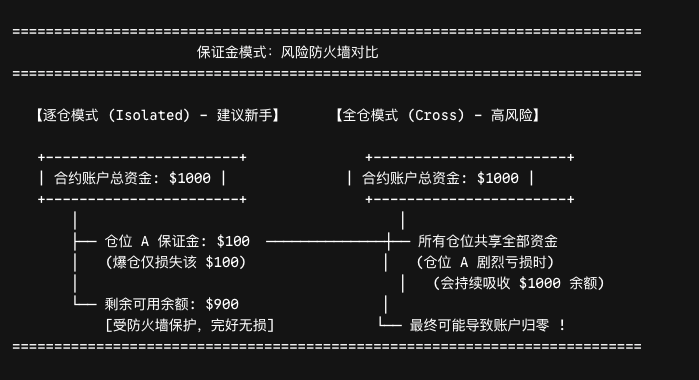
Consider 10x leverage. With 100 USDT in margin, you can open a position worth about 1,000 USDT. If the price rises by 10%, the gain is approximately 100 USDT, equal to a 100% return on the original capital. If the price falls by about 10%, however, the unrealized loss approaches the entire margin and can trigger liquidation.
Perpetual futures are the most common vehicle for leveraged crypto trading. They have no expiration date and use funding rates to track the spot price. When perpetual prices trade above spot, long positions pay short positions; when they trade below spot, shorts pay longs. This means a long-term position can carry ongoing costs rather than a one-time borrowing charge.
Two Margin Modes: Isolated and Cross
In leverage trading, the margin mode directly determines how risk is distributed:
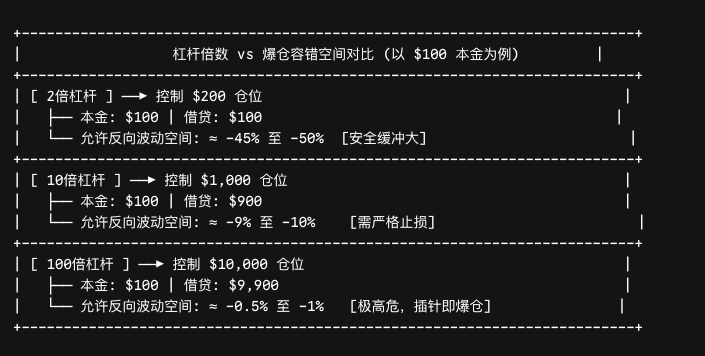
Isolated margin: Margin is calculated separately for each position, so risks do not spill over between positions. A loss on one trade will not consume the margin assigned to other positions. This is generally the safer choice for beginners.
Cross margin: The entire derivatives-account balance serves as shared margin for all positions. If one position loses money, funds backing other positions may be used to cover it. This offers more resilience against short-term volatility, but it also concentrates account-wide risk.
Gains and Risks: Two Sides of the Same Multiplier
Leverage is a double-edged sword. When the market moves in your favor, it multiplies gains. When the market moves against you, it multiplies losses as well. Because positions are continuously marked to market, losses can quickly erode account equity until liquidation is triggered.
One extreme example occurred in June 2026, when public figure Andrew Tate used roughly 100,000 USDC in margin on Hyperliquid to open a Bitcoin long position with about 40x leverage and a notional value of approximately $3.79 million. Bitcoin fell by only around 2%, yet the position was fully liquidated within 24 hours, producing a loss of more than $95,000. He later switched to a short position and was liquidated again when the price rebounded, leaving the account with about $14,000—nearly wiping it out.
Liquidation and Leverage: Higher Leverage Leaves Less Room for Error
Liquidation is the central risk mechanism in leveraged trading. When losses push account equity below the platform's maintenance-margin requirement, the system automatically closes the position to prevent the trader from owing the platform money.
The higher the leverage, the smaller the adverse price move a position can withstand:
At 100x leverage, a move of only about 0.5%–1% in the wrong direction may trigger liquidation.
At 50x leverage, the margin for error is still only around 2%.
At 2x–3x leverage, there is substantially more room for an ordinary price pullback.
This is why liquidation becomes more likely as leverage rises. Your market thesis may eventually prove correct, but the margin can be exhausted before price reaches your target.
Cascading Liquidations: When Leverage Creates a Domino Effect
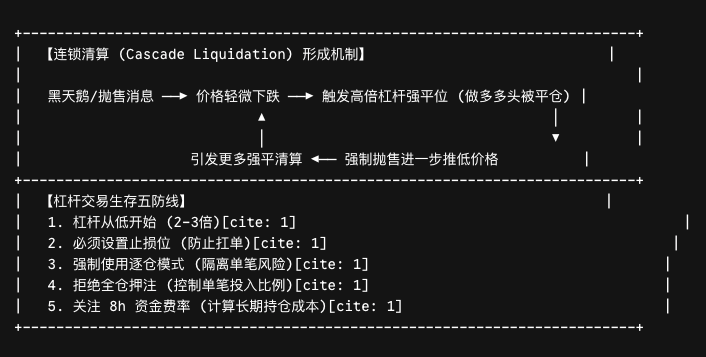
Another systemic danger is cascading liquidation. When many leveraged positions cluster around similar price levels, one market move can trigger a chain of forced closures. Each forced sale pushes prices lower, causing additional positions to cross their liquidation thresholds and reinforcing the downward spiral.
On October 10, 2025, a tariff-related news item triggered a crypto sell-off. More than $19 billion in leveraged positions were liquidated within roughly 24 hours, while open interest in perpetual futures on major exchanges fell 43% in a single day. Trading platforms maintain insurance funds as buffers, but if those funds are depleted during extreme conditions, profitable positions may even be forcibly reduced to keep the system solvent.
Survival Rules for Leverage Trading
Start with low leverage. Beginners should generally stay at 2x–3x rather than using the maximum leverage of 100x or more offered by some platforms.
Always set a stop-loss. A stop-loss defines the maximum loss you are willing to accept and is the main defense against emotionally holding a losing position.
Use isolated margin instead of cross margin. Isolated mode limits the risk of a single position to the margin allocated to it.
Never go all in. Committing the entire account under high leverage means one extreme move can reduce the balance to zero.
Understand funding costs. When funding is positive, longs continuously pay shorts, which can erode returns on long-term positions.
Frequently Asked Questions (FAQ)
Q1: What does 100x leverage mean?
With 100x leverage, only 1% of the position value is required as initial margin, allowing you to control a position 100 times the size of your capital. However, an adverse move of roughly 0.5%–1% may trigger liquidation. The margin for error is extremely small, making it an ultra-high-risk trading tool.
Q2: Are margin trading and futures trading the same thing?
Not exactly. Margin trading usually means borrowing funds to trade in the spot market. The trader holds the underlying asset and pays borrowing interest. Futures and perpetual contracts are derivatives: the trader does not hold the underlying asset, profits and losses come from price movements, and costs are commonly reflected through funding rates rather than borrowing interest.
Q3: Why is leverage not simply “gambling with borrowed money”?
Leverage is fundamentally a capital-efficiency tool that can support directional speculation, hedging, or return enhancement. The danger comes from misuse, including failing to set stops, using excessive leverage, and ignoring funding costs. Disciplined use of low leverage and clear risk limits is fundamentally different from gambling.
Related tutorials:
Complete Guide to Futures Trading: From Basics to Risk Control
What Is Futures Liquidation? Mechanics and Liquidation Price Calculation
Recommended reading:
Lectura recomendada
Ver más