
LINE Investment Group Scams: Fake Advisors, Fake Teachers, and Where to Get Help
Being pulled into a “investment teaching,” “teacher-led trading,” or “guaranteed profit advisory” group on LINE is a common investment scam tactic. The other party may start with dating, a job offer, or a “wrong number,” then introduce a so-called analyst, teacher, or inside market information and direct you to deposit funds on a designated website or app. Group members often show profits, and small withdrawals may even be allowed at first. Once your investment grows, withdrawals are blocked by “taxes, margin, account upgrades, or anti-money-laundering reviews,” followed by demands for more transfers. The balance shown on the page is usually controlled by the other party; what actually happens is often just you sending funds to their address or account.
Below is a summary of publicly disclosed consultation and reporting channels from law enforcement or competent authorities in Taiwan, Hong Kong, Japan, and Singapore, with their scope of application noted. This article cannot determine whether your individual case can recover funds, nor does it provide legal advice.
Key Takeaways
- High-risk combinations usually involve: a contact of unknown origin, a quick move to LINE, the appearance of a “teacher/advisor/insider group,” and a request to deposit or transfer crypto on a designated platform.
- Taiwan’s Criminal Investigation Bureau has warned that combining fake dating with fake investment is a prevalent tactic; small early withdrawals are often used to lower suspicion, after which withdrawals are delayed with excuses such as taxes or margin.
- There is no investment teaching that guarantees profits. When the other party emphasizes secrecy, urges you to borrow and add positions, or says “just one last payment and you can withdraw,” stop making new transfers immediately.
- In Taiwan, you can call the 165 anti-fraud consultation hotline, or file an online report through the official 165 website and follow instructions to complete a statement at a branch (police) station.
- In Hong Kong, you can call the Anti-Deception Coordination Centre’s 18222 hotline for 24-hour consultation; if you believe you are already a victim, report to the nearest police station; in an emergency, call 999.
- Japan’s Financial Services Agency has a “fraudulent investment consultation hotline”; in Singapore, you can call the ScamShield hotline 1799 and report to the police as instructed officially. In other regions, use channels published by local law enforcement and do not misuse foreign hotlines.
How These Scams Usually Unfold
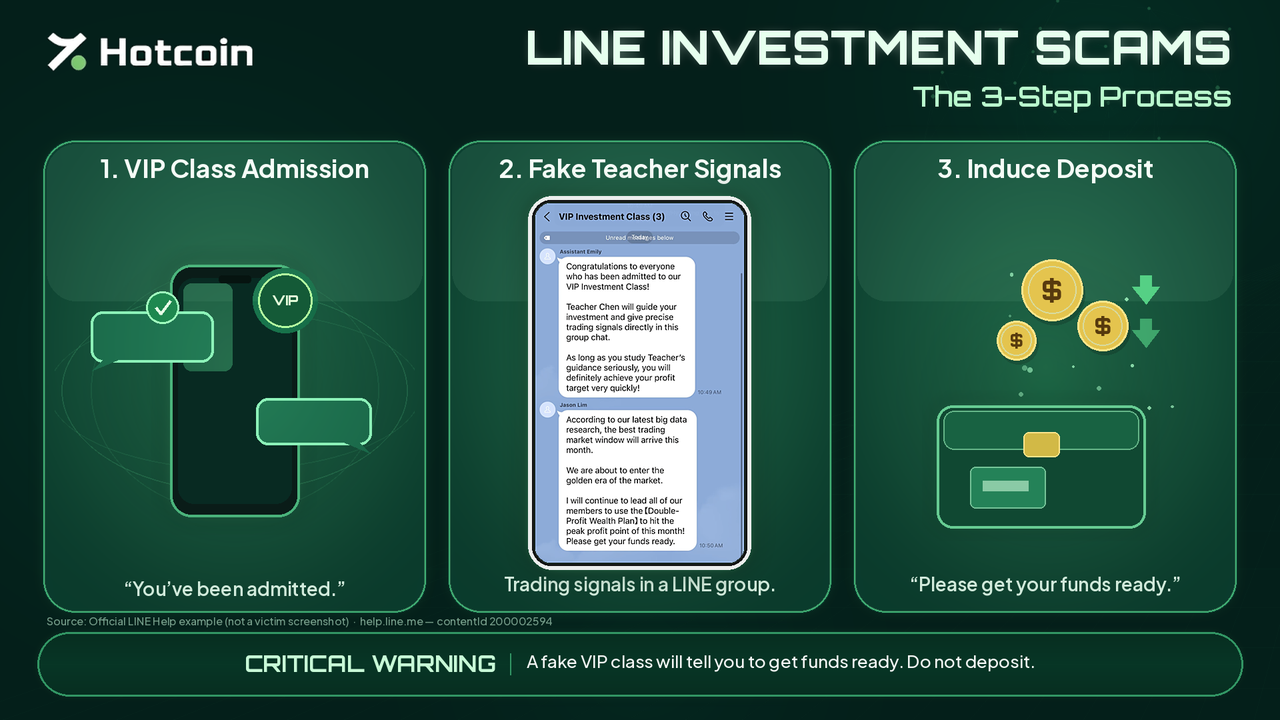
The tactic does not always start with “buy crypto now.” It often begins by building a relationship and trust. A common process is:
- You receive an unsolicited message on a social app, dating app, or comment section, and it initially looks like ordinary chat.
- The other party suggests moving to LINE to continue, perhaps citing “bad signal,” “materials in the group,” or “the teacher only guides on LINE.”
- Analysts, teachers, customer service, and several “students” appear in the group, sharing screenshots, track records, or insider spots.
- You are asked to open an account or deposit on a designated website or app, or to buy crypto elsewhere and transfer it to a designated address.
- You may be able to withdraw a small amount at first, supposedly proving “the platform is real.”
- After you invest more, withdrawals are blocked for reasons such as taxes, margin, credit score, or regulatory review, and you are asked to pay more.
In a public statement in January 2022, Taiwan’s Criminal Investigation Bureau, under the National Police Agency of the Ministry of the Interior, warned: “Be careful when making friends online; adding someone on LINE to talk about investing is a scam.” It noted that in the previous year’s fraud cases, “fake dating investment” ranked among the top in both case numbers and financial losses. The path described is highly similar to the above: build a relationship through dating chat, move to LINE, then guide the victim to buy virtual currency or enter a so-called third-party exchange; the victim first receives a small withdrawal, then invests more, and finally, when trying to withdraw, is asked to pay margin before realizing the scam.
The Criminal Investigation Bureau also reminded the public that in such cases, the same group may play the roles of the online friend, investment advisor, and customer service; there is no such thing as guaranteed, 100% profit. Treating “many people in the group are making money” as evidence is unreliable, because the group members themselves may be controlled by the other party.
Recent public law enforcement reports and judicial cases clearly show this script repeating:
- Approached on a karaoke app, moved to LINE, induced to transfer USDT: According to a public case on Taiwan’s National Police Agency “165 Anti-Fraud Dashboard,” a victim met a stranger claiming to be “Brother Kai” on a voice karaoke app (Quanmin Party). After adding each other on LINE, the person crafted a persona as a virtual currency investment expert and frequently sent “daily investment statements” that looked profitable, claiming that following a professional team would guarantee profits. Persuaded by the other party, the victim repeatedly bought Tether (USDT) and transferred it to a designated wallet for “managed trading,” until the funds only went in and never came out and no returns arrived. The victim only realized the scam after mentioning it to relatives and friends.
- Dating app traffic routed into groups, fake financial specialist teamed up with a “fake crypto dealer” to steal NT$2.74 million: According to a July 2026 report by Taiwan’s Public Television Service, Taichung prosecutors indicted a typical gang-based fraud case. The fraud group first had members meet the victim on a dating app and gain trust, then pulled the victim into a pre-set LINE investment group; a “fake financial specialist” in the group lured the victim to add funds with promises of high returns and arranged accomplices posing as “crypto dealers” to meet the victim offline and exchange cash for virtual currency. The victim handed over a total of NT$2.74 million, and only when the final withdrawal request was completely blocked did the victim realize the entire transaction had been a setup from beginning to end.
Common Talking Points of Fake Advisors and Fake Teachers
The following statements alone may not determine fraud, but if they appear alongside requests to transfer money, download unofficial apps, or keep secrets, you should pause.
- “Just observe first; you can join the group without investing.” Later, they urge you to deposit by citing limited spots, market conditions, or the teacher naming you.
- “This is an internal market, institutional order; ordinary people can’t see it.” They use information asymmetry to stop you from verifying with people outside the group.
- “Try a small amount first; if you lose, I’ll cover it.” Or they allow one small withdrawal, then ask you to scale up “the same way.”
- “If you want to make money, trust the teacher first and don’t tell your family.” They frame the independent judgment of relatives and friends as interference.
- “The account was flagged by regulators; you need to pay taxes, margin, or an anti-money-laundering review fee before you can withdraw.” This is a common excuse to keep funds that have already been transferred.
- “You’ve already made a lot; quitting now would waste all your previous effort.” They use paper numbers to create pressure to pay again.
When judging, do not just look at whether the other party claims to be a licensed advisor; look at where the funds ultimately go. Group announcements, license images, so-called regulatory letters, and blockchain explorer screenshots can all be fabricated by the same party. Independently verify whether the website or app they direct you to is an official source you saved in advance, and whether the on-chain transfer went to the address designated by the other party.
If the relationship has been built over a long period, the other party rarely talks about romance, and instead repeatedly talks about “learning to invest together,” it may still be the same type of scam. For a more complete explanation of long-term relationship scams, read Pig Butchering Scam Explained.
What to Do First When You Spot Something Suspicious or Have Already Transferred Funds
First, stop making new payments and stop confronting the other party; then preserve evidence and report through official local channels. Do not transfer more money to strangers for “one last unfreezing payment” or “help recovering funds.”
Save immediately:
- LINE account, group name, and the claimed identity of the teacher or customer service
- Complete chat records, promotional images, and voice messages
- Names and download sources of any apps you were asked to install
- Time, amount, account, or transaction hash of transfers or on-chain transactions
- Website addresses and receiving addresses designated by the other party
If you have shared your screen, installed remote software, or provided verification codes, also change the relevant account passwords on another trusted device, check login sessions, and secure your email. Do not continue operating large assets on the device that may have been compromised.
Treat as high-risk anyone who sends unsolicited private messages claiming to be a lawyer, hacker, platform investigator, or regulator and demands prepaid cryptocurrency to recover funds. When contacting a platform or law enforcement, use official entry points you saved yourself, not links or phone numbers sent by the other party.
Where to Get Help: First Check Which Region Applies to You
The following channels apply only to public information for the respective regions and are not globally universal numbers. First confirm your location or account-opening location and the place from which funds were transferred, then use the local official entry point. Numbers, hours, and procedures may change; refer to what each institution has published at the time.
Taiwan
According to public information from the National Police Agency of the Ministry of the Interior, for fraud-related matters you can call the 165 anti-fraud consultation hotline for consultation, reporting, or filing a case. To file a formal report, in addition to calling 165, you can also use the official 165 website (https://165.npa.gov.tw), select “I want to report” on the homepage to pre-fill information, and then have dedicated personnel refer you to a nearby branch (police) station to complete a statement and other procedures. The Criminal Investigation Bureau also reminds the public that if you have doubts about investment or dating information, you can call 165 for consultation and pay attention to scam clues published through official channels.
Hong Kong
According to public information from the Hong Kong Police Force’s Anti-Deception Coordination Centre, the “Anti-Deception 18222” hotline provides 24-hour anti-fraud consultation, helps handle suspected scams, and provides information on the latest tactics. The hotline is mainly for consultation; if you believe you have become a scam victim, report to the nearest police station. In an emergency, call 999 immediately.
Japan
On June 19, 2024, Japan’s Financial Services Agency announced the establishment of a “fraudulent investment consultation hotline.” It accepts consultations from people who have suffered losses after trading forex, crypto assets, etc. with unregistered operators due to solicitations via social apps, dating apps, or impersonation of famous people, or who find such solicitations suspicious. The number is 0570-050588, answered on weekdays from 10:00 to 17:00; the announcement states that IP phone users should dial 03-6206-6066 instead. The FSA website also provides a 24-hour consultation entry point. The FSA also states that the hotline can provide referrals to agencies and summarize key points, but cannot mediate, intermediate, or conciliate individual transactions. If criminal victimization is involved, still use the reporting or consultation channels published by local Japanese police.
Singapore
Singapore’s official anti-scam channel ScamShield provides the hotline 1799 for inquiries and identifying suspicious situations. If you believe you have been scammed, file a report online or at a Neighborhood Police Post or police station in the manner published by ScamShield and the Singapore Police Force, and contact the relevant bank or transfer platform as soon as possible to explain that this is a scam. Whether funds can be intercepted or recovered depends on whether they can still be restricted and on local procedures; no guarantee can be given in advance.
Other Regions, Including Mainland China
Use the consultation and reporting channels published by your local public security organs, anti-fraud authorities, or financial regulators. Do not treat Taiwan’s 165, Hong Kong’s 18222, or numbers from other regions as the formal reporting entry point for your location. If funds were transferred out of a trading platform, you can also submit transaction records through that platform’s official customer service to assist the investigation; the platform cannot replace a police case filing and cannot promise recovery.
Common Misconceptions
- “Being able to withdraw a small amount proves the teacher and platform are real.” — In official case analyses, small withdrawals are precisely used to lower suspicion and attract larger investments.
- “So many students in the group are profiting at the same time; it can’t be fake.” — Group members and screenshots can be staged by the same gang and cannot replace independent verification of where funds go and who operates the platform.
- “The other party looks like a licensed advisor, so I can transfer some money first.” — Whether they hold a local license should be checked against official registries or inquiry systems, not just images or group announcements sent by the other party.
- “The withdrawal is already blocked; paying the tax will get it back.” — In these scams, so-called taxes and margin are usually just the next loss. Stop paying, preserve evidence, and use official channels.
- “It’s more useful to scold the other party in chat or tell them I’m calling the police.” — This may not recover funds and may prompt the other party to destroy evidence or move assets. Preserve records first, then report through formal channels.
- “Paying a private recovery team is faster.” — “Recovery services” that ask for prepaid crypto, remote control, or verification codes are themselves high-risk and should not replace official reporting.
FAQ
Q1: Are all LINE groups discussing investments scams? Not every chat group can be directly classified as a scam. What warrants caution is: a contact of unknown origin moves you to LINE, so-called teachers or inside market information appear, and you are asked to transfer money to a designated address or an unknown platform. Whether a crime is constituted is determined by local law enforcement; for users, these combinations should prompt a pause in transfers and independent verification.
Q2: I haven’t transferred money yet; I just joined the group. Should I report it? You can first ask through official local consultation channels and preserve group and chat records. Whether the conditions for reporting are met depends on local authorities’ guidance. Even without losses, you should not continue installing unknown software or providing ID documents or verification codes as requested.
Q3: Does calling a consultation hotline mean I have already reported a case? Not necessarily. Taking the public information for Taiwan and Hong Kong as examples, 165 and 18222 can both be used for consultation, but completing a formal report usually still requires going to a police station in accordance with local procedures, or using the official website’s reporting entry point and completing follow-up procedures. Follow the instructions of the staff at the time.
Q4: I already transferred crypto to the other party’s address. Can the platform just reverse it for me? Once an on-chain transfer is confirmed, it usually cannot be unilaterally reversed by the sender. Submit the transaction hash and time to official customer service and local law enforcement as soon as possible, and ask whether there is still room to notify the receiving platform or stablecoin issuer to help restrict the funds. Results cannot be guaranteed.
Q5: The other party says “this involves money laundering, and you must pay another amount to unfreeze it.” Should I pay? Do not pay the other party’s designated account. This is a common late-stage excuse in such scams. Stop transferring, preserve conversations and payment records, and report through official local channels.
Q6: My family member is deeply involved in the group and refuses to call the police. What should I do? First help stop new transfers and preserve evidence, and avoid mocking or forcing a confrontation that could lead to records being deleted. You can explain the situation to the official customer service of the transferring platform and ask local law enforcement or anti-fraud channels what materials they can accept. Whether a case is ultimately filed is still up to local authorities.
Conclusion
LINE investment group scams rely on trust, in-group demonstration, and letting you see a small “successful withdrawal” first. What truly determines the loss is whether funds enter an address or fake platform controlled by the other party. When you encounter unknown teachers, advisors, and inside market information, first pause new transfers, preserve complete records, and then use the official consultation and reporting channels for your location; do not apply one region’s hotline to another place, and do not pay strangers again to unfreeze or recover funds. Whether funds can be recovered depends on local procedures and whether they can still be restricted, and cannot be guaranteed in advance here.
If a transfer or authorization has already occurred and you want to organize stop-loss and reporting steps by loss type, you can first read What to Do After Being Scammed.
Risk warning: This article is for educational and informational purposes only and does not constitute legal, investment, or case-handling advice, nor does it guarantee that funds can be recovered. Consultation phone numbers, website entry points, and reporting procedures in various places may change; please refer to the information published at the time by local law enforcement, anti-fraud agencies, and financial regulators. Do not transfer money to anyone claiming they can unfreeze, dismiss a case, or recover funds on your behalf, and do not provide verification codes, remote control, or ID documents. For matters involving legal liability, consult qualified local professionals when necessary.
Lectura recomendada
Ver más