What is KYC? Why Do Exchanges Require Identity Verification
When registering on an exchange, the system often prompts "Identity Verification"—the English abbreviation is KYC (Know Your Customer): the platform uses official documents and facial information to confirm that the "account operator" matches the "claimed identity."
For users, it affects deposit/withdrawal limits and unlocking certain features; for exchanges, it is a fundamental part of anti-money laundering, anti-fraud, and compliance risk control. This article explains the definition of KYC, the reasons for it, privacy boundaries, and Hotcoin's verification steps.
Key Takeaways
- KYC = Know Your Customer, a common identity verification process on crypto exchanges used to verify real identity.
- Exchanges conduct KYC mainly to reduce money laundering and fraud risks, protect deposit/withdrawal security, and meet local compliance and risk control requirements.
- According to the Help Center, on Hotcoin you can still trade without completing KYC, but the daily withdrawal limit is capped at the equivalent of 2 BTC; when participating in official events requiring verification or when the account triggers risk control, you may need to complete KYC first. After verification, you can unlock fiat deposit/withdrawal and higher digital asset withdrawal limits (subject to your account page).
- Only submit documents through the official App/website; do not give document photos, verification codes, or facial verification processes to "customer service" who proactively messages you.
What does KYC mean?
KYC (Know Your Customer) literally means "know your customer." In the context of crypto exchanges, it usually means: you submit personal information such as your name, a valid government-issued ID, and complete facial recognition verification, so the platform can confirm that the account is held by a real user who meets age and policy requirements.
KYC often appears alongside AML (Anti-Money Laundering): AML is the overall anti-money laundering system, and KYC is the step of "first confirming who you are." Complete KYC usually involves more than a one-time identity check at account opening; it also includes ongoing monitoring of abnormal transactions.
Why do exchanges require identity verification?
The reasons can be broken down into three layers (mechanism explanation, not scare tactics):
- Deposit/withdrawal and account security: Confirming the operator's identity helps reduce account theft, impersonation for deposits/withdrawals, and related fraud risks.
- Anti-money laundering and financial crime prevention: Anonymous or pseudo-anonymous channels that do not verify identity at all are more easily abused. Similar obligations are common in traditional finance's anti-money laundering frameworks.
Taking the United States as an example, the Bank Secrecy Act (BSA) authorizes the Treasury Department to require financial institutions to keep records, file large cash transaction reports, and report suspicious activities to help detect and prevent money laundering (public explanation see FinCEN: The Bank Secrecy Act). Regulatory frameworks vary by region, and specific rules for virtual asset service providers differ across jurisdictions. Exchanges often use tiered KYC as one of their compliance and risk control tools.
- Resource tiering and responsibility boundaries: Different verification levels correspond to different limits and features; if no identity verification is done at all, malicious users may find it easier to evade accountability, and the platform may also bear higher compliance risks.
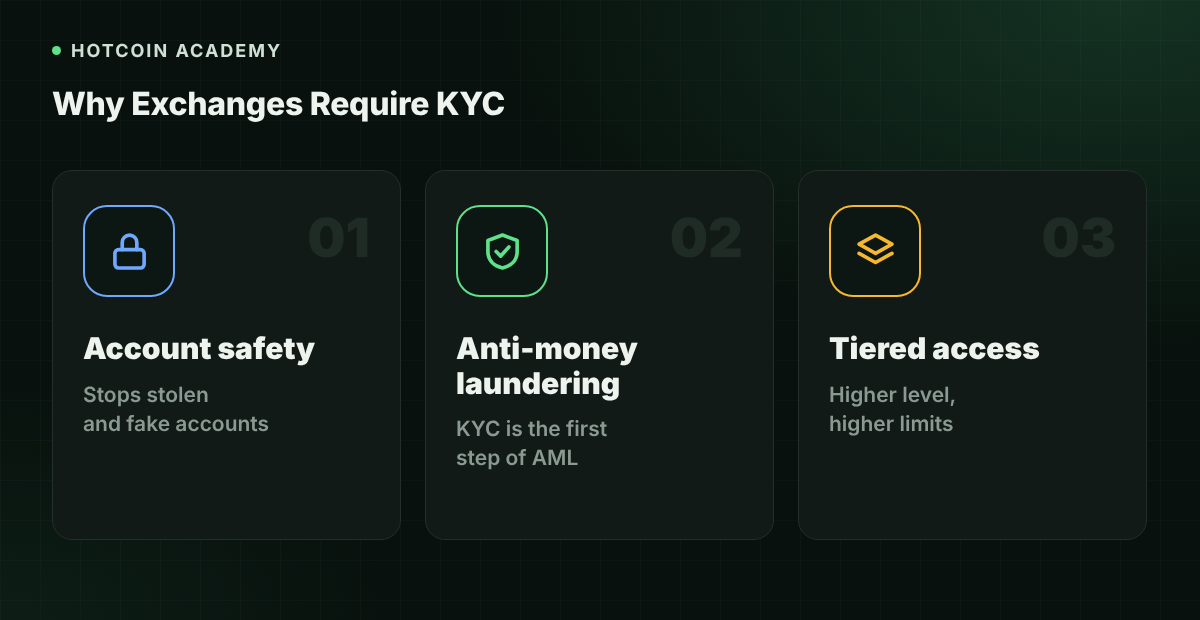
Therefore, KYC is not "deliberately making things difficult," but clarifying "who is using this account" so that there is a verifiable basis during abnormal withdrawals, account theft disputes, or regulatory investigations.
Personal privacy boundaries: What to submit, who not to give it to?
KYC generally requires identity information such as documents and facial data for identity verification and compliance risk control; the specific collection scope and purpose are subject to the platform's privacy policy. Hotcoin's Help Center states: the KYC information you provide will be securely encrypted and stored, and claims to comply with privacy policies and not disclose personal data.
However, any platform's centralized storage of identity data can become an attack target, so besides looking at the platform's protective measures, you should also reduce your own exposure points: only upload through official entry points, use a dedicated email, and enable two-factor authentication.
Boundaries you need to guard yourself:
- Only enter "Account Security/Identity Verification" through the official App or the official website you manually typed/bookmarked.
- Do not send document photos, selfie videos, SMS verification codes, or ID numbers to social media DMs, fake customer service, or unknown links.
- After KYC is approved, you should still set strong passwords, two-factor authentication, and other account protections—verification itself cannot replace login security.
How to complete KYC on Hotcoin?
For the complete web guide, see How to complete identity verification (KYC) on the web; for the App, see How to complete identity verification (KYC) in the App. The following is organized from the official Help Center; actual entry points, buttons, and available features are subject to the prompts on your account page.
Web
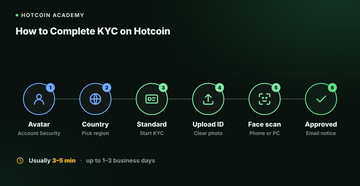
- After logging in, click the avatar in the upper right corner → Account Security.
- On the right side of "Identity Verification," click Unverified to enter the identity verification page.
- Select Country or Region (the system will match available document types and corresponding verification limits).
- Select verification type: most users first click Standard Identity Verification → "Start Now."
- Select document type and upload a clear photo (information clear, unobstructed, and no glare; passports usually only require the personal information page).
- Follow the instructions to complete facial recognition (on a computer, you can choose "Continue on Phone" to scan the QR code or copy the link to your phone).
- After submission, the status may show "Pending" or "Under Review"; please wait patiently.
- After approval, the status updates, and Hotcoin will notify you of the result by email; if not approved, please follow the prompts on the account page or email.
App (Help Center uses iOS as an example)
- Open the App, tap your personal avatar on the "Home" page, and enter the "Unverified" page.
- Select Personal Standard Verification or Personal Advanced Verification; for standard, tap "Upgrade Verification" at the bottom of the page.
- Select country and verification type and submit, follow the instructions to upload documents and complete facial liveness verification.
- After submission, the page may show "Personal Standard Identity Under Review"; please wait for system review.
Available document types: The official operation guide lists ID card, passport, driver's license, permanent residence permit, and "domestic passport" applicable in some regions. Actual selectable documents depend on the country/region and the prompts on the verification page.
What is the difference between standard and advanced verification?
| Type | What to prepare | Suitable for | Limits (Official Description) |
|---|---|---|---|
| Standard Identity Verification | Personal information, ID card/passport, etc., facial recognition | Most users | After successful verification, unlock: fiat deposit/withdrawal up to USD 100,000 per day; digital asset deposit unlimited; digital asset withdrawal up to 5 BTC per day |
| Advanced Identity Verification | Additional proof of address on top of standard | High-frequency traders | Digital asset withdrawal can be increased to up to 10 BTC per day |
The above limits are compiled from the Help Center operation article; when selecting a country or region on the web, the system will match the corresponding verification limits, and daily withdrawals may also be affected by other account rules. Please refer to the current display on your account page and the latest Help Center instructions.
What if KYC is not completed?
According to Hotcoin Help Center Do I need to complete KYC verification on Hotcoin?: Without completing KYC, you can still trade; but the daily withdrawal limit is capped at the equivalent of 2 BTC (applicable to various tokens supported by the platform). If you participate in official events requiring identity verification, or if the account triggers platform risk control, the system may prompt you to complete KYC first to continue related operations. Actual limits and whether verification is required first are subject to the current prompts on your account page.
How long does review take?
According to Identity Verification (KYC) Common Issues and Solutions: The KYC process usually takes 3–5 minutes; in some cases, review may be extended to 1–3 business days, depending on platform security requirements, local compliance policies, product features, or network environment.
Please refer to the account page status and email notifications for actual progress.
Common reasons for KYC failure
Compiled from Identity Verification (KYC) Common Issues and Solutions:
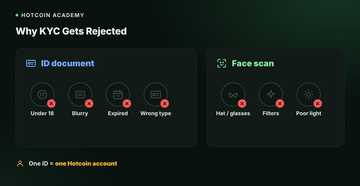
Documents
- The individual is shown as under 18 years old
- Image is blurry, obstructed, or incomplete
- Document is expired
- Document type does not match (the article lists acceptable: ID card, driver's license, passport, or permanent residence permit)
Facial
- Face is obstructed; wearing a hat, glasses, etc.
- Using filters/beauty effects
- Insufficient lighting, unclear image
Additionally: Each user can only use one Hotcoin account for identity verification; if prompted that the document number has already been used for verification, please use the originally verified account; if the original account has been deleted, contact official customer service for assistance.
Common Misconceptions
- "You can't trade at all without KYC"—In Hotcoin's public description, unverified users can still trade, but withdrawals have a daily limit equivalent to 2 BTC (subject to the current prompts on the account page).
- "KYC means handing assets to the platform for custody"—KYC verifies identity; asset custody/withdrawal security also depends on platform risk control and your own login, withdrawal whitelist, and other settings.
- "Sending documents to customer service via DM can speed up review"—High risk; only upload within the official process.
- "One failure means you can't try again"—If the page or email prompts that you can correct and resubmit, follow the prompts; do not assume on your own whether you can or cannot retry.
- "Decentralized exchanges don't require KYC, so it's easier"—Many decentralized exchanges do not require account KYC, but they usually also do not directly provide fiat deposit/withdrawal and customer service appeal channels; private keys, contract authorizations, and fraud risks are mainly borne by the user.
- "Everyone needs to do advanced verification immediately"—The official description states that advanced requires additional proof of address and is aimed at high-frequency users; most people can complete standard first and compare with their own limit needs.
FAQ
Q1: What is KYC? KYC (Know Your Customer) is a common identity verification process in financial and crypto services, used to confirm users' real identity and prevent money laundering, fraud, and other risks.
Q2: Do I have to complete KYC on Hotcoin before trading? You do not necessarily have to complete KYC before trading. Official description: Without completing KYC, you can still trade, but the daily withdrawal limit is equivalent to 2 BTC; when participating in specific events or triggering risk control, you may be required to complete verification first. Please refer to the current prompts on your account page.
Q3: How long does verification take? Hotcoin Help Center states: The KYC process usually takes about 3–5 minutes, and in some cases review may be extended to 1–3 business days. Please refer to the account status and email notifications.
Q4: Will my document information be leaked? Hotcoin Help Center states that KYC information is encrypted and stored and complies with privacy protection policies. At the same time, please submit through official entry points and ensure the security of your account and email.
Q5: What is the difference between standard and advanced verification? Standard requires personal information, documents, and facial recognition; advanced requires additional proof of address. According to the official operation article, after standard success, digital asset withdrawals are up to 5 BTC per day, and after advanced, it can be increased to 10 BTC; fiat deposit/withdrawal up to USD 100,000 per day, digital asset deposit unlimited. Actual limits are subject to the account page.
Conclusion
KYC is a compliance and risk control tool that matches "accounts" with "real identities": exchanges use it to reduce criminal abuse and deposit/withdrawal risks, and you use it to unlock higher limits and reduce identity ambiguity during abnormal disputes. In terms of steps, first go through official standard verification, ensure documents are clear, and the facial environment is clean; for details and troubleshooting, please return to the Help Center operation article and FAQ.
After verification, don't forget to complete your login and withdrawal protections. You can continue reading Crypto Security Fundamentals: 15 Iron Rules for Protecting Digital Assets.
Risk Warning: This article is for educational and informational purposes only and does not constitute investment, legal, or tax advice. Please only complete KYC through the official App/website, and do not provide documents, facial videos, or verification codes to strangers. Crypto asset trading involves risks such as price volatility and account theft; limits and review rules may change, please refer to the Hotcoin account page and the latest Help Center instructions.
Lectura recomendada
Ver más