What Is Impermanent Loss? Calculation, Examples, and Ways to Reduce It
Two people start with the same 1 ETH and a sum of USDC. One puts them into a liquidity pool, the other keeps them in a wallet. Then ETH rises. Both portfolios gain, but the liquidity provider earns less. How does the gap appear when both started with the same assets? And how much of it can trading fees make up?
Key takeaways
- The benchmark is holding as-is: compare the liquidity position and the original tokens at the same time and the same set of prices.
- The calculation depends on relative price: in a fee-free 50/50 full-range constant product pool, when the price ratio of the two tokens doubles or halves, impermanent loss is about 5.72% either way.
- Pool type determines the method: concentrated liquidity positions must factor in their price range, and weighted pools and stablecoin pools have their own conditions.
- Fees can offset the gap: to assess the actual result, take the fees and rewards already earned, subtract on-chain transaction costs, and compare with simply holding.
What Is Impermanent Loss?
Impermanent loss (IL) is the shortfall in the value of a liquidity position relative to simply holding the same batch of tokens. The calculation uses the same time and the same unit of account on both sides. Even if the liquidity position is worth more than what was put in, the gap appears whenever holding the tokens as-is would be worth more at the end. See also Uniswap Labs' explanation of impermanent loss.
Why does providing liquidity earn less?
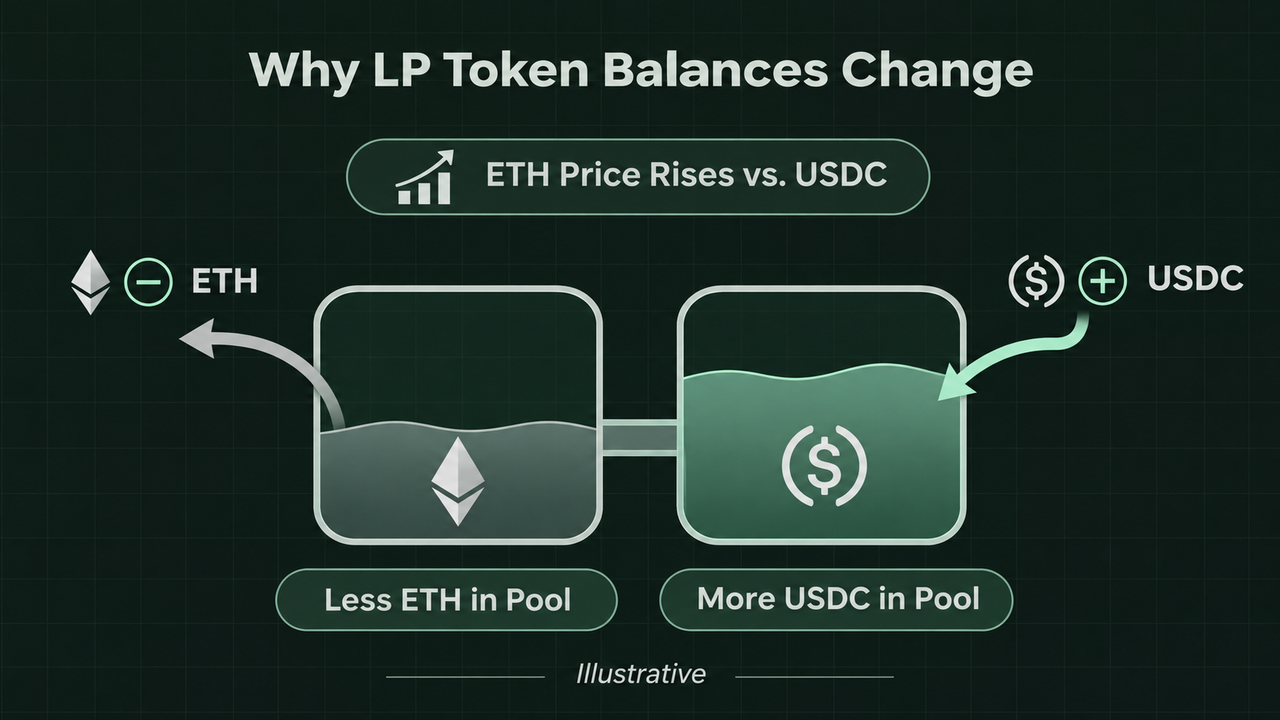
Take an ETH/USDC constant product pool. When ETH rises against USDC on the external market while ETH in the pool is temporarily cheaper, arbitrageurs can buy ETH from the pool with USDC. As trades proceed, ETH in the pool decreases and USDC increases, and the pool price gradually moves toward the external market.
The number of tokens a liquidity provider (LP) can withdraw changes with the pool's reserves. Someone who simply held keeps the original amount of ETH, while the LP position holds less ETH, so it participates less in that ETH rally.
Why is it called "impermanent"?
As long as the original position stays in the pool, the gap can change with the price ratio. In the fee-free standard model, if the relative price of the two tokens returns to the level at deposit, the theoretical impermanent loss returns to zero. If liquidity is withdrawn first, the token mix received at that moment is fixed, and later pool trades will no longer adjust that withdrawn position.
How Is Impermanent Loss Calculated? Formula and an ETH/USDC Example
First confirm the formula's conditions
The formula below applies to a two-asset, initially equal-value, full-range constant product pool. The calculation assumes the pool price has adjusted to the market price being compared, and excludes trading fees, rewards, and gas fees.
Price change ratio r = final relative price ÷ initial relative price
Impermanent loss = [1 − (2 × √r) ÷ (1 + r)] × 100%
Here a positive value represents the loss magnitude. Some sources write the expression inside the brackets as (2 × √r) ÷ (1 + r) − 1, using a negative value to represent the performance gap of the liquidity position relative to holding. See DeFiPy's formula and derivation for details.
From 1 ETH + 2,000 USDC to the final gap
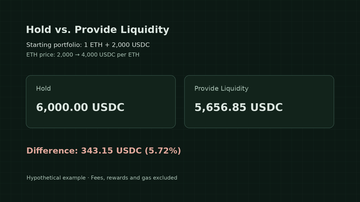
Suppose you start with 1 ETH and 2,000 USDC, and the ETH price rises from 2,000 USDC/ETH to 4,000 USDC/ETH. This is a teaching example: both approaches use the same final price and are denominated in USDC.
- Calculate the price change ratio. r = 4,000 ÷ 2,000 = 2.
| Approach | Final token amounts | Final value |
|---|---|---|
| Hold as-is | 1 ETH + 2,000 USDC | 6,000.00 USDC |
| Provide liquidity, excluding fees | About 0.707107 ETH + 2,828.427125 USDC | About 5,656.85 USDC |
Calculate the value of holding as-is. The ETH amount stays at 1, so the final value is 1 × 4,000 + 2,000 = 6,000 USDC.
Calculate the value of the liquidity position. In this model, the ETH amount becomes 1 ÷ √2 and the USDC amount becomes 2,000 × √2. Valued at the final price, the total is (1 ÷ √2) × 4,000 + (2,000 × √2), or about 5,656.85 USDC.
Using unrounded figures, the LP position is short by about 343.15 USDC. Dividing this gap by the 6,000 USDC from holding as-is at the end gives about 5.72%. Both approaches gained relative to the starting point. The 5.72% here measures how much the two approaches differ at the end.
Which Liquidity Pools Need Different Calculations?
Seeing two tokens in a pool is not enough; you also need to confirm how it prices them and whether your position has a price range. Even for the same ETH/USDC pair, different pool types can return different token amounts after a price move.
| Pool type | What to look at when calculating |
|---|---|
| 50/50 full-range constant product pool | The change in the relative price of the two tokens. Under the assumptions above, the standard formula applies. |
| Concentrated liquidity position | The price at deposit, the upper and lower bounds of the chosen range, and the final price. |
| Non-equal-weight weighted pool | The weight of each token and the change in relative price, e.g. a Balancer weighted pool. |
| Pool using a stable asset curve | The pricing curve used by the protocol, the pool balances, and related parameters. |
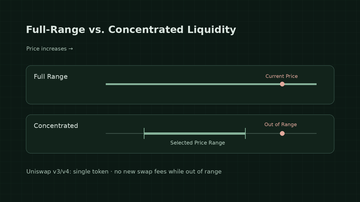
Take Uniswap v3/v4 as an example: when the price moves outside your chosen range, the liquidity position holds only one of the tokens and stops accruing new trading fees. Only when the price returns to the range does the position's liquidity rejoin trading. When calculating such positions, the range bounds affect the final token amounts.
How to Reduce Impermanent Loss Risk?
Once you have used the impermanent loss method to estimate the gap from a price move, you can assess it in two steps. First look at how much relative price exposure the pair and pool type create, then at how much actual fee income can make up.
| Approach | Effect | Still to watch |
|---|---|---|
| Assess the relative price of the two tokens | Under the same model, a smaller change in relative price usually means smaller theoretical impermanent loss. | Two tokens whose past prices tracked closely can still diverge later due to a depeg or other events. |
| Choose a wider range for concentrated liquidity | The price must move further to exit the range, so the position can trade across a wider price band. | The same capital is spread over a wider price band, so liquidity density near the current price is lower. |
| Compare final value using actual fees and costs | Fees and rewards already earned can offset some or all of the gap. | The annualized yield shown on the page will change, and on-chain costs of entering, exiting, and adjusting the position also matter. |
When comparing, estimate the value of the withdrawable position at the same point in time, add fees and rewards not yet included, subtract related costs, and compare with the value of holding as-is. If fees are already reflected in the withdrawable value, just use that value. See Uniswap's liquidity and fees documentation · Uniswap's liquidity risk documentation for details.
Impermanent Loss FAQ
Q1. If the price returns to where it started, does impermanent loss disappear?
If the original position is still in the pool and the relative price of the two tokens returns to the level at deposit, the theoretical gap in the standard model returns to zero. Looking only at one token's USD price does not tell you whether the price ratio between the two has returned to the starting point.
Q2. If both tokens rise or fall together, is there still impermanent loss?
If both tokens rise or fall by the same percentage, the relative price stays the same and the theoretical gap in the standard model is zero. If the two move by different percentages, the relative price still changes, even if both move in the same direction.
Q3. Will a concentrated liquidity position be liquidated if it exits its range?
For a Uniswap v3/v4 liquidity position alone, moving out of range does not trigger liquidation. The position converts to a single token and stops accruing new trading fees until the price returns to the range.
Q4. Can stablecoin pools also have impermanent loss?
Yes. When both stablecoins stay pegged, their relative price is usually close. Once one depegs, the price ratio and the pool's token composition can change at the same time, and the position may end up holding more of the depreciating side.
Conclusion
When assessing a liquidity position, first confirm the pool type, then compare "providing liquidity" and "holding as-is" at the same final price. After calculating the gap, factor in the actual fees, rewards, and on-chain costs to see whether providing liquidity beat holding as-is over that period.
Risk notice: This article is for educational and informational purposes only and does not constitute investment advice. The impermanent loss calculations here are based on specific pool types and price assumptions and should not be used as a basis for buying or selling, using leverage, or providing liquidity. Crypto asset prices are highly volatile, and liquidity positions may also lose principal due to depegs or smart contract risks. Make decisions according to your own risk tolerance and consult a professional advisor if necessary.
Lectura recomendada
Ver más