Dollar-Cost Averaging (DCA) Explained: Using Time to Beat Market Volatility
Dollar-cost averaging (DCA) is an investment strategy in which you buy a set amount of a chosen asset at fixed intervals. It requires no judgement about whether the market is high or low; disciplined, staggered purchases smooth out how price swings affect your average holding cost. The data shows that 59.13% of crypto investors name DCA as their preferred investment strategy, making it the most widely used systematic approach. In a crypto market that trades 24 hours a day and swings violently, the core value of DCA is not catching the bottom but trading time for room, letting long-term accumulation replace short-term timing.
The Core Principle of DCA: Turning Price Swings Into an Ally
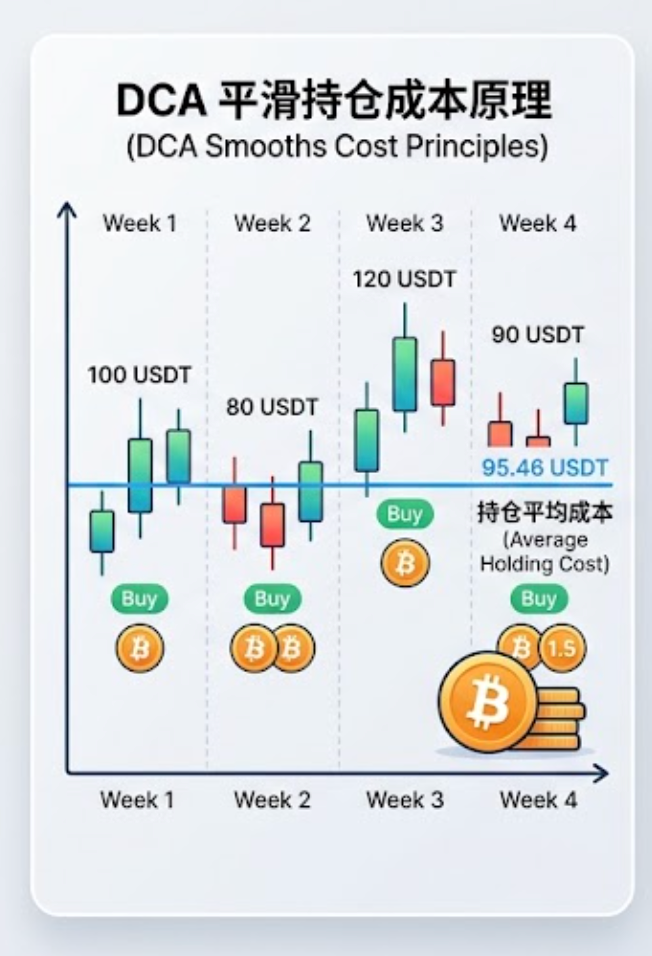
The math behind DCA is not complicated: when the price falls, the same amount of money buys more units; when it rises, the same amount buys fewer. After several rounds of purchases, your average holding cost is pulled toward the middle instead of being locked at a potentially high entry.
Take a four-week example: suppose you invest 100 USD each week and Bitcoin trades at 100, 80, 120 and 90 USD over those four weeks. You buy roughly 4.19 units in total for 400 USD, for an average cost of about 95.46 USD. Even though the highest price reached 120 USD, staggered buying left the average cost in the middle of the range. If the price returns to 100 USD four weeks later, the position shows a small unrealized gain; had you bought everything at the peak, you would still be at a loss.
The conclusion is straightforward: DCA does not try to buy at the lowest point, it makes sure you do not buy at the highest one.
Three Core Advantages of DCA
Lower timing risk: crypto prices can swing sharply within hours. Trying to buy the bottom or sell the top is not only stressful, it often means missing opportunities or making poor decisions on emotion. DCA spreads your entry points across different price ranges, greatly reducing the odds of buying at the wrong moment.
No emotional interference: the crypto market is driven by extreme emotion, from FOMO pushing people to chase rallies to panic triggering capitulation. DCA removes the human factor from the equation: the only reason you buy is that today is an investment day. That discipline is often the difference between success and failure.
A low entry threshold: you do not need a large sum to start. Ten dollars a week or fifty dollars a month is enough to build a position gradually. For ordinary investors with steady cash flow, DCA fits naturally with a payday-and-invest rhythm.
DCA vs a Lump-Sum Investment: Which to Choose, and When?
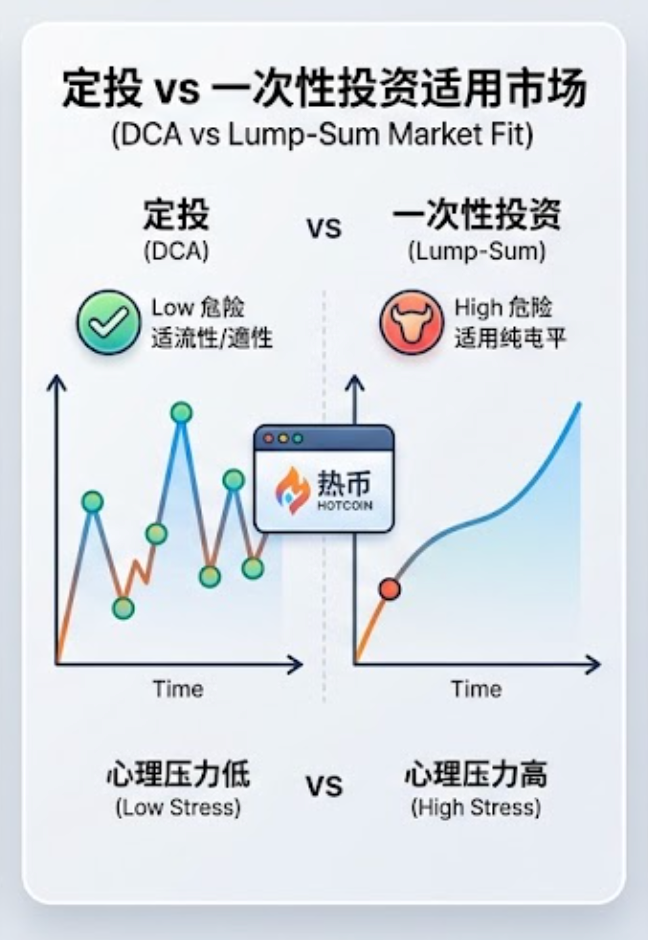
The two strategies each have strengths in different market environments. Here is the core comparison:

In short: if you are bullish on an asset over the long term but unsure about the near term, DCA is the safer choice; if you are confident the market is at the start of a bull run, investing in one go may deliver higher returns. In the range-bound conditions of 2026, however, DCA is statistically the safer option.
A Four-Step DCA Routine
Step 1: choose the asset. DCA is a long-term strategy, so pick assets whose long-term prospects you trust. For beginners, Bitcoin and Ethereum are usually the first choices. Before deciding, assess durability, fundamentals, market trends and liquidity.
Step 2: set a budget and a frequency. Decide how much to invest each period based on your finances, making sure it does not interfere with daily life or long-term goals. Weekly, biweekly and monthly are common frequencies. Note that too high a frequency can pile up fees, while too low a frequency can mean missing market opportunities.
Step 3: turn on automatic investing. As of 2026, mainstream trading platforms generally offer automated DCA, which turns the strategy into a set-and-forget routine. Automation is the key to keeping discipline, especially when the market is volatile.
Step 4: track progress without overreacting. Reviewing the plan regularly is necessary, but do not change the strategy over short-term price swings. The core advantage of DCA is consistency.

Limits and Risks of DCA
No guarantee of profit: if the market falls for a long time, DCA can still lose money. DCA reduces timing risk, not the downside risk of the market itself.
Accumulated fees: frequent purchases can raise your total fee bill. Choose a platform with transparent fees and reasonable costs.
Long-term discipline required: it is easy to waver when the market chops sideways. Whether DCA succeeds largely depends on whether you can stick with it through the turbulence.
Not suitable for every asset: DCA should not be applied blindly to projects with weak fundamentals. Averaging into a strong project during a short-term slump is a very different proposition from averaging into an investment with weak fundamentals.
Advanced: Hybrid and Smart DCA
As of 2026, many advanced traders have adopted a hybrid DCA plan: about 70% of capital goes into core assets such as BTC and ETH through automation, while a small cash reserve is held back to add manually during sharp market drops. Smart DCA bots can also adjust the buying pace automatically, increasing allocations during extreme fear to capture deeper value and reducing them during greed to protect the long-term cost basis.
FAQ
Q1: Is DCA suitable for beginners?
Yes, very much so. DCA lets beginners start investing without mastering complex technical analysis. It is simple to operate, strongly disciplined and one of the lowest-risk ways to enter the crypto market.
Q2: Can DCA still work in a bear market?
It can, but you need to adjust your expectations. In a falling market, DCA accumulates more assets at lower prices and pulls down your average cost. The premise is that you have real confidence in the long-term value of the asset you chose. If the asset's fundamentals are broken, DCA only amplifies the loss.
Q3: How does DCA differ from grid trading?
DCA is a long-term accumulation strategy: regular purchases, no selling, aiming at long-term holding. Grid trading is a short-term swing strategy that buys low and sells high repeatedly inside a range. The two have different goals and suit different market phases and investment objectives.
Q4: Does DCA need take-profit and stop-loss settings?
DCA itself is a buying strategy and usually carries no stop-loss, because a decline actually lowers your cost. You can, however, set a target take-profit: selling in stages to lock in gains once the asset reaches a certain price or return. Take-profit is the exit of a DCA strategy and needs to be planned before you start.
Related tutorials:
Complete Grid Trading Tutorial: Earn From Range-Bound Markets Automatically
Trend-Following Strategy: A Profitable Method That Trades With the Trend
Recommended reading:
Lectura recomendada
Ver más