

What to Do If Your Bank Account Is Flagged: Handling Fraud-Related Funds Received via P2P Crypto Trading
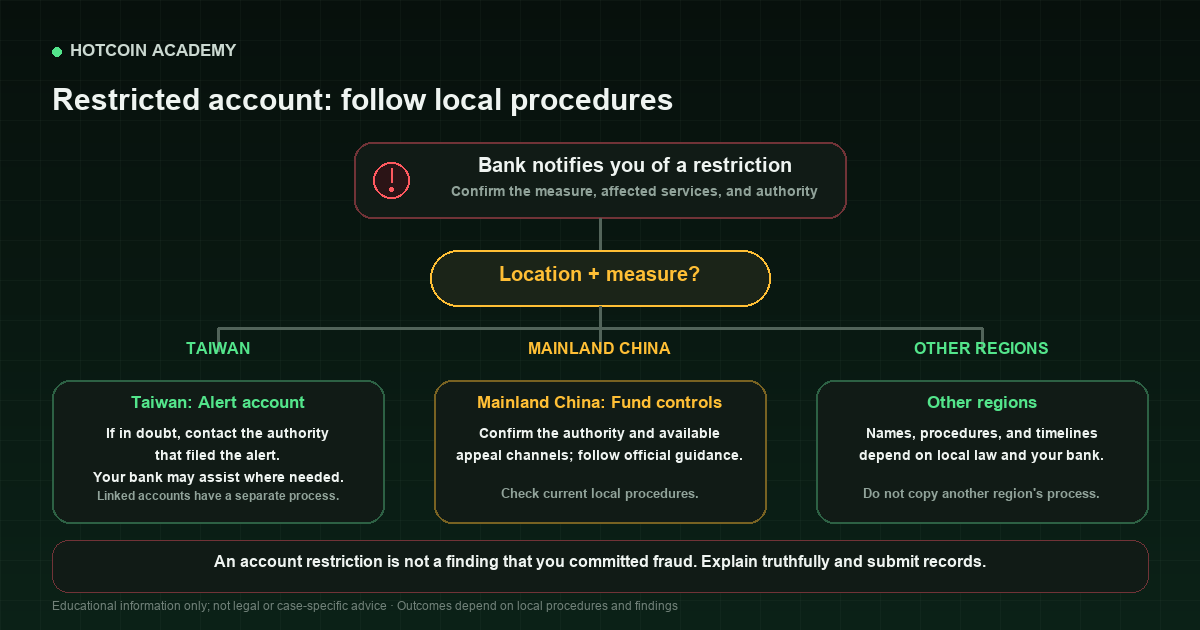
"Alert account" is primarily a statutory term used in Taiwan's banking sector. It does not mean every region uses the same name or the same procedures. When a bank account is restricted, it may be called an alert account, a derivative control account, a case-related account, a payment stop, or a freeze. The competent authority, time limits, and unfreezing channels also differ. When handling the matter, follow the explanations provided at the time by your account-opening bank and local law enforcement or anti-fraud channels. Do not treat one region's process as a universal rule.
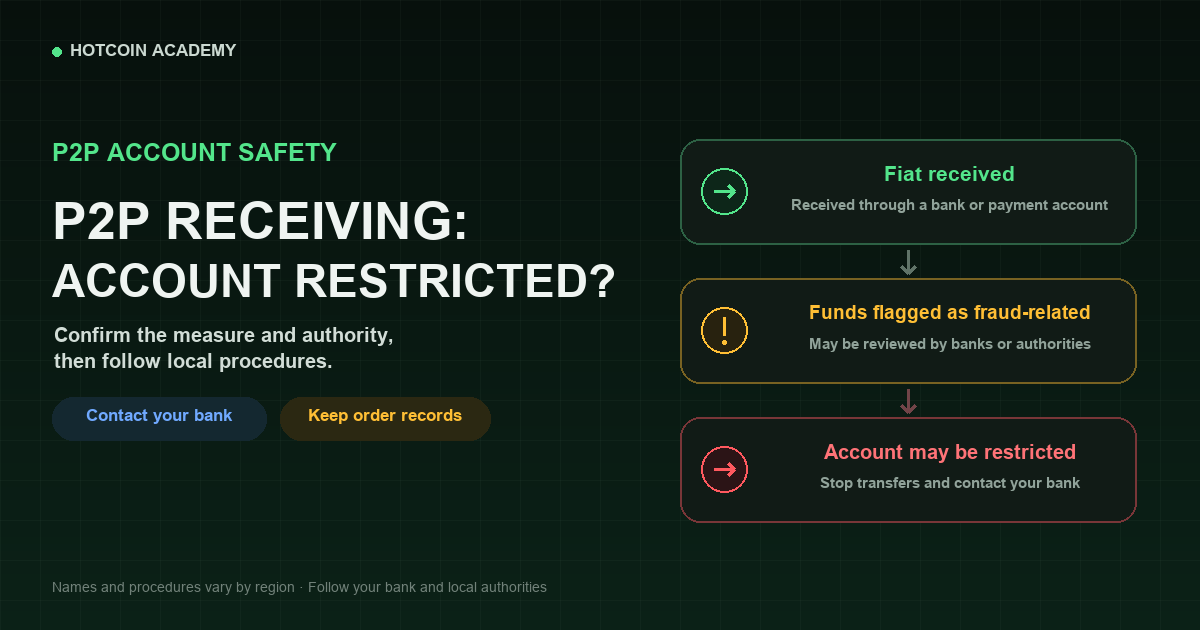
When buying or selling cryptocurrency through peer-to-peer (P2P) trading, if the fiat currency received in your bank or payment account is later identified as fraud proceeds, the receiving account may be restricted by a bank or law enforcement agency. In that case, contact your account-opening bank as soon as possible, keep complete records, and report the matter to local anti-fraud or police channels. Do not transfer the funds away or redirect them at a stranger's request. This article cannot determine whether your account can be unrestricted, nor can it promise that funds will definitely be recovered.
Key Takeaways
- Different regions use different names, procedures, and competent authorities for restricted bank accounts. Taiwan's "alert account" is governed by dedicated regulations. In Mainland China, terms such as emergency payment stop, rapid freezing, and case-related account are more common. In other regions, follow local banks and law enforcement agencies.
- In P2P transactions, the account that actually receives fiat currency is often the one more likely to be targeted. The search term "buying crypto" is often used as a general label for these transactions, but before handling the matter, you first need to determine whether you are the payer or the payee.
- If you discover that funds you just received may come from fraud, immediately contact your account-opening bank, preserve the order, transfer, and chat records, and report the matter to local anti-fraud or police channels. Do not transfer the funds out, withdraw cash, or redirect them to another account at the other party's request.
- Taiwan's regulations state that once an account is reported as an alert account, the bank shall suspend all transaction functions of that account, and subsequent incoming remittances shall be returned to the remitting bank. If the account holder has doubts, they should contact the original reporting authority, and the bank should provide assistance when necessary. Banks cannot lift an alert on their own. For derivative control accounts, restrictions shall be lifted immediately once the bank verifies that the relevant abnormal circumstances no longer exist, and it is not necessary to wait for the alert account to be lifted at the same time.
- Mainland China's Anti-Telecom and Online Fraud Law provides that public security organs may lawfully decide to take measures such as immediate inquiry, emergency payment stop, rapid freezing, timely unfreezing, and fund return for funds involved in a case, and banks and payment institutions shall cooperate. Specific conditions, time limits, and remedies are subject to the explanations of local public security organs, account-opening banks, and current supporting regulations.
- Do not trust "paid unfreezing," "transfer the money away first to protect it," or so-called agents who contact you privately. This article does not provide legal advice and does not promise unfreezing or fund recovery.
First, Understand the Differences: Names Vary by Region, and One Process Cannot Be Applied Everywhere
A bank account is usually restricted because a law enforcement agency is handling a case, or because a bank or payment institution has taken risk measures under local anti-fraud or anti-money-laundering rules. Similar names do not mean the handling authority and time limits are the same.
- Taiwan: The statutory terms include "alert account" and "derivative control account." An alert account is listed after a court, prosecutors' office, or judicial police agency reports it to a bank for the purpose of investigating a criminal case.
- Mainland China: In law and banking practice, the more common terms are emergency payment stop, rapid freezing, timely unfreezing, and fund return for funds involved in a case, as well as restrictions or suspension of business imposed by banks on abnormal accounts. The notice may not necessarily contain the words "alert account."
- Other regions: The terms may include freeze, transaction restriction, payment suspension, or case-related account. The rules are determined by local law and the account-opening institution.
Therefore, after receiving a bank SMS, phone call, or counter notice, first confirm with your account-opening bank: what type of measure the restriction is, which functions are affected, which authority issued the original report or decision, and what you need to prepare now. Do not infer the outcome on your own based on another region's "unfreezing experience" found online.
Why P2P Receipts May Lead to Account Restrictions
P2P or C2C trading on a platform involves users exchanging crypto assets for fiat currency. The platform can provide orders, escrow, and appeals, but fiat currency still moves through bank or payment accounts. If the source of an incoming remittance is later identified by a victim as a fraudulent transfer, the receiving account may be brought into the scope of an investigation or risk control.
The more common scenario is this: as the party selling crypto assets, you receive fiat currency from the counterparty under an order; the funds the counterparty used to pay may have come from a previously defrauded victim. After the victim reports the matter to the police or an anti-fraud channel, law enforcement may take payment-stop, freezing, or alert-listing measures against the account into which the funds were transferred. If the payer used an already restricted account, or the transferred funds are later intercepted by a bank, the order itself may also be affected, but the "account being listed" first occurs at the end that actually received the funds.
This does not automatically mean the account holder is the person who committed the fraud. The purpose of restricting the account is to pause further movement of funds and make it easier to clarify where the funds came from and where they went. The final determination can only be made through local law enforcement and judicial procedures. This article only explains the direction already set out in public rules and does not draw conclusions about individual cases.
To reduce this risk, the Help Center's current C2C security guidance and FAQs emphasize: complete transactions only within platform orders, and do not accept off-order transfers or private transactions; before selling crypto assets, confirm in your own receiving account that the funds have actually arrived, and do not release assets based only on a screenshot or SMS; transfers must use a payment method consistent with the real-name verification information, and do not pay to accounts inconsistent with the order's real-name information. These practices help verify whether a transaction was completed according to the order, but they cannot guarantee that the received funds will never later be identified as fraud proceeds. For methods such as the counterparty urging you to release coins or forging payment receipts, see How to Tell If the Other Party May Be a Scammer When Buying Crypto or Doing P2P.
What You Can Do Now If You Suspect You Have Received Fraud-Related Funds
The purpose of the following steps is to help banks and local law enforcement understand the situation as soon as possible and to preserve records that can be verified. They are not intended to teach people to evade investigations, nor can they replace local formal procedures.
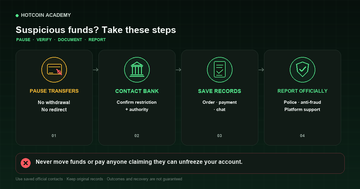
- Contact your account-opening bank or payment institution immediately. Explain the time and amount of receipt, the counterparty's name and account number, and the transaction in which you received the money. Ask what type of measure the current restriction is, whether you can still check transaction details, and what information you need to supplement. Use only your bank card, the official app, or customer service channels published by the bank. Do not call back unfamiliar numbers in notification SMS messages.
- Do not transfer the funds out, withdraw cash, or redirect them to another account at the other party's request. Continuing to move the funds may make it harder to trace where they went and may complicate the account situation. Preserve the account as it is and follow the guidance of the bank and law enforcement. Before the situation is clarified, do not use other bank or payment accounts to continue receiving similar payments, so as to avoid adding fund flows that need to be explained.
- Preserve complete records and do not delete or alter chats and statements. At a minimum, keep: the platform order number, order placement and release times, the receipt or payment information displayed by the counterparty, the bank or payment account receipt record, the payer's name on the receipt record, your own records of how you previously obtained the crypto assets (if any), in-order chat records, and the times you contacted the bank and customer service. Originals and original screenshots have more verification value than explanations assembled after the fact.
- Report to local anti-fraud or police channels. In Taiwan, you can confirm the original reporting authority with your account-opening bank, consult the 165 anti-fraud hotline, or follow the police agency's instructions; if the account holder has doubts about the listing, they should contact the original reporting authority. In Mainland China, you can report to the local public security organ and supplement materials through the anti-fraud channels published by the public security organ or bank. In other regions, use the channels designated by local police and banks. Do not describe any one hotline as the only universally applicable way to handle the matter.
- If the transaction occurred within a platform order, submit evidence through official customer service or an order appeal. The Help Center's current C2C guidance states: when a dispute arises, both buyers and sellers may contact platform customer service; provide payment evidence, order chat records, and other information so customer service can assist with verification. After payment has been made, do not cancel the order or make another transfer at the other party's request. Do not settle privately with the counterparty outside the order, and do not privately contact the counterparty to request withdrawal of a report, a self-arranged refund, or another transfer; still less should you transfer money to anyone claiming they can "unfreeze on your behalf."
- Also check your login and receipt security. If anyone asks you to provide verification codes, operate remotely, or transfer money to a "safe account," stop immediately and verify the account through the official entry point you have saved yourself.
Taiwan's Official Rules on "Alert Accounts" (Applicable Only to Accounts Opened in Taiwan)
The following content is based on the Regulations Governing Deposit Accounts and Suspected Illegal or Obviously Abnormal Transactions, administered by Taiwan's Financial Supervisory Commission and published in the Laws and Regulations Database, as well as public explanations from institutions such as the Joint Credit Information Center and the Criminal Investigation Bureau of the National Police Agency. It applies only to deposit accounts opened in Taiwan and listed under those regulations. Other regions should not apply it directly.
Under those regulations, an alert account means a deposit account that a court, prosecutors' office, or judicial police agency has reported to a bank for listing as an alert because it is needed to investigate a criminal case. Once an account is reported as an alert account, the bank shall suspend all transaction functions of the account, and incoming remittances shall be returned to the remitting bank by way of return remittance. Other deposit accounts of the same account holder may be listed as "derivative control accounts": electronic payment functions will be suspended, and incoming remittances will likewise be returned; when the holder handles withdrawals, transfers, or outward remittances at the counter, the bank may require transaction information to prove reasonableness and may refuse the transaction if it cannot be explained.
The regulations also state:
- The alert period starts from the time of reporting and automatically expires after two years; if continued alert is necessary, the original reporting authority should report again before the period expires, and any extension is limited to one time and one year.
- If the account holder has doubts about being listed as an alert, they should contact the original reporting authority, and the bank should provide assistance when necessary.
- The bank may lift the restriction only after the original reporting authority issues a release report or the alert period expires. In other words, the bank cannot lift an alert solely at the account holder's request.
- The path for lifting restrictions on a derivative control account differs from that for an alert account. The Joint Credit Information Center publicly explains: derivative control accounts are managed by financial institutions themselves, and the relevant restrictions should be lifted immediately after verification that the suspected illegal or obviously abnormal circumstances no longer exist; it is not necessary to wait for the alert account to be lifted at the same time. The account holder may ask each account-opening bank what explanatory materials need to be supplemented, and the bank's explanations at the time remain controlling.
The Joint Credit Information Center explains that it handles data exchange and records between the police and financial institutions, but it is not the unit that creates alert accounts; if a party has doubts, the financial institution can provide the name of the original reporting police agency, and the account holder can bring identity documents to inquire. The Criminal Investigation Bureau of the National Police Agency publicly explains: aside from automatic release upon expiry of the alert period, one may download the "Application Form for the Public to Remove an Alert Account", prepare materials according to the instructions, and go to the competent police agency to handle the matter. Acceptance conditions and required documents in each locality are subject to the explanations of the competent authority at the time.
The public documents above do not state that "the restriction will definitely be lifted after application" or provide a uniform compensation standard, nor do they state that all cases must be unfrozen within the same time limit. Therefore, this article does not judge the probability of removal or the amount of return.
Relevant Mainland China Rules (Only Publicly Stated Principles)
In Mainland China, when a bank or payment account is restricted, the notice may not contain the words "alert account." Under the Anti-Telecom and Online Fraud Law of the People's Republic of China, promulgated on September 2, 2022, and effective from December 1, 2022:
- Banking financial institutions and non-bank payment institutions shall monitor abnormal accounts and suspicious transactions; based on the risk situation, they may take necessary preventive measures such as verifying transaction circumstances, re-verifying identity, delaying payment settlement, and restricting or suspending relevant business.
- The public security department of the State Council, together with relevant departments, shall establish and improve systems for immediate inquiry, emergency payment stop, rapid freezing, timely unfreezing, and fund return for funds involved in telecom and online fraud, and shall clarify the relevant conditions, procedures, and remedies. Where public security organs lawfully decide to take the above measures, banks and payment institutions shall cooperate.
- The law also provides that efforts to recover stolen property and compensate losses shall be strengthened and the lawful property of victims shall be returned in a timely manner; no unit or individual may illegally buy, sell, rent, or lend bank accounts, payment accounts, and the like.
- The same law also provides that when restrictive measures such as restricting or suspending services are taken against abnormal circumstances involving fraud, the person subject to the measures shall be informed of the reason for the measures, the remedy channels, and the materials to be submitted; the person subject to the measures may file a complaint with the department or unit that made the decision or took the measures. If verification is passed, the relevant measures shall be lifted immediately. The specific acceptance methods and materials to be submitted are subject to the explanations of the decision-making unit at the time.
The legal provisions themselves do not specify a fixed number of days for unfreezing, conditions for successful unfreezing, or compensation ratios applicable to all cases. Since 2016, departmental notices have also made operational arrangements for payment-stop and freezing mechanisms, but specific time limits and procedures may be adjusted with supporting regulations. Therefore, this article does not state time limits or return standards that are not uniformly set out in the current legal provisions. Please confirm directly with your account-opening bank and local public security organ the procedure applicable to your specific account.
Common Misunderstandings
- "They are all called freezes, so handling is the same everywhere" — alerts, payment stops, freezes, and bank risk-control restrictions may come from different authorities and apply different rules. First confirm the measure name and reporting authority with your account-opening bank.
- "I just need to go to the bank and explain, and it will be lifted the same day" — In Taiwan, an alert account can be lifted only after the original reporting authority issues a release report or the alert period expires. In other regions, it also depends on how the authority that decided the payment stop or freeze handles the matter. Banks can assist with inquiries and forwarding materials, but that does not mean they can decide the outcome on the spot.
- "Transfer the money to another card first to protect the funds" — Continuing to move the funds may complicate the investigation, and it does not mean the funds are already outside the restriction. Preserve the current situation and follow the guidance of banks and law enforcement.
- "Pay someone to handle it, or transfer money according to a private message to get it unfrozen" — Such requests are themselves worthy of suspicion. Do not provide verification codes, identity documents, or further funds to strangers.
- "This is a normal sale, so it cannot be restricted" — The restriction concerns whether the funds are identified as case-related or abnormal, not whether you subjectively believe the transaction is normal. Being restricted also does not mean you have already been found to have committed fraud, but you need to explain and provide evidence through formal procedures.
- "Deleting the chat records makes things easier" — Original orders, transfers, and communication records are the most direct basis for explaining the situation to banks, police, or platforms, and should be preserved completely.
- "Follow the standard wording online and describe the funds as a loan or payment for goods to get through more easily" — When explaining to banks or law enforcement, truthfully explain the transaction background and do not use a fund purpose inconsistent with the facts. Statements that do not match the evidence will only make the situation harder to clarify.
Frequently Asked Questions
Q1: Is "alert account" the term used in all regions? No. It is mainly a term in Taiwan's relevant regulations. Other regions may use names such as freeze, payment stop, or case-related account. When you see "alert account" in search results, first confirm where you opened the account and what measure the bank actually adopted.
Q2: Can the bank directly lift the restriction for me? Taking Taiwan's public regulations as an example, an alert account can be lifted only after the original reporting authority issues a release report or the alert period expires; if the account holder has doubts, they should contact the original reporting authority, and the bank should provide assistance when necessary. For derivative control accounts, the bank lifts the restriction after verifying that the abnormal circumstances no longer exist; the statement that "the bank cannot lift an alert on its own" cannot be directly applied to such accounts. In other regions, it depends on the authority that made the decision and local procedures, and you need to confirm with your account-opening bank; do not assume the bank has the power to lift it on the spot.
Q3: How long does unfreezing take? Will the funds definitely be recovered? Neither public regulations nor help pages provide a fixed time limit or compensation standard applicable to all regions and all cases. Taiwan's regulations set out alert periods and extension rules, but those are the periods for the listing effect, not a promise that "the restriction must be lifted a certain number of days after application." Mainland China's law requires the establishment of a timely unfreezing and fund return system, but the specific conditions are subject to the explanations of local public security organs and banks. This article cannot predict the outcome of your case.
Q4: I only received payment according to an order, so why was my account restricted? Because the incoming funds may later be identified as fraud proceeds. The purpose of the restriction is usually to pause further movement of funds and make it easier to clarify their source. This cannot be directly equated with a finding that the account holder committed fraud, but the account holder needs to cooperate with banks and law enforcement in explaining the transaction background and provide order and receipt evidence.
Q5: If I find that the funds may be fraud-related, should I transfer the money away first? You should not transfer it out, withdraw cash, or redirect it at the other party's request. Contact your account-opening bank, preserve evidence, and report to local anti-fraud or police channels, and handle the matter according to formal guidance.
Q6: Can the platform directly unfreeze my bank account? Restrictions on bank accounts are handled by the account-opening bank and local law enforcement and regulatory procedures. Trading platforms cannot lift bank card restrictions on behalf of banks. If the relevant transaction occurred within a platform order, you can submit the order and payment information through official customer service to help explain the transaction process. Whether the platform account itself has other functional restrictions is subject to account notifications and the Help Center's current guidance, and is not the same matter as whether the bank card has been listed.
Conclusion
When a bank account is restricted, first confirm with the account-opening bank what measure it is and who reported or decided it, and then handle the matter through the formal channels of the account-opening location. Do not apply Taiwan's "alert account" rules to other regions, and do not move suspicious funds you have just received. If the funds came from a P2P transaction, preserve the order and transfer evidence completely and explain the situation to the bank and local anti-fraud or police channels. What you can do is cooperate with verification, not look for shortcuts to private unfreezing. The outcome depends on local procedures and factual findings and cannot be guaranteed in advance here.
If you want to further assess the flow of funds and permissions in common scams, you can first read the Complete Guide to Crypto Scams.
Risk warning: This article is for educational and informational purposes only. It does not constitute legal, investment, or case-specific advice, and it does not guarantee that an account can be unrestricted or that funds can be recovered. The names, procedures, time limits, and remedies for restricted bank accounts vary by region and may change. Please rely on the explanations provided at the time by your account-opening bank, local law enforcement agencies, and competent authorities. Do not transfer money to anyone claiming they can unfreeze an account or recover funds on your behalf, and do not provide verification codes or identity documents. For matters involving funds and legal liability, consult qualified local professionals when necessary.
Lectura recomendada
Ver más