
What Is a Sidechain? How Polygon's Technology Roadmap Evolved
A sidechain is a blockchain that runs alongside a main chain with its own consensus and its own validator set, exchanging assets or messages with that main chain through a bridge. Polygon PoS is still an Ethereum sidechain today, not a rollup.
Polygon's roadmap grew from Matic Network into a PoS chain, ZK technology, POL and Agglayer. The names and the vision have changed several times, so it is essential to separate networks that already run from upgrades that are still on the drawing board.
What actually separates a sidechain from a rollup?
A sidechain decides for itself which blocks are valid, and the main chain usually receives only checkpoints, bridge proofs or specific messages. A rollup hands disputes over state correctness, or validity proofs, to an L1 contract, and publishes to L1 the data needed to reconstruct its state.
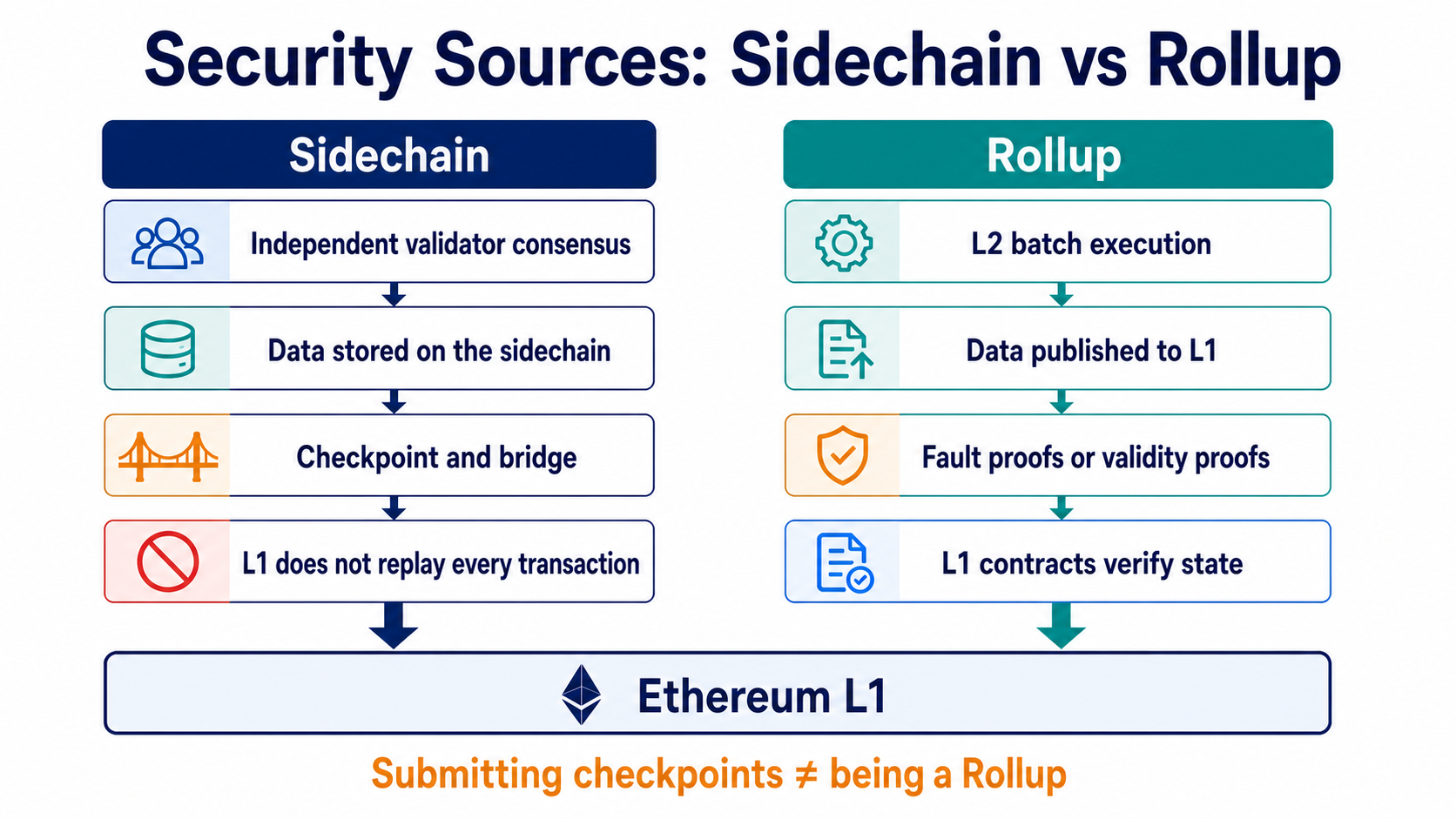
| Dimension | Sidechain | Rollup |
|---|---|---|
| Consensus or verification | Sidechain validators decide the canonical state on their own | An L1 contract verifies fault proofs or validity proofs |
| Where data lives | Held mainly by sidechain nodes | Data needed to reconstruct state is posted to L1 |
| Asset bridge | Relies on sidechain consensus, checkpoints and bridge rules | Relies on the rollup and bridge contracts on L1 |
| Risks beyond a main-chain failure | Validator collusion, sidechain downtime, bridge permissions | Sequencer, proving, data availability, upgrade keys |
| Typical strengths | Low fees, independent parameters, flexible upgrades | Inherits L1 data and settlement guarantees more directly |
A sidechain writing Merkle roots or checkpoints to Ethereum on a regular schedule does not mean Ethereum re-executes and verifies every transaction inside them. A checkpoint anchors a state that sidechain consensus has already accepted; whether that state was valid in the first place still rests on the sidechain validators.
Why did Polygon start out as a sidechain?
Matic Network set out to give Ethereum applications higher throughput and lower fees. Polygon PoS uses EVM-compatible execution so Solidity applications and wallets can migrate with relatively little friction, while producing blocks quickly through its own validators, the Bor execution layer and the Heimdall consensus layer.
Heimdall validators stake in Ethereum contracts and submit Polygon PoS checkpoints to Ethereum; Bor handles transaction execution and block production. Ethereum plays the role of staking venue and anchor here, but it does not act as a state verifier for each Polygon PoS batch.
That design brought costs down, and it also means the security boundary of Polygon PoS includes its limited validator set and the PoS bridge, rather than resting on Ethereum validators alone.
Which stages has Polygon's technology roadmap gone through?
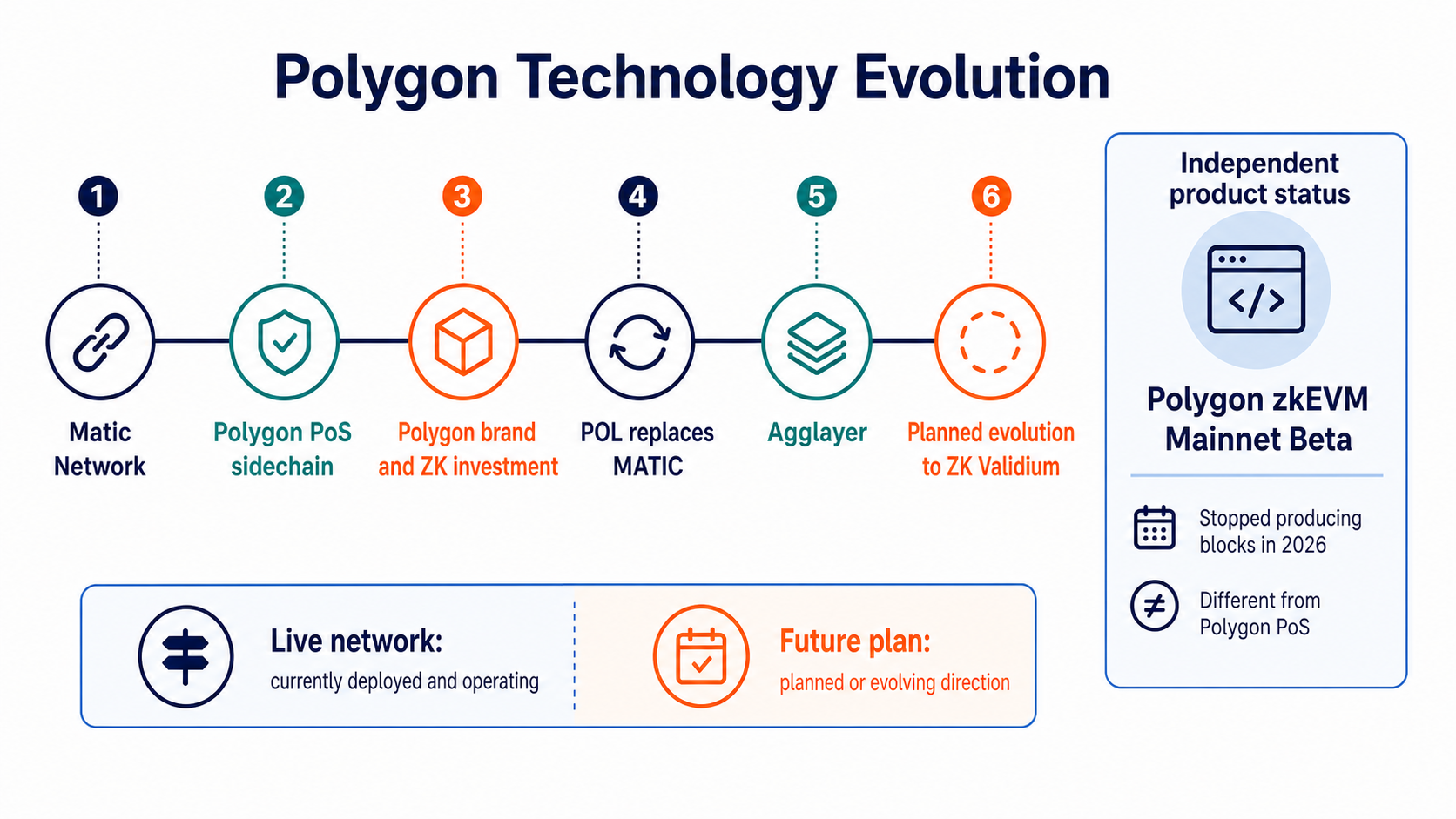
| Stage | What actually changed | What not to confuse it with |
|---|---|---|
| Matic Network | Built a PoS network aimed at scaling Ethereum | Early Plasma research does not mean every asset uses Plasma today |
| Polygon rebrand | Grew from a single-chain brand into an ecosystem of scaling technologies | Polygon no longer refers to just one network |
| ZK investment | Shipped and researched zkEVM, provers and chain development components | The existence of ZK technology does not make PoS a ZK rollup |
| POL migration | POL replaced MATIC as the gas and staking asset of Polygon PoS | A token migration does not change the consensus classification |
| Agglayer | Connects chains that use different execution and proving models | Connected chains do not thereby share an identical security model |
| PoS ZK plan | Official documentation still describes a planned evolution to a ZK Validium | A planned state must not be written up as a finished one |
One more detail that dates quickly: Polygon zkEVM Mainnet Beta stopped producing blocks in 2026. It was a ZK rollup product separate from Polygon PoS, so its retirement does not mean Polygon PoS stopped running, and it is equally wrong to call PoS a zkEVM because of it.
How does Polygon PoS confirm transactions today?
Bor produces and executes blocks, while Heimdall-v2 validators finalize milestones through CometBFT-based consensus and submit checkpoints to Ethereum on a regular basis. Finality inside Polygon and a checkpoint landing on Ethereum are two distinct stages.
The network currently uses POL as its gas and staking asset. Official documentation explicitly calls Polygon PoS an EVM-compatible sidechain and lists the move to a ZK Validium as future work. That is the most direct basis for judging its classification today.
What should you check before using Polygon PoS?
Start by confirming that your wallet is pointed at Polygon PoS rather than the retired Polygon zkEVM, another Agglayer chain or a testnet with a similar name. Then verify POL for gas, the contract address of the token you want and the bridging route.
When an asset moves from Ethereum into Polygon PoS, identify whether it arrives through the official PoS bridge, native issuance by the issuer, or a third-party bridge. On the way out, check the Ethereum checkpoint, the bridge contract and L1 gas instead of estimating from Polygon's local block times alone.
For rollups and other scaling routes, see A Complete Guide to Layer 2 Scaling, and for how Optimistic Rollups work in detail, see Arbitrum and Optimism.
FAQ
Is a sidechain always less secure than a rollup?
You cannot answer that without looking at the specific design. A sidechain adds trust assumptions around independent validators and a bridge, while rollups carry sequencer, upgrade and proving risks. What deserves comparison is the attack conditions and the exit guarantees, not the labels.
Once Polygon PoS submits a checkpoint to Ethereum, are those transactions verified by Ethereum?
Ethereum confirms the checkpoint submission transaction and the state of the bridge contract, but it does not re-execute all the Polygon transactions covered by that checkpoint. Transaction validity is judged first by Polygon PoS consensus.
After MATIC migrates to POL, do old contract addresses change automatically?
Different chains and services may handle the token migration differently. A wallet's displayed name is not enough to tell whether it is complete, so check the official migration notes and the specific contract addresses.
Is Agglayer a new Polygon main chain?
No. Agglayer is infrastructure for connecting multiple chains and coordinating cross-chain state and liquidity. Connected chains keep their own execution, sequencing and data designs.
Lectura recomendada
Ver más


service hotcoin.com
producthotcoin.com
businesshotcoin.com
casecnhotcoin.com