
Optimistic Rollups Explained: Arbitrum and Optimism
Optimistic Rollups accept off-chain execution results first, then use a challenge period and fault proofs to weed out incorrect states. Arbitrum and Optimism both follow this approach, but they differ in execution software, dispute protocols, and multichain stacks.
“Optimistic” describes the order of verification, not unconditional trust in the operator. Transaction data is compressed and published to Ethereum so that verifiers can replay execution; if a state claim is wrong, challengers can dispute it through the process defined in the L1 contracts.
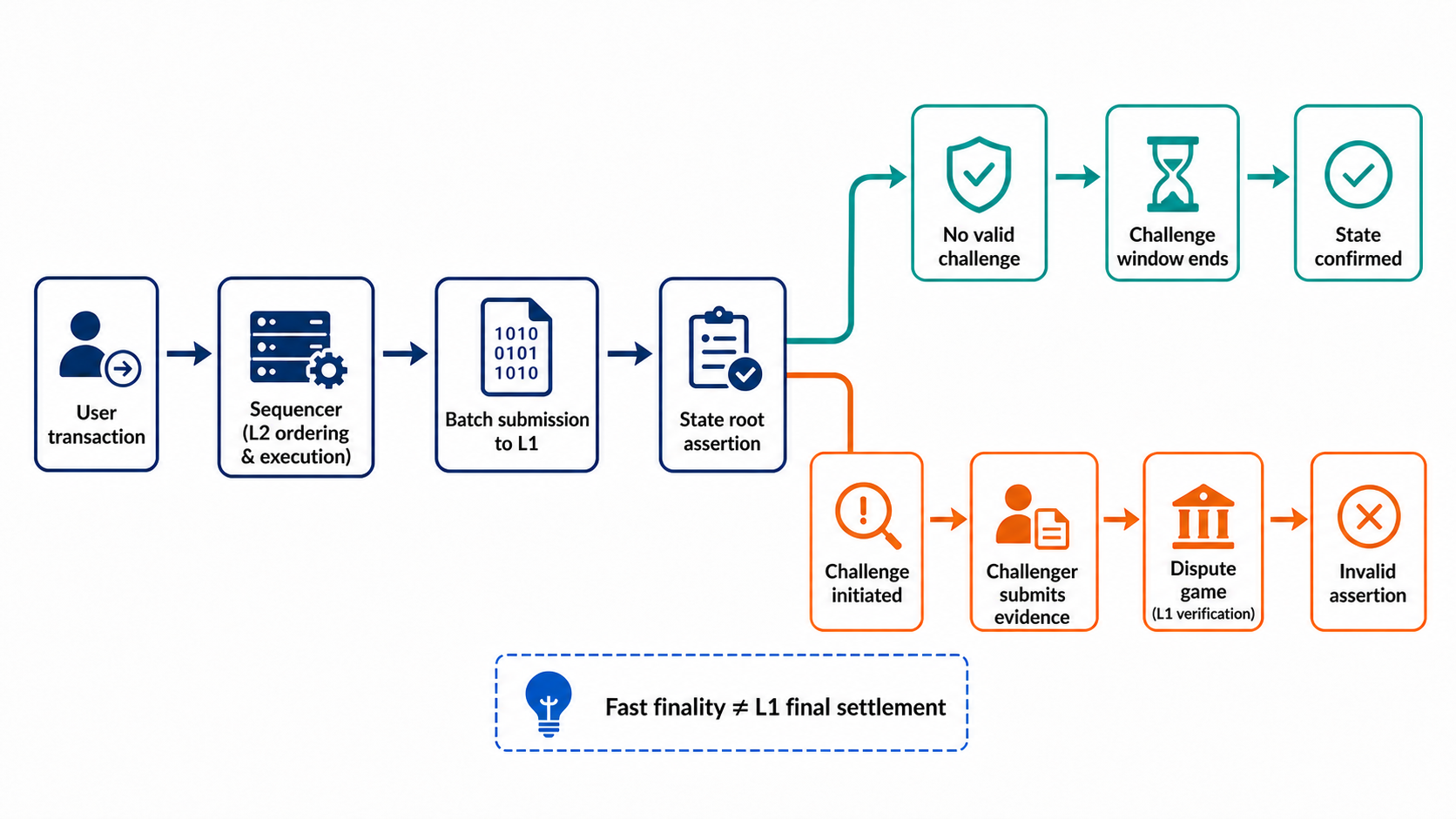
How Does an Optimistic Rollup Handle a Batch of Transactions?
A batch of transactions normally moves through four stages, from fast confirmation to settlement on L1.
- The sequencer receives user transactions, decides their order, and executes them on L2, so users see a receipt almost immediately.
- A batching service compresses the transaction data and publishes it to Ethereum as Blob or calldata.
- A state proposer submits an L2 state claim to the L1 contracts, while challengers independently replay the data and check the result.
- A state with no valid challenge is confirmed once the window closes; when a dispute arises, the fault proof protocol narrows the disagreement down to an execution step that L1 can verify.
So sequencer confirmations mainly solve responsiveness, publishing data on L1 guarantees that others can reconstruct execution, and fault proofs deal with incorrect states. Remove any one of those layers and the security properties change.
Why Do Official Bridge Withdrawals Often Wait for the Challenge Period?
When exiting from L2 back to Ethereum, the L1 contracts must establish that the state a withdrawal relies on is valid. An Optimistic Rollup does not attach a validity proof to every batch, so the official bridge normally waits until the challenge window has closed.
Standard exits on Arbitrum One and OP Mainnet are designed around a challenge period of roughly one week, though the exact steps and the point at which the clock starts should be checked against the current official bridge. Third-party liquidity bridges can front the assets on the destination chain and complete formal settlement in the background, but that adds liquidity provider, bridge contract, and asset version risk for the user.
The challenge period does not force every transaction inside L2 to wait a week. Transfers and application interactions can be confirmed by the sequencer and included in L2 blocks first; the longer wait mainly applies when returning to L1 through the protocol's native path.
What Do Arbitrum and Optimism Have in Common?
Both move large volumes of EVM transactions to L2 for execution, submit the data needed to reconstruct chain state to Ethereum, and handle state claims and disputes through L1 contracts. On both mainnets users normally pay gas in ETH, and both work with familiar Ethereum wallets and Solidity tooling.
Their shared trust boundaries look similar too:
- The sequencer can influence short-term ordering and transaction availability, so users should understand force inclusion and L1 fallback paths.
- Core contracts can be upgraded, and security councils, timelocks, and governance permissions determine how quickly the rules can change.
- Standard bridges only handle specific assets and message paths, while third-party bridges add another set of contracts and liquidity assumptions.
- Fast confirmation, data posted on chain, state confirmation, and Ethereum finality are distinct layers.
Where Do Arbitrum and Optimism Mainly Differ?
Their differences today can no longer be summarized the way early articles put it, as one protocol using multi-round proofs and the other using a single-round proof. Both keep upgrading their fault proofs, execution clients, and permission structures, so any comparison should look at what is deployed now rather than reuse labels from older versions.
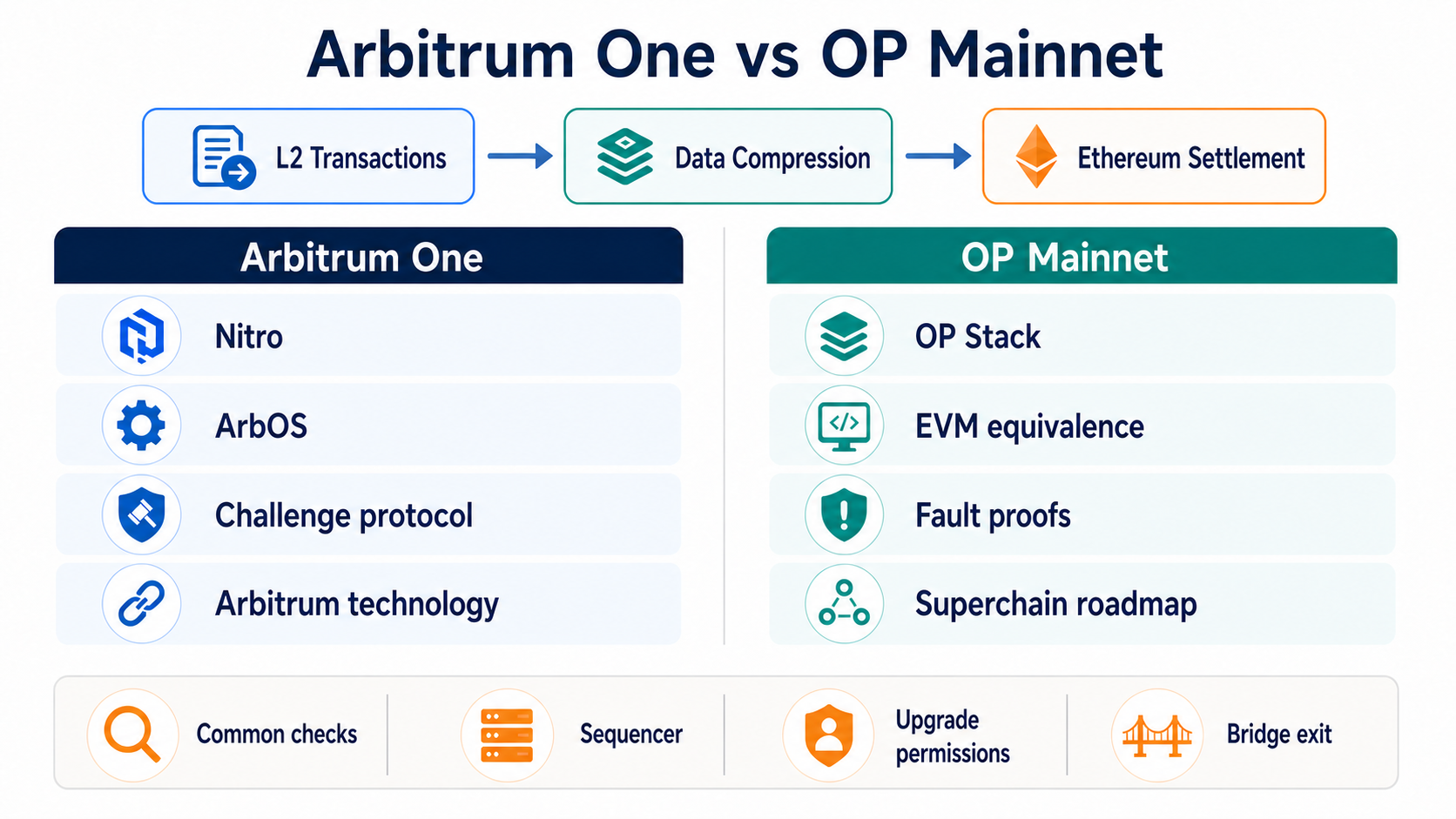
| Comparison | Arbitrum One | OP Mainnet |
|---|---|---|
| Core technology | The Nitro architecture, combining Ethereum client components, ArbOS, and a dispute execution environment | OP Stack, a modular combination of execution, derivation, batching, and fault proof components |
| State disputes | Arbitrum's challenge protocol narrows a dispute down to verifiable execution, and the BoLD roadmap emphasizes bounded delay and broader validation participation | OP Stack fault proofs handle invalid claims through dispute games and a verifiable execution program |
| Multichain roadmap | Arbitrum technology powers One, Nova, and custom Arbitrum chains, and data availability configurations can differ between them | OP Stack has been adopted by many chains, and the Superchain roadmap emphasizes shared standards and interoperability |
| Developer compatibility | Targets EVM applications and offers extended execution capabilities such as Stylus | Emphasizes EVM equivalence and a standardized OP Stack developer experience |
| What users should check | First identify whether you are on Arbitrum One, Nova, or another Arbitrum chain | First distinguish OP Mainnet from other networks built on OP Stack |
Arbitrum Nova uses the AnyTrust data availability design, so the Arbitrum name alone does not make its security assumptions identical to those of Arbitrum One. In the same way, building on OP Stack does not automatically give a chain the same governance, data publishing, and proof deployment status as OP Mainnet.
Why Do Fees on the Two Networks Change?
Transaction fees on an Optimistic Rollup usually include the cost of L2 execution plus the L1 data cost of publishing compressed data to Ethereum. Network congestion, contract complexity, transaction byte size, Blob prices, and protocol parameters all move the final figure.
The price of a simple transfer at a given moment does not represent the cost of a complex swap. When comparing Arbitrum and Optimism, simulate the same operation on both sides and check the gas limit, the estimated L1 data fee, and the swap slippage your wallet reports.
A full migration can also involve four groups of fees: approval on the source chain, bridging, swapping on the destination chain, and a future exit. Comparing only a single transaction inside L2 may understate the real cost.
What Should You Check Before Using Arbitrum or Optimism?
| Check | How to do it |
|---|---|
| Network identity | Verify the chain ID, RPC, explorer, and bridge addresses against official sources, so another chain on the same stack is not mistaken for the mainnet |
| Asset version | Confirm whether a token is natively issued, bridged through the standard bridge, or bridged by a third party |
| Confirmation layer | Distinguish sequencer confirmation, batch publication, and L1 settlement instead of relying on the wallet's success icon |
| Exit path | Review the standard bridge waiting time, L1 gas, and the extra assumptions a third-party fast bridge introduces |
| Permission status | Check whether fault proofs are enabled, who can upgrade the contracts, and whether emergency powers are constrained by a timelock |
To understand the other major rollup approach, read ZK-Rollups Explained; to compare rollups with sidechains and Validium, return to A Complete Overview of Layer 2 Scaling Solutions.
FAQ
Are ARB and OP the Gas Tokens of These Two Networks?
On Arbitrum One and OP Mainnet, ordinary transactions normally pay gas in ETH. ARB and OP are mainly tied to the governance of their respective ecosystems, so a wallet holding governance tokens but no ETH may still be unable to send a transaction.
Would a Sequencer Outage Make Assets on L2 Disappear Forever?
A sequencer failure first affects transaction submission and fast confirmation. Whether assets can be recovered in the worst case depends on whether the data is available, whether the L1 contracts provide a forced transaction or exit path, and whether the relevant contracts still operate normally.
Do Withdrawals From an Exchange to Arbitrum or Optimism Have to Go Through Ethereum?
The interface usually does not require you to bridge anything yourself, because the platform manages funds on the relevant network in the background. Before withdrawing, still confirm that the network selected on the platform matches the network of the receiving wallet, and check whether deposits and withdrawals are paused.
If an Application Is Deployed on Both Chains, Will the Contract Addresses Be Identical?
Not necessarily. A project can use deterministic deployment to obtain the same address, or use different contracts for different networks. You cannot infer an L2 contract from the project name or a mainnet address alone; verify it through the project's official entry point.
Recommended
View more
service hotcoin.com
producthotcoin.com
businesshotcoin.com
casecnhotcoin.com