What Is Filecoin (FIL) and How to Buy It?
Filecoin is a decentralized storage network: users pay to store data with storage providers around the world, and providers use FIL as collateral to prove they actually store the data.
FIL is the network's native token, used for storage fees, staking, and gas. The Filecoin story has expanded from "replacing cloud storage" to "verifiable data and AI training data."
Key Takeaways
- Filecoin uses blockchain to coordinate storage trading, and storage providers must stake FIL and submit proofs.
- The network supports storage, retrieval, and FVM smart contracts, aiming to turn data into programmable assets.
- FIL is used for payments, staking, and gas, with a total supply of about 1.96 billion tokens.
- Risks include insufficient storage demand, token inflation, competition, and prolonged low prices.
What Is Filecoin?
At the core of Filecoin is "proof of storage": storage providers must regularly submit Proof-of-Replication and Proof-of-Spacetime to prove the data is still there. If a proof fails, the staked FIL is slashed.
Users reach deals with providers through the storage market and pay FIL to store data; the retrieval market lets users retrieve data on demand. FVM allows developers to deploy smart contracts on Filecoin, combining storage with DeFi, NFTs, and AI data.
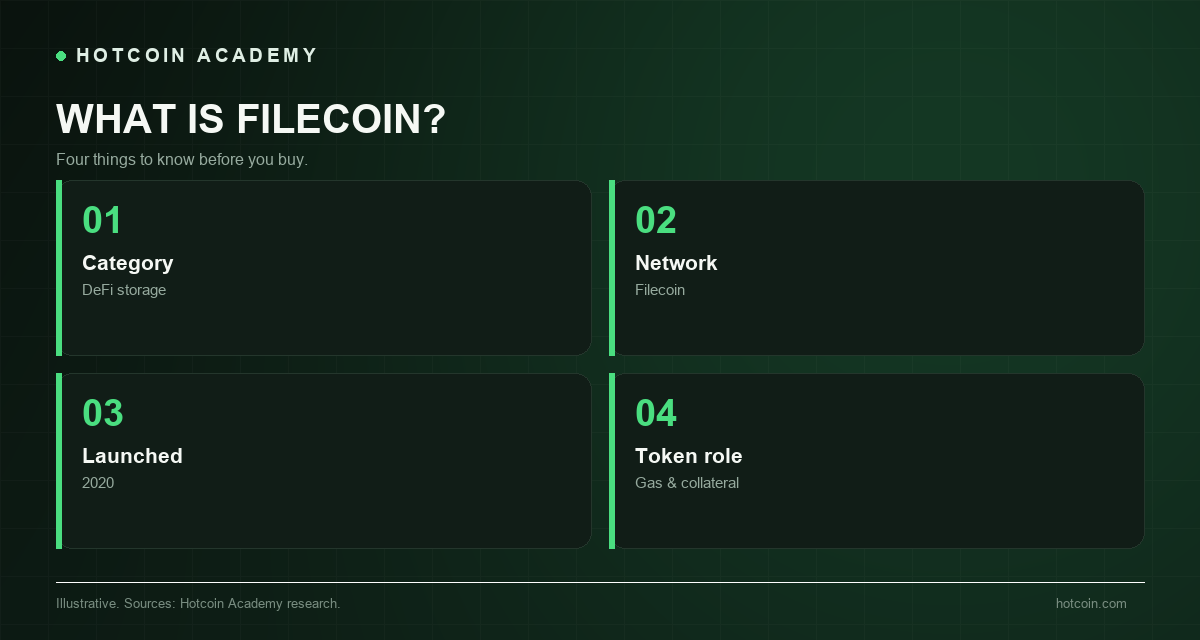
Figure: Four basic facts about Filecoin.
Filecoin's challenge is on the demand side: there is plenty of supply in decentralized storage, but few customers are truly willing to pay. Without stable storage demand, token staking and gas demand will also be limited.
How Does Filecoin Work?
Filecoin's operation can be broken down into three parts:
- Storage: Users pay FIL to store data with providers and receive verifiable storage credentials.
- Staking: Providers stake FIL to prove their storage commitment, and failure results in slashing.
- FVM: Smart contracts run on Filecoin, combining storage with on-chain applications.
FIL Tokenomics
FIL has a total supply of about 1.96 billion tokens and a circulating supply of about 846 million. The token is used for storage fees, staking, and gas, and inflation and unlocks are long-term pressures.
| Item | Data |
|---|---|
| Token name | Filecoin (FIL) |
| Total supply | About 1.96 billion tokens |
| Circulating supply | About 846 million tokens |
| Market cap | About US$644 million |
| Current price | About US$0.761 |
| Drawdown from all-time high | About -99.7% |
Data from CoinGecko, November 11, 2026; supply and burns are subject to official sources.
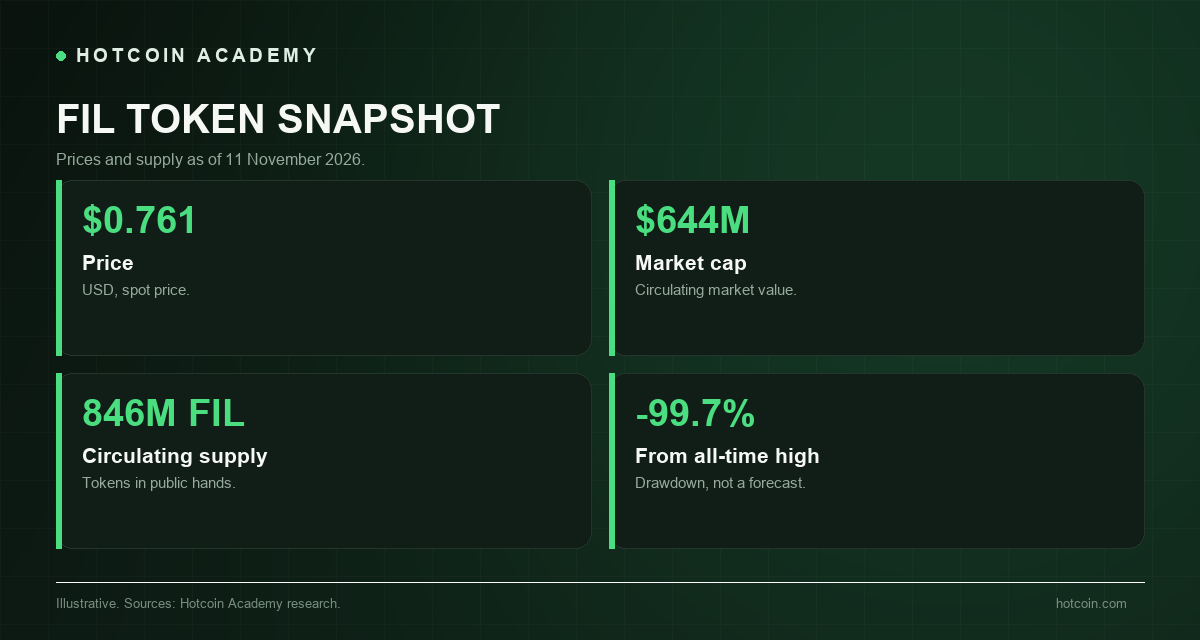
Figure: FIL market data snapshot (November 11, 2026).
Filecoin in 2026: Current Situation and Risks
In 2026, Filecoin is focusing on "verifiable data" and AI: model training requires large amounts of data, and if data provenance and integrity can be proven, Filecoin has a chance to become data infrastructure. But this path requires time and real customers.
FIL is down about 99.7% from its high, with a market cap of about US$644 million. The prolonged low price reflects oversupply and insufficient demand, and reminds investors that storage network adoption is far slower than the narrative.
- Insufficient demand: There are limited real paying storage customers, and supply is excessive.
- Token inflation: Block rewards and unlocks continuously increase circulating supply.
- Competition: Arweave, cloud storage, and emerging DA layers compete for the market.
- Low prices: The token price affects providers' willingness to stake and network security.
How to Buy FIL?
If you already understand Filecoin's mechanics and risks and decide to participate with a small amount, you can follow these steps to buy FIL on Hotcoin.
- Registration and KYC: Complete Hotcoin account registration and identity verification.
- Deposit: Deposit USDT, or use a supported fiat on-ramp.
- Search for the trading pair: Search for FIL/USDT in the spot section.
- Place an order: Choose a market or limit order, confirm fees and slippage, and buy.
- Withdraw: For long-term holding, it is recommended to withdraw to a self-custody wallet and verify the contract address.
Common Misconceptions
- Treating "storage capacity" as "real demand."
- Ignoring FIL's inflation and unlocks.
- Treating Filecoin as a direct beneficiary of the AI narrative without looking at actual orders.
FAQ
What is Filecoin? Filecoin is a decentralized storage network where users pay to store data and providers stake FIL and submit storage proofs.
What is FIL used for? It is used for storage fees, staking, and gas, and is also the collateral asset for storage providers.
What is the relationship between Filecoin and IPFS? IPFS is a content-addressing protocol, and Filecoin is an incentive layer built on top of it, using tokens to coordinate storage and retrieval.
Why has FIL fallen so much? Insufficient storage demand, token inflation, competition, and a broad market correction have combined to push FIL about 99.7% below its all-time high.
Conclusion
Filecoin is one of the earliest experiments in "coordinating storage with tokens." Its technology is solid, but commercial demand has not kept up. Its future depends on whether verifiable storage can become real infrastructure.
For FIL holders, storage orders and network utilization are more convincing than the slogan of "decentralized cloud."
Risk warning: This article is for educational and informational purposes only and does not constitute investment advice. Crypto assets are highly volatile, and new and small-cap tokens carry higher liquidity risk; investors may lose all of their principal. Please do your own research and manage your position size.
Recommended
View more