What Is Ethena (ENA) and How to Buy It?
Ethena is a DeFi protocol that issues the synthetic dollar USDe. Instead of relying on dollar reserves held in banks, it uses crypto assets such as ETH as collateral while establishing short hedges in the derivatives market, keeping USDe's price pegged to $1 as closely as possible.
ENA is the protocol's governance token. To understand Ethena, the key is not ENA's short-term price, but understanding where USDe's yield comes from and under what conditions it could fail.
Key Takeaways
• Ethena issues the synthetic dollar USDe and maintains its peg through a delta-neutral strategy of "spot collateral + perpetual shorts."
• USDe's yield mainly comes from ETH staking rewards and perpetual futures funding rates; sUSDe is the yield-bearing receipt after staking.
• ENA is used for governance, incentives, and ecosystem partnerships, and its price is highly correlated with USDe supply and the funding rate environment.
• Key risks include negative funding rates, exchange counterparty risk, liquidations, and regulatory changes.
What Is Ethena?
USDe's mechanism can be broken into two steps: users deposit assets such as ETH and stETH into the protocol and mint an equivalent amount of USDe; at the same time, the protocol establishes ETH perpetual shorts on centralized exchanges to hedge against the risk of ETH price declines. This way, the dollar value of the collateral remains relatively stable, and USDe can stay near $1.
sUSDe is the yield-bearing receipt obtained by staking USDe. When funding rates are positive and ETH staking generates yield, the net value of sUSDe rises; when funding rates turn negative, yield may be eroded, and in extreme cases the protocol needs to draw on reserves.
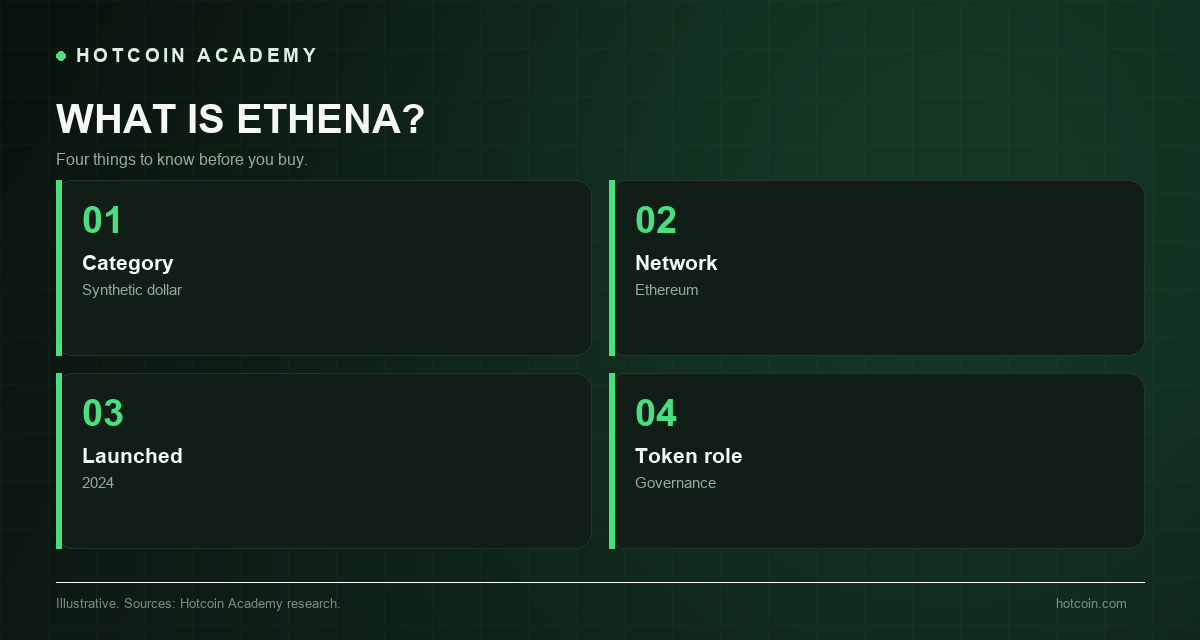
Figure: Four basic facts about Ethena.
Ethena expanded rapidly in 2024, and USDe briefly became one of the largest decentralized stablecoins. Its innovation lies in tokenizing basis trades, but this also means it brings the risks of centralized exchanges, custodians, and derivatives markets onto the chain.
How Does Ethena Work?
Ethena's operation can be broken into three stages:
• Minting: Deposit ETH or liquid staking tokens to mint USDe based on the collateral value.
• Hedging: The protocol shorts ETH perpetuals on exchanges to reduce collateral price volatility.
• Yield: Stake USDe to obtain sUSDe; yield comes from staking and funding rates.
ENA Tokenomics
ENA is Ethena's governance token; holders can vote on protocol parameters, reserve management, and ecosystem incentives. ENA does not directly share in protocol revenue; its value comes more from governance rights and expectations of ecosystem growth.
| Item | Data |
|---|---|
| Token name | Ethena (ENA) |
| Total supply | 15 billion tokens |
| Circulating supply | About 13.5 billion tokens |
| Market cap | About $2.1 billion |
| Current price | About $0.154 |
| Drawdown from all-time high | About -90% |
Data from CoinGecko as of November 11, 2026; prices and market caps change with market conditions.
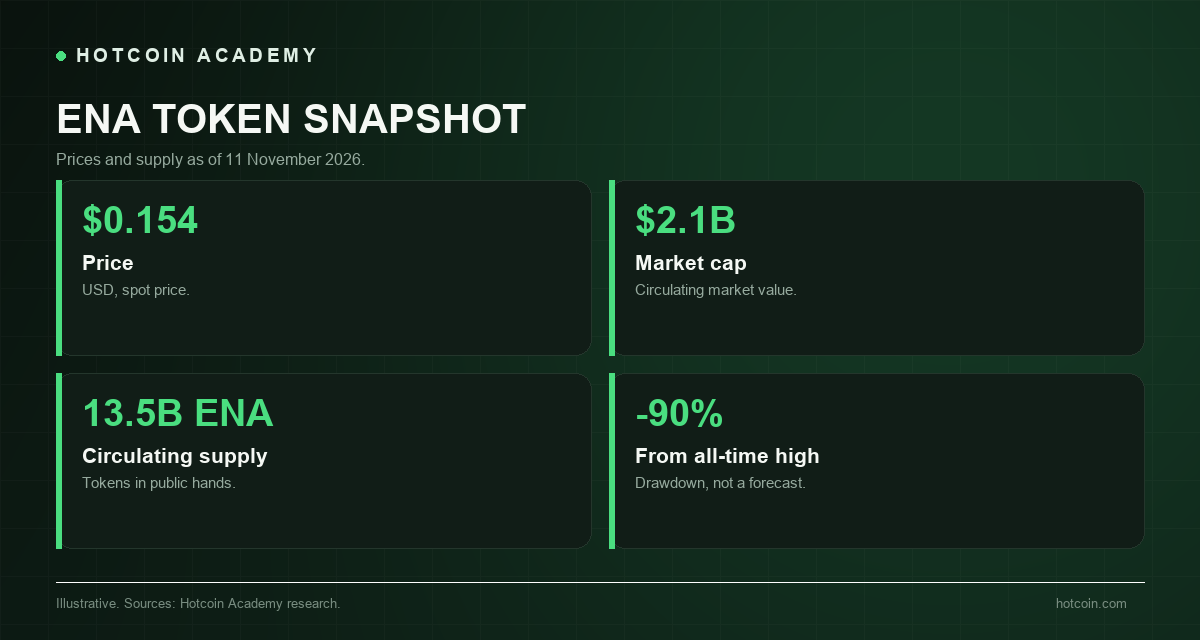
Figure: A snapshot of ENA market data (November 11, 2026).
Ethena in 2026: Current Status and Risks
In 2026, the crypto market is in a deep correction; USDe supply is about $4.5 billion, ENA's market cap is about $2.1 billion, and it has drawn down about 90% from its all-time high. The market's focus on synthetic dollars has shifted from "how high is the yield" to "can it stay stable in extreme conditions."
Ethena's resilience depends on three things: whether funding rates remain positive over the long term, whether exchange counterparties are safe, and how long the protocol can withstand a negative funding rate environment. If any one of these links fails, USDe's peg and sUSDe's yield will both be affected.
• Negative funding rates: During market panic, shorting perpetuals may require paying fees, eroding sUSDe yield.
• Exchange and custody risk: Collateral and hedge positions are distributed across centralized platforms, creating counterparty and transparency risks.
• Liquidation and liquidity: In extreme conditions, collateral and short positions may come under pressure at the same time.
• Regulatory risk: Synthetic dollars and yield-bearing stablecoins face different compliance requirements across jurisdictions.
How to Buy ENA?
If you already understand Ethena's mechanics and risks and have decided to participate with a small amount, you can follow these steps to buy ENA on Hotcoin.
• Registration and KYC: Complete Hotcoin account registration and identity verification.
• Deposit: Deposit USDT, or use a supported fiat on-ramp.
• Search for the trading pair: Search for ENA/USDT in the spot market.
• Place an order: Choose a market or limit order, confirm fees and slippage, and buy.
• Withdraw: For long-term holding, it is recommended to withdraw to a self-custody wallet and verify the contract address.
Common Misconceptions
• Treating USDe as a dollar with deposit insurance: it is a synthetic asset, not a bank deposit.
• Looking only at sUSDe's annualized yield without considering the direction and sustainability of funding rates.
• Treating ENA as a "stablecoin concept coin that must rise," ignoring supply and unlock pressure.
FAQ
What is Ethena? Ethena is a DeFi protocol that issues the synthetic dollar USDe, maintaining its peg through spot collateral and perpetual short hedges; ENA is its governance token.
What is the difference between USDe and USDT? USDT is backed by reserves such as cash and short-term US Treasuries held by the issuer; USDe uses crypto asset collateral combined with derivative short hedges, and its sources of yield and risk are different.
What is ENA used for? ENA is mainly used for governance, ecosystem incentives, and partnerships, and does not directly represent a claim on protocol revenue.
What is the biggest risk of buying ENA? ENA's price is highly correlated with USDe supply, the funding rate environment, and market risk appetite; in extreme conditions, its decline may be far larger than that of mainstream assets.
Conclusion
Ethena has turned basis trades into an on-chain dollar product. USDe's scale proves market demand, but it also exposes the fragility of synthetic dollars: the more attractive the yield, the more it depends on the normal functioning of derivatives markets.
If you follow ENA, beyond price, you should track USDe supply, sUSDe yield, and funding rates. Understanding the mechanics is more important than chasing narratives.
Risk warning: This article is for educational and informational purposes only and does not constitute investment advice. Crypto assets are highly volatile, and new coins and small-cap tokens carry higher liquidity risk; investors may lose all of their principal. Please do your own research and manage your position size.
Recommended
View more