

Taiwan Crypto Regulations: VASP Registration, Special Act Progress, and User Rights
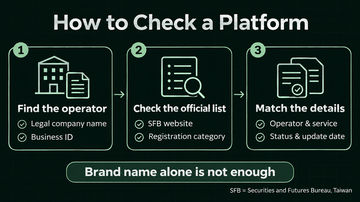
To find out whether a virtual asset platform can provide services in Taiwan, first check whether the company behind it has completed AML registration. The lookup portal is the official website of the Securities and Futures Bureau (SFB) of the Financial Supervisory Commission (FSC). You need to verify the company's full legal name, unified business number, and registration status; do not rely solely on the brand name.
Another distinction must be made clear: AML registration is not the same as a license under the special act. As of 2026-11-20, the Virtual Asset Service Act has been promulgated but has not yet come into force. For now, platform eligibility must still be checked against the current registration regime.
Key Takeaways
- A VASP is a virtual asset service provider, such as a business that offers buying and selling/exchange, transfer, or custody services.
- To check a platform's eligibility, verify the operating company's AML registration with the SFB; do not rely solely on certificate images on the official website.
- The special act has been promulgated, but the effective date has not yet been determined; the transition period starts from the effective date.
- Current rules already require certain fund protections, asset segregation, and complaint handling, but they do not mean the government guarantees principal or that full compensation is certain if something goes wrong.
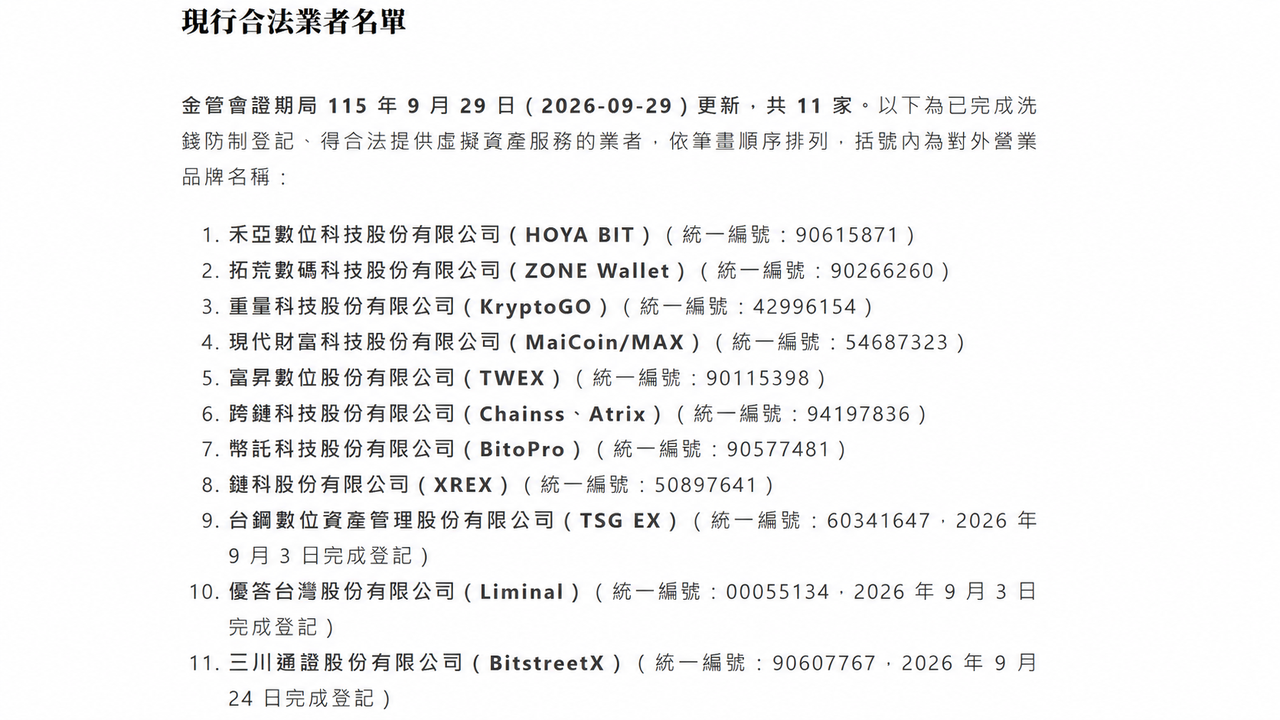
What Is a VASP? How Do Registration and Licensing Differ?
A VASP is a Virtual Asset Service Provider. Businesses that help clients buy and sell, transfer, or custody virtual assets may all be subject to relevant regulations.
The registration discussed here is registration by the business with the competent authority, not your account registration on an exchange.
| Item | AML Registration | Special Act License and Permit |
|---|---|---|
| Current status | In force | Special act promulgated, not yet in force |
| What businesses must do | Register by business category | Obtain licenses and permits by business type |
| How users check | Check the SFB registration list | After the new regime takes effect, check according to official methods |
Article 6 of the Money Laundering Control Act stipulates that businesses that have not completed the corresponding registration may not provide virtual asset services. Overseas businesses providing services within Taiwan are also subject to company or branch establishment and registration requirements.
Therefore, the fact that a platform can be opened, accounts can be registered, or the business is registered in other jurisdictions does not directly prove that it meets Taiwan's service requirements.
If you want to further distinguish "whether individual holding is legal" from "whether a platform can operate," you can read Is Crypto Legal?.
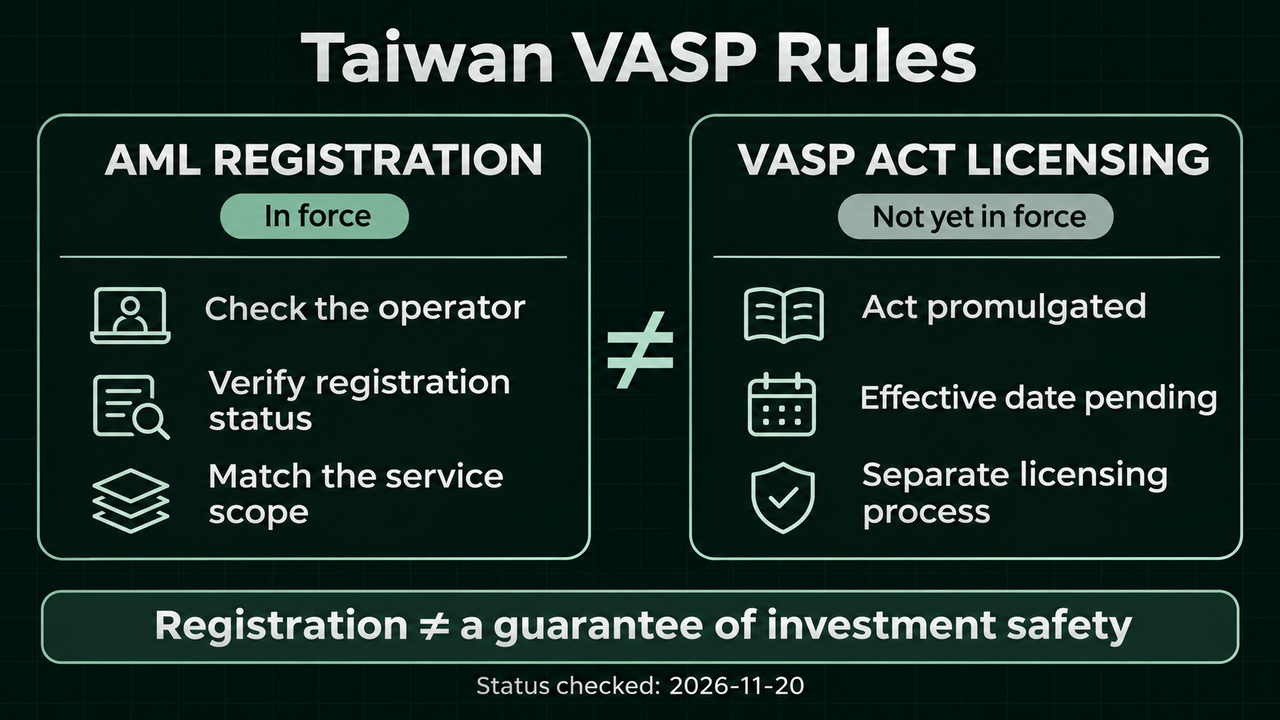
How to Check Whether a Platform Has Completed AML Registration
Find the company's legal name and unified business number in the platform's terms of service or company information, then compare them on the FSC SFB section to confirm whether the company is listed among those that have "completed AML registration," and check the latest update date. If it is listed as "self-applied for deregistration" or "registration incomplete, no longer permitted to provide services," past registration or compliance statements cannot prove current eligibility. For the latest data update date, see Businesses or Persons Providing Virtual Asset Services - Financial Supervisory Commission Securities and Futures Bureau Global Information Network.
| List Status | What It Means |
|---|---|
| Completed AML registration | The company has completed the registration shown on the list |
| Self-applied for deregistration | Past registration information can no longer prove current eligibility |
| Registration incomplete, no longer permitted to provide services | Past compliance statements cannot replace the currently required registration |
Where Does the Virtual Asset Service Act Stand?
The Virtual Asset Service Act was promulgated on 2026-07-22, and the effective date is to be decided by the Executive Yuan. The new regime requires businesses to obtain licenses and permits by business type, such as exchange, trading platform, transfer, and custody services.
For readers, just remember two points:
- Promulgation does not equal implementation.
- Obtaining a license for one business does not mean all products can be operated.
Do Businesses That Have Completed Registration Still Need to Apply Later?
Yes. Article 55 sets out the following deadlines for eligible existing businesses and financial institutions:
| Counting from the effective date of the special act | Matters to Complete |
|---|---|
| Within 12 months | Submit a license application |
| Within 21 months | Obtain licenses and permits |
| When necessary | The deadline for obtaining permits may be extended by 3 months, limited to one time |
The deadline starts from the effective date, not from the promulgation date of 2026-07-22. This is also not a general grace period allowing unregistered businesses to continue operating.
Do the Capital Amounts in the Drafts Apply Now?
Not yet directly. The eight related drafts listed in the FSC's regulatory system were announced on 2026-11-06, with a comment period from 2026-11-07 to 2026-12-16, covering matters such as establishment, business management, internal control, outsourcing, and financial reporting.
When you see capital or operating guarantee deposit figures, first confirm whether they come from a draft or from regulations already in force. Drafts may still be revised and cannot be used to directly judge whether a business currently meets the requirements.
To compare regimes in other jurisdictions, you can read What Is MiCA? to learn more. Licensing scope and implementation timing in different jurisdictions must be considered separately.
What Safeguards Apply to Money Held on a Platform?
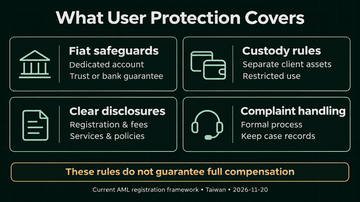
The fact that the special act has not yet come into force does not mean platforms have no management rules. The current Regulations Governing AML Registration of Businesses or Persons Providing Virtual Asset Services already imposes requirements on client funds, custody, and complaints.
| Your Concern | What Current Rules Require |
|---|---|
| How should fiat currency left on the platform be handled? | Use a dedicated account in the same currency as required, and deliver it to a trust or obtain a full bank performance guarantee |
| What information must the platform disclose? | Registration information, service content, fees, client protection measures, complaint procedures, etc. |
| Can client assets be mixed with company assets? | Custodians must segregate custody and are subject to restrictions on the use of assets |
| Are there asset records? | Custodians must keep individual client records, perform reconciliations, and at least annually appoint an accountant to issue a report and publish it |
| What if a service dispute arises? | Businesses must establish complaint procedures and handle them fairly and promptly |
These requirements can be found in Articles 11, 13, 14, and 23 to 27 of the registration regulations.
In plain terms, platforms cannot treat client assets in custody as their own money and use them arbitrarily, and they must let clients know about fees, custody, and complaint methods.
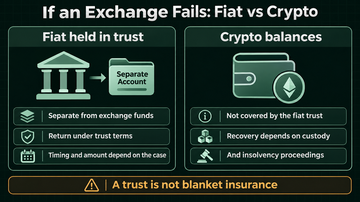
However, safeguards have limits. Some trading platforms already deliver client fiat currency to bank trusts, such as MAX and BitoPro. A trust means keeping this money separate from the platform's own funds; if the platform collapses, returns may be processed according to procedures when the trust contract conditions are met, rather than the bank "compensating" all losses on behalf of the platform. You can read Bankee Investment Settlement Account FAQ to learn more.
| Assets Held on the Platform | What Safeguards Apply? | If the Platform Collapses |
|---|---|---|
| Fiat currency delivered to trust, such as New Taiwan Dollar balances | Managed by the bank under the trust contract, separate from the platform's own funds | Returns may be processed according to the contract and related procedures; actual amounts and timing depend on the individual case |
| Cryptocurrencies, such as BTC, ETH, USDT | They do not receive the same safeguards merely because the platform has a fiat trust | Must be handled according to the asset custody situation and subsequent legal procedures; the bank cannot be required to pay compensation under the fiat trust arrangement |
For example, if New Taiwan Dollars deposited on a platform have been included in a trust, there are corresponding return arrangements; once converted into USDT, what you hold is cryptocurrency, no longer a New Taiwan Dollar balance protected by that fiat trust.
KYC and Platform Registration Are Two Different Things
KYC is the platform confirming your identity; AML registration is a requirement imposed on businesses by the competent authority.
Completing identity verification does not automatically give the platform a business license; platform registration does not mean users can skip necessary verification.
If you are unsure what verification is for, you can refer to What Is KYC?. When submitting documents, use the official website or App; do not give your information to "customer service" who messages you first. You can read the full illustrated guide on the web at How to Complete Identity Verification (KYC) on the Web, and on the App at How to Complete Identity Verification (KYC) on the App.
Withdrawals Stuck or Disputes Arising: What Information to Prepare First?
First keep the following records, then file a complaint through the platform's official channels:
- Account information and case number.
- Trading, deposit, and withdrawal records.
- On-chain transaction hash (TxID) and bank statements.
- Customer service conversations, notifications, and related screenshots.
If suspected fraud or asset theft is involved, report it to the police promptly. Withdrawal anomalies may also involve platform review, on-chain status, or judicial measures; you cannot judge how long it will take to resolve based solely on "withdrawal failed."
Common Misconceptions
- "Completing AML registration means the government guarantees principal." Registration is an operating requirement, not an investment or solvency guarantee.
- "After the special act is promulgated, the licensing regime takes effect immediately." Promulgation and implementation are different stages.
- "If we made compliance statements in the past, we don't need to check now." You should check the current registration status.
- "Being registered overseas means you can provide all services in Taiwan." Taiwan's applicable requirements and the specific business scope must still be confirmed.
FAQ
Q1: In Taiwan, should I check registration or a license now?
As of the verification date of this article, check AML registration first. The special act licensing regime must be confirmed in line with the law's implementation and subsequent arrangements.
Q2: Can a platform that has completed registration offer all products?
Not necessarily. You also need to confirm the business category and whether the product involves other licenses or restrictions.
Q3: Do registered businesses need to reapply after the special act takes effect?
Yes. Businesses meeting the transition conditions must apply within 12 months after the effective date and obtain licenses and permits within 21 months; the deadline for obtaining permits may be extended by 3 months once when necessary.
Q4: If a platform shuts down or assets are stolen, does the law guarantee full compensation?
There is no general guarantee of full compensation. How much can actually be recovered and how to claim it depends on the asset situation, contract, liability, and individual procedures.
Q5: The platform is not on the list, but I can register. Does that mean I can use it?
Being able to register does not mean it has been approved to provide services. First confirm the operating company and registration information; if you cannot find it or the explanation is unclear, confirm with the competent authority.
Conclusion
To check a platform's eligibility, first find the operating company, then verify the official registration list. After checking eligibility, also look at how funds are custodied, how fees are charged, and who to contact if problems arise.
To further understand the legal differences between holding, trading, and platform operation, you can read Hotcoin's Is Crypto Legal?; if you need to understand identity verification, you can read KYC Basics.
Risk Warning: This article is for educational and informational purposes only and does not constitute legal, compliance, or investment advice, nor does it guarantee the registration status, solvency, or fund safety of any platform. Laws, drafts, and official lists may be updated; please refer to the content published by the Laws and Regulations Database, the FSC, the SFB, and the Executive Yuan. For whether specific services can be used or for asserting disputed rights, consult a qualified local professional when necessary.
Recommended
View more