What Is Short Selling? Spot and Futures Shorting Methods and Risks Explained
“Selling the coins you hold because you are bearish” and “opening a short position” sound like two ways to respond to a decline, but the risks involved are completely different. The former may simply reduce your holdings, while the latter may keep losing money as prices rise and can even be forcibly liquidated.
Short selling is establishing a position that benefits from a price decline. Before understanding it, you need to distinguish between borrowing coins and selling them versus opening a futures short, and then factor in interest, funding fees, and margin—rather than only looking at the floating PnL on the screen.
Key Takeaways
- Simply selling spot assets you already hold does not equal establishing a net short position.
- Borrow-and-sell shorting usually involves borrowing an asset and selling it first, then buying it back to repay, bearing borrowing and price risks.
- A futures short obtains bearish exposure through derivatives and may not require actually borrowing the corresponding token.
- Leverage magnifies PnL at the margin level, and even a correct price call can be liquidated due to interim volatility.
What Is Short Selling
Short selling is basically about establishing a selling exposure first, then buying back or closing the position at a lower price. If the price falls as expected, you can earn the price difference; if the price rises, you will lose money. Traditional securities short selling also follows the logic of borrowing first, selling, and finally buying back to return.
For example, you do not originally hold a certain token, so you borrow 1 token and sell it for $100. The price then drops to $80, and you spend $80 to buy back 1 token and return it, for a gross price difference of $20. If you buy it back only after the price rises to $130, the gross loss is $30. The actual result also needs to deduct borrowing interest, trading fees, and slippage.
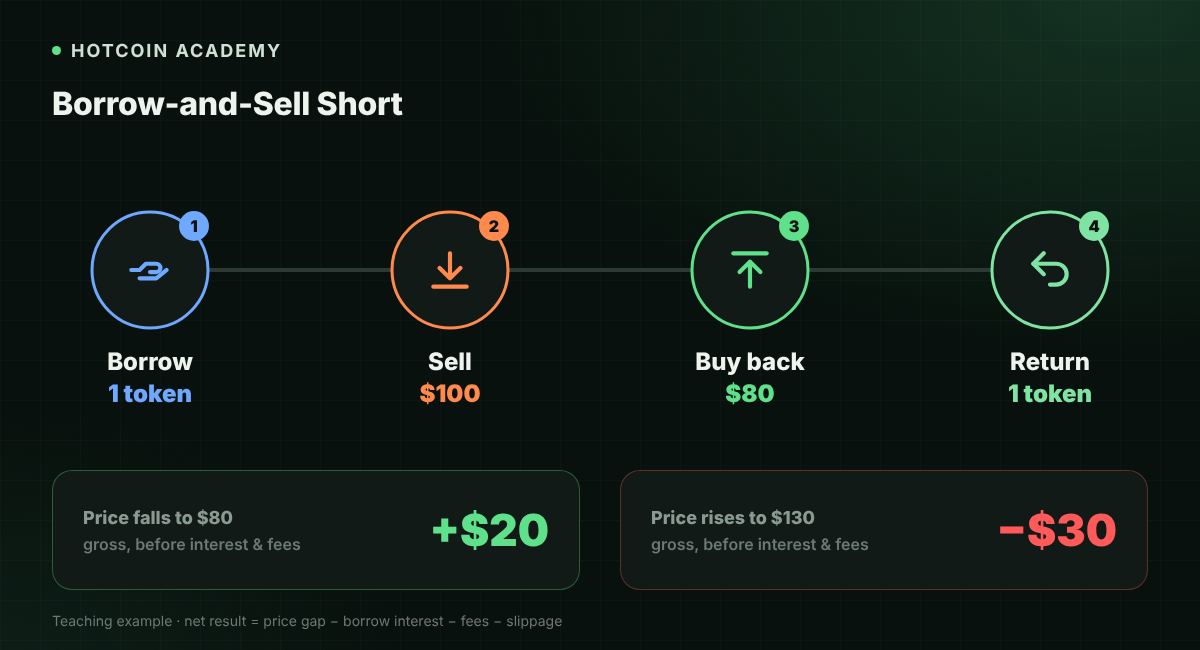
If you simply sell 1 token you hold and no longer hold it afterward, you have only gone from holding the coin to holding cash, and you do not automatically gain short profits if the price continues to fall.
What Is the Difference Between Spot Borrow-and-Sell Shorting and Futures Shorting
“Spot shorting” usually refers to borrowing coins and selling them through margin or lending mechanisms, and not all ordinary spot accounts support it. Futures shorting is establishing a derivatives short position, with specific settlement and margin rules depending on the product.
| Comparison Item | Spot Borrow-and-Sell Short | Futures Short |
|---|---|---|
| Basic Method | Borrow tokens and sell them in the spot market | Sell the corresponding futures or perpetual contracts |
| Whether the Corresponding Token Is Borrowed | Usually required | Not necessarily required |
| Holding Cost | Borrowing interest and trading fees, etc. | Trading fees, funding fees, or term basis, etc. |
| Main Constraints | Borrowing limit, collateral ratio, and repayment requirements | Initial and maintenance margin requirements |
| After Closing | Buy back and complete repayment | Close the corresponding contract position |
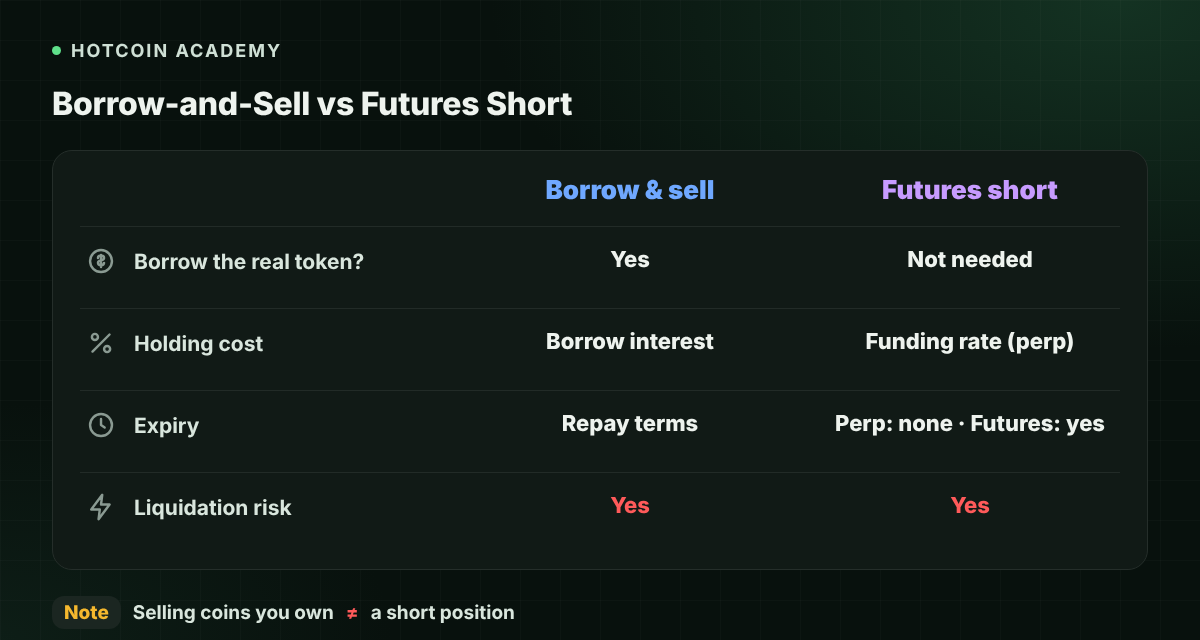
Dated futures have expiry settlement arrangements; common perpetual contracts have no fixed expiry date and usually use mechanisms such as funding rates to keep prices close to spot. Different platforms and products have different billing cycles, settlement currencies, and rules, so the same formula cannot be directly applied to all of them.
How Is PnL Calculated for a Futures Short
Using a linear contract settled in stablecoins as a teaching example: assume you establish a short position of 1 token at an entry price of $100 and close it at $80. The gross profit, excluding fees, is (100−80)×1 = $20. If you close at $120, the gross loss is $20.
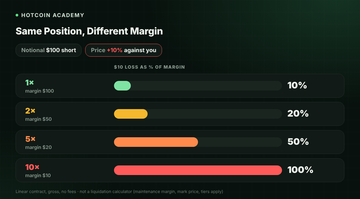
If this $100 notional position uses about $20 of initial margin, that is equivalent to about 5x leverage. A 10% adverse price move corresponds to a gross loss of about $10, or about 50% of the initial margin. This only illustrates how leverage magnifies the return on margin; it is not a liquidation price calculator.
Risk illustration for the same notional position with different margins
Actual liquidation is also affected by maintenance margin, mark price, fees, risk tiers, and other assets in the account. Coin-margined or inverse contracts are calculated differently, and the linear example above cannot be directly copied.
Why You Can Still Lose Money Even When the Direction Is Right
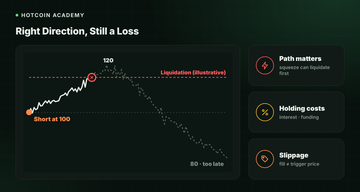
The price path affects the result. You expect the price to fall from 100 to 80, but the market first rises to 120 and then falls back. The short position may already have been liquidated during the rise and cannot wait for the later decline.
Holding a position is not cost-free. Borrowing interest accumulates; perpetual contract funding rates may also require shorts to pay fees. Under common conventions, a positive rate is usually paid by longs to shorts, and a negative rate is the opposite, but you must check the specific product.
The execution price may not equal the trigger price. Stop-loss orders may encounter slippage or insufficient liquidity. Stop-limit orders may also fail to execute because the price jumps past the limit, and this cannot be understood as unconditionally locking in the maximum loss.
Which Risks Should Beginners Understand First
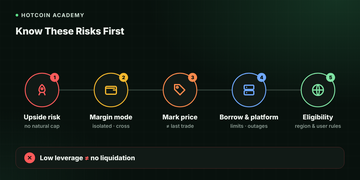
- Upside risk. Asset prices can theoretically keep rising, and the loss on a naked short has no natural symmetric cap like “falling to zero”; the platform may trigger liquidation first, but that does not mean the economic risk disappears.
- Margin scope. Isolated and cross margin determine how risk is allocated. Cross margin may use other available margin in the account, and isolated margin does not automatically exclude additional calls or other liabilities in all cases.
- Mark price mechanism. The basis for liquidation may differ from the latest traded price, so you should read the platform rules.
- Borrowing and platform risk. Changes in borrowing limits, product suspensions, and system failures may all affect repayment and closing.
- Regional and eligibility restrictions. Related products are not necessarily available to all regions or users, so you should confirm the applicable conditions first.
Common Misconceptions
- “It has risen too much, so it must be suitable for shorting.” A high price does not mean the rise is over, and a short squeeze may continue to push prices higher.
- “Low leverage means no liquidation.” Low leverage only changes the room to withstand volatility; it cannot eliminate liquidation risk.
- “Once the stop-loss is set, the maximum loss is capped.” Actual execution is affected by liquidity, order type, and market conditions.
FAQ
Q1: Can an ordinary spot account short directly? Usually you cannot establish a net short position with just the ordinary sell button. Corresponding mechanisms such as lending, margin, or derivatives are required.
Q2: Is the maximum loss on a short limited to the margin? It cannot be generalized. The actual liability depends on product terms, margin mode, and market conditions, and you cannot assume that all products guarantee no additional losses.
Q3: Does a short position always receive funding fees? No. The funding rate may be negative, and shorts may also need to pay, and fees are usually calculated on the notional position.
Q4: Can shorting be used for hedging? It can be used to reduce some directional exposure, but it introduces basis, fees, margin, and matching errors; it is not a free way to eliminate risk.
Q5: Is a short position without leverage risk-free? No. Even if the notional leverage is low, price increases, accumulated costs, and product mechanisms can still cause losses.
Conclusion
The core of short selling is bearing reverse price exposure, not just clicking sell. First distinguish the tools, then look at the PnL formula, ongoing costs, and liquidation conditions, so you can know what risks you are actually taking.
Risk Warning: This article is for educational and informational reference only and does not constitute investment advice or opening guidance. Short selling and leveraged trading may cause significant losses, and losses on some products may exceed the initial investment.
Recommended
View more