Futures Position Management: The Kelly Criterion and Pyramiding
Position management decides where profit and loss finally land in futures trading — getting the direction right but letting position size run out of control until liquidation is the most common regret in this market. The goal of position management is not to maximise the profit of any single trade, but to keep every loss within a tolerable range so the account still has capital to keep trading after a losing streak. This article covers two classic approaches to position sizing: the fixed fractional method and pyramid scaling.
The Basic Mindset: Define Risk First, Then Size the Position
Many traders make the same mistake: they decide how much leverage to use before they open a position. But the decisive factor for position size should be how much you are willing to lose on the trade, not the leverage multiple itself.
The correct order of thinking is: first decide the maximum amount this trade may lose, then work out how large the position should be from the distance to your stop loss.
Position size (notional value) = (Account value × Risk percentage) / (Entry price - Stop-loss price)
The formula says: the more risk you are willing to accept and the tighter your stop distance, the larger the position you can open, and the smaller it becomes in the opposite case. It holds no matter how much leverage you use. Changing leverage only changes the margin you need to open the position; it does not change the risk exposure you actually carry.

The Fixed Fractional Method: Cap the Loss on Every Trade
The fixed percentage method is the most basic and most practical way to manage futures positions. A common approach is to keep the risk of a single trade between 0.5% and 2% of account equity.
Example: account equity of 10,000 USDT, with risk per trade set at 1% (a maximum loss of 100 USDT). You go long BTC at an entry price of 60,000 USDT and place the stop at 59,000 USDT, a stop distance of 1,000 USDT.
Putting that into the formula: position size = 100 / 1,000 = 0.1 BTC notional value = 0.1 × 60,000 = 6,000 USDT.
This way, even if the stop is triggered, the loss is already locked at 100 USDT and will not exceed the range you planned.
Practical advice: if you have fewer than 100 trades of history, the fixed percentage method is more practical than the Kelly Criterion — with an insufficient sample, the Kelly output may not be reliable.
The Kelly Criterion: An Advanced Sizing Tool
The Kelly Criterion is a mathematical model for calculating the optimal bet proportion, aiming to maximise long-run capital growth given a known win rate and payoff ratio.
Its simplified form is:
Kelly fraction = Win rate - (1 - Win rate) / Payoff ratio
In practice, though, the Kelly Criterion has clear limitations: it assumes you know your win rate and payoff ratio accurately, which is nearly impossible in short-term trading. What is more, positions calculated with Kelly usually land between 10% and 20%, which already counts as a fairly heavy position in the futures market and can overshoot badly in highly volatile conditions.
That is why half Kelly is more common in practice — dividing the Kelly fraction by 2 to allocate positions more conservatively.
Pyramiding: Protecting Profit While Controlling Risk
The pyramid scaling strategy answers the question of whether and how to add to a position once it is in profit.
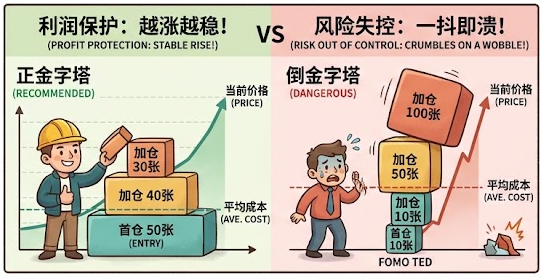
Pyramiding: The Upright Pyramid
Core principle: when adding to a winning position, each additional buy should be smaller than the last, so the average holding cost does not rise too quickly.
Use 5% of your capital for the first entry (5,000 USDT of a 100,000 principal, for example), and add 3% of capital each time price breaks a key level instead of going all in at once. For example, after price breaks a key resistance level you add 5 contracts first, then 4 more once the profit is confirmed, then 3 more on the next breakout, so holding cost rises far more slowly than price. Even if price pulls back slightly, the position as a whole can still stay in profit.
Inverted pyramiding, where each add is larger than the one before, is a dangerous practice — as price rises, position size grows geometrically, average cost is pushed up quickly, and a small pullback can wipe out the profit entirely.
Dynamic Stop Loss: Protecting Profit
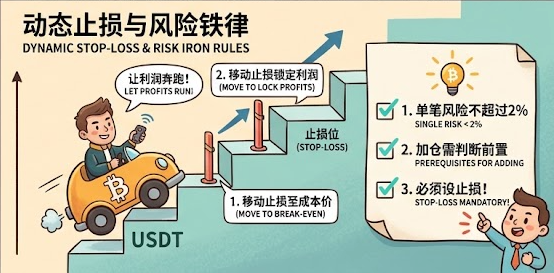
After every add, move the overall stop up to the new cost basis so the trade cannot flip from profit to loss even if the market reverses. This is known as climbing the stop-loss ladder — at 20% profit, move the stop to the cost basis (break-even); at 50% profit, move it 30% above the cost basis to lock in part of the gain; and take profit on 20% of the position each time a new high is made.
Scaling Out and Closing
When a preset profit target is reached, take profit in planned batches. When the trend shows a reversal signal, such as a break below a key moving average or shrinking volume, close the remaining position at once rather than waiting to see.
Three Iron Rules of Position Management
Keep risk per trade under 2%: beginners should start at 1%. Even after ten consecutive losses, capital drawdown stays under 20%, and the account keeps the ability to survive and recover.
Adding to a position must have preconditions: adding is confirmation and reinforcement of the original thesis, not averaging down because price fell a lot. You may only do it when price reaches a preset range, the original logic still holds, total position size is below the cap, and enough time has passed since the last add.
Futures trading requires a stop loss: the only case where you can skip it is when the position is so small that even going to zero would not affect the account structure. Trading futures without a stop loss is essentially using a derivative with funding rates and a liquidation mechanism to bet on a long-term direction.
FAQ
Q1: Should beginners use the fixed percentage method or the Kelly Criterion?
The fixed percentage method. The Kelly Criterion needs a longer trading record and an accurate estimate of the win rate, and beginners struggle to supply reliable inputs. The fixed percentage method is simple and clear, and controls single-trade losses effectively.
Q2: What is pyramiding, and should each add be larger or smaller?
Pyramiding means adding to a position while it is in profit, with each subsequent add smaller so that average holding cost rises much more slowly than price. If each add is instead larger than the last (inverted pyramiding), average cost is pushed up quickly and a small pullback swallows the entire profit.
Q3: What does dynamic stop loss mean?
A dynamic stop loss is a profit-locking mechanism: each time the market moves in your favour and you add to the position, you move the stop up to a new support level or to the cost basis, so floating profit is not given back entirely. It is the key tool that lets profit run in a trend without letting a winner turn into a loser.
Q4: How should the stop loss be adjusted after adding to a position?
After each add, recalculate the average cost of the whole position and move the stop to a new key support level, or at least close to the blended cost basis. That keeps the overall profit-and-loss state from flipping straight from floating profit to a large loss if the market suddenly reverses.
Related tutorials:
Complete Futures Trading Guide: From Getting Started to Risk Control
What Is Futures Liquidation? The Mechanics and Liquidation Price
How to Set Take-Profit and Stop-Loss on Futures: A Must-Learn Lesson in Protecting Profit
Recommended reading:
Recommended
View more