Earnings Season and Fed Rate Decisions: How Do They Affect Tokenized Stocks?
Earnings change expectations for a company's profit, and rate decisions change valuation conditions, so both can move the price of tokenized stocks. An asset that trades as a token does not detach itself from the business performance of the company it is linked to or from the wider financial market. For Hotcoin users, understanding these events helps when observing US equity related products, but it is also necessary to tell tokenized exposure apart from stock perpetual contracts: a move in the underlying share price is not the same thing as the final profit or loss in your account.
Updated: September 8, 2026. This article explains the transmission mechanism and does not predict the price direction of any specific stock; the tokenized structure uses xStocks as an industry example and does not mean Hotcoin has listed every product from that issuer.
Why do earnings affect tokenized stocks?
An earnings report delivers new information on revenue, profit, cash flow and business trends, and the market reassesses the company's future value accordingly. Tokenized products linked to that stock are usually affected by the repricing of the underlying asset, but their secondary market price is also constrained by their own buy and sell demand, fees and liquidity. Tokenization changes how a product is recorded and traded; it does not make corporate earnings irrelevant. Before any analysis, confirm which company the product refers to, which type of security it represents and what economic rights it carries.
If earnings grow, why can the stock still fall?
The price reaction after an earnings report often depends on the gap between the actual result and market expectations, not on year-over-year growth alone. Suppose a company grows revenue by 20%, but investors had already priced in 30% growth and guidance for the next quarter slows; the valuation can still be revised down even though the current quarter's figure is positive. This hypothetical shows why the comparison base matters and is not a case about any specific stock. When reading a report, separate historical performance, market expectations and management's view of the future instead of merging them into one conclusion.
Which information should you focus on in an earnings report?
When reading a company's report, look at revenue, profit margin, earnings per share, cash flow and next-period guidance together rather than pulling out only the most flattering metric. Also distinguish GAAP from non-GAAP measures, year-over-year from quarter-over-quarter comparisons, and one-off items from sustainable changes in the business. NVIDIA's reports, for example, disclose business revenue, gross margin and forward guidance at the same time; read the company's own filing first, then decide which information changes your earlier assumptions instead of letting a news summary replace your full judgement.
Source example: NVIDIA financial results for the second quarter of fiscal 2026. This is a historical reading case published in 2025, not the latest quarterly data.
Through which channels do Fed rate decisions affect stocks?
The Federal Reserve's policy decisions and communication influence market interest rates and financial conditions, and in turn corporate funding costs, demand and asset valuations. All else being equal, a higher discount rate lowers the present value of future cash flows, but companies differ in their debt structure and profit sources. For tokenized stocks, these effects travel mainly through the underlying security and are then combined with the product's own trading supply and demand; "rate hikes always mean a fall" or "rate cuts always mean a rise" cannot be applied to every company.
Mechanism reference: The Federal Reserve: monetary policy goals and transmission.
Why can a rate cut also come with falling stocks?
The market's direction after a rate cut depends on the policy change, what was already priced in and the economic reason behind the cut. If the cut was already fully reflected in prices, the announcement does not necessarily count as new good news; if easier policy comes with weaker demand and a weaker profit outlook, operating pressure can offset the support to valuations. When watching a decision, read the policy statement and the press conference together, distinguish the current rate decision from the future path, and avoid judging the trading direction of every product from a single rate number.
How do you find the exact timing of rate decisions and earnings?
Check rate decisions against the Fed's FOMC calendar, and check earnings dates on the company's investor relations page first, confirming the date, time zone and pre-market or after-hours arrangement. As of September 8, 2026, the next meeting listed on the FOMC calendar runs from September 15 to 16 and is marked as including economic projections. That is the meeting date, not the full set of release times in China's time zone; when setting a reminder, check the official agenda again and do not treat the local date as your own trading moment.
Calendar entry: FOMC meeting calendar. We do not pre-fill decisions or projections that have not yet been published.
Do tokenized stocks always copy the underlying move in step?
Tokenized stocks have an economic link to the underlying security, but short-term quotes and returns are not always identical. Take xStocks as an example: its product documentation describes it as a tracking certificate, the secondary market price is set by supply and demand on each platform, and issuance and redemption have their own timing and conditions. When an event occurs, spreads can widen if the underlying market is closed or the token order book is thin; compare valid quotes taken at close to the same time rather than treating a price difference between two different moments as risk-free arbitrage.
Industry case: xStocks product mechanics and pricing notes. This case does not replace the terms of a specific Hotcoin product.
What should you check first when watching these events on Hotcoin?
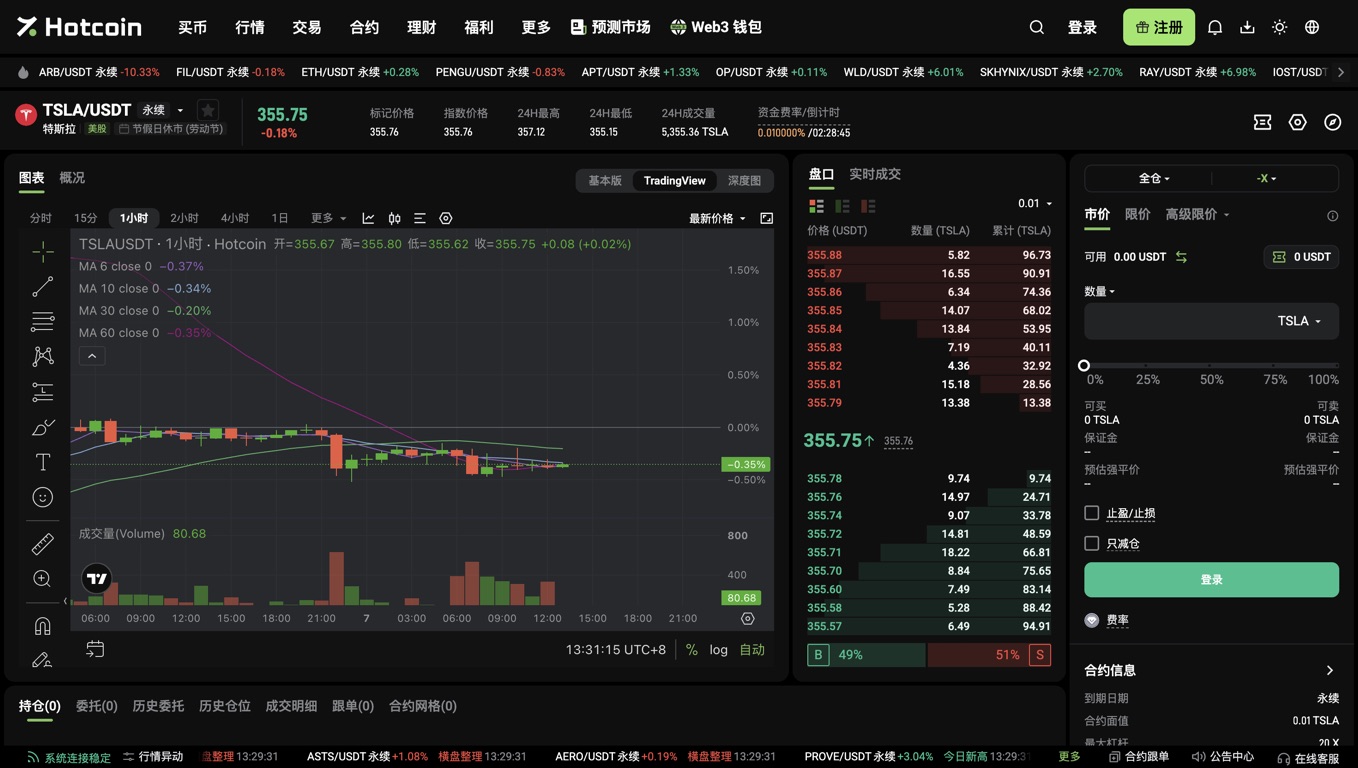
When you watch an earnings or rate event on Hotcoin, first confirm whether you are looking at a spot product or a perpetual contract, then check the linked asset and the market status. On a perpetual page, the mark price, funding rate, margin and position tiers affect how you manage a position, so do not stare only at stock news. The historical screenshot below shows the perpetual label and the market-closed notice for TSLA/USDT; it is meant to show where to look in the interface and does not mean that a particular earnings release or rate decision caused the price change in the image.
Before and after an event, how do you check your risk exposure?
Checks before and after an event should cover tolerable loss, liquidity and order execution conditions rather than betting on the direction of the news. First verify the notional value of the position and the margin, then check bid-ask spreads, unfilled orders and stop-loss conditions; if a product moves to reduce-only mode, clarify which operations are restricted. A triggered stop-loss does not guarantee execution at the set price, and gaps caused by earnings or policy news can increase slippage, so a risk control tool should not be read as a promise to exit at a fixed price.
FAQ
Does earnings season only affect individual stocks, not ETFs?
Earnings season can also affect ETFs and related products, because the results of component companies change portfolio value and industry expectations. The size of the effect depends on component weights, correlation and the product's strategy, and the rise or fall of one company's share price cannot be applied proportionally to the whole ETF. For products with high industry concentration or leveraged and inverse strategies, also check the holdings structure and the reset mechanism; several tickers that look different may still be concentrated in the earnings risk of one industry or a handful of large companies.
If the Fed leaves rates unchanged, will the market stay calm?
Even when the Fed holds rates steady, the wording of the statement, economic projections and communication about the future policy path can still shift market expectations. Investors price not only the current rate level but also future funding conditions and growth assessments, so "no change" does not automatically mean there is no new information. When observing related products, combine prior expectations with the full set of published materials; do not read only the "rates unchanged" headline, and do not attribute all short-term moves to a single policy factor.
If a tokenized stock pays dividends, does that mean a profit after earnings?
An earnings release, a company's decision to pay a dividend and an investor's total return are different events, so the existence of a dividend handling mechanism in a tokenized product does not mean a profit is guaranteed after earnings. Different products may reflect corporate actions through cash, reinvestment or a change in token quantity, and applicable fees and tax treatment are also involved. A price decline can offset the related income, and holders do not necessarily hold direct shareholder rights; read the issuance documents for the specific arrangement instead of extending one token's rules to every product.
At Hotcoin, we suggest understanding how an event changes expectations first, then checking how a product passes risk on to you. This article is for learning only and offers no specific trading direction or guarantee of returns.
Recommended
View more