
What Is Cardano (ADA)? Ouroboros, Ecosystem, and Controversies
Cardano is a blockchain that supports smart contracts, and ADA is the native coin used on this chain. Sending transfers, using on-chain applications, delegating stake, and participating in governance may all involve ADA.
Cardano's most distinctive feature is that it conducts research first, then gradually brings the research results into the network. This development approach has attracted supporters who value technical verification, and has also sparked discussion about "when exactly will features be delivered." To understand Cardano, you can start with how it processes transactions, what ADA is used for, and which upgrades have already launched.
Key Takeaways
- Cardano is the blockchain, ADA is the native coin. ADA can be used for transaction fees, stake delegation, and on-chain governance.
- The mainnet uses Ouroboros Praos. It adopts Proof of Stake (PoS), where stake pools participate in block production, without competing on mining hash power.
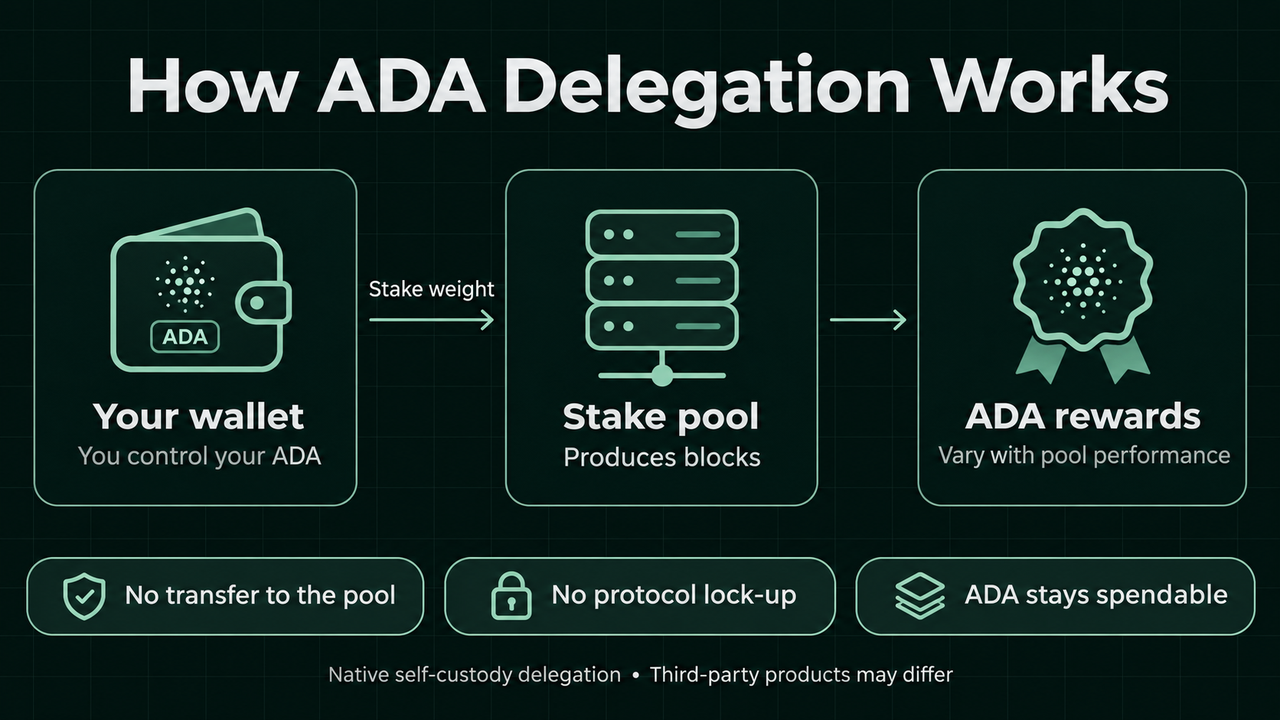
- Native delegation does not require sending ADA to a stake pool. ADA remains controlled by your own wallet, and there is no protocol lock-up period.
- Smart contracts, native tokens, and on-chain governance are already available. Leios is a scaling upgrade still in development and testing.
- Main discussions focus on delivery speed, application usage, and governance decisions. Technical research has value, but the actual user experience also needs continuous observation.
What Is the Difference Between Cardano and ADA?
You can think of Cardano as a network that provides transfer and application services, while ADA is the asset needed to use this network.
| Name | What It Is | Main Function |
|---|---|---|
| Cardano | Blockchain network | Processes transactions, runs smart contracts, and records governance decisions |
| ADA | Network native coin | Pays fees, delegates stake, and participates in governance |
| Ouroboros | Consensus protocol family | Determines how nodes produce blocks and how they agree on the same transaction record |
For example, when you send ADA from a wallet, you need to pay a network fee denominated in ADA; when using applications on Cardano, you may also need ADA to pay transaction fees. Official development documentation also lists ADA as the base asset used for network fees, rewards, and some deposit arrangements.
If you want to compare ADA with stablecoins and exchange platform tokens, you can read Hotcoin's Complete Guide to Cryptocurrency Types to first distinguish the main uses of different assets.
How Does Ouroboros Make Cardano Work?
A blockchain needs a set of rules so that nodes distributed across different locations can reach consistency on transaction records. Ouroboros is the consensus rule set used by Cardano.
It adopts Proof of Stake (PoS). Simply put, the network randomly selects participants eligible to create blocks based on the ADA stake represented by stake pools. More stake usually means a higher chance of being selected, but it does not guarantee block production every time. Cardano's official documentation currently states that the mainnet runs Ouroboros Praos.
Two time units are commonly found in official documentation:
| Term | Plain Explanation |
|---|---|
| Epoch | A time period of network operation |
| Slot | A finer time unit within an epoch, used to schedule block production opportunities |
You do not need to memorize all the terms. For general users, it is more practical to distinguish: a transaction being sent, a transaction being on-chain, and an exchange having credited the deposit are different states.
After a wallet sends a transaction, the network still needs to verify, include, and accumulate confirmations; exchanges also have their own deposit requirements. To understand this process, you can refer to The Process of a Blockchain Transaction from Initiation to Confirmation.
Cardano emphasizes that Ouroboros' security analysis is based on peer-reviewed research. "Provably secure" means the protocol has a mathematical proof under specific assumptions; it does not mean that wallets, applications, or user operations will never have problems.
Do I Need to Hand Over My ADA to a Stake Pool to Delegate?
No. With native delegation through a Cardano self-custody wallet, ADA remains in an address you control and can still be transferred and used. What you delegate is the stake participating in block production; the stake pool does not gain the authority to spend your assets.
Those who do not want to maintain nodes themselves can choose a stake pool, letting the operator handle equipment and block production while they participate in reward distribution according to the rules.
| Participation Method | What Needs to Be Done |
|---|---|
| Run your own stake pool | Maintain nodes, network connections, and related settings |
| Delegate to an existing stake pool | Use a wallet that supports delegation, select a pool, and sign the delegation transaction |
When choosing a pool, you can look at fees, historical block production performance, and whether it is overly saturated. Rewards are affected by factors such as pool performance, and they are not credited immediately after delegation.
In addition, Cardano native delegation has no slashing mechanism (no penalty on delegated principal). Poor pool performance may affect rewards, but the protocol will not deduct your delegated ADA because of it. This still does not eliminate the risks of price declines, lost private keys, or using third-party services.
If you are using wealth management or custody products provided by a trading platform, you need to separately check the product's lock-up, redemption, and custody conditions; the rules for self-custody delegation cannot be directly applied.
To learn how other PoS networks work, you can read Proof of Stake (PoS).
What Can the Cardano Ecosystem Do Now?
The features of Cardano include transfers, asset issuance, running smart contracts, and on-chain governance.
| Feature | What Users Can Do |
|---|---|
| ADA transfers | Send ADA between Cardano addresses |
| Native tokens and NFTs | Issue, hold, and transfer on-chain assets |
| Smart contract applications | Use applications such as trading and lending built by developers |
| Stake delegation | Choose a stake pool and participate in network block rewards |
| On-chain governance | Delegate voting power and participate in network upgrade and fund usage decisions |
One technical feature of Cardano is that general tokens and NFTs can be natively supported by the ledger; basic transfers do not need to rely on token contract execution like Ethereum ERC-20 tokens. More complex application logic can be handled through smart contracts.
In governance, ADA holders can delegate voting power to a DRep (Delegated Representative), who researches and votes on governance proposals. This is different from delegating to a stake pool: the former participates in decision-making, while the latter participates in block production. Both types of delegation can exist at the same time.
When using applications, remember to confirm whether you are connected to the mainnet or testnet. If you want to check where assets went after a transfer, you can paste the transaction hash into a Cardano-supporting blockchain explorer. For instructions, you can refer to Hotcoin's Blockchain Explorer Usage Guide.
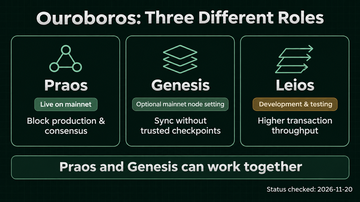
What Is the Difference Between Praos, Genesis, and Leios?
Ouroboros is the name of a series of protocols, and different versions address different problems.
| Name | What Problem It Mainly Solves | Status at the Time of This Article's Verification |
|---|---|---|
| Praos | Selects block producers and maintains network consensus | Protocol running on the mainnet |
| Genesis | Allows new nodes to find the correct chain without relying on trusted checkpoints | Optional mainnet node setting |
| Leios | Improves transaction processing and increases throughput | In development and testing |
Praos and Genesis are not mutually exclusive: the former involves block production and consensus, while the latter improves how nodes synchronize when joining the network.
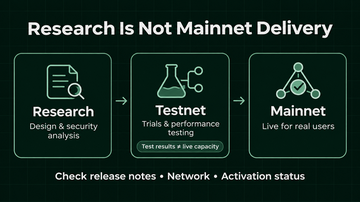
Leios also has testing progress. Cardano's official website published first-round testnet results in August 2026, indicating that it has entered actual testing; however, these results describe the test environment and cannot be directly treated as the current mainnet's processing capacity.
Therefore, when you see headlines like "Cardano performance increases several times," first check whether it refers to test results or an upgrade already activated on the mainnet. This is more useful than just remembering a single TPS number.
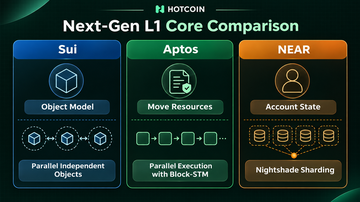
If you want to compare scaling methods of other public chains, you can read Sui / Aptos / Near: Next-Gen L1 Comparison.
Where Are Cardano's Main Controversies?
Cardano's research route is very distinctive, but whether research results can become easy-to-use products still depends on actual delivery. When discussing it, three things are most worth paying attention to.
First, whether development progress can keep up with demand.
Peer review helps validate designs, but users also care about whether transactions are smooth, whether wallets are easy to use, and when new features will be available. Paper publication, testnet completion, and mainnet activation each represent different levels of progress.
Second, whether applications are actually being used.
Supporting smart contracts is only the starting point. The number of users, capital scale, transaction experience, and ability to sustain operations will affect whether the ecosystem can grow. When comparing different public chains, also avoid mixing test performance with actual transaction volume.
Third, how governance funds are spent.
Cardano's governance covers protocol adjustments and treasury fund usage. For holders, in addition to seeing how much support a proposal receives, it is also worth tracking the use of funds, delivery results, and follow-up reports.
These questions can be evaluated separately: agreeing with the research method does not mean every product is mature; dissatisfaction with delivery speed also requires specifically identifying which feature or progress segment is affected.
Common Misconceptions
- "Delegating ADA means sending coins to the pool." Native delegation does not transfer control of assets; services that require you to transfer coins directly need separate verification of their nature.
- "All PoS chains lock up and slash principal." Rules differ across chains; Cardano native delegation has no lock-up period and no slashing.
- "Leios has test results, so the mainnet upgrade is complete." Testnet results and mainnet activation are different stages.
- "Receiving more ADA from delegation means the investment is guaranteed to profit." The quantity of coins and the asset value calculated in fiat currency are two different things.
FAQ
Q1. Are ADA and Cardano the same thing?
Cardano is the blockchain network, and ADA is its native coin. Using this chain to transfer, pay fees, or participate in delegation all involve ADA.
Q2. Can Cardano be mined?
It uses PoS, with stake pools participating in block production, and does not use the hash-power mining method used by Bitcoin. General holders can participate through delegation.
Q3. After delegating ADA, can I still transfer it away?
When using native delegation through a self-custody wallet, ADA can still be transferred and used. Trading platforms or other third-party products may have separate redemption conditions.
Q4. What is the difference between delegating to a stake pool and delegating to a DRep?
Stake pools are responsible for block production; DReps participate in governance voting on behalf of delegators. The two types of delegation have different purposes and can be set at the same time.
Q5. Does the Cardano mainnet use Leios now?
As of November 20, 2026, when this article was verified, the official documentation still lists Praos as the mainnet running protocol. The development and testing progress of Leios should be viewed separately from official mainnet activation.
Conclusion
To understand Cardano, first grasp three things: ADA is used to use the network and participate in governance; stake pools produce blocks through PoS; native delegation allows holders to participate while retaining control of their ADA.
Then look at whether the ecosystem is easy to use, where upgrades have been delivered, and what results governance funds have brought. These specific questions can help you understand Cardano better than labels like "strong research" or "too slow development" alone.
To continue learning about how it differs from other PoS networks, you can read Proof of Stake (PoS).
Risk Warning: This article is for educational and informational reference only and does not constitute investment advice. ADA prices may fluctuate significantly; delegation rewards do not guarantee profit. When using wallets and on-chain applications, also pay attention to private key custody, phishing, and smart contract risks.
Recommended
View more