BTC to HKD | How Much Is 1 BTC in HKD? Live Conversion
To find out how much 1 BTC is worth in Hong Kong dollars, you first need to confirm whether you are looking at a direct HKD quote or a USD price converted through an exchange rate. The Hong Kong dollar is closely linked to the US dollar, but that does not mean the HKD value of BTC stays fixed.
The HKD value of 1 BTC depends on the latest price and update time shown by the market data service you use. This article explains conversion methods, quantity calculations and fee differences. All figures below are illustrative teaching assumptions, not current quotes or locked exchange rates.
Key Takeaways
- First confirm that the asset is BTC and the target currency is HKD, then check the price source and timestamp.
- Reference value depends on quantity and quote; when using a USD cross conversion, you also need to include the foreign exchange rate.
- The latest traded price is not the same as the executable price at which you can buy or sell.
- Trading, transfers and currency conversion may incur different fees; the actual amount received must be calculated separately.
What Are BTC and HKD?
Bitcoin (BTC): Bitcoin is a crypto asset that can be transferred over a peer-to-peer network. BTC is the asset code, while USD is the US dollar; a quote represents how many US dollars the market is willing to exchange for 1 BTC. There is no fixed USD redemption price for Bitcoin promised by an issuer.
Hong Kong's Linked Exchange Rate System provides the background for understanding the relationship between the US dollar and the Hong Kong dollar. The convertibility undertaking arrangements under the system apply to specific banking system operations and should not be understood as every retail currency conversion being able to settle at a fixed mid-rate. Banks, platforms and payment channels may still offer different bid-ask spreads.
How to Calculate the HKD Value of 1 BTC
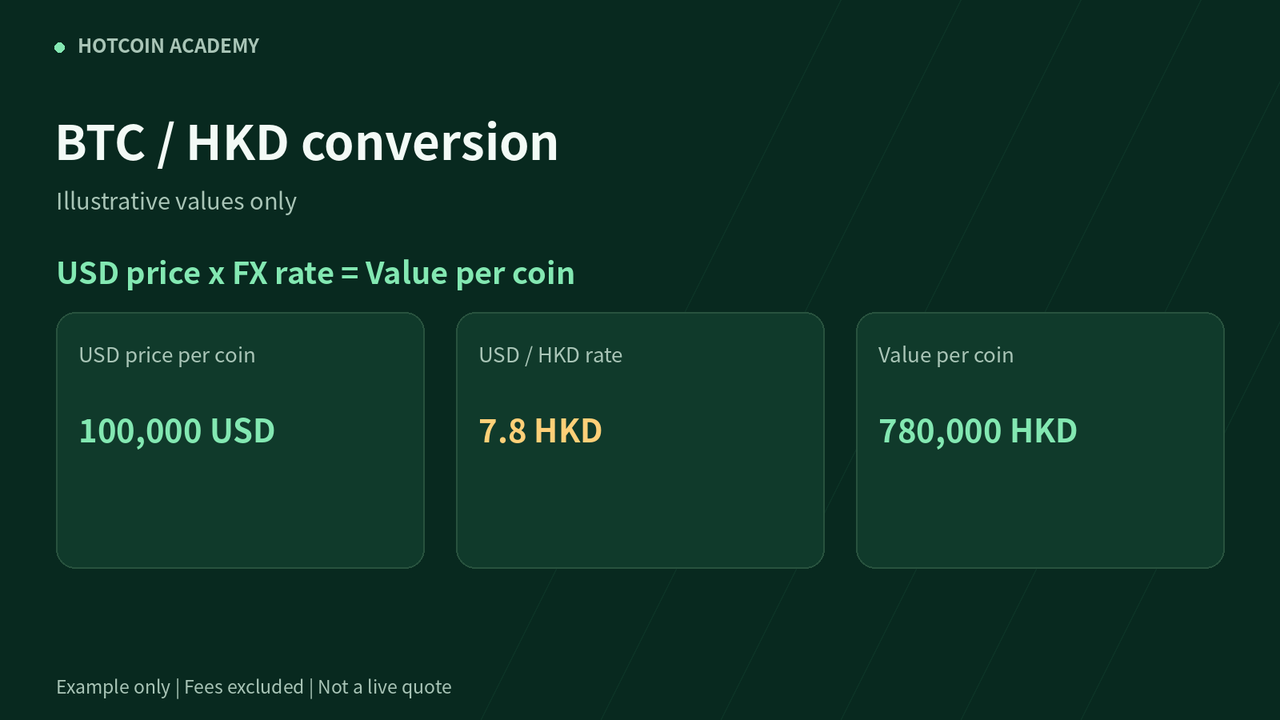
BTC quantity × BTC/USD price × USD/HKD rate = HKD reference value.
Suppose 1 BTC = 100,000 USD and 1 USD = 7.8 HKD. The reference value of 1 BTC would then be 100,000 × 7.8 = 780,000 HKD. All assumptions exclude fees, slippage, taxes or withdrawal costs; they are only used to illustrate the multiplication relationship. When calculating with real data, replace the assumed price with the actual quote for the relevant time and market.
| BTC quantity | Reference value based on the above assumptions |
|---|---|
| 0.001 BTC | 780 HKD |
| 0.01 BTC | 7,800 HKD |
| 0.1 BTC | 78,000 HKD |
| 1 BTC | 780,000 HKD |
For a reverse calculation, divide the HKD amount by the HKD price per BTC to estimate the corresponding quantity. If fees are deducted from the payment amount, deduct the fees first and then divide; if fees are charged in BTC, they also need to be deducted from the quantity received. Do not deduct the same fee twice.
To estimate a conversion amount at the latest rate, you can use the Hotcoin crypto converter.
Direct HKD Quotes vs USD Cross Conversion
| Price source | Conversion method | What to check |
|---|---|---|
| Direct BTC/HKD quote | Quantity × HKD price in that market | Check local depth, spread and trade time |
| USD cross conversion | Quantity × BTC/USD × USD/HKD | Use data from the same point in time where possible |
| OTC or payment channel quote | Calculate using the merchant's actual executable price | Check limits, fees and settlement conditions |
A difference in quotes does not automatically mean risk-free arbitrage. If cross-platform transfers, token swaps or fiat withdrawals are required, prices may change during the process, and channels may have minimum amounts, limits or settlement time requirements.
Why the Conversion Result Differs from the Actual Amount Received
Changes in BTC's underlying price are the first layer of impact; when the target currency is TWD or HKD, the USD exchange rate is another layer. In addition, different markets' data update times, order depth and trade direction can all cause two seemingly identical quotes to differ.
For example, if BTC's USD price rises, its HKD-converted value will usually be affected as well, but the actual USD/HKD rate and the service provider's spread cannot be ignored. The Linked Exchange Rate System does not eliminate the large volatility of crypto assets themselves.
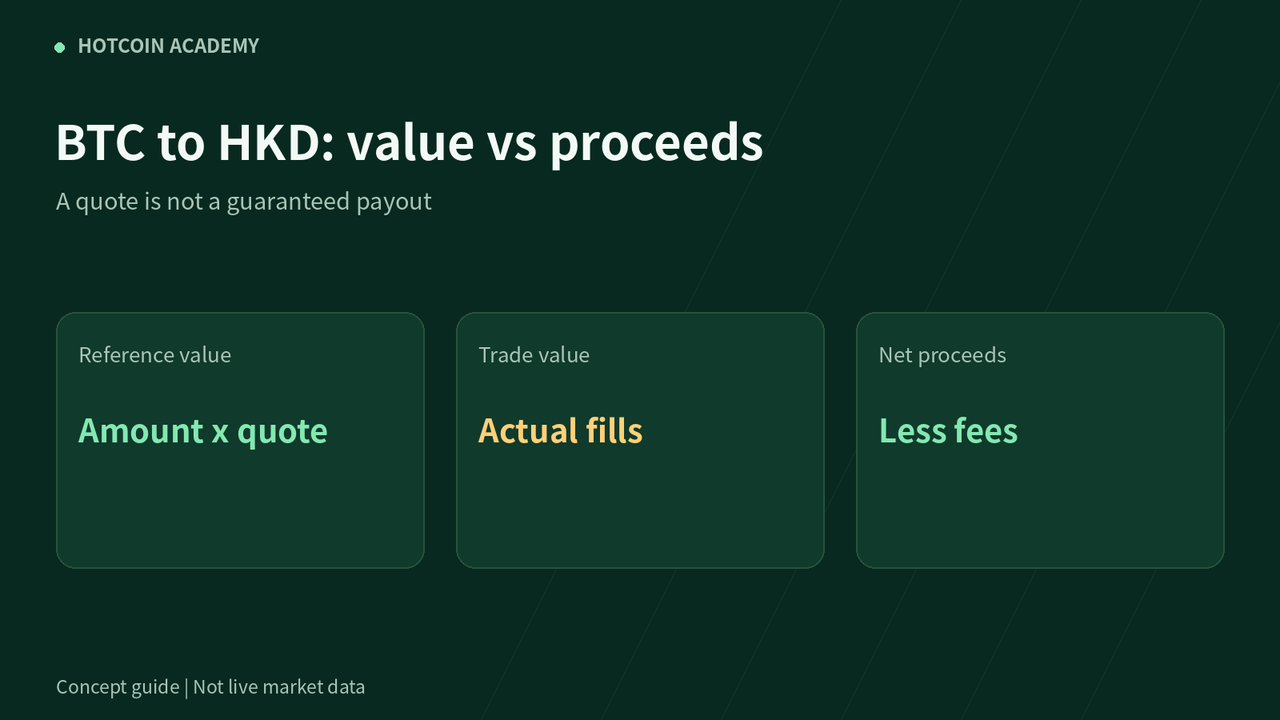
When selling, you can estimate the net amount as "actual total trade value minus relevant fees charged in the target currency". If the total trade value has already been calculated at the actual average fill price, do not deduct slippage again as the same loss; if you still need to withdraw or convert currency at the end, calculate the fees for that later stage separately.
Bitcoin Price and Market Depth
The valuation of a large BTC position cannot rely only on the last traded price. The executable quantity at different price levels in the order book determines whether a market order can be filled close to the screen price. When the market is volatile, the brief interval between a quote update and order execution may also change the final amount.
BTC spot, perpetual contracts and wrapped assets are not the same quote object. A contract's mark price is used for risk control and settlement of specific products and cannot be directly treated as a spot selling price; mapped assets on other networks also involve custody or cross-chain mechanisms.
What to Check Before Using a Conversion Result
- Check the quantity. Use the available balance and distinguish between locked, staked, pending and settled assets.
- Check the quote. Confirm the asset, quote currency, spot or contract, and data timestamp.
- Check the direction. For buying, look at the actual cost paid; for selling, look at the executable sell price and estimated net proceeds.
- Check the path. If network transfers or fiat settlement are involved, check receiving requirements, fees and limits.
- Recalculate. Review the final quote again before confirming the order; do not use an earlier screenshot instead of the trade preview.
FAQ
Q1: Can I convert amounts below 1 BTC? Yes. Conversion is based on multiplying the quantity, and fractional amounts also apply; actual trading must still meet the minimum order size and precision requirements of the service used.
Q2: Why do two websites show different BTC-to-HKD prices? They may use different markets, times, aggregation methods or trade directions. Align the basis first, then compare whether the difference is enough to cover all costs.
Q3: Is the amount in the conversion table the final amount I will receive? No. The table shows reference values calculated under explicit assumptions. The actual amount received depends on the average fill price, executable quantity, fees at each stage and receiving channel conditions.
Q4: Can I still convert on weekends? Crypto asset markets usually trade continuously, but bank currency exchange and fiat transfers may have different service hours. A visible quote does not mean funds can be received instantly.
Q5: Can I use the converted price to decide whether to buy BTC? Not on its own. Conversion only standardizes the unit of account; it does not measure whether an asset is undervalued, nor can it predict future returns.
Conclusion
When calculating BTC to HKD, first align the asset, quote and timing, then put the quantity, exchange rate and costs at each stage into the same calculation process. Understanding the difference between reference value and net proceeds helps you avoid replacing real trading conditions with a seemingly precise number.
Risk disclaimer: This article is for educational and informational purposes only and does not constitute investment advice or a conversion commitment. Crypto assets can be highly volatile, and stablecoins, trading channels and on-chain transfers also involve risks.
Recommended
View more