What Is Bitcoin Pizza Day? The Story of 10,000 BTC for Two Pizzas
Paying 10,000 BTC for two pizzas sounds hard to imagine today. But back in 2010, the point of the story was that someone was willing to pay with Bitcoin—and someone actually accepted the trade.
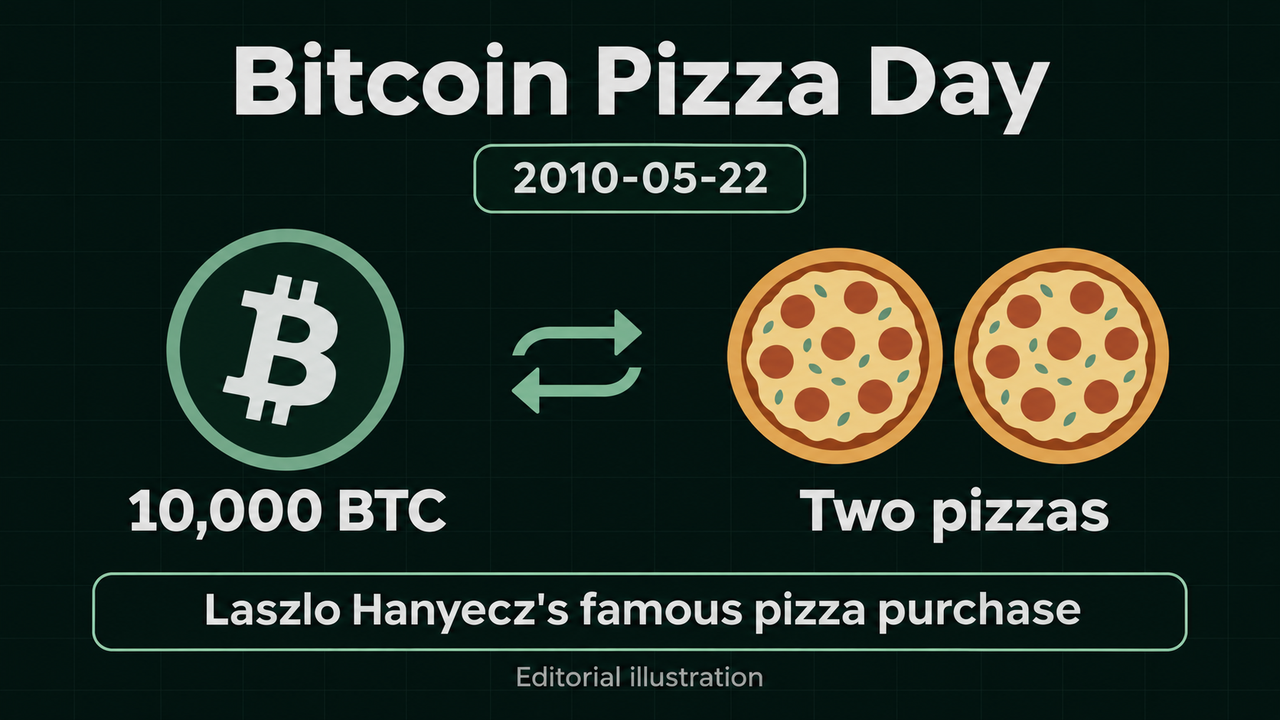
"Bitcoin Pizza Day" is celebrated every May 22 to commemorate Laszlo Hanyecz's trade of 10,000 BTC for pizza. Rather than just calculating how much he "missed out on," it's worth first looking at how this meal was actually bought.
Key Takeaways
- Bitcoin Pizza Day is May 22 each year, originating from a 2010 transaction.
- Laszlo posted on a forum offering 10,000 BTC for two large pizzas.
- The trade was completed with help from another forum user and should not be simplified as a pizza shop directly accepting BTC.
- Calculating value at today's price is hindsight and does not reflect the purchasing power known at the time.
- Pizza Day commemorates a story of usage and is a different event from the Bitcoin halving.
When Is Bitcoin Pizza Day?
Bitcoin Pizza Day is May 22.
On that day in 2010, Laszlo replied on the Bitcointalk forum confirming he had successfully traded 10,000 BTC for pizza and thanking the user jercos who helped complete the transaction. That reply can still be traced back through the original thread.
Note that the date the request was posted and the date the trade was completed are different. May 22 commemorates the completion of the exchange.
How Were These Two Pizzas Actually Bought?
It started with a forum post with a very direct title: Pizza for bitcoins?
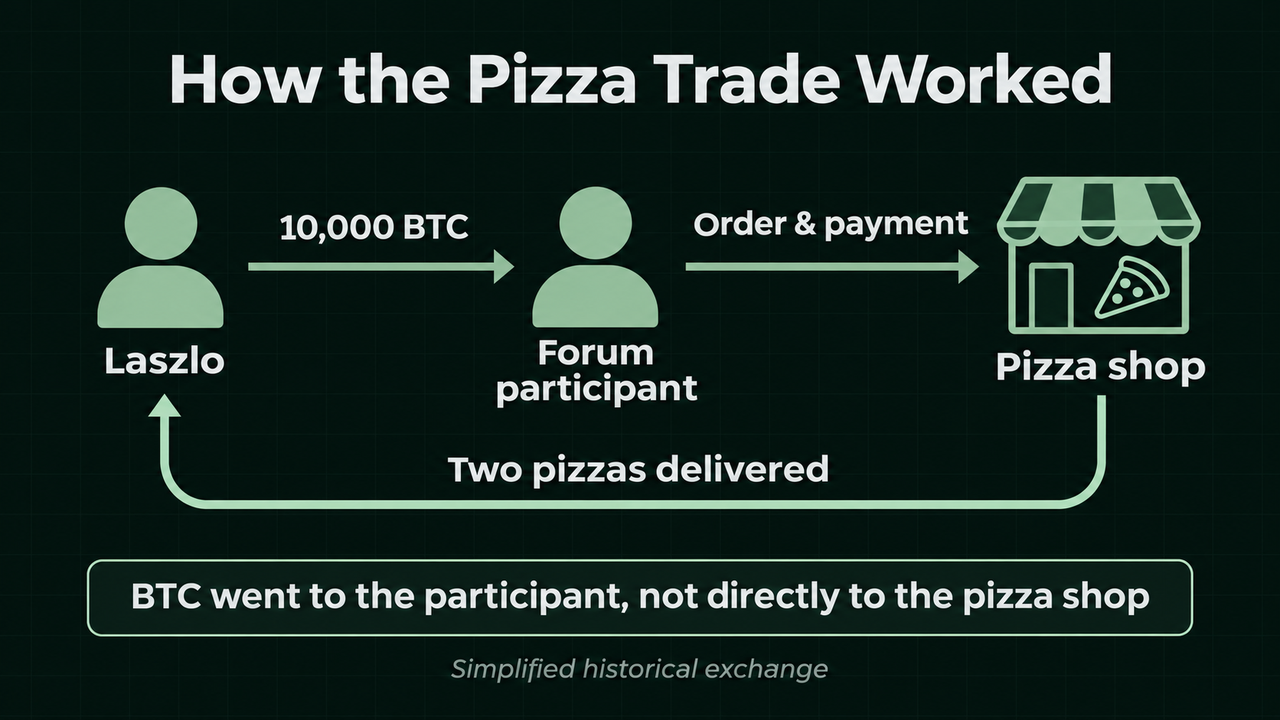
Laszlo offered to pay 10,000 BTC in exchange for two large pizzas. He did not require the other party to make them personally and was fine with someone ordering from a delivery shop on his behalf; what he wanted was a meal delivered to his door in exchange for BTC.
Eventually someone took up the trade and arranged for the pizzas to be delivered. The transaction can be viewed from two sides:
| Role | What they did in the transaction |
|---|---|
| Laszlo | Paid BTC, received pizzas |
| Helper | Received BTC, arranged purchase and delivery |
| Pizza shop | Made and provided the pizzas |
So "buying pizza with Bitcoin" does not necessarily mean the pizza shop already had a BTC payment system at the time. The exchange could be completed with help from another person.
To understand how such transfers are recorded behind the scenes, you can read Hotcoin's Bitcoin Deep Dive. The pizza story explains "what it's used for," while the network mechanism explains "how it moves."
How Much Was 10,000 BTC Worth Then? Why Would Anyone Make the Trade?
This question cannot be answered directly with today's market prices.
In 2010, the market size, trading channels, and usage environment were all different from today. For both parties, the basis for the trade was that one side was willing to pay BTC and the other was willing to provide the service of buying pizza.
The commonly seen "how much was that in USD back then" requires clarifying which price was used, on which day, and whether it refers to the pizza's sale price or the BTC quote. These numbers are not necessarily the same thing.
Likewise, back-calculating with today's price cannot be directly stated as Laszlo "spending this many of today's dollars" back then.
Assuming this is purely to demonstrate the calculation:
Assuming a BTC price of 100,000 USD:

10,000 BTC × 100,000 USD
= 1,000,000,000 USD
This is a result calculated using an assumed price, not a live quote, nor a prediction of future prices.
If you want to convert it yourself, you can first check a timestamped BTC quote on Hotcoin and then apply the formula. The calculation is interesting, of course, but it cannot tell us whether either party still held all the BTC afterward.
Why Is This Transaction Remembered?
Because it turned an abstract question into a concrete story: can BTC on the network be exchanged for things in real life?
This time someone made an offer, someone accepted, and delivery was completed. Compared with discussing only price and technology, two pizzas make it easier to understand what "exchange value" really means.
Looking at the story today, we already know how the market developed afterward; people at the time did not have that answer. Therefore, directly mocking the decision of that time using today's price ignores the information gap between two different eras.
Bitcoin Pizza Day is therefore also a good entry point for understanding Bitcoin: start with a real use case, then gradually learn about recording, supply, and custody.
What Activities Are There for Pizza Day?
Hotcoin also brings this festive atmosphere into its platform activities. In 2025, for example, Hotcoin held the "Pizza Festival Futures Trading Challenge" from May 14 to May 28, featuring a first futures trading task and a trading ranking competition, with a total prize pool of 100,000 USDT, awarded as futures bonus funds. For specific tasks and claiming conditions, see the Hotcoin Pizza Festival event announcement.
If you want to know what is scheduled during Pizza Day, follow Hotcoin's latest activities or the announcement center. If you are new to cryptocurrency, you can first use Hotcoin's exchange beginner's guide to learn about account security and basic operations, then choose how to participate based on your own experience.
From finding someone to buy pizza back then to today's ways of accessing Bitcoin through platform trading, wallet payments, or funds, there are now many more ways to participate. This also raises the next question: when people say "buy Bitcoin" today, what exactly might they be buying?
From Pizza to Today: How Has Bitcoin's Use Changed?
The pizza story started with directly exchanging BTC for things. Today, talking about Bitcoin also involves holding, trading, payments, and ETFs.
Supply: Pizza Day does not change issuance rules
Bitcoin controls new issuance through protocol rules; the block subsidy halves regularly based on block height, with a supply cap of about 21 million coins. Pizza Day is a community commemoration and does not trigger a halving or change rewards.
To distinguish the two clearly, you can read Hotcoin's Bitcoin Halving Cycle Explained.
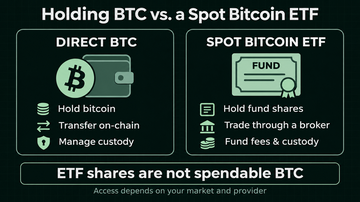
Holding method: directly holding BTC is different from buying an ETF. You can read A Comprehensive Guide to Spot BTC ETFs: A Milestone for Institutional Entry to learn more.
Directly holding BTC requires considering whether to keep it on a platform or in a personal wallet, and how to transfer and safeguard it.
Accessing Bitcoin price through a spot ETF means holding fund shares, subject to the fund's trading, fee, and custody arrangements; it cannot be directly used as BTC in a wallet to make payments.
If you started learning about Bitcoin through the pizza story, you can use the Bitcoin Deep Dive, Halving Introduction, and A Comprehensive Guide to Spot BTC ETFs: A Milestone for Institutional Entry to understand the network, supply, and different ways to participate.
Common Misconceptions
- "The pizza shop directly received 10,000 BTC at the time." The trade involved a forum user who helped with the purchase, and this role cannot be omitted.
- "Bitcoin had no value at all back then." Since someone was willing to provide goods or services in exchange, it cannot simply be said to have no exchange value.
- "Converting at today's coin price is the actual loss back then." This is a back-calculation assuming the BTC was held until now, not a result known at the time.
- "Pizza Day and the halving are the same thing." The former is a historical event; the latter is a protocol issuance rule.
FAQ
Q1: Why is Bitcoin Pizza Day on May 22?
Because on May 22, 2010, Laszlo confirmed he had successfully traded 10,000 BTC for pizza.
Q2: Who bought the pizza?
Laszlo Hanyecz. He posted the exchange terms on the forum and replied after it was completed.
Q3: Did the pizza shop directly accept BTC at the time?
This story involved a forum user who helped with the purchase and cannot be taken as evidence that the pizza shop directly accepted BTC.
Q4: How much is 10,000 BTC worth now?
Multiply 10,000 by the BTC quote at the time. Quotes change, so when sharing results, include the price date and time.
Q5: Does Pizza Day affect Bitcoin's issuance?
No. It is a commemorative day; new issuance and halvings follow protocol rules.
Conclusion
What makes Bitcoin Pizza Day interesting, beyond the price comparison, is that someone actually tried to spend BTC—and the trade succeeded. Two pizzas gave "can digital assets be used to buy things" an easy-to-remember answer.
To continue understanding the Bitcoin behind this story, start with Hotcoin's Bitcoin Deep Dive, then explore halving and ETFs as interested.
Risk Disclaimer: This article is for educational and informational purposes only and does not constitute any investment advice. Historical stories, past prices, and hypothetical back-calculations do not represent future performance. Bitcoin prices may fluctuate significantly, and direct holding or participation through related products involves risk that may lead to loss of principal. Please make decisions based on your own risk tolerance and consult a professional advisor when necessary.
Recommended
View more