What Is TRON (TRX)? Why Most USDT Transfers Use TRC20
When you send USDT to someone, the recipient often says to "use TRC20." TRC20 here is not another kind of US dollar; it is the token form of USDT on the TRON network. To understand why many people choose this route, first separate three concepts: TRON is the blockchain, TRX is the native asset of that chain, and TRC-20 is the fungible token standard on the chain.
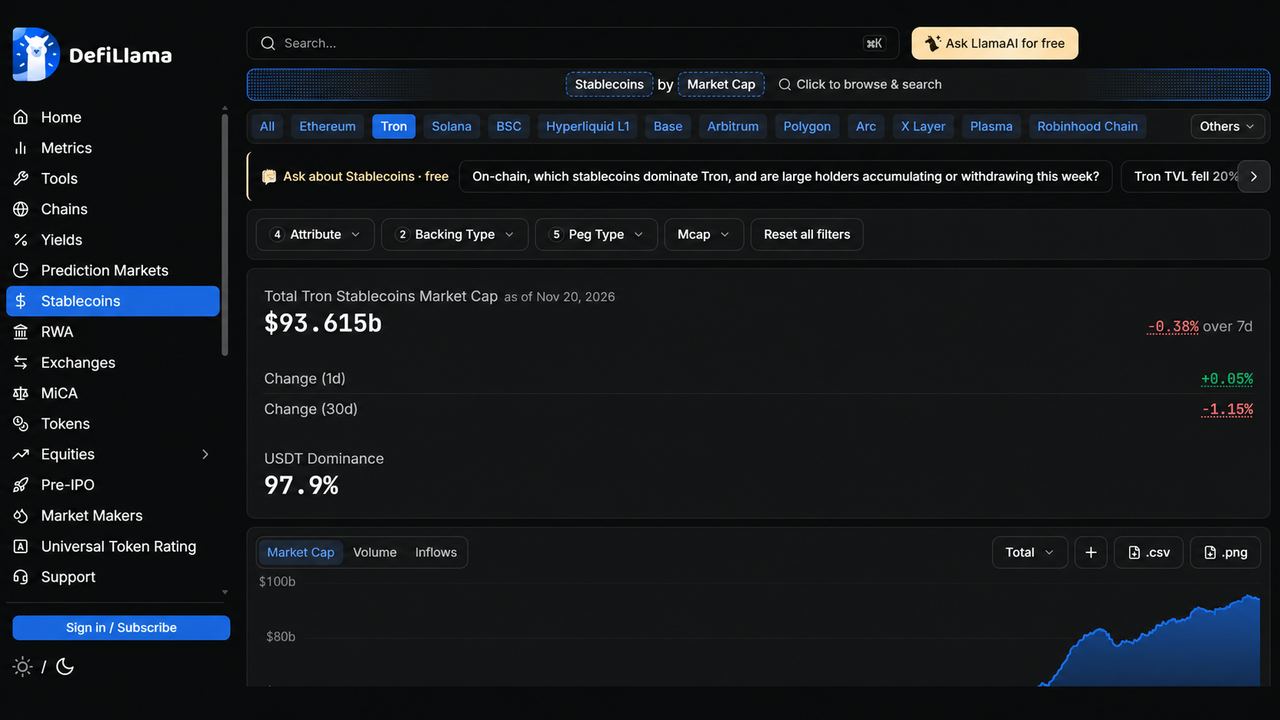
TRON uses a Delegated Proof of Stake (DPoS) consensus and focuses on faster transaction processing and lower fees. USDT transfers are one of its common uses. According to DefiLlama, as of November 20, 2026, the market cap of USDT on TRON was approximately USD 91.6 billion, accounting for about 98% of the chain's total stablecoin market cap, making it one of USDT's main circulation networks.
Key Takeaways
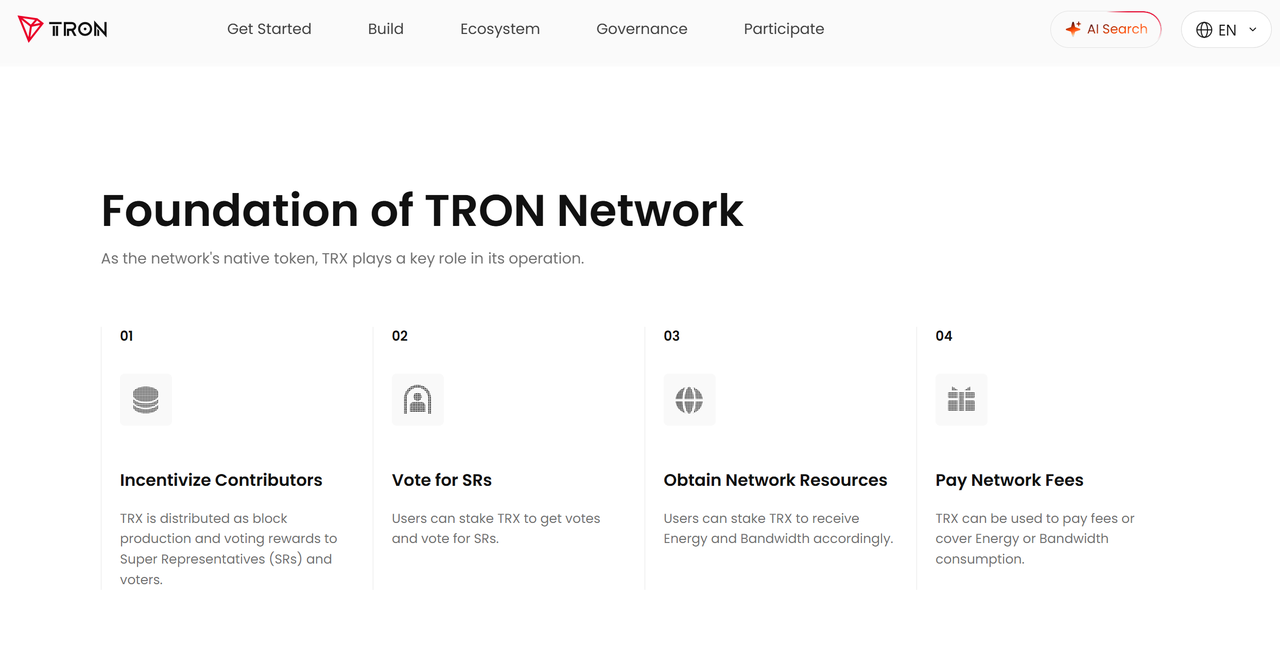
- TRON is a public blockchain, and TRX is its native asset, used to pay fees, stake for resources, and vote for Super Representatives.
- TRC-20 is the fungible token standard on TRON. Official documentation states that it is interface-compatible with Ethereum's ERC-20. Tether officially lists TRON as one of the supported networks for USDT, and its contract address should be treated as authoritative.
- Transferring TRC-20 tokens on TRON usually consumes Bandwidth and Energy. When an account lacks sufficient resources, TRX is burned as a fee according to the on-chain parameters at the time.
- The common mechanism behind "USDT often uses TRC20" is faster confirmation, relatively controllable fees, and broad support for this network among recipients and wallets. Specific fees change; when comparing, check our multi-chain fee explainer and what the transfer page shows at the time, and do not rely on outdated figures.
- The most important thing when transferring is not choosing the "network that looks cheaper," but ensuring the sending network exactly matches the network of the recipient address.
What TRON and TRX Refer To
According to TRON official developer documentation, TRON is an open-source public blockchain that uses a Delegated Proof of Stake (DPoS) consensus, aiming to provide higher throughput, shorter confirmation times, and relatively low transaction fees. The documentation states a block time of about 3 seconds, with 27 Super Representatives producing blocks; TRX holders can vote for these representatives and participate in on-chain parameter governance.
TRX is the native asset of this network, and the official documentation summarizes its main uses:
- Burning TRX to pay fees according to the on-chain parameters at the time when bandwidth or energy is insufficient
- Staking TRX to obtain additional bandwidth, energy, and voting power (TRON Power)
- Voting for Super Representatives and participating in governance-related arrangements according to the rules
- Paying energy consumption when deploying or calling smart contracts; resources can also be delegated to other accounts
Therefore, to transfer on TRON or interact with contracts, an account usually needs to hold a certain amount of TRX or obtain resources delegated by others in advance. Even when transferring USDT, the fee is not paid in USDT itself but covered by bandwidth, energy, or burned TRX.
The TRON Virtual Machine (TVM) is broadly compatible with the Ethereum Virtual Machine according to official descriptions, and many Solidity contracts can be deployed with few modifications. Compatibility does not mean the two chains can mix addresses or transfer directly across chains. TRON address formats differ from Ethereum's, and they cannot substitute for each other when transferring.
TRON addresses usually start with T, making them easy to distinguish at a glance from Ethereum addresses starting with 0x. If the address format does not match, stop sending. The official documentation also notes that network parameters can be adjusted through on-chain committee proposals, not necessarily requiring a hard fork every time; therefore, fee-related parameters may also change, and you should rely more on the estimates given by the chain or wallet at the time.
Regarding resource prices, the official developer documentation, when explaining the resource model, states: when staked or free bandwidth is insufficient to cover the entire transaction, the current mainnet price is 1,000 sun per unit of bandwidth, equivalent to about 0.26 to 0.30 TRX burned for a simple transfer; contract calls have no free energy, and the current mainnet price is 100 sun per unit of energy, subject to the transaction's fee_limit. 1 sun equals 0.000001 TRX. These are the "current mainnet prices" written in the official documentation on the day of checking and may be adjusted later; they should not be treated as permanent fixed rates.
What TRC-20 Is and How It Relates to USDT
TRC-20 is the fungible token standard on TRON. Official documentation states that it is fully compatible with ERC-20 at the interface level, and any contract implementing the specified functions and events can be considered a TRC-20 token. USDT and other fungible tokens issued on TRON can all use this standard, but they are not the same asset.
USDT is issued by Tether and aims to maintain a value close to the US dollar. Tether officially supports multiple blockchains, explicitly listing "TRC20 Token via Tron Blockchain" and providing the contract address on TRON. In other words, TRC20-USDT is the same issuer's form of USDT on TRON; it is not another kind of US dollar, nor a new token unrelated to ERC20-USDT.
USDT on different networks is often treated by the issuer as interchangeable for redemption and accounting, but on-chain transfers must use the same network. If the recipient address is in TRON format, you cannot send via Ethereum or another network. The name USDT alone does not guarantee that funds will arrive if you choose the wrong network.
For stablecoin reserves, depeg risks, and regulatory frameworks, see What Is a Stablecoin. To learn how to identify USDT and how to choose a network when buying and withdrawing, continue with What Is USDT.
Why Many People Choose TRC20 for USDT Transfers
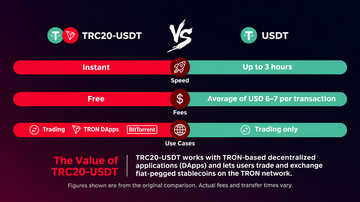
The first consideration for many people choosing TRC20 for USDT transfers is fees. Especially when the Ethereum network is congested and Gas fees are high, TRC20 often becomes an alternative. However, which network is cheaper still depends on the fee shown on the transfer page for that particular transaction; you cannot keep applying past prices.
If you use a personal wallet, note that even though you are transferring USDT, paying the fee usually requires TRX. So a wallet holding only USDT may still be unable to send. TRON also allows users to stake TRX or have other accounts provide the resources needed for the transfer, reducing the TRX fee deducted directly. These resources appear in the wallet as "Bandwidth" and "Energy"; when using it for the first time, just check how much fee the wallet estimates and whether TRX is sufficient. If withdrawing from an exchange, simply check the fee listed on the withdrawal page.
Another reason is convenience and broad platform support. TRON produces a block about every 3 seconds, and many wallets and trading platforms support TRC20-USDT. If the recipient provides a TRC20 address and your sending platform supports the same network, you can transfer directly. However, after a transaction is written into a block, the receiving platform may still wait for more confirmations before crediting it; this does not mean it will definitely arrive 3 seconds after you press send.
Tether itself has also issued USDT on TRON and publishes the contract address on its official website for users to verify. When adding USDT to a wallet or confirming whether the USDT you received is genuine, compare the official contract address; do not rely only on the name and icon.
Fees, transfer speed, and platform support make TRC20 a common way to transfer USDT. But when choosing a network, first confirm which one the recipient supports, then compare fees. To see differences between networks, refer to Hotcoin's Multi-Chain Transfer Fee Comparison, and in actual operations rely on the fee shown on the transfer page.
What Else to Verify When Transferring USDT via TRC20
First confirm three things: the asset is USDT, the network is TRON/TRC20, and the address is a TRON-format recipient address. All three must be correct at the same time.
When verifying USDT on TRON, rely on the contract published on Tether's official supported protocols page. The TRON USDT contract address listed there is TR7NHqjeKQxGTCi8q8ZY4pL8otSzgjLj6t. If the contract shown in your wallet or on the transfer page differs, pause first and cross-check against the issuer's official page. Do not confirm an asset's identity based only on its name, icon, or search ranking.
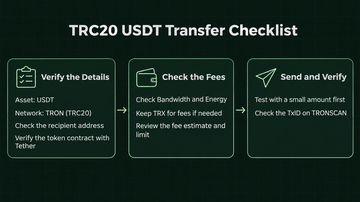
If withdrawing from a trading platform, explicitly select TRC20 or the TRON network on the withdrawal page rather than submitting just because you see USDT. If sending from a wallet, also select the correct network in the wallet and, as far as possible, compare against the official contract address above to avoid being misled by tokens with the same name.
Keep some TRX in the account to pay fees, or confirm that there is sufficient bandwidth and energy. If you hold only USDT and have no TRX or resources at all, a contract transfer may fail to send. When transferring to an address that has not yet been activated for the first time, the consumption may also differ from transferring to an activated address; before sending, check the estimate given by the wallet or explorer.
Setting or confirming fee_limit is also important. The official documentation reminds users that contract calls are constrained by the maximum fee allowed for the transaction. If the limit is too low, the transaction may fail; but this does not mean you should set it arbitrarily high. Base it on the wallet's estimate and send only after understanding the fee ceiling you can accept.
Whether the account is already activated also affects consumption. When transferring to an address that has not yet been activated, the required resources and fees may differ from transferring to an activated address. Before sending, read the estimates and prompts from the wallet or exchange, and do not assume that every TRC20 transfer costs the same.
After the transfer is complete, use the transaction hash to check the status on a TRON block explorer. Do not judge that funds have arrived based only on a chat screenshot or the other party's verbal statement. Before larger transfers, testing with a small amount first is usually safer.
Common Misconceptions
- "TRC20 and ERC20 are two different USDTs with different values" — They are forms of the same issuer on different chains; the differences are mainly the network, address, and fees, not another kind of US dollar.
- "Just choose the network with the lowest fee" — You must first ensure it matches the recipient's network, then compare fees.
- "TRON transfers do not need TRX" — Transferring TRC-20 tokens usually requires energy or burned TRX; without resources, it may not be possible to send.
- "If officials said fees are low, it will always be a fixed number" — Resource prices and account status change; rely on the estimate at the time.
- "The highest market share must be the safest" — Without a unified, consistently verifiable official market share measure, do not state "the most" as fact; network security, address correctness, and issuer risk should be viewed separately.
FAQ
Q1: What is the difference between TRON, TRX, and TRC20?
TRON is the network, TRX is the native asset, and TRC-20 is the token standard on this chain. USDT on TRON usually exists in TRC-20 form.
Q2: Why does the recipient always ask me to use TRC20?
A common reason is that the other party only provided a TRON address, or wants relatively controllable fees and faster confirmation. Whether it is suitable still depends on whether your sending wallet or platform supports the same network.
Q3: Can TRC20-USDT and ERC20-USDT be transferred directly to each other?
You cannot send directly across networks. You must use a service that supports exchange or cross-chain conversion to swap USDT on one network for USDT on another network. Sending ERC20 assets directly to a TRON address may result in the funds not arriving.
Q4: How much is the fee for a TRC20-USDT transfer?
There is no long-term fixed number. It depends on bandwidth, energy, whether you have staked, and the on-chain parameters at the time. Check the estimate on the transfer page, or refer to the explanation on our multi-chain fee comparison page at the time.
Q5: Can I transfer only USDT without TRX?
Usually not. Calling the TRC-20 contract requires energy or burned TRX. Prepare a small amount of TRX in advance, or confirm that the account already has available resources.
Conclusion
TRON is a public blockchain that uses TRX to pay for resources and fees, and TRC-20 is a common token standard on it. USDT often uses TRC20 mainly because the issuer has already issued it on this chain, transfer confirmation is faster, and fees are often more predictable. It is one of the common choices, but it is not a "default optimal network" that can be used without verification. Before sending, confirm that the network and address match, then check the fee at the time.
If you need to compare the fees and points to note when transferring USDT across different networks, read Multi-Chain Transfer Fee Comparison, and rely on what that page and the transfer page show at the time.
Risk disclosure: This article is for educational and informational purposes only and does not constitute investment or transfer advice. Stablecoins still carry issuer, reserve, and depeg risks; choosing the wrong network or address may cause assets to fail to arrive and be difficult to recover. Fees, resource prices, and platform withdrawal rules all change; please rely on official documentation, block explorers, and what the pages show at the time.
Đề xuất đọc
Xem thêm