
Consensus Mechanisms Explained: How Blockchains Reach Agreement
A consensus mechanism is a set of rules that enables distributed nodes to agree on valid transactions, block order, and the state of the ledger. It handles forks and malicious nodes, but it cannot guarantee that off-chain data is true.
Without a central database administrator, nodes may receive transactions and blocks at different times and may even encounter conflicting information. A consensus mechanism enables honest nodes, under defined network and fault assumptions, to eventually accept the same valid history.
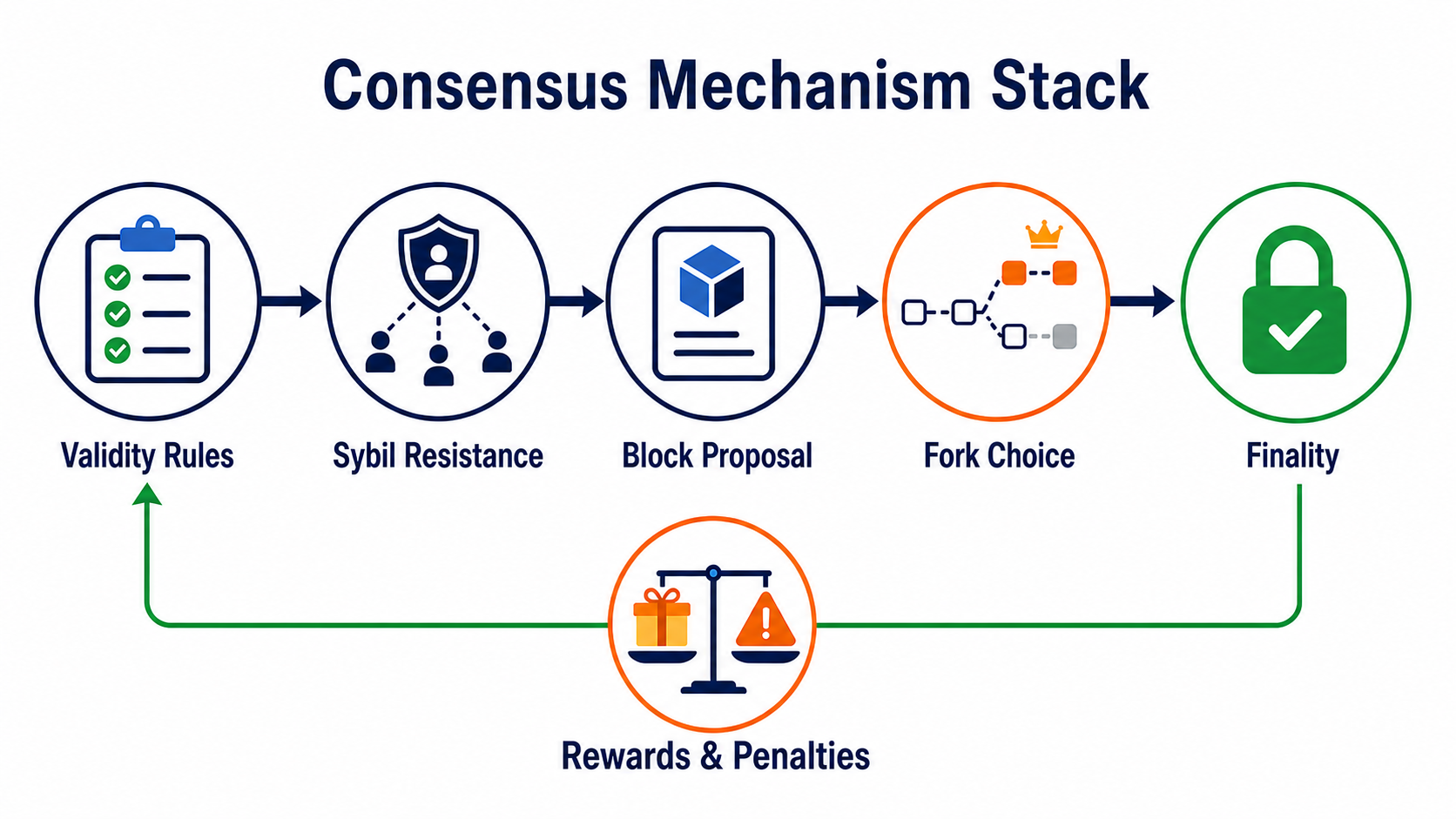
What Problems Must a Consensus Mechanism Solve?
Blockchain consensus does not require every computer to hold exactly the same data at every moment. Instead, it defines how nodes validate updates, handle temporarily different chain heads, and decide when a segment of history is stable enough to trust.
It generally addresses the following tasks:
- Determining whether transactions and blocks comply with protocol rules, including checks on signatures, balances, block structure, and execution results.
- Deciding who is eligible to propose new blocks, preventing a participant from controlling the network by creating many false identities.
- Selecting a chain head according to fork-choice rules when multiple valid candidate blocks appear at the same time.
- Reducing the likelihood that accepted history will be reversed through confirmation depth or a finality mechanism.
- Using rewards, penalties, computational costs, or identity-based accountability to make honest participation more economically attractive than malicious behavior.
Consensus only ensures that the network records inputs consistently. If an oracle submits an incorrect price or a user signs the wrong transfer, nodes may still record that incorrect data on-chain according to the rules.
Why Aren't PoW and PoS the Complete Answer?
In everyday usage, PoW and PoS are often called consensus mechanisms. More precisely, they mainly address Sybil resistance and the allocation of block-proposal rights. A complete system also needs validity rules, network propagation, fork choice, finality, and other components.
| Component | Question It Answers | Common Implementations |
|---|---|---|
| Validity rules | Which transactions and blocks can be accepted? | Signature, balance, script, or state-execution checks |
| Sybil resistance | How can one person be prevented from posing as many participants? | Computing power, staked assets, authorized identities |
| Proposer selection | Who creates the candidate block in this round? | Hash-power competition, random selection, rotating production |
| Fork choice | Which chain head should nodes follow when several appear at once? | Cumulative work, stake-weighted voting |
| Finality | When is history difficult or impossible to reverse within the protocol? | Confirmation depth, checkpoint voting, BFT finality |
| Incentives and penalties | How is participant behavior constrained? | Block rewards, fees, slashing, loss of eligibility |
As a result, two chains that both use the PoS label may still have different proposer-selection methods, voting thresholds, and finality rules. Their security boundaries cannot be judged by the label alone.
How Does a Transaction Reach Consensus Confirmation?
After a user signs and broadcasts a transaction, nodes first verify that it is valid. Transactions that comply with the rules enter a pending pool, from which miners, validators, or authorized block producers select them for inclusion in a candidate block.
Other nodes independently validate the block when they receive it rather than simply trusting its proposer. If multiple valid blocks appear at the same height, nodes update their chain head according to the network's fork-choice rule. Additional blocks or validator votes then increase confidence in the transaction until it reaches the application's required number of confirmations or the protocol's defined final state.
For a complete walkthrough of transaction propagation and confirmation, continue with How Blockchain Works.
How Do Common Consensus Mechanisms Differ?
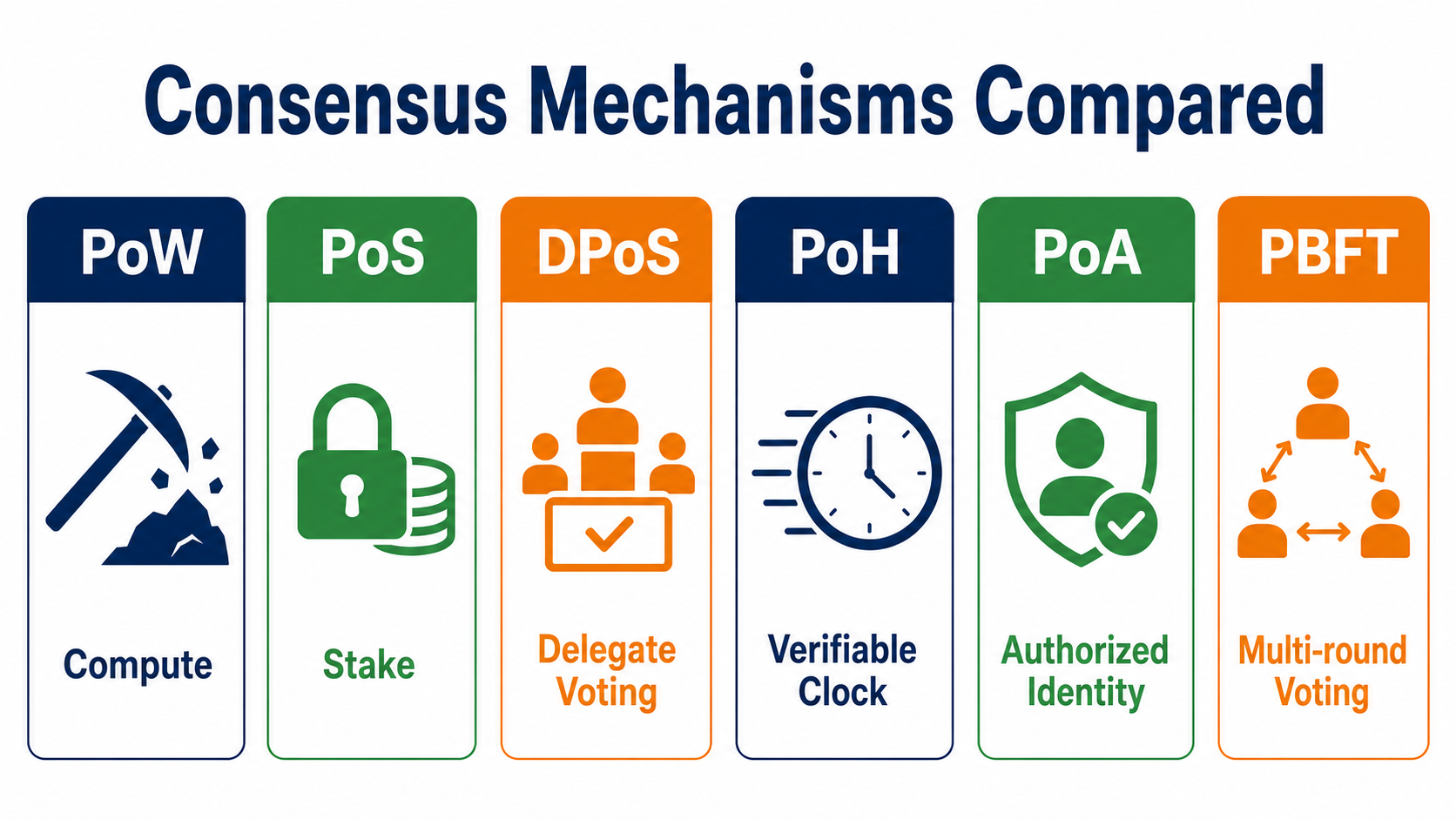
| Mechanism | Primary Basis | How Block Producers Are Chosen | Main Trade-offs |
|---|---|---|---|
| PoW | Computing and energy costs | Miners compete to find a hash that meets the difficulty target | Straightforward rules and a long operating history, but high energy use and potential mining-pool concentration |
| PoS | Locked native assets | Validators are selected through staking and randomized rules | Lower energy use and the ability to slash malicious validators, but more complex protocol design |
| DPoS | Token-holder voting or delegation | A small set of elected delegates take turns producing blocks | Fast confirmation and direct governance, but voting concentration and delegate collusion require ongoing monitoring |
| PoA | Authorized identity or reputation | Known validators rotate according to defined rules | Suitable for permissioned or clearly governed networks, but less open participation |
| PBFT-style | Multi-round messaging among known replicas | A primary proposes and replicas vote to confirm | Fast finality, but communication costs increase as the participant set grows |
| PoH | Verifiable time ordering | Must be combined with mechanisms such as PoS or BFT | Reduces ordering and clock-coordination costs, but is not a complete consensus protocol by itself |
To explore these mechanisms individually, read Proof of Work, Proof of Stake, Delegated Proof of Stake, and Other Consensus Mechanisms.
How Can You Tell Whether a Consensus Mechanism Suits a Blockchain?
Transactions per second should not be the only comparison. An evaluation should first establish whether participants need permission, how many offline or malicious nodes the network can tolerate, whether the application needs probabilistic confirmation or rapid finality, and how costly it is for an ordinary user to run a validating node.
Protocol design must also be distinguished from actual distribution. Permissionless participation in theory does not mean that computing power, stake, or client implementations are not concentrated. Likewise, a large validator count does not mean that the validators are controlled by an equally large number of independent entities.
| Evaluation Dimension | What to Examine |
|---|---|
| Participation threshold | Whether specialized hardware, minimum stake, identity screening, or election is required |
| Security resource | Whether an attacker must control hash power, stake, delegate seats, or authorized keys |
| Finality | Whether confidence accumulates through later blocks or comes from explicit checkpoint voting |
| Fault assumptions | What proportions of network delay, offline nodes, and malicious nodes the system can tolerate |
| Governance and upgrades | Who can change parameters, replace validators, or coordinate emergency upgrades |
| Actual concentration | Whether mining pools, staking services, cloud providers, or clients are overly concentrated |
For the specific trade-offs between PoW and PoS, see PoW vs. PoS: A Comprehensive Comparison. To understand the consequences of excessive concentration in consensus resources, read What Is a 51% Attack?.
Consensus Mechanism Learning Path
| Question You Want to Answer | Recommended Reading |
|---|---|
| How does Bitcoin use computing power to select its main chain? | Proof of Work (PoW) |
| How does Ethereum use staking and voting to confirm blocks? | Proof of Stake (PoS) |
| How do token holders elect block producers? | Delegated Proof of Stake (DPoS) |
| How should PoW and PoS be compared? | PoW vs. PoS: A Comprehensive Comparison |
| What problems do PoH, PoA, and PBFT each solve? | An Overview of Other Consensus Mechanisms |
| What happens when a majority of resources is controlled? | What Is a 51% Attack? |
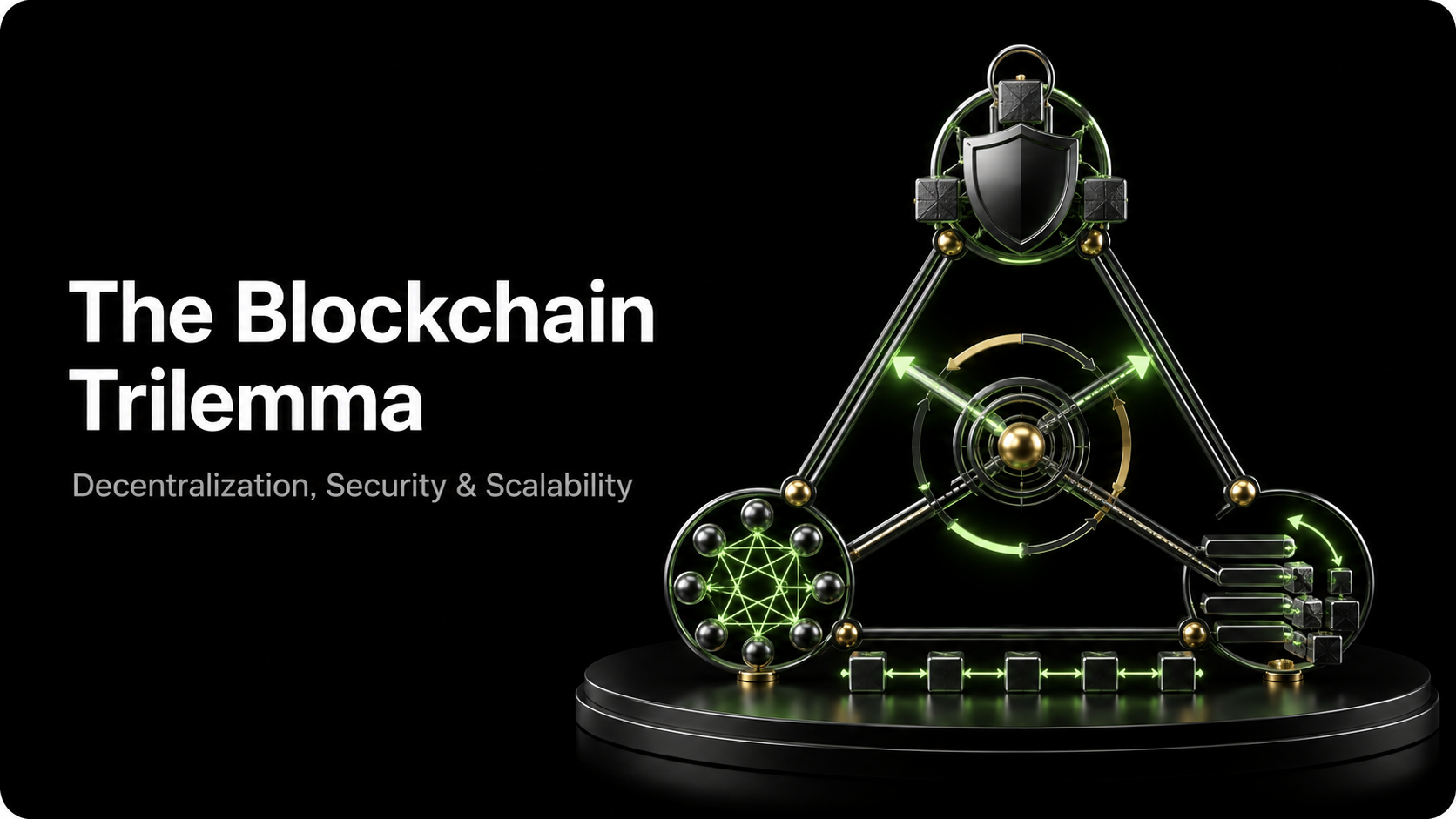
| Why do security, decentralization, and scalability constrain one another? | The Blockchain Trilemma |
| How do validators, nodes, and delegators divide responsibilities? | What Is a Blockchain Validator? |
Frequently Asked Questions
Can Nodes Reach Consensus Again After a Temporary Network Disconnection?
Usually, yes. After reconnecting, nodes exchange blocks and votes and converge according to validity and fork-choice rules. If a network partition lasts too long, some protocols pause finality, while others may form competing histories that require later resolution.
Can a Consensus Mechanism Be Replaced After a Blockchain Is Already Running?
Yes, but doing so requires a protocol upgrade, client implementations, and coordination among participants. Changing the security resource and finality rules affects miners, validators, wallets, and trading platforms, so it is generally not an ordinary software update.
Does Having More Nodes Always Make Consensus More Secure?
Not necessarily. You must also consider who controls the nodes, whether they validate independently, which clients they use, and how hash power or stake weight is distributed. A large number of nodes that all depend on the same provider is not equivalent to the same number of independent participants.
Once Consensus Is Reached, Can a Transaction Never Change?
That depends on the protocol's finality model. With probabilistic confirmation, a transaction becomes harder to reverse as block depth increases. BFT or PoS checkpoints may provide protocol-defined finality. Client bugs, social coordination, and protocol upgrades remain separate boundaries that must be evaluated.
Đề xuất đọc
Xem thêm

service hotcoin.com
producthotcoin.com
businesshotcoin.com
casecnhotcoin.com