
Proof of Stake (PoS): Ethereum's Green Revolution
Proof of stake allows participants to lock up a network's native assets to become validators. The protocol then selects block proposers and aggregates validation votes. Malicious validators may be slashed, shifting the cost of security from computing power to capital at stake.
Ethereum completed The Merge in 2022, transitioning from proof of work to proof of stake. PoS no longer requires miners to compete continuously over hashes, but nodes must still validate transactions, propagate blocks, and apply fork-choice rules.
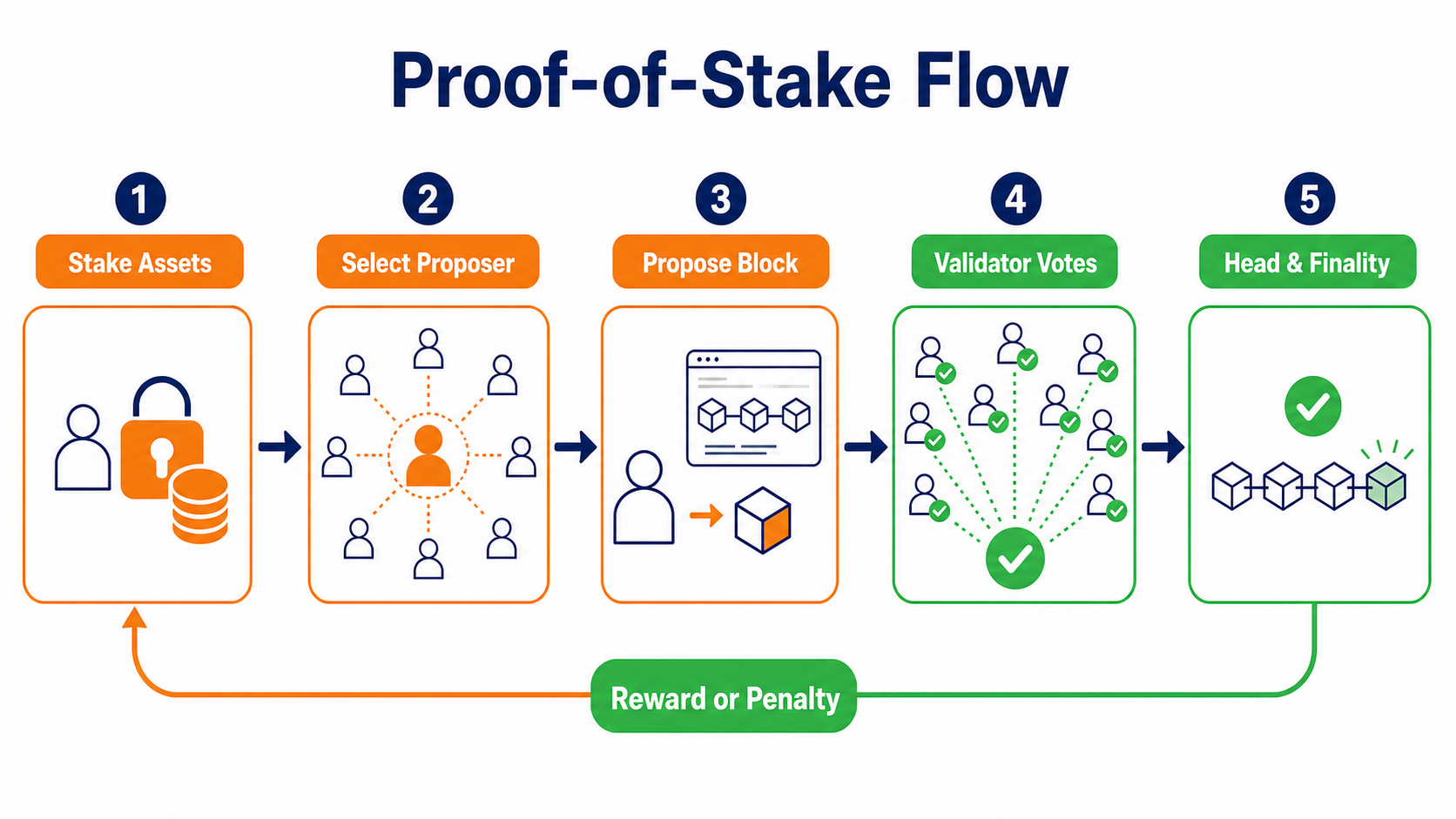
How Does PoS Select and Confirm Blocks?
Validators first lock up assets as required by the protocol and run node software. During each time period, the protocol selects one or more active validators to propose a block, while other validators check it and submit signed votes.
Nodes aggregate these votes and use a fork-choice algorithm to determine the current chain head. Checkpoints that meet the protocol's threshold may also become justified or finalized. Time units, selection algorithms, and voting thresholds vary between PoS networks.
Ethereum divides time into slots and epochs. A block proposer is selected for each slot, while validator committees submit attestations. Ethereum uses LMD-GHOST to select the chain head with the greatest voting weight and Casper FFG to finalize checkpoints. The name PoS alone does not describe all of these components.
How Does Staking Hold Validators Accountable?
Staked assets serve as a bond that the protocol can penalize. Validators earn rewards when they propose and validate blocks correctly and cast timely votes. Those that remain offline or miss duties for extended periods forgo rewards and incur ordinary penalties.
Provable misconduct, such as signing conflicting blocks for the same period or submitting contradictory votes, may trigger slashing. Slashing destroys part of a validator's stake and forces the validator to exit. Some protocols also increase correlated penalties when multiple validators violate the rules at the same time.
Not every period of downtime is malicious, and not every PoS chain applies the same slashing conditions. Before operating a validator, review the specific protocol's client, key-management, uptime, and exit requirements.
How Does Ethereum Achieve Finality?
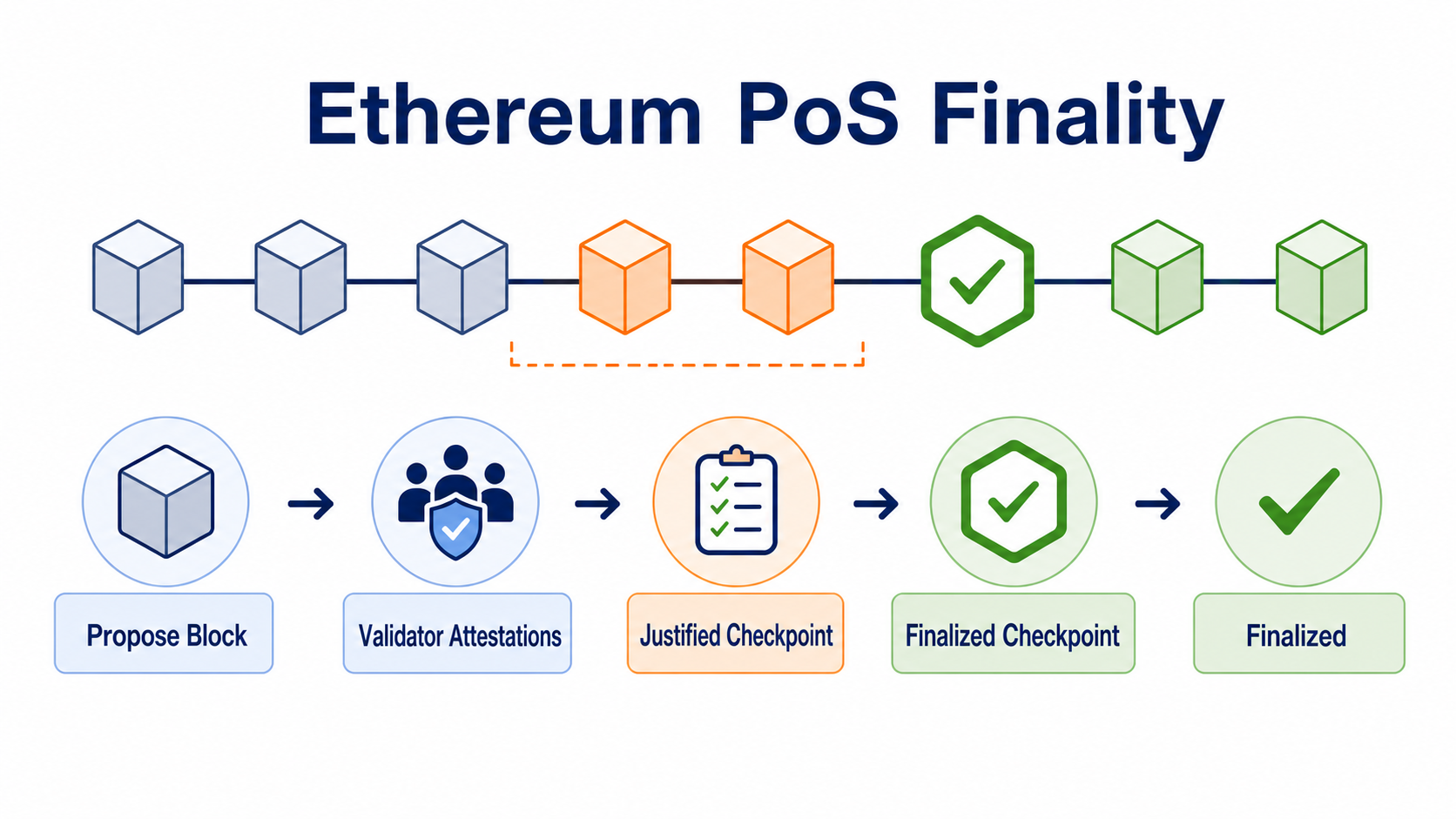
Ethereum validators vote both for the current chain head and for checkpoints. Once the required share of staked weight supports a checkpoint, it becomes justified. It is then finalized when subsequent conditions are met.
Finality is not the same as an ordinary number of confirmations. Blocks near the chain head may still undergo brief reorganizations because of network latency. Replacing a finalized checkpoint with a conflicting history would require violations on a massive scale, triggering severe economic consequences and social coordination.
A blockchain explorer showing a transaction as “successful” does not mean that a trading platform has credited it. Platforms may wait for additional blocks, finality, and internal risk-control procedures.
Why Is PoS More Energy-Efficient Than PoW?
PoS does not require large numbers of mining machines to repeatedly compete over hashes. Validators still consume electricity to run nodes, verify transactions, and sign messages, but ongoing energy competition is no longer a prerequisite for earning the right to propose blocks.
Ethereum officially estimates that The Merge reduced the network's energy consumption by approximately 99.95%. This figure describes Ethereum's transition from its previous PoW architecture. It cannot be applied directly to every PoS network, nor does it mean that PoS chains have no hardware or data-center costs.
PoS reduces the energy requirements of the consensus layer; it does not automatically increase transaction throughput. Scaling also depends on execution capacity, data availability, Layer 2 solutions, and other measures.
What Centralization and Operational Risks Does PoS Face?
Staking providers, liquid staking protocols, and custodial platforms may concentrate substantial voting power. Excessive reliance on the same cloud providers or dominant clients can also cause seemingly independent validators to go offline simultaneously or suffer from the same software defect.
The hardware threshold for running a personal validator is generally lower than for professional PoW mining, but validators still need stable connectivity, sound key management, timely client updates, and safeguards against duplicate signing. Staking services can reduce operational complexity, but they introduce custodial, smart contract, or operator risk.
For the hashpower-based security model behind PoW, see Proof of Work. For representative voting, see Delegated Proof of Stake. For a comparison of the two leading mechanisms, read PoW vs. PoS, or return to the broader framework in Consensus Mechanisms Explained.
Frequently Asked Questions
Does Simply Holding ETH Automatically Earn Staking Rewards?
No. Holding assets and participating in staking are different activities. Users must run their own validator, join a staking pool, or use another staking service. Each option has different requirements, fees, and risks.
Will a Validator Always Be Slashed for Brief Downtime?
Ordinary downtime typically does not trigger immediate slashing, but the validator may miss rewards or incur inactivity penalties. Slashing targets serious conduct explicitly defined by the protocol, such as conflicting signatures. If a network cannot reach finality for an extended period, offline validators may also face higher losses.
Can One Server Run Multiple Validators?
Technically, yes. Capacity depends on the client and protocol. Concentrating many validators on one device, cloud region, or client increases the impact of a single point of failure.
Can Staked Assets Be Transferred Immediately After Exit?
Not necessarily. Many PoS protocols impose exit queues or unbonding periods, during which some rules may continue to apply. Consult the target network's current rules for the applicable waiting time.
Recommended
View more


service hotcoin.com
producthotcoin.com
businesshotcoin.com
casecnhotcoin.com