
What is Chain Abstraction?
Chain Abstraction is an emerging technological concept in the blockchain and cryptocurrency fields, aimed at providing users and developers with a simpler, more user-friendly, and efficient way to interact with blockchain technology by abstracting away its underlying complexities. In traditional blockchain applications, users must handle complex operations such as private key management, transaction signing, and gas fee calculation, all of which create high entry barriers for newcomers and increase the workload for developers. Chain Abstraction leverages a series of technologies and protocols to encapsulate these underlying details, allowing users and developers to interact with blockchain systems as seamlessly as they do with traditional internet applications, focusing on business logic instead of technical intricacies.
Core Concept of Chain Abstraction
The core of Chain Abstraction lies in the idea of “decentralization without perception.” This means users are largely unaware of the complex blockchain infrastructure operating behind the scenes when interacting with blockchain applications. This design philosophy significantly enhances the user experience, lowers the entry barrier, and promotes the widespread adoption of blockchain technology. Much like the “abstraction layer” in computer science, Chain Abstraction hides low-level operations through standardized interfaces and tools, creating a more accessible environment for application development.
Implementation of Chain Abstraction
The implementation of Chain Abstraction relies on a variety of technical components and protocols, including:
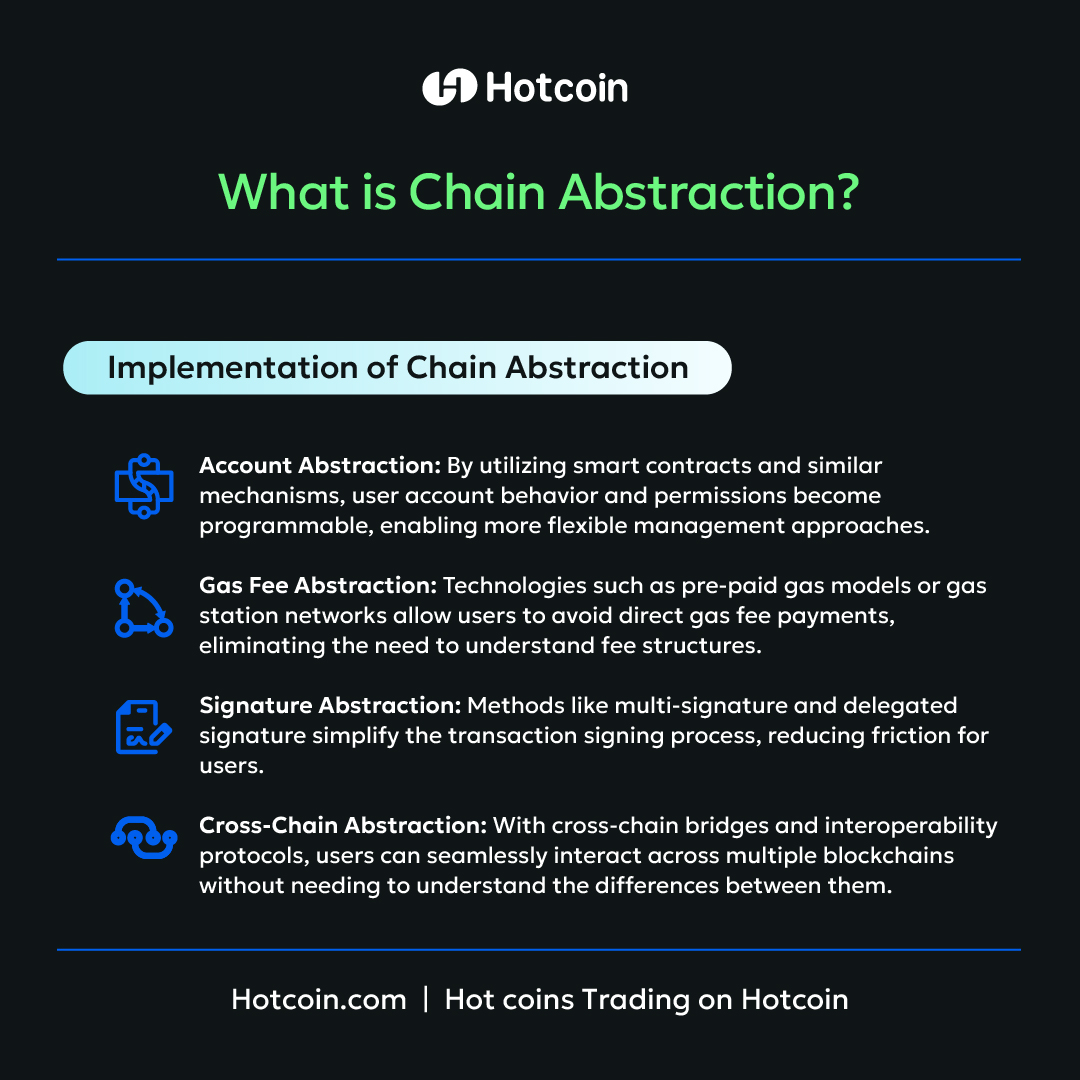
Account Abstraction: By utilizing smart contracts and similar mechanisms, user account behavior and permissions become programmable, enabling more flexible management approaches.
Gas Fee Abstraction: Technologies such as pre-paid gas models or gas station networks allow users to avoid direct gas fee payments, eliminating the need to understand fee structures.
Signature Abstraction: Methods like multi-signature and delegated signature simplify the transaction signing process, reducing friction for users.
Cross-Chain Abstraction: With cross-chain bridges and interoperability protocols, users can seamlessly interact across multiple blockchains without needing to understand the differences between them.
The combination of these technologies not only enhances the user experience but also provides developers with greater room for innovation. Developers can focus on the development of application functions without being overly entangled in the technical details of the blockchain underlying layer.
Representative Projects of Chain Abstraction
Notable projects that embody the principles of Chain Abstraction include:
Particle Network: Aims to provide end-to-end Chain Abstraction solutions through account abstraction, gas abstraction, and more, helping developers build intuitive blockchain applications.
NEAR Protocol: A high-performance blockchain platform featuring a unique account model and optimized gas fee design, enabling users to operate using memorable account names and lowering operational complexity.
StarkNet: A Layer 2 solution based on zk-Rollup that uses account abstraction to achieve scalability and supports developers in building sophisticated decentralized applications.
The emergence of Chain Abstraction is gradually transforming the blockchain industry. By simplifying interactions and lowering the technical threshold, it paves the way for the mass adoption of blockchain technology.
Đề xuất đọc
Xem thêm



Service@hotcoin.com
Product@hotcoin.com
Business@hotcoin.com
Casecn@hotcoin.com