SOL to HKD | How Much is 1 SOL in HKD? Live Conversion
To find out how much 1 SOL is worth in Hong Kong dollars, you first need to confirm whether you are looking at a direct HKD quote or a USD price converted through an exchange rate. The close link between HKD and USD does not mean the HKD value of SOL remains fixed.
The HKD value of 1 SOL depends on the latest price and update time shown by your chosen market data service. This article explains the conversion methodology, quantity calculations, and fee differences; all figures below are illustrative teaching assumptions, not current quotes or locked-in exchange rates.
Key Takeaways
- First confirm the asset is SOL and the target currency is HKD, then verify the price source and time.
- Reference value is determined by quantity and quote; when using USD cross-conversion, the foreign exchange rate must also be included.
- The latest traded price does not equal the executable price at which you can buy or sell.
- Trading, transfers, and currency exchange may incur different fees; the actual amount received must be calculated separately.
What Are SOL and HKD?
Solana Native Token (SOL): SOL is the native asset of the Solana network, used to pay network fees and participate in related staking mechanisms. It is distinct from other tokens running on Solana; SOL's USD quote cannot be directly used to calculate the value of all Solana tokens.
Hong Kong's Linked Exchange Rate System provides the background for understanding the relationship between USD and HKD. The conversion guarantee arrangements within the system operate for specific banking sectors and should not be understood as every retail currency exchange being able to transact at a fixed mid-rate. Banks, platforms, and payment channels may still offer different bid-ask spreads.
How to Calculate 1 SOL in HKD
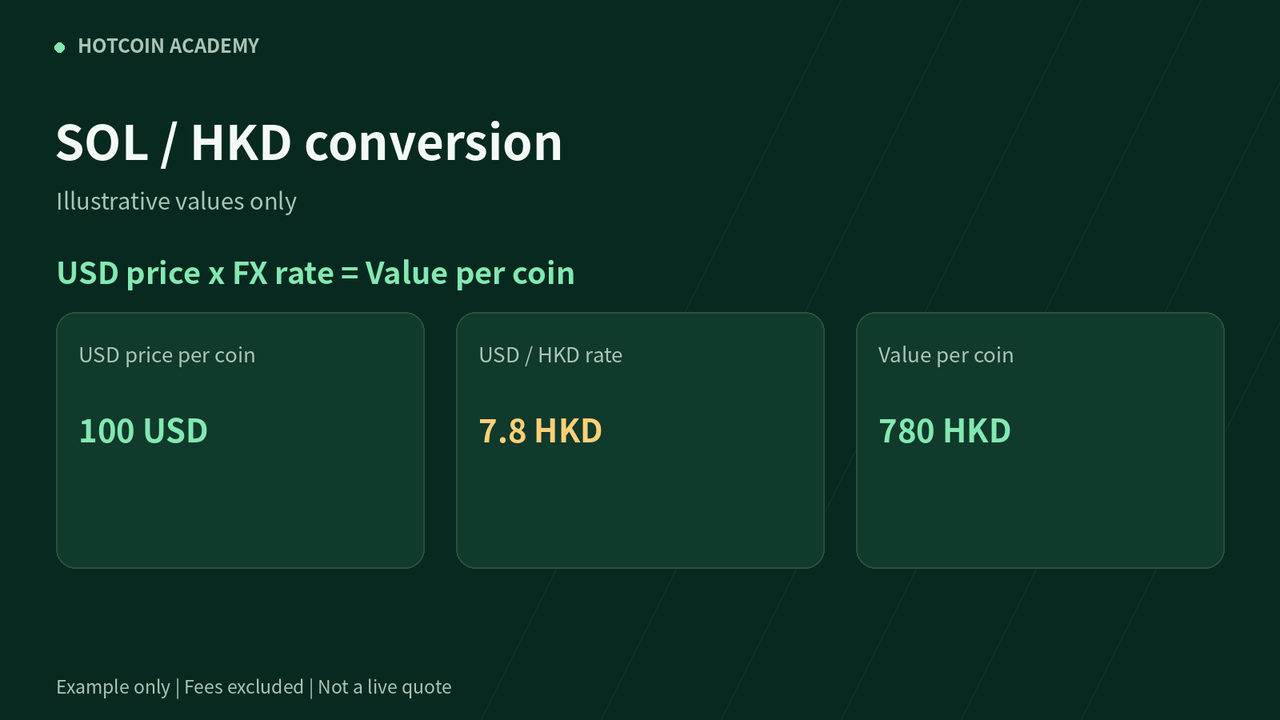
SOL Quantity × SOL/USD Price × USD/HKD Rate = HKD Reference Value.
Assume 1 SOL = 100 USD and 1 USD = 7.8 HKD; the reference value of 1 SOL is 100 × 7.8 = 780 HKD. All assumptions exclude fees, slippage, taxes, or withdrawal costs; they are used only to illustrate the multiplication relationship. When calculating with real data, replace the assumed unit price with the actual quote from the corresponding time and market.
SOL Quantity | Reference Value Based on Above Assumptions |
0.1 SOL | 78 HKD |
1 SOL | 780 HKD |
10 SOL | 7,800 HKD |
100 SOL | 78,000 HKD |
For reverse calculation, divide the HKD amount by the HKD unit price per SOL to estimate the corresponding quantity. If fees are deducted from the payment amount, deduct fees first before dividing; if fees are charged in SOL, they must also be deducted from the received quantity. Do not double-count the same fee.
To estimate exchange amounts at the latest rates, you can use the Hotcoin Cryptocurrency Converter.
Direct HKD Quotes vs. USD Cross-Conversion
Price Source | Conversion Method | Key Points |
Direct SOL/HKD Quote | Quantity × HKD unit price in that market | Check local depth, spread, and execution time |
USD Cross-Conversion | Quantity × SOL/USD × USD/HKD | Try to use both data sets from the same time point |
OTC or Payment Channel Quote | Calculate based on the merchant's actual executable price | Verify limits, fees, and fund settlement conditions |
Quote differences do not automatically represent risk-free arbitrage. If cross-platform transfers, currency swaps, or fiat withdrawals are required, prices may change during the operation, and channels may have minimum amounts, limits, or settlement time requirements.
Why Conversion Results Differ from Actual Receipts
Changes in SOL's base price are the first layer of impact; when the target currency is TWD or HKD, the USD exchange rate is another layer. Additionally, data update times, order depth, and buy/sell direction across different markets can cause two seemingly identical quotes to diverge.
For example, if SOL's USD price rises, the HKD-converted value is typically affected as well, but the actual USD/HKD rate and service provider spreads cannot be ignored. The linked exchange rate system does not eliminate the significant volatility of crypto assets themselves.
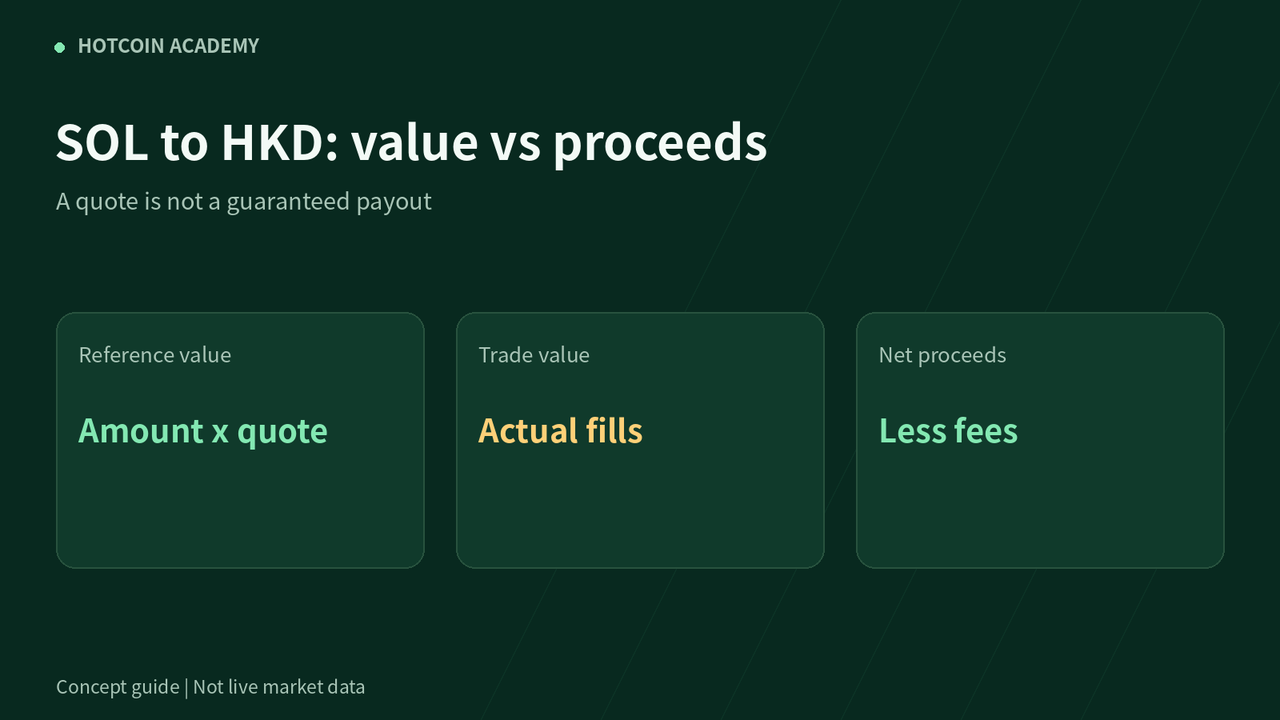
When selling, estimate the net amount using "actual total trade value − relevant fees charged in the target currency." If the total trade value has already been calculated at the actual average execution price, do not deduct slippage again as the same loss; if final withdrawal or currency exchange is required, calculate the fees for that subsequent stage.
Tradable SOL vs. Other Balances
When viewing holdings, distinguish between available SOL, staked assets, and staking receipts. Their exit processes and tradable quantities may differ. The valuation shown on the conversion page does not mean all assets can be sold immediately; you must still confirm available balances and the actual trading counterparty.
There are many tokens in the Solana ecosystem, and the price increase may be for an application token rather than SOL itself. Before transferring, you also need to verify the network supported by the receiver; do not ignore asset identity just because the page says Solana.
What to Check Before Using Conversion Results
- Verify Quantity. Use available balances, distinguishing locked, staked, pending settlement, and executed assets.
- Verify Quote. Confirm the token, quote currency, spot or contract, and data time.
- Verify Direction. For buying, check actual payment cost; for selling, check executable sell price and estimated net proceeds.
- Verify Path. If network transfers or fiat settlement are involved, check receiving requirements, fees, and limits.
- Recalculate. Review the final quote again before confirming the order; do not use an earlier screenshot as a substitute for the execution preview.
FAQ
Q1: Can staked SOL be sold directly at the quote? The quote can be used for reference valuation, but the immediately sellable quantity depends on staking status, exit arrangements, and specific product rules. Do not treat the entire displayed balance as immediately tradable spot.
Q2: Why do two websites show different SOL to HKD prices? They may use different markets, times, aggregation methods, or buy/sell directions. Align the methodology first, then compare whether the difference is sufficient to cover all costs.
Q3: Is the amount in the conversion table the final money I will receive? No. The table is a reference value calculated based on explicit assumptions. Actual receipts depend on the average execution price, tradable quantity, fees at each stage, and receiving channel conditions.
Q4: Can I convert on weekends? Crypto asset markets typically trade continuously, but bank currency exchange and fiat transfers may have different service hours. A visible quote does not mean funds can be settled immediately.
Q5: Can I use the conversion price to judge whether I should buy SOL? Not on its own. Conversion only unifies the unit of account; it does not measure whether an asset is undervalued, nor can it predict future returns.
Conclusion
When calculating SOL to HKD, first align the asset, quote, and time point, then put the quantity, exchange rate, and costs at each stage into the same calculation process. Understanding the difference between reference value and net proceeds is essential to avoid substituting a seemingly precise number for real trading conditions.
Risk Disclosure: This article is for educational and informational purposes only and does not constitute investment advice or an exchange commitment. Crypto assets may experience significant volatility, and stablecoins, trading channels, and on-chain transfers also carry risks.
読書をお勧めします
もっと見る