Greater Fool Theory and Crypto Bubbles
The greater fool theory describes a form of speculation in which investors buy an asset not because of its intrinsic value, but because they believe they can resell it at a higher price to someone even more foolish. When no greater fool is left in the market, the game of passing the parcel stops and the last holders absorb the entire loss. In crypto markets, meme coin manias, the surge of tokens with no real use case, and frenzied NFT auctions are all textbook examples of the greater fool theory.
What Is the Greater Fool Theory?
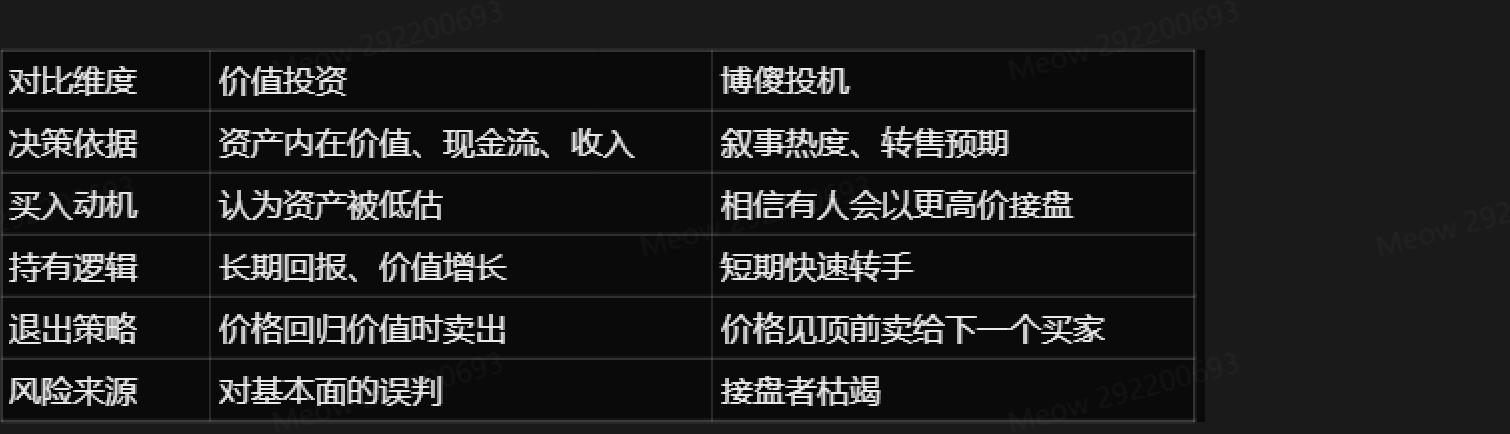
The core logic of the greater fool theory is the exact opposite of value investing: value investors ask "what is this asset really worth?", while greater fool participants only ask "will someone pay more for it?".
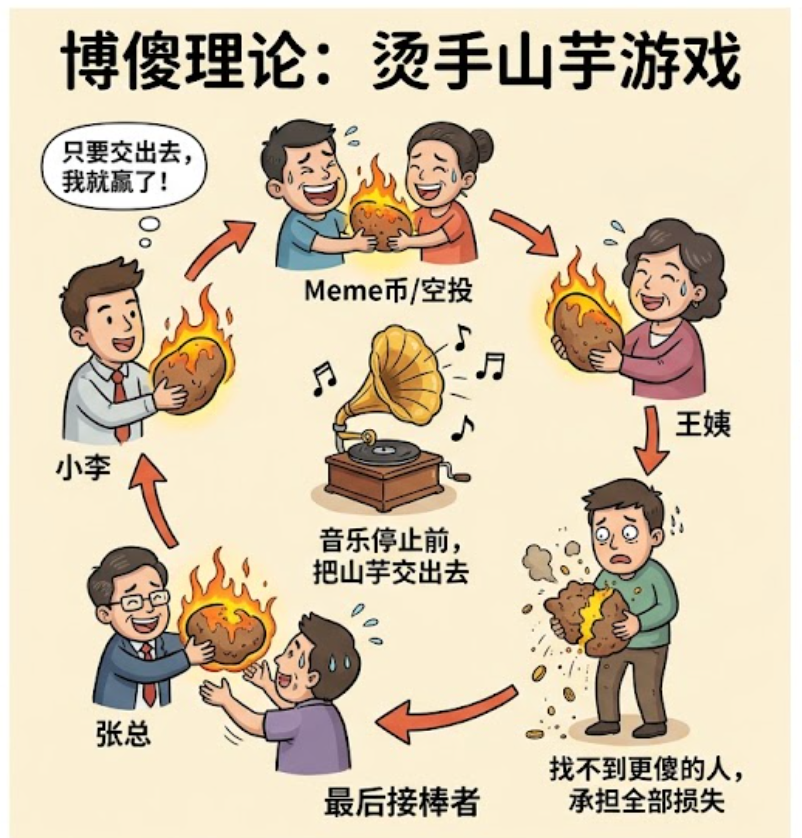
You can picture the greater fool theory as a game of hot potato: as long as you can pass the potato on before the music stops, you profit; the moment no next buyer appears, the person holding it last takes the main loss.
In crypto markets, greater fool behaviour shows up most often in the following situations:
Meme coin manias: the sharp rallies in tokens such as DOGE, DOGE, SHIB and $PEPE are usually driven not by technical breakthroughs but by community hype and FOMO.
Newly issued tokens: projects with no revenue model or real use case that attract speculators on "narrative" alone.
NFT auctions: digital collectibles whose prices are pushed up quickly, with early holders selling to later buyers at a profit.
Why Crypto Markets Are a Hotbed for the Greater Fool Theory
The greater fool theory is not unique to crypto, but certain features of crypto markets make greater fool behaviour especially easy to breed:
First, 24/7 trading and an extremely low barrier to entry. Anyone can enter at any time, a token can be deployed and paired with a liquidity pool within minutes, and a hot narrative can spread worldwide through social media within hours.
Second, FOMO (fear of missing out) is naturally amplified. Crypto Twitter is full of "2x screenshots" and "overnight fortune" stories, and this selective display creates a strong urge to catch up among onlookers. Data shows that 84% of crypto holders have made an investment decision because of FOMO.
Third, liquidity is fragmented and shallow. Crypto assets are spread across different blockchains and exchanges, so a small amount of capital can move prices violently in a short period, which creates the conditions for the greater fool relay.
Fourth, there is no unified valuation framework. Traditional assets have cash flow, price-to-earnings ratios and other valuation standards, while many crypto projects, especially meme coins, have no verifiable revenue or user data, leaving price more easily dominated by sentiment and narrative.
How the Greater Fool Theory Works: Four Stages
The formation and bursting of a crypto bubble usually follow a similar path of evolution:
Stage one: ignition. A new narrative appears, for example "this meme coin will start a cultural movement" or "this new public chain will disrupt Ethereum". Early participants buy a small amount and the price starts to climb.
Stage two: diffusion and FOMO. Rising prices attract more attention, KOL (key opinion leader) commentary, social media screenshots and profit stories spread quickly through communities. More buyers rush in on FOMO, pushing the price up faster and creating a positive feedback loop.
Stage three: extreme greed and the top. Retail investors flood in, and the funding rate on perpetual contracts stays positive for a long time and keeps climbing, signalling extreme greed. After a sharp rally, price swings violently (long upper wicks) and marginal buying begins to dry up.
Stage four: the crash. Negative news or a trigger event, such as tighter regulation or a macro shift, breaks the consensus, new buyers stop coming in, and early holders begin to take profits. Once selling pressure exceeds buying demand, price falls quickly, triggering a chain of forced liquidations on leveraged positions and accelerating the decline.
Greater Fool Theory vs Value Investing: Two Ways of Thinking
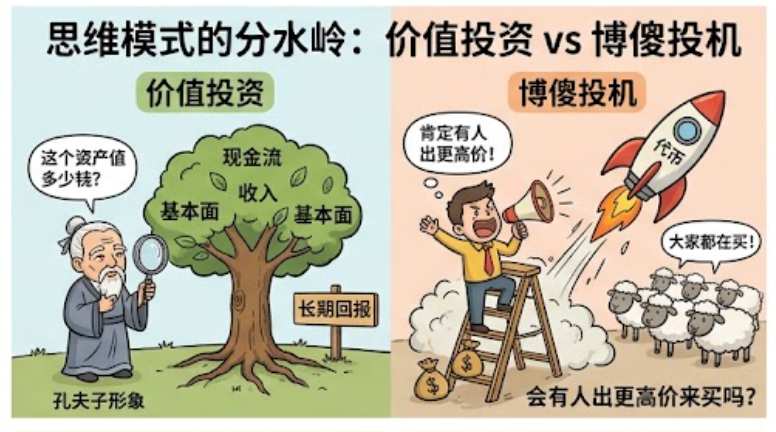
The difference between these two investment philosophies lies not only in trading technique but in a fundamentally different mindset:
Real-World Cases of the Greater Fool Theory
Meme coins and the NFT boom (2021): in 2022 Bill Gates called NFTs and related crypto projects assets "based on the greater fool theory", joking that "expensive digital pictures of monkeys" would not improve the world. Data shows that large-scale pump-and-dump events on some meme coins in 2024 have caused heavy retail losses.
The greater fool theory is not a fringe phenomenon in crypto; it is the core mechanism holding up prices in certain sectors. Research suggests that around 90% of altcoins lack a real use case and rely on the greater fool theory to sustain their valuations.
When the funding rate stays positive for a long time and long positions are crowded, the market may be in the final stage of the greater fool game.
FAQ
Q1: Does the "fool" in the greater fool theory mean investors lack intelligence?
No. The greater fool theory describes a pattern of behaviour, not a level of intelligence. Many people taking part in greater fool speculation know perfectly well that they are speculating; they simply believe they can exit before the top. The problem is that the assumption that "everyone can exit before the music stops" does not hold statistically, because a last holder must exist.
Q2: How do I tell "greater fool speculation" from "early investing"?
The key is your reason for holding the asset. Early investing rests on a judgement about fundamentals: the team, the technical roadmap, market demand and the revenue model. Greater fool decisions are based on "it has gone up a lot lately", "everyone is buying" or "my friend made money". If you remove the expectation of reselling to the next buyer and find no reason left to hold, it is probably greater fool speculation.
Q3: Does the greater fool theory mean the whole crypto market is a scam?
No. The greater fool theory applies to assets supported by resale expectations rather than intrinsic value. Bitcoin and Ethereum have large developer ecosystems, real users and on-chain economic activity, and their value rests on far more solid ground than meme coins and vapourware projects. The greater fool theory describes part of the behaviour in crypto markets, not all of it.
Q4: How do I avoid becoming the greater fool's "last holder"?
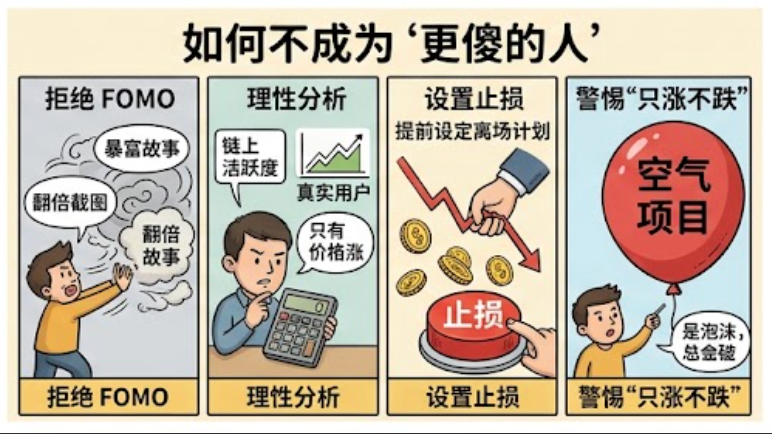
The following measures can effectively reduce the risk of being left holding the bag: refuse to chase pumps while in a state of FOMO; stay suspicious of narratives that "only go up"; check whether an asset has real users and on-chain activity, since a price spike with stalled metrics may be a bubble; and set a stop loss in advance instead of repeatedly postponing your exit plan because "it can still go up".
Related tutorials:
Crypto Trading Psychology: From Emotion Management to Discipline
Overcoming FOMO (Fear of Missing Out): A Must-Learn Lesson in Rational Trading
Fear and Greed Index: A Quantitative Guide to Market Sentiment
Recommended reading:
読書をお勧めします
もっと見る