Crypto Trading Psychology: From Emotional Management to Discipline
What decides long-term profit and loss in crypto trading is not how refined your technical analysis is, but whether you can stay rational as fear and greed take turns and strictly follow your own trading plan. Research consistently shows that 70% to 80% of retail traders lose money — not because they lack technical knowledge, but because they cannot control how they apply it. In a crypto market that never closes and swings violently, emotional control often matters more than the ability to read a candlestick chart.
The Core of Trading Psychology: The Tug of War Between Fear and Greed
Trading psychology studies the emotions and mental factors that shape trader behaviour, including how fear, greed, overconfidence and various cognitive biases affect decisions. The crypto market amplifies these emotions — there is no closing bell and no break, prices keep moving at 3 a.m., on weekends and on holidays, and social media shows every pump and dump in real time.
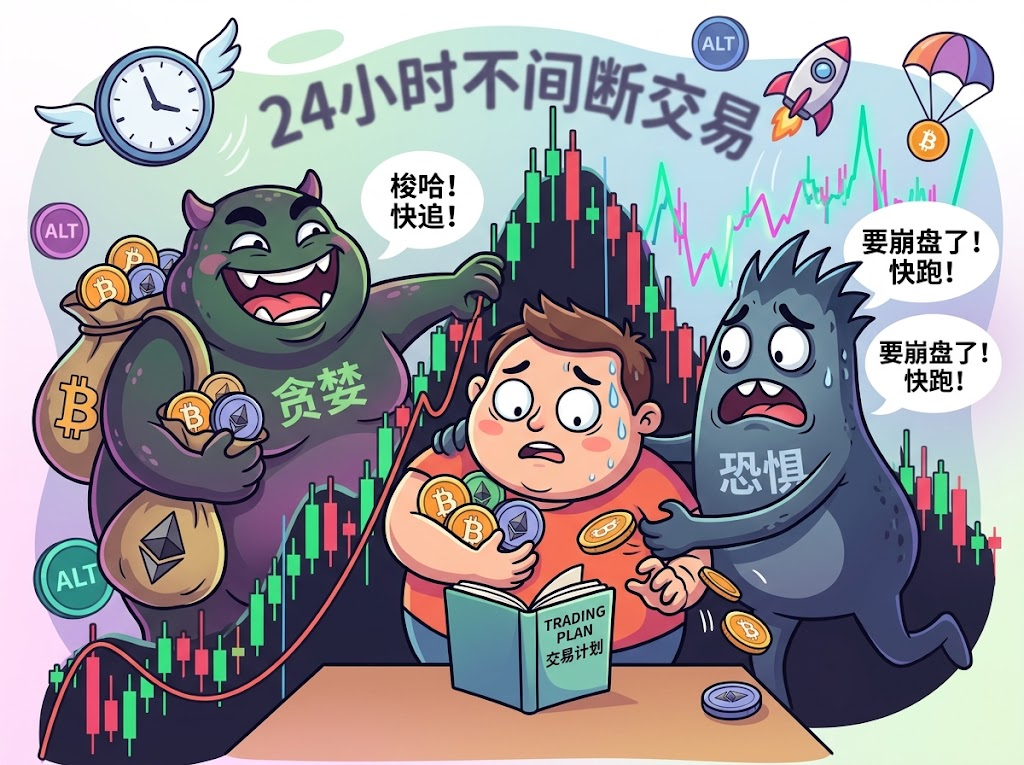
The two dominant emotions in the market are fear and greed, and at critical moments they pull traders in opposite directions:
Greed pushes traders into positions they should never take: chasing a rally, adding to a losing trade, holding for too long.
Fear pushes traders to exit too early: panic-selling on the first red candle, or skipping valid setups because of a recent loss.
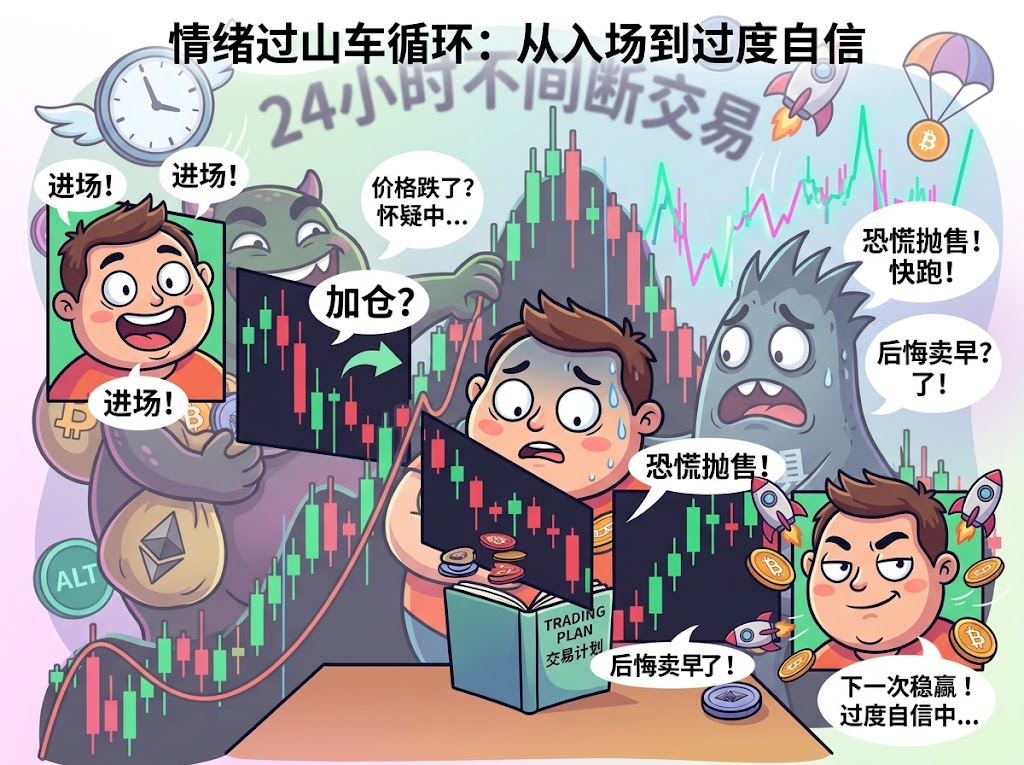
Both emotions follow a predictable cycle in every trade: excitement on entry → doubt when price moves against you → panic at the low → regret during the recovery → overconfidence after the next win. Recognising where you are in that cycle is the first step to breaking it.
The Five Most Common Psychological Traps
1. FOMO (Fear of Missing Out)
FOMO is the urge to enter because an asset is rising fast, driven by the fear of missing out on profit rather than by rational analysis. It is one of the most common reasons people buy at the top of a market.
In crypto, the damage FOMO does is magnified: when Bitcoin ran from $30,000 to $69,000, traders who had been sitting on the sidelines finally "capitulated" and bought the top — not because their read on the market had changed, but because watching other people profit became psychologically unbearable. Trades driven by FOMO almost never come with a clear stop-loss or sensible position sizing — they are pure emotional reactions.
2. Loss Aversion and "Holding a Losing Trade"
Research in behavioural economics shows that the pain of a loss is felt about twice as strongly as the pleasure of an equivalent gain. This "loss aversion" makes traders hold on to losing positions in the hope of a rebound instead of cutting the loss in time. In some cases, refusing to accept a loss leads to an even larger financial loss.
One trader who lived through big swings and big drawdowns summed it up this way: "What a trader fears most is not being wrong, but refusing to admit being wrong."
3. Revenge Trading
Revenge trading is the impulse to trade immediately after a loss in an attempt to win the money back fast. It is driven by frustration and ego rather than logic, and it almost always leads to a bigger loss than the original one.
The psychological mechanism is straightforward: the brain treats a loss as a threat, triggers a stress response and creates an urgent need to "fix" the situation. So the trader opens a position — usually larger and with less analysis — to make the money back. The result: the loss grows further.
4. Overconfidence
After a winning streak, traders start to believe they "have the market figured out". They increase leverage, abandon risk management rules and take lower-quality setups. The market has a way of humbling traders who think they are invincible — overconfidence is every bit as dangerous as fear after a losing streak.
5. Confirmation Bias
Confirmation bias is the tendency to seek out information that supports your existing view while ignoring evidence that contradicts it. A trader holding ETH, for example, will habitually look for "ETH is a long-term hold" posts on Crypto Twitter instead of researching why ETH might not be the best choice. This bias leads to poor decisions and overtrading.
Building Discipline: From Awareness to Action
Recognising emotional traps is only the first step; building an executable discipline framework is what matters.
Write a Trading Plan
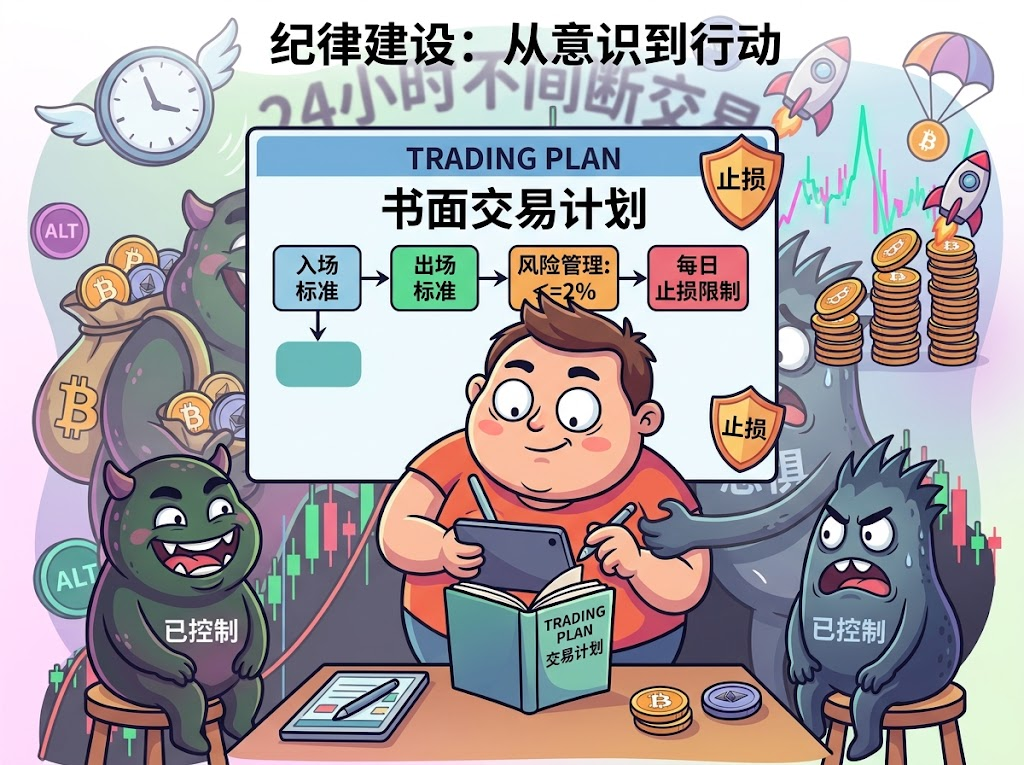
Professional traders write a trading plan that takes emotion out of the decision. The plan should clearly define: entry criteria, exit criteria, position sizing rules and a daily maximum loss limit.
When emotions run high, the plan provides objective guidance. Without pre-defined rules, every decision can be swayed by how you feel in the moment.
Strict Risk Management
Risking no more than 1% to 2% of total account capital per trade is a common rule among professional traders. One trader who watched his account shrink by 800,000 shared: "My position never exceeds 40%; the remaining 60% is the money that keeps me alive. If the drawdown passes 15% I cut immediately — no wishful thinking, no stubbornly holding on."
Sizing positions this way ensures that a losing streak cannot destroy the account. Preserving capital matters more than the profit from any single trade.
Stop-Loss Is the Bottom Line of Discipline
Every trade must have a clear stop-loss. A stop-loss is not an admission of defeat; it is what leaves you a chance to start over. Professional traders accept small losses as a cost of trading. They understand that some positions will always be in the red, and what matters is keeping those losses within a controllable range.
Don't Get Overconfident After a Win, Don't Rush to Win It Back After a Loss
"Don't get cocky when you're winning, and don't rush to win it back when you're losing." Mature traders understand the value of stepping away from the screen after a big win or a big loss, so the emotion does not carry over. Leaving after a big loss prevents revenge trading; leaving after a big win prevents overconfidence.
Keep a Trading Journal
Record every trade, including your emotional state on entry and exit. This habit reveals hidden emotional decision patterns. When reviewing losing trades, look for psychological errors rather than simply blaming market conditions.
What Makes the Crypto Market Different
The crypto market adds extra challenges to trading psychology:
24-hour market: unlike traditional markets that close on weekends, crypto is open around the clock. Traders whose emotions swing easily can be triggered into trading at any moment.
Extreme volatility: a coin can double within a day and fall back to where it started. Violent moves amplify fear and greed and make rational thinking harder.
Social media noise: beginners are highly susceptible to the mood on Crypto Twitter, Reddit and similar platforms. Following influencers blindly or piling into a token because everyone else is often the beginning of a loss.
FAQ
Q1: How do you tell the difference between "reasonable risk" and "emotional gambling"?
Reasonable risk is built on clear entry and exit rules, a stop-loss that is already set, and a maximum loss per trade kept within 1-2% of your account. Emotional gambling looks like this: an impulse to chase a rally or catch a falling knife, no stop-loss plan, positions larger than usual, and decisions based on "a feeling" instead of rules.
Q2: After a run of losses, how should I reset my mindset?
First, stop trading — step away from the screen after two or three consecutive losses so you do not fall into the vicious cycle of revenge trading. Then review your trading journal and work out whether the losses are a systemic problem or a normal drawdown. If it is a normal drawdown, accept it as part of trading; if it is systemic, adjust your strategy before re-entering the market.
Q3: What should I do when FOMO hits?
When FOMO strikes, the most effective response is to write down "this is not my trade" and step away from the screen. Accept that "missing a move is always better than taking a bad trade". Set price alerts instead of staring at the chart, so you detach yourself from real-time price action.
Q4: How can I tell whether confirmation bias is affecting me?
Ask yourself: have I mainly been reading information that supports my positions recently? Have I actively looked for arguments against my own view? If you find that you are always looking for confirmation rather than disconfirmation, you may already be caught in confirmation bias. Deliberately reading analysis that is bearish on the assets you hold is a good way to test for it.
Related tutorials:
Building Trading Discipline: How to Make and Follow a Trading Plan
Trading Journal Template: How to Review Every Trade Properly
Recommended reading:
読書をお勧めします
もっと見る