Arbitrage Strategies for Beginners: Cross-Exchange, Cash-and-Carry and Triangular Arbitrage
Arbitrage is a trading strategy that exploits price differences for the same asset across markets or trading pairs, locking in risk-free (or low-risk) profit by buying and selling at the same time. Unlike betting on price direction, arbitrage is built on being "market neutral": whether BTC rises or falls, the profit is locked in as long as the spread exists. Because crypto is fragmented across many exchanges, trades 24 hours a day and suffers from uneven liquidity, it offers more arbitrage opportunities than traditional markets — but professional quant teams are compressing those windows to milliseconds.
Cross-Exchange Arbitrage: Spatial Price Gaps
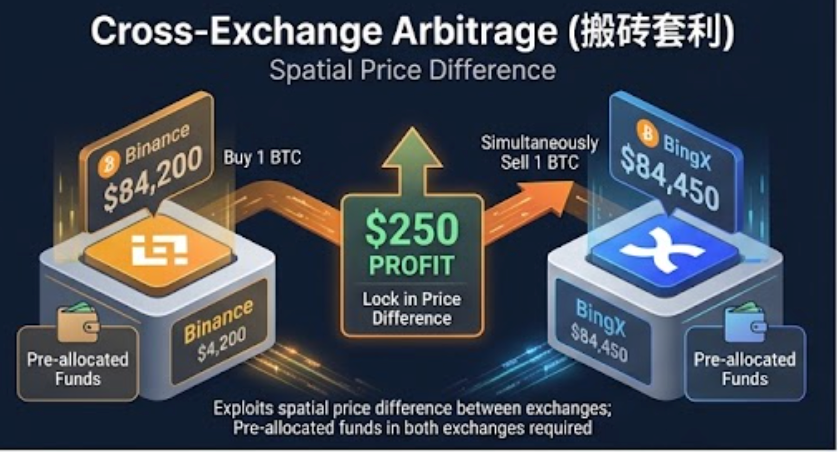
Cross-exchange arbitrage (known in Chinese as "moving bricks") is the most intuitive form of arbitrage: buy an asset cheaply on one exchange and sell it at a higher price on another, capturing the spread. It is called "moving bricks" because arbitrageurs behave like porters, carrying assets from the cheap platform to the expensive one.
How It Works
Suppose that at the same moment BTC is quoted at $84,200 on Binance and $84,450 on BingX. An arbitrageur buys 1 BTC on Binance and simultaneously sells it on BingX, theoretically earning $250 per BTC before fees.
In practice, however, arbitrageurs usually pre-fund both exchanges rather than buying on one side and waiting for a transfer before selling on the other. Blockchain transfers need confirmation time, and the price gap can disappear within minutes or even seconds.
A Classic Case: The Kimchi Premium
The "kimchi premium" is the classic example of cross-exchange arbitrage. Bitcoin traded above international market levels on Korean exchanges for a long period, with the spread once reaching 50%. FTX founder SBF used the premiums in the Korean and Japanese markets for cross-exchange arbitrage between 2017 and 2020. As Korean regulation tightened and arbitrageurs flooded in, that premium has narrowed substantially.
Risks and Costs
Fee erosion: every trade incurs Maker/Taker fees, so the spread must be wide enough to cover them. Transfer time and cost: blockchain transfers require confirmation, during which the spread may vanish; cross-chain or cross-exchange transfers also carry Gas fees. Deposit and withdrawal limits: some exchanges impose time or amount limits on deposits and withdrawals.
Cash-and-Carry Arbitrage: Earning the Basis and Funding Rate
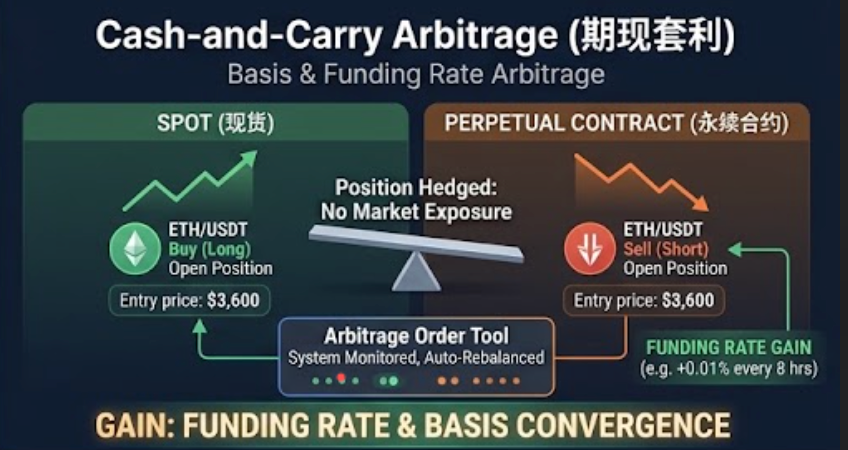
Cash-and-carry arbitrage profits from the difference between spot prices and futures or perpetual contract prices. The most common approach is to buy spot and short an equal amount of perpetual contracts, forming a hedged position that earns the funding rate or the convergence of the basis. It is currently the most widely used arbitrage method among institutional investors.
Basis Arbitrage (Delivery Contracts)
With delivery contracts, the futures price is usually higher than the spot price (a contango market, meaning futures trade at a premium). The arbitrageur buys spot and shorts an equal amount of futures, holding until expiry. At expiry, futures and spot prices converge, and the arbitrageur keeps the spread (the basis) captured at entry. The strategy is market neutral: when prices rise the spot leg gains and the futures leg loses, and when prices fall the opposite happens, so the two offset each other and the profit comes from the basis itself.
Funding Rate Arbitrage (Perpetual Contracts)
Perpetual contracts have no expiry date and anchor to the spot price through the funding rate. When the funding rate is positive, longs pay shorts. An arbitrageur buys spot and shorts an equal amount of perpetual contracts; as long as the funding rate stays positive, the position keeps collecting funding payments while price risk is hedged.
The return formula for funding rate arbitrage is: APY = capital utilisation rate × funding rate × daily settlement frequency × 365.
Exchanges such as Bybit offer dedicated "arbitrage order" tools that execute the two-leg spot plus perpetual hedge in one click. The system monitors both legs every 2 seconds and automatically tops up any shortfall to keep the position balanced.
Risk Notes
The funding rate can turn from positive to negative, at which point being long spot and short perpetuals makes you the payer; in extreme markets the basis can widen sharply or invert; and shorting perpetual contracts requires paying the funding rate, which becomes a cost if the rate reverses.
Triangular Arbitrage: Pricing Deviations Inside One Exchange
Triangular arbitrage happens within a single exchange, using inconsistent exchange rate pricing across three trading pairs to make three consecutive conversions and capture the difference between the theoretical and actual spread. It involves no cross-exchange transfers, so execution is faster, but the opportunities are even shorter lived.
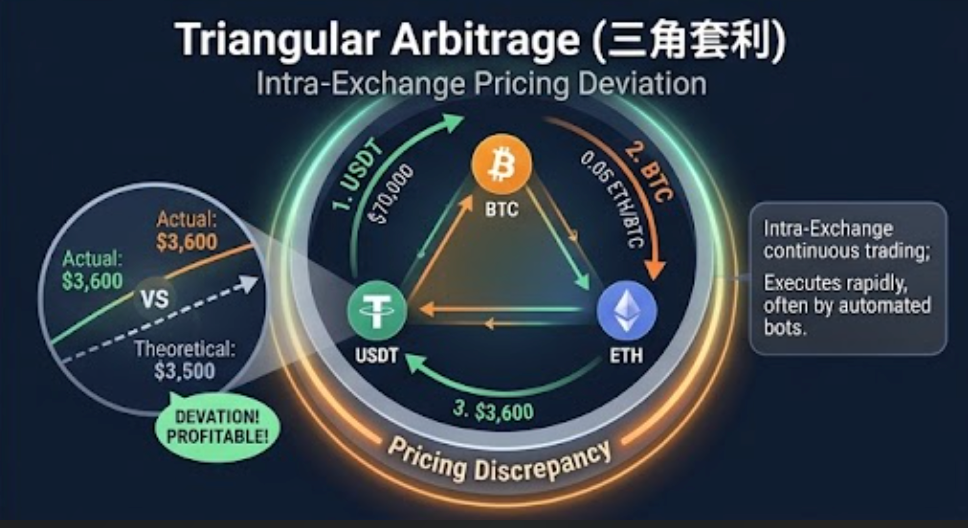
How It Works, with an Example
Suppose that at a given moment the BingX exchange shows these three trading pairs:
BTC/USDT = 70,000
ETH/BTC = 0.05
ETH/USDT = 3,600
At the theoretical exchange rate: 1 BTC → 0.05 ETH → 3,600 USDT → back to BTC gives 0.0514 BTC. If actual rates deviate from the theoretical level and a positive return remains after fees, a triangular arbitrage opportunity exists.
Difficulty and Execution
Triangular arbitrage is now dominated by quant teams and high-frequency traders; manual operation is nearly impossible. Opportunities typically last only seconds to minutes. It requires API access to live quotes, automatic calculation of the optimal path and millisecond order placement, while still leaving a positive return after fees, and it must also account for slippage and order execution delays.
Core Risks of Arbitrage Strategies
Arbitrage is often marketed as "risk-free", but in practice it carries multiple risks:
Execution speed risk: arbitrage windows are extremely short and manual trading easily misses them. Fees eating profits: every trade generates fees, and in high-frequency trading costs take a very large share. Slippage and unfilled orders: market volatility can push the actual fill price away from expectations. Asset transfer limits: some exchanges restrict deposits and withdrawals. Smart contract and system risk: DeFi arbitrage involves contract vulnerabilities or platform failures. Regulatory risk: some countries restrict cross-border capital flows.
Frequently Asked Questions (FAQ)
Q1: Is arbitrage really "risk-free"?
There is no genuinely "risk-free arbitrage". Arbitrage strategies in crypto are market neutral, not risk-free. Spreads disappearing, fee erosion, transfer delays, slippage and platform failures can all turn an arbitrage into a loss.
Q2: Which arbitrage strategy suits beginners best?
Funding rate arbitrage is relatively the most suitable for beginners, because positions can be held for a long time to keep collecting funding payments, and major exchanges provide automated arbitrage tools (such as the Bybit arbitrage order) that lower execution difficulty. Beginners still need to understand the risk that the funding rate fluctuates.
Q3: Can ordinary people do triangular arbitrage?
It is extremely hard. Triangular arbitrage opportunities are fleeting and require API access to real-time data, automatic path calculation and millisecond execution, and are currently dominated by quant teams and high-frequency traders. Beginners are advised not to attempt triangular arbitrage manually.
Q4: Do exchanges ban arbitrage trading?
Most mainstream exchanges do not ban arbitrage trading, but some platforms limit API request frequency, and high-frequency arbitrage may trigger risk controls. It is wise to check the target exchange's API terms of use and risk control rules in advance.
Related tutorials:
The Complete Futures Trading Guide: From Basics to Risk Control
What Is the Funding Rate? How Perpetual Contracts Anchor to Spot
Advanced Futures Strategies: Hedging, Insurance and Calendar Spreads
Recommended reading:
読書をお勧めします
もっと見る