
What Is a Block? An In-Depth Look at Block Structure
A block is a batch of transactions and verification data committed to a blockchain in sequence. The block header identifies the block and links it to history, while the block body stores transactions and other data. The exact fields vary by network.
Describing a block as an ordinary folder is misleading. Nodes parse blocks according to strict encoding and consensus rules, and an error in any field can cause the entire block to be rejected.
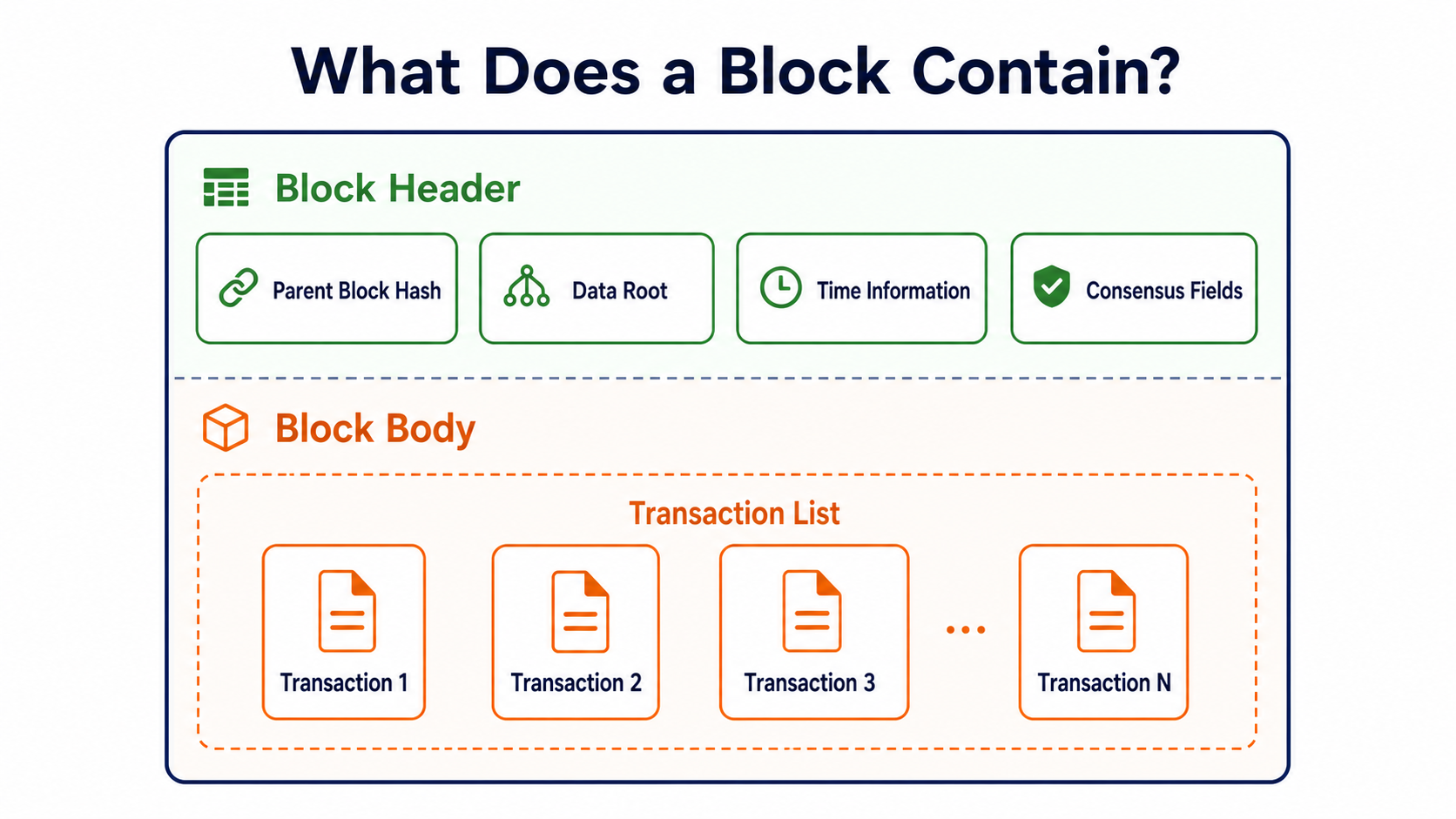
What Does a Block Usually Contain?
A block can usually be divided into a block header and a block body. The relatively small header often contains the parent block hash, commitments to transaction data, time- or height-related fields, and information required by the consensus mechanism. The block body mainly stores transactions in order; some networks also include proofs, withdrawals, or other protocol data.
Field names are not universal. A Bitcoin block header contains the version, previous block hash, Merkle root, timestamp, difficulty target, and nonce. An Ethereum block includes fields such as the state root, receipts root, Gas-related values, and execution payload. The structure of one blockchain should not be treated as a template for every blockchain.
How Does the Parent Block Hash Form a Chain?
Each new block references the hash of its parent, giving blocks an explicit order. If the contents of an older block change, its hash changes and the reference stored by its child no longer matches. For an alternative history to be accepted, an attacker would also need to rebuild the subsequent blocks and satisfy the network's consensus requirements.
Two child blocks can sometimes appear briefly for the same parent, creating competing chain tips. Nodes converge according to fork-choice rules, and the branch that is not selected does not continue as the main-chain history. For more detail, see What Are Blockchain Forks?.
How Does a Merkle Root Summarize Transactions?
Many blockchains first hash each transaction, combine the hashes in pairs, and hash them repeatedly until only one root value remains. This value is called the Merkle root, a compact commitment to the complete set and ordering of transactions.
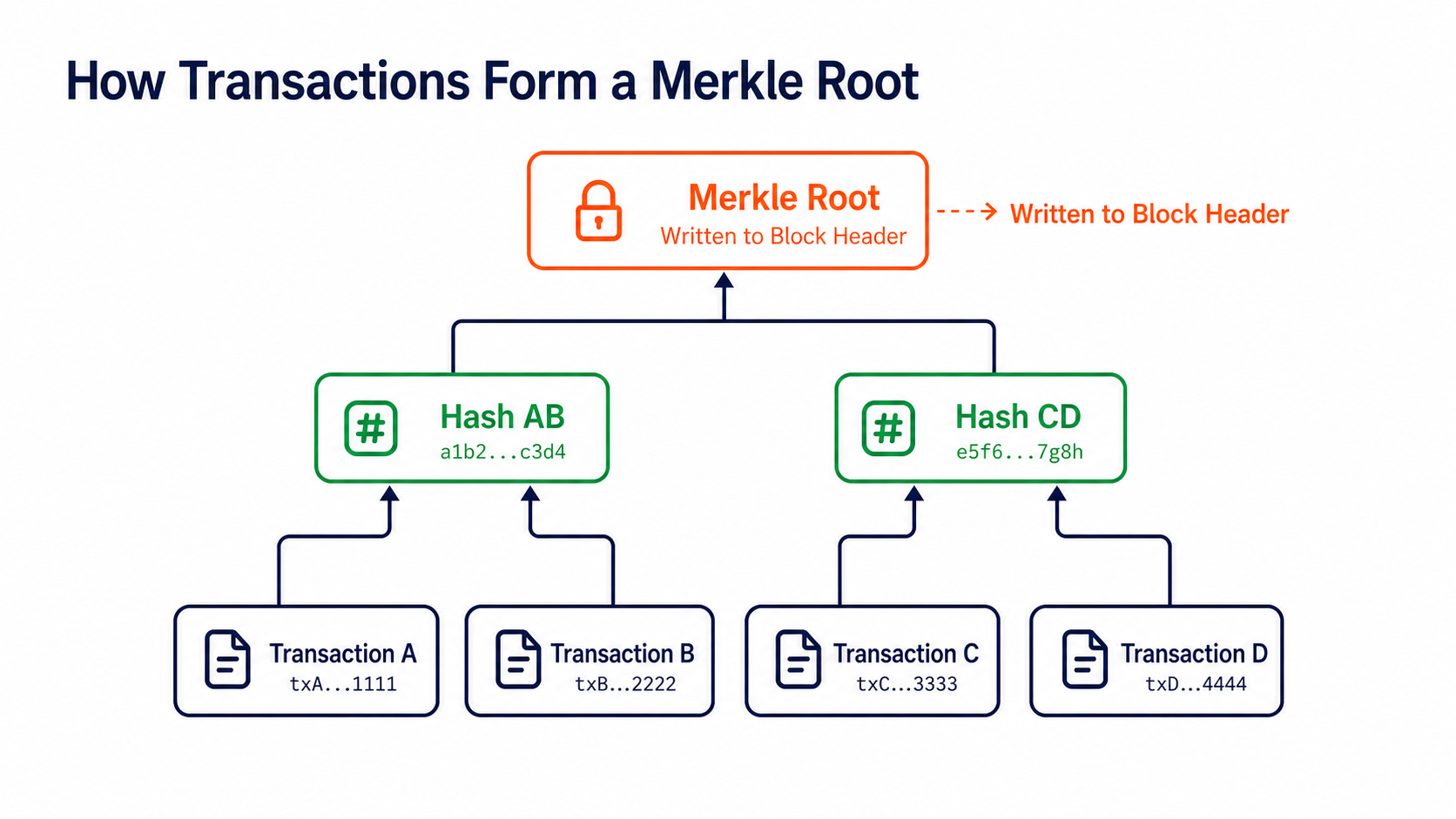
To verify that a transaction is included in the tree, a verifier only needs the target transaction, neighboring hashes at each level, and the path to the root. The proof grows relatively slowly as the number of transactions increases, making it suitable for lightweight verification. However, an inclusion proof only shows that a transaction was committed by a particular block; the verifier must still confirm that the block belongs to the chain recognized by the network.
What Is the Difference Between a State Root and a Transaction Root?
A transaction root commits to the set and order of transactions in a block. A state root commits to the global state produced after those transactions are executed, such as account balances and smart contract storage. Not every blockchain uses an account state root. UTXO-based networks focus more on the unspent output set and transaction history.
Fields such as the receipts root and logs Bloom serve different purposes. When viewing a block explorer, first identify the network's data model rather than assuming that every field containing the word “root” represents the same transaction hash.
What Is the Purpose of Block Size or Gas Limits?
A network must limit how much data or computation a block can contain; otherwise, oversized blocks would slow propagation and verification. Bitcoin-like networks usually impose block weight or size limits, while Ethereum-like networks commonly limit execution work through Gas.
Looser limits may allow a block to process more activity, but they also increase bandwidth, computation, and storage demands on nodes. Tighter limits cause transactions to compete for scarce block space during congestion. Protocols must balance throughput, propagation speed, and the resource requirements for decentralized participation.
How Do Block Height, Confirmations, and Finality Differ?
Block height indicates a block's position in the chain, with the genesis block usually assigned height 0. Confirmations describe how many blocks have accumulated after the block containing a transaction, although some interfaces count the containing block itself as the first confirmation.
Finality is a consensus-layer concept indicating that the probability of reversing history has fallen to a level defined by the protocol. Networks use different finality mechanisms, so the same confirmation count cannot be applied uniformly across all chains. For the special role of the first block, see What Is the Genesis Block?.
What Does a Node Check When It Receives a Block?
A node verifies the block's encoding, parent block, data roots, consensus proof, and resource limits, then validates or re-executes its transactions. A block enters the ledger recognized by that node only when all required conditions satisfy its local consensus rules.
This is why block producers cannot decide the rules unilaterally. Producers propose blocks, while validating nodes check them. To follow the complete transaction flow, read How Does Blockchain Work?. For an overview of how the components fit together, return to What Is Blockchain? Core Concepts Explained.
Frequently Asked Questions
Does an Empty Block Really Contain No Transactions?
An empty block usually means that it contains no ordinary user transactions. It may still include a system transaction, reward record, or consensus data required to create the block, so its byte content is not necessarily empty.
Can One Block Connect to Two Parent Blocks?
A traditional linear blockchain usually references one direct parent block. Protocols that use directed acyclic graphs or special merge structures may reference multiple preceding objects, so the answer depends on the specific protocol.
Is the Block Hash the Hash of the Entire Block File?
Not necessarily. In Bitcoin, for example, the block hash is derived from the block header, while transactions are committed to the header through the Merkle root. Different networks use different calculation scopes and encoding rules for block identifiers.
Can Transactions Be Added After a Block Is Full?
A block that has been accepted by the network cannot be modified directly. Transactions that did not enter that block must wait for a later block or, where the protocol permits, adjust their fees or replace the pending transaction.
読書をお勧めします
もっと見る


service hotcoin.com
producthotcoin.com
businesshotcoin.com
casecnhotcoin.com