
What is an Oracle?
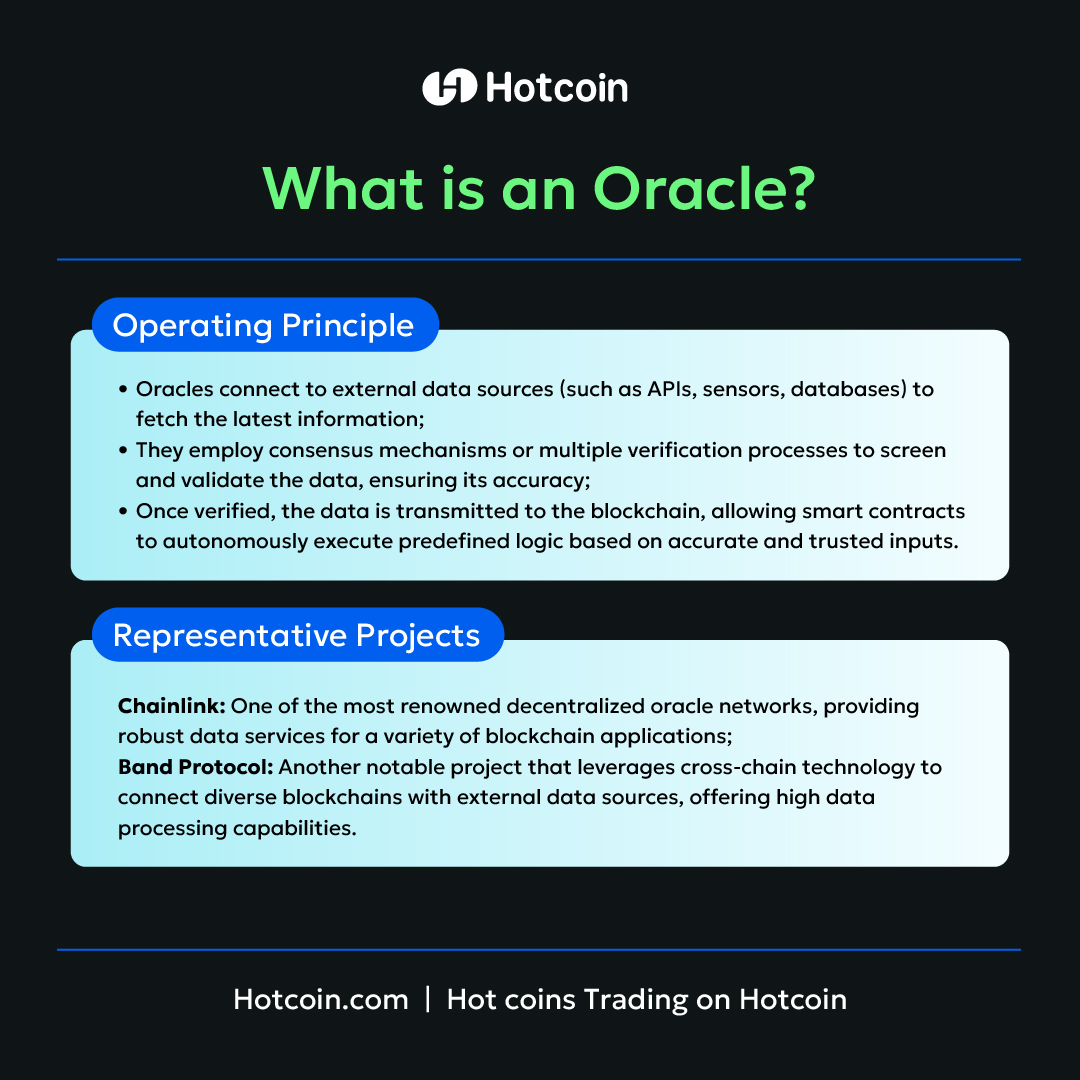
An oracle is a vital bridge connecting blockchain networks with real-world data, enabling smart contracts to interact with external information.
Definition
An oracle is an intermediary that retrieves and verifies off-chain data before transmitting it to the blockchain, thereby supplying smart contracts with real-time and reliable information.
Operating Principle
Oracles connect to external data sources (such as APIs, sensors, databases) to fetch the latest information;
They employ consensus mechanisms or multiple verification processes to screen and validate the data, ensuring its accuracy;
Once verified, the data is delivered to the blockchain, enabling smart contracts to execute pre-defined logic based on accurate inputs.
Types
Software Oracles: Primarily fetch data from online sources, such as market prices, weather updates, etc.;
Hardware Oracles: Use IoT devices and sensors to collect data directly from the physical world;
Centralized Oracles: Depend on a single data provider, making them susceptible to single points of failure or targeted exploit;
Decentralized Oracles: Aggregate data from multiple sources and use consensus algorithms to minimize manipulation risks and enhance reliability.
Representative Projects
Chainlink: One of the most renowned decentralized oracle networks, providing robust data services for a variety of blockchain applications;
Band Protocol: Another notable project that leverages cross-chain technology to connect diverse blockchains with external data sources, offering high data processing capabilities.
Functions
Serve as the interface between smart contracts and the external world, expanding the scope of blockchain applications;
Enable industries such as decentralized finance, insurance, and supply chain management by powering business logic with reliable data.;
Reduce the need for manual intervention, thereby enhancing automation and operational efficiency within blockchain systems.
Risks
Data Manipulation Risk: Inadequate validation or reliance on a single source may lead to the uploading of incorrect or manipulated information;
Security Risk: Vulnerabilities or cyber attacks can compromise the integrity of data transmission;
Trust Issues: Even decentralized oracle networks may still have nodes that exhibit centralized tendencies, potentially compromising the overall trustworthiness of the system.
In summary, oracles play an essential role in integrating blockchain with real-world data, fueling the growth of smart contract applications across various industries. However, continuous improvements in security and data verification methods are crucial to mitigate associated risks and ensure a robust, trustworthy ecosystem.
読書をお勧めします
もっと見る

Service@hotcoin.com
Product@hotcoin.com
Business@hotcoin.com
Casecn@hotcoin.com